
BuddhistCatholicContemplativeEvangelicalGeneral ChristianHinduJewishLatter-day SaintMuslimNew VisionsProgressive Christian
Beliefs
- Buddhist
- Catholic
- Contemplative
- Evangelical
- General Christian
- Hindu
- Jewish
- Latter-day Saint
- More Voices
- Muslim
- New Visions
- Pagan
- Progressive Christian
Topics
- Religion News
- Food and Religion
- Sports and Religion
- Religious Art
- Religious Music and Entertainment
- Religious Events
- History and Religion
- Style and Religion
- Politics and Religion
- Women in Religion
- Recreation Outdoors and Religion
- Business Finance and Religion
- Careers Workplace and Religion
- Education and Religion
- Family Parenting and Religion
- Health Fitness and Religion
- Home and Religion
- Relationships and Religion
- Technology and Religion
- Travel and Religion
Columnists
- Buddhist Columnists
- Business Finance and Religion Columnists
- Careers Workplace and Religion Columnists
- Catholic Columnists
- Contemplative Columnists
- Education and Religion Columnists
- Evangelists Columnists
- Family Parenting and Religion Columnists
- General Christian Columnists
- Health Fitness and Religion Columnists
- Hindu Columnists
- History and Religion Columnists
- Home and Religion Columnists
- Jewish Columnists
- More Voices Columnists
- Latter Day Columnists
- Muslim Columnists
- New Visions Columnists
- Nonreligious Columnists
- Pagan Columnists
- Politics and Religion Columnists
- Progressive Columnists
- Recreation Outdoors and Religion Columnists
- Relationships and Religion Columnists
- Religion News Columnists
- Religious Art Columnists
- Religious Events Columnists
- Religious Music and Entertainment Columnists
- Sports and Religion Columnists
- Style and Religion Columnists
- Technology and Religion Columnists
- Travel and Religion Columnists
- Women in Religion Columnists
Resource Library
- 2026 Calendar
- Library of World Religions
- The 100 Most Holy Places on Earth
- Patheos Answers
- Podcasts
- Videos
- Faith Leaders Database
- Anglican Episcopalian
- Bahai
- Baptist
- Buddhism
- Christianity
- Confucianism
- Eastern Orthodoxy
- Hinduism
- Holiness and Pentecostal
- ISKCON
- Islam
- Judaism
- Lutheran
- Methodist
- The Church of Jesus Christ of Latter-day Saints
- New Age
- Paganism
- Presbytarian and Reformed
- Protestantism
- Religion Behind the Scenes
- Roman Catholic
- Scientology
- Shia Islam
- Sikhism
- Sufism
- Sunni Islam
- Taoism
- Zen
- See all religions
Research Tools
 Ad-Free & Subscriber Log-In Subscription Support
Ad-Free & Subscriber Log-In Subscription Support
Follow Patheos 

- Trending:
- Forgiveness
- |
- Marriage
- |
- Consciousness
- |
- Death Penalty
- |
- Election
- |
- Halloween

- Home
- Progressive Christian
- Politics and Religion
- Election Season Sermon Ideas for Mark 10:46-52, Oct. 27
Election Season Sermon Ideas for Mark 10:46-52, Oct. 27
Last updated on: October 16, 2024 at 8:37 am by Leah D. Schade
Election Season Sermon Ideas for Mark 10:46-52, Oct. 27 2024-10-16T08:37:31-04:00 Leah D. Schade
Patheos Explore the world's faith through different perspectives on religion and spirituality! Patheos has the views of the prevalent religions and spiritualities of the world.
Mark 10:46-52 is the Gospel reading in the Revised Common Lectionary for Oct. 27, just two Sundays before Election Day. Here are election season sermon ideas using Gentle, Invitational, and Robust approaches.
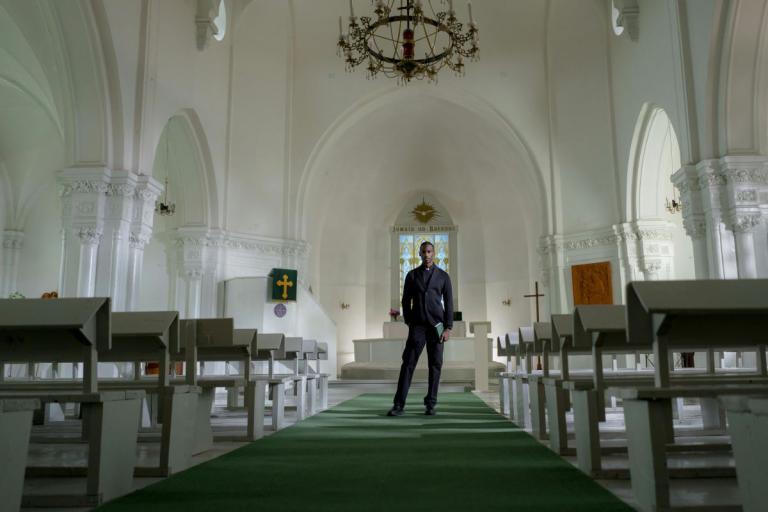
Election season sermon ideas. Photo by cottonbro studios on Pexel.com
[If you’re preaching instead on John 8:31-36 for Reformation Sunday instead, see this article: https://www.patheos.com/blogs/ecopreacher/2024/10/preaching-reformation-sunday-election-season-john-8-31-36/]
[Did you miss the sermon ideas for Oct. 20? Click here!]
Before we examine Mark 10:46-52 and how it might shape a sermon during the election season, I want to explain that preachers can address issues related to the election.
Preachers are free to discuss the themes and issues relevant to an election – as long as they refrain from endorsing specific candidates. In fact, many congregants appreciate when their ministers offer biblical, theological, and ethical insight on social issues that impact their lives, families, and communities.
In this article, I explained the do’s and don’ts of what clergy and congregations can say and actions they can take when it comes to politics.
Keep in mind that the biblical writers spoke to the social and political issues of their time because God is concerned with the well-being of all people. This means that it’s not only permissible for preachers to discuss the election, but it is also their moral and ethical duty to relate the Bible and theology to the issues that are relevant today, particularly as people prepare to exercise their right to vote.
But HOW a preacher talks about the election in their sermon also matters.
I developed an Assessment Tool for preaching and social issues which you can take here. This 5-minute online tool will help you think about your approaches to preaching and social issues using a three-dimensional questionnaire that measures: (1) your own vulnerabilities and strengths, (2) the characteristics of the congregation you serve, and (3) the quality of relationships within the congregation and between the congregation and yourself.
Gentle, Invitational, and Robust Approaches
Based on your score from the Assessment Tool, you’ll see that I suggest three approaches to a sermon addressing a social issue: Gentle, Invitational, and Robust. This is a framework I developed for my book Preaching and Social Issues: Tools and Tactics for Empowering Your Prophetic Voice to help ministers choose which path works best for them and their context.
- The Gentle approach is for clergy who are in situations where there may be personal or congregational stress, the congregation is new to sermons addressing social issues, or there is vulnerability on the part of the preacher.
- The Invitational approach is for congregations that are ready for a more challenging message by way of dialogue and building bridges of listening, empathy, and understanding.
- The Robust approach is for clergy and congregations who are ready to fully engage in public theology and to put their faith into action on social issues.
I suggest three strategies for each, for a total of nine in all. You can read about these approaches in more detail in my book. In the meantime, here’s a graphic with a quick summary:
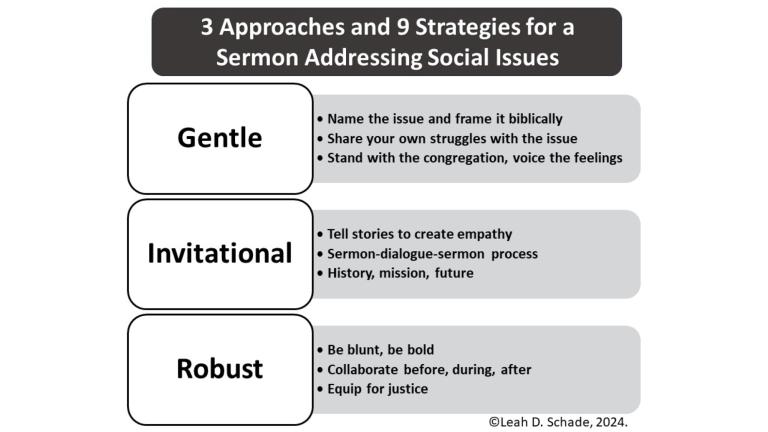
3 approaches, 9 strategies for preaching and social issues, copyright Leah D. Schade
For this installment on election season sermon ideas, we’ll look at Mark 10:46-52. I’ll begin with a brief exegetical summary of the passage and suggest connections to election issues. Then I’ll offer Gentle, Invitational, and Robust sermon ideas that you can use in your preaching context.
Oct. 27, 2024: Twenty-third Sunday after Pentecost: Mark 10:46-52
Exegetical summary
The famous line from the hymn, “Amazing Grace,” comes to mind when encountering the story of Jesus healing Bartimaeus: “Was blind but now I see.” We want to be cautious, however, about making blindness the focus of this passage, given the implications for our neighbors with vision problems and actual blindness. Instead, we can concentrate on two fundamental questions:
Who gets our attention? And how do we respond to those in need who demand our attention?
In the story, Bartimaeus is initially relegated not just to the sidelines but to the gutter by the side of the road. No one pays attention to that place of tossed-out garbage unless it becomes too much to ignore. As it happens, Bartimaeus does exactly that – he makes himself too loud to be ignored. Even when the disciples and accompanying crowd try to silence and dismiss him, Bartimaeus persists.
Hearing himself addressed as “Son of David” for the first time stops Jesus in his tracks. While Bartimaeus lacks physical vision, he certainly possesses the ability to recognize who Jesus is and the healing he is capable of giving. But Jesus does not assume to know what Bartimaeus wants. He asks, “What do you want me to do for you?”
Notably, Jesus does not take credit when Bartimaeus regains this sight. Instead, he tells him that his faith has made him well. Bartimaeus’s trust in the power and goodness of Jesus enables him to see with his own eyes. In turn, he follows Jesus without hesitation.
Connections to election issues
During this election season, we must ask: who is calling out for help from the side of the road? Which individuals and groups are cast aside like inconvenient trash as the rest of the world speeds along the highways to their destinations? Who is standing alongside Bartimaeus requiring our attention as we engage in political conversations and debate public policies?
Certainly, many congregations can point to ministries that assist people like Bartimaeus. Ministries of feeding, clothing, financial assistance, and housing are shining lights in many communities. Congregations can build on this by exploring how they can help these folks be seen and heard by those who create laws and enact policies that affect their lives.
For example, the Poor People’s Campaign intentionally centers the people who have borne the brunt of policies that enrich some while tossing others to the side of the road. On July 14, 2024, poor and low wage workers gathered in Washington, DC to make their voices heard at The Mass Poor People’s & Low Wage Workers’ Assembly & Moral March on Washington, DC and to the Polls. The vision of this movement is to have the poor and disenfranchised set the agenda for public policy.
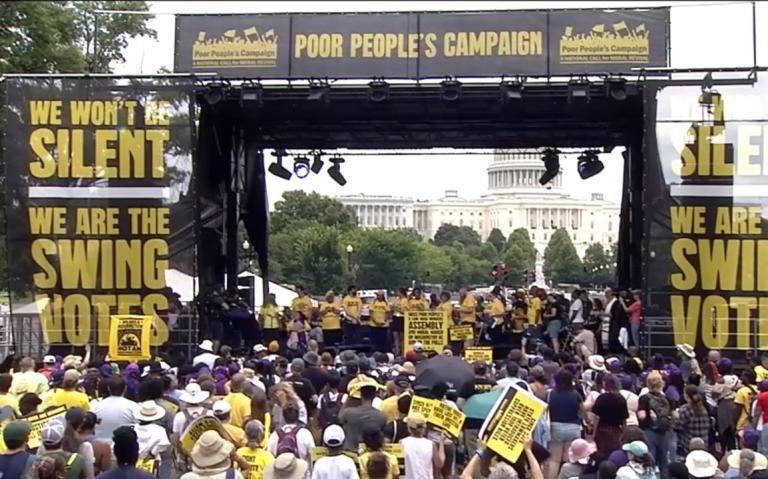
The Mass Poor People’s & Low Wage Workers’ Assembly & Moral March on Washington, DC and to the Polls, June 29, 2024
Any movement to assist those with needs would do well to follow Jesus’s example of not assuming to know what would be most helpful. Just as Jesus stopped, turned his attention to Bartimaeus, and asked him want he wanted, so we, too, must give voice and agency to the people in need in our own communities. Such an approach builds bonds of trust and relationship, just as Jesus had with Bartimaeus.
Gentle approach: Name the issue and frame it biblically.
Some congregations may initially be resistant to the idea of engaging in advocacy on justice issues. So, the story of Bartimaeus makes the case that when it comes to those in need, the church’s role is to do more than simply comfort them as they remain on the sidelines. Instead, congregations can take part in or even host community listening sessions to learn what the needs are and what would be most helpful.
Just like the disciples and crowd in Mark 10:46-52, we can transition away from silencing those in need. Instead, we can encourage and accompany them as they throw off their cloaks of despair, helplessness, and hopelessness. We can help to amplify their voices and empower them to claim their self-worth and belovedness.
Invitational approach: Tell stories to create empathy.
Congregations can host community listening sessions to discern local needs. You might call it a “Bartimaeus Gathering” and invite local neighbors and community groups to attend. Ask people to share what they think are the most pressing challenges facing the community. If possible, use a skilled facilitator to moderate the conversation so that people talk and listen without judgment
The sermon can include vignettes of what people shared (obscuring personal details to protect privacy) and invite the congregation to reflect on what they hear in these stories. The preacher can then suggest that the congregation take next steps such as participating in a community organizing effort to follow up with action on one of the issues raised.
In this way, congregations can build meaningful relationships with their communities and develop targeted ministries that address real needs. Check out the Community Tool Box for step-by-step instructions for conducting public forums and listening sessions.
Robust approach: Equip for justice.
For congregations who either know what it’s like to have been cast to the side of the road, or who are convicted of their obligation to help their neighbors, a more robust approach to a sermon on Bartimaeus is in order. In this case, a preacher could help equip their congregation for justice by articulating a plan that emerged from the listening session.
Once an issue is identified, the minister can call for their congregation to either claim their “Bartimaeus voice” or amplify that voice with their neighbors in need. Perhaps the plan involves partnering with local organizations, visiting with local elected officials, or organizing a protest event to raise awareness.
Whatever the next steps are, Mark 10:46-52 can provide the biblical framing for the action. With Bartimaeus, we begin by calling out to Jesus for mercy – publicly and with loud persistence! Then, in a public event, people can bring cloaks or coats with the issue emblazoned on the fabric and symbolically throw off their cloaks. Imagine cloaks with the word “homelessness” or “poverty” or “mental health” or “opioid crisis” being laid at the feet of community leaders. The session should include a clear “ask,” just as Bartimaeus made of Jesus. The demands of the church and local partners should be concise and actionable, while also including a date by which the community expects a response.
Bottom line – Speak and listen with the compassion of Jesus
Whether pursuing the Gentle, Invitational, or Robust approach, every preacher can encourage their listeners to vote. By electing leaders who align with the intention to help those in need, we influence policies, budgets, and laws at the local, state, and national level. Elected officials have the power to allocate resources so that no one is tossed to the side of the road. Preachers can encourage their listeners to vote with Bartimaeus in mind so that the needs of all citizens are heard and met.
May God bless your discernment, dialogue, preaching, and ministry during this election season!
Stay tuned for sermon helps for Nov. 3!
Read also:
Election Season Sermon Ideas for Mark 10:35-45, Oct. 20
What Clergy Can Say (and Not Say) During the Election Season
Preaching 2024 Election – How will Clergy Navigate Issues?
Post-Election Messaging & Preaching: Red, Blue & Purple Church Tactics

Leah D. Schade
The Rev. Dr. Leah D. Schade is the Associate Professor of Preaching and Worship at Lexington Theological Seminary in Kentucky and ordained in the ELCA. Dr. Schade does not speak for LTS or the ELCA; her opinions are her own. She is the author of Preaching and Social Issues: Tools and Tactics for Empowering Your Prophetic Voice (Rowman & Littlefield, 2024), Preaching in the Purple Zone: Ministry in the Red-Blue Divide (Rowman & Littlefield, 2019) and Creation-Crisis Preaching: Ecology, Theology, and the Pulpit (Chalice Press, 2015). She is the co-editor of Rooted and Rising: Voices of Courage in a Time of Climate Crisis (Rowman & Littlefield, 2019). Her book, Introduction to Preaching: Scripture, Theology, and Sermon Preparation, was co-authored with Jerry L. Sumney and Emily Askew (Rowman & Littlefield, 2023).
General Christian
Politics and Religion
election resources for faith leaders
Previous Post
October 16, 2024
Preaching Reformation Sunday, Election Season: John 8:31-36
Next Post

October 17, 2024 “Love Your Neighbor” Includes God’s Creation
Recent Comments
"Or, people could just realize our planet is also a living organism, a 4.5 billion ..."
Love Your Neighbor – Including Earth-Kin: ..."
"Climate change is getting attention but not enough. The study of the issue needs to ..."
Preaching About Climate Change: What Clergy ..."
"Yes! The Season of Creation is a month-long liturgical season to focus on all aspects ..."
Making Space for Eco-Grief—and Hope—in Your ..."
"The new Feast of Creation festival in the liturgical year offers an intentional opportunity for ..."
Making Space for Eco-Grief—and Hope—in Your ..."
Browse Our Archives
Select a Category Academy of Homiletics Addiction Advent AI (Artificial Intelligence) Animals Apocalypse Appalachia Ash Wednesday Baptism Bible Black Lives Matter Blade Runner Book review Children in church Christian Nationalism Christian/Islamic relations Christmas Church Clergy Climate change COVID-19 Creation Data Centers Death penalty Devotional Dialogue Doubt Earth Day Easter Ecofeminism EcoPreacher 1-2-3 ELCA ELCA Youth Gathering Election Environment/ecology Epiphany Faith Faith and Politics Feminism Film review Food Food and Faith Forgiveness Fracking Good Friday Good Omens Grief Gun violence Holy Humor Sunday Holy Week Howard Thurman ICE Immigration Indigenous wisdom Interview Jesus Kentucky Lafayette High School Marching Band Leadership Lent LGBTQIA+ Marching band Martin Luther Martin Luther King Jr. Mary Maundy Thursday Michael Sheen Mother of Jesus Nature New Year's Eve Palm Sunday Parables Pentecost Poem, Poetry Politics Poor People's Campaign Pop culture Prayers Preaching Progressive Christianity Public theology Purple Zone Racism and White Privilege Religion Religion and environment Religion and politics Religion and pop culture Religion and violence Rev. Nelson Rabell Gonzalez Sermons Spanish language resources for preaching Technology Thanksgiving Theological education theology Trees Trump Uncategorized Vegan War Women and religion Workshop Worship
Select a Month October 2026 September 2026 July 2026 June 2026 May 2026 April 2026 March 2026 February 2026 January 2026 December 2025 November 2025 October 2025 September 2025 May 2025 April 2025 March 2025 February 2025 January 2025 December 2024 November 2024 October 2024 September 2024 August 2024 July 2024 June 2024 May 2024 April 2024 March 2024 February 2024 January 2024 December 2023 November 2023 October 2023 September 2023 August 2023 July 2023 June 2023 May 2023 April 2023 March 2023 February 2023 January 2023 December 2022 November 2022 October 2022 August 2022 July 2022 June 2022 May 2022 April 2022 March 2022 February 2022 January 2022 December 2021 November 2021 October 2021 September 2021 August 2021 July 2021 June 2021 May 2021 April 2021 March 2021 January 2021 December 2020 November 2020 October 2020 September 2020 August 2020 July 2020 June 2020 May 2020 April 2020 February 2020 January 2020 December 2019 November 2019 October 2019 September 2019 August 2019 July 2019 June 2019 May 2019 April 2019 March 2019 January 2019 December 2018 November 2018 October 2018 September 2018 August 2018 July 2018 June 2018 May 2018 April 2018 March 2018 February 2018 January 2018 December 2017 November 2017 October 2017 September 2017 August 2017 July 2017 June 2017 May 2017 April 2017
Follow Us!
TAKE THE
Religious Wisdom Quiz
Who saw a vision of a flying scroll with curses written on it?
Select your answer to see how you score.
Zechariah Micah Ezekiel Daniel
Books by This Author Books by Leah D. Schade
Related posts from EcoPreacher

Pastoral Wisdom for Responding to Sermon Pushback

"Render Unto Caesar": Faith, Politics, and Elections

What Matt. 21:23-32 Teaches About Integrity In An...

Preaching About Climate Change: What Clergy Need Most
TRENDING AT PATHEOS Progressive Christian

What Being a Modern-Day Apostle Means to Me
In my last column, I discussed the ins and outs of modern-day...

Did Ancient China Once Worship the God of...
Across human history, a common thread weaves through the origins of the...

Love Your Neighbor – Including Earth-Kin: Lev. 19,...
God’s command to love your neighbor means acting in an ethical and...

Lead a Church Study of “Jesus and Lao...
Guest writer Jack Thomas (The Irreverent Reverend) reflects on leading his church...

Pastoral Wisdom for Responding to Sermon Pushback
Getting sermon pushback on your social justice sermon? Learn practical, Proverbs-based strategies...

Principles for Understanding the Apostolic Ministry Today
Whenever people discover that my formal ministry title is "apostle," as in...
view all Progressive Christian blogs
What Are Your Thoughts?leave a comment
Ad-Free & Subscriber Log-In Subscription Support
- About Us
- 2026 Calendar
- Videos
- Podcasts
- Library of World Religions
- Faith In Media Tracker
- Advertise With Us
- Write for Us
- Privacy Policy
- Terms of Service
- Do Not Sell My Data
- Contact Us
- Radiant Digital
- Manage Newsletter Subscriptions
- Unsubscribe From Notifications
- Sitemap
Copyright 2008-2026, Patheos. All rights reserved.
Subscription Support Ad-Free & Subscriber Log-In
Follow Patheos