
BuddhistCatholicContemplativeEvangelicalGeneral ChristianHinduJewishLatter-day SaintMuslimNew VisionsProgressive Christian
Beliefs
- Buddhist
- Catholic
- Contemplative
- Evangelical
- General Christian
- Hindu
- Jewish
- Latter-day Saint
- More Voices
- Muslim
- New Visions
- Pagan
- Progressive Christian
Topics
- Religion News
- Food and Religion
- Sports and Religion
- Religious Art
- Religious Music and Entertainment
- Religious Events
- History and Religion
- Style and Religion
- Politics and Religion
- Women in Religion
- Recreation Outdoors and Religion
- Business Finance and Religion
- Careers Workplace and Religion
- Education and Religion
- Family Parenting and Religion
- Health Fitness and Religion
- Home and Religion
- Relationships and Religion
- Technology and Religion
- Travel and Religion
Columnists
- Buddhist Columnists
- Business Finance and Religion Columnists
- Careers Workplace and Religion Columnists
- Catholic Columnists
- Contemplative Columnists
- Education and Religion Columnists
- Evangelists Columnists
- Family Parenting and Religion Columnists
- General Christian Columnists
- Health Fitness and Religion Columnists
- Hindu Columnists
- History and Religion Columnists
- Home and Religion Columnists
- Jewish Columnists
- More Voices Columnists
- Latter Day Columnists
- Muslim Columnists
- New Visions Columnists
- Nonreligious Columnists
- Pagan Columnists
- Politics and Religion Columnists
- Progressive Columnists
- Recreation Outdoors and Religion Columnists
- Relationships and Religion Columnists
- Religion News Columnists
- Religious Art Columnists
- Religious Events Columnists
- Religious Music and Entertainment Columnists
- Sports and Religion Columnists
- Style and Religion Columnists
- Technology and Religion Columnists
- Travel and Religion Columnists
- Women in Religion Columnists
Resource Library
- 2026 Calendar
- Library of World Religions
- The 100 Most Holy Places on Earth
- Patheos Answers
- Podcasts
- Videos
- Faith Leaders Database
- Anglican Episcopalian
- Bahai
- Baptist
- Buddhism
- Christianity
- Confucianism
- Eastern Orthodoxy
- Hinduism
- Holiness and Pentecostal
- ISKCON
- Islam
- Judaism
- Lutheran
- Methodist
- The Church of Jesus Christ of Latter-day Saints
- New Age
- Paganism
- Presbytarian and Reformed
- Protestantism
- Religion Behind the Scenes
- Roman Catholic
- Scientology
- Shia Islam
- Sikhism
- Sufism
- Sunni Islam
- Taoism
- Zen
- See all religions
Research Tools
 Ad-Free & Subscriber Log-In Subscription Support
Ad-Free & Subscriber Log-In Subscription Support
Follow Patheos 

- Trending:
- Forgiveness
- |
- Marriage
- |
- Consciousness
- |
- Death Penalty
- |
- Election
- |
- Halloween

- Home
- Progressive Christian
- Politics and Religion
- Election Season Sermon Ideas for Mark 10:35-45, Oct. 20
Election Season Sermon Ideas for Mark 10:35-45, Oct. 20
Last updated on: September 25, 2024 at 8:14 am by Leah D. Schade
Election Season Sermon Ideas for Mark 10:35-45, Oct. 20 2024-09-25T08:14:00-04:00 Leah D. Schade
Patheos Explore the world's faith through different perspectives on religion and spirituality! Patheos has the views of the prevalent religions and spiritualities of the world.
Mark 10:35-45 is the Gospel reading in the Revised Common Lectionary for Oct. 20, just three weeks before Election Day. Here are election season sermon ideas using Gentle, Invitational, and Robust approaches.

Jesus didn’t choose his right hand man. He encouraged shared leadership in Mark 10:35-45. Photo by Alena Darmel on pexels.com.
Before looking at Mark 10:35-45, let’s address the elephant in the room.
Can preachers mention the election in sermons?
Yes, preachers are free to discuss the themes and issues relevant to an election – as long as they refrain from endorsing specific candidates. In fact, many congregants appreciate when their ministers offer biblical, theological, and ethical insight on social issues that impact their lives, families, and communities.
In this article, I explained the do’s and don’ts of what clergy and congregations can say and actions they can take when it comes to politics.
Keep in mind that the biblical writers spoke to the social and political issues of their time because God is concerned with the well-being of all people. This means that it’s not only permissible for preachers to discuss the election, but it is also their moral and ethical duty to relate the Bible and theology to the issues that are relevant today, particularly as people prepare to exercise their right to vote.
But HOW a preacher talks about the election in their sermon also matters.
I developed an Assessment Tool for preaching and social issues which you can take here. This 5-minute online tool will help you think about your approaches to preaching and social issues using a three-dimensional questionnaire that measures: (1) your own vulnerabilities and strengths, (2) the characteristics of the congregation you serve, and (3) the quality of relationships within the congregation and between the congregation and yourself.
Gentle, Invitational, and Robust Approaches
Based on your score from the Assessment Tool, you’ll see that I suggest three approaches to a sermon addressing a social issue: Gentle, Invitational, and Robust. This is a framework I developed for my book Preaching and Social Issues: Tools and Tactics for Empowering Your Prophetic Voice to help ministers choose which path works best for them and their context.
The Gentle approach…
is for clergy who are in situations where there may be personal or congregational stress, the congregation is new to sermons addressing social issues, or there is vulnerability on the part of the preacher.
The Invitational approach…
is recommended for congregations that are ready for a more challenging message by way of dialogue and building bridges of listening, empathy, and understanding.
The Robust approach…
is for clergy and congregations who are ready to be fully engaged in public theology and to put their faith into action on social issues.
I suggest three strategies for each approach, for a total of nine in all. You can read about these approaches in more detail in my book. In the meantime, here’s a graphic with a quick summary:
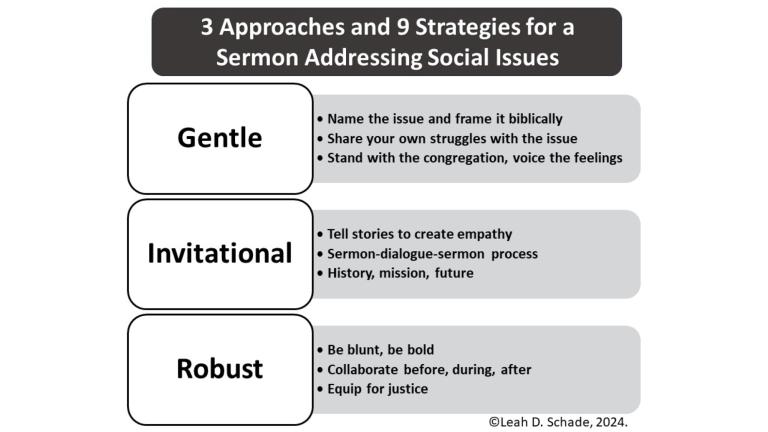
3 approaches, 9 strategies for preaching and social issues. Copyright Leah D. Schade
For this installment on election season sermon ideas, I’ll begin with a brief exegetical summary of the passage and suggest connections to election issues. Then I’ll offer Gentle, Invitational, and Robust sermon ideas that you can use in your preaching context.
[Did you miss the sermon ideas for Oct. 6 and 13? Click here!]
Oct. 20, 2024
Twenty-second Sunday after Pentecost: Mark 10:35-45
Exegetical summary
This dialogue among the disciples and Jesus takes place just after the third time he announces his impending death. They are about to enter into Jerusalem when this internal controversy erupts. As Jesus is teaching them, he references the “servant song” in Isaiah 53:4-12 and also v. 45 about giving his life as a ransom for many. This sets the stage for what is to come in his crucifixion.
The presenting issue is: who will be in closest proximity to Jesus when he comes into his power? James and John want to sit at Jesus’s right and left hand (the seats of honor next to the king). The other disciples fear losing out on the prized seats of power. This leads to anger among them.
But Jesus tries to reorient their understanding of what true power means and what it involves.
In telling this story, the author of Mark’s Gospel is instructing his church about what kind of community they should be and how they should understand power. Their use of power is not to imitate the violent hierarchy of Rome. Instead, it should model the distributive power of the Realm of God that honors and serves all.
Thus, Jesus is breaking open binary thinking about power that believes when others have it, I don’t.
Also, his words are meant as foreshadowing. There is a double entendre going on here. When he references the cup and baptism, this is about his suffering as a result of serving others in the face of the domination system.
Interestingly, when Jesus comes into his power (crucifixion) the ones on his right and left are not the disciples at all. They are criminals (Mk. 15:27). And attending him in his “court” are the women (Mk. 15:40-41). Thus, Jesus inverts Rome’s honor-shame paradigm because those without honor and power are the ones who are closest to Jesus.
This teaching has important implications for Christians who vote for the leaders who will represent them.
Connections to election issues
Notably, Jesus did not shut down the conversation with James and John when they came at him with such audacity. He engaged with them and the rest of the disciples. This was a “teachable moment” with them.
Likewise, as we approach the election, there are teachable moments for us as well.
It’s important for the church to engage in dialogue about what it means to have power, exercise power, share power, and confront abuses of power.
Like the disciples, we may be shocked to hear Jesus declare their rulers as “tyrants.”
This term has been used in our own political discourse and may require some unpacking. But in this election cycle there are definitely choices to be made about the kind of leaders we want.
Our choices today should be guided by the desire for a life and economy rooted in a governing system where there is fair representation of the people’s interests – not just those in leadership. This leads to a healthy, sustainable balance where power is shared equitably and supports the common good.
In contrast, a life and economy ordered by Caesar (and today’s Caesar-like rulers) dictates that people and land must be exploited and extracted to create wealth that flows upward to the elite, not shared with the community.
With this exegesis and connection to election issues in mind, here are three approaches to preaching on Mark 10:35-45.
Gentle approach: Stand with the congregation, voice the feelings.
The preacher can invite listeners into an imaginative space where they stand among the disciples listening to James’s and John’s request to sit at Jesus’s right and left hand. It’s not fair! Peter has been called “The Rock”; doesn’t he deserve to be at the top? What about me? Aren’t I smart enough? Rich enough? Good looking enough? Athletic enough?
What does it feel like to be left out of the decision-making process? To be on the outside looking in, where people discuss your body, your rights, your livelihood, and your healthcare without consulting you?
Conversely, what would it be like to live in a society led by people who embody servant leadership? What would be different if we had leaders who listen to the people they serve? How would it feel to have your voice heard and your body matter? How would things change for the better in our workplaces, schools, homes, and even our own congregation?
Invitational approach: History, mission, future.
This strategy uses a congregation’s history as well as its current mission to help them envision their prophetic future. Given that Jesus challenges the disciples to live in a more equitable, more sustainable covenantal relationship with neighbors and God, in what ways has your church done this in the past? Today, how is their ministry of serving others inspiring them to engage in advocacy on behalf of the downtrodden and oppressed?
Especially with the upcoming election, how can the church make space for holding the tensions around issues of faith and politics? And beyond the election, how can we be a place that invites dialogue about how to reorder our economy around covenantal relationships that honor people, planet, and God?
Robust approach: Collaborate before, during, and after.
For this strategy, the preacher works collaboratively with members of a congregation on the sermon process. The preacher gathers a group of individuals who covenant with each other to listen deeply to lived experiences of those impacted by the issue, think critically about the challenges of addressing the issue, and work creatively to craft a collaborative sermon that engages the congregation.
In this sermon process, the preacher and collaborators would be rooted in Mark’s premise that there is an important standard God uses to judge political leadership: how well it supports the care and protection of those most vulnerable.
The group could explore different ways to activate moral and theological responses as we approach our national election. They can examine the voting records and public statements of candidates in local, state, and national levels and ask: what are the policies that affect our community most directly or urgently?
To be clear, the sermon would not draw conclusions about which candidates Christians should support. Rather, they would share what the group had discerned about which issues they should pay attention to during this election and beyond.
Following the sermon, the group can host a feedback session to listen to what the congregation heard, how they felt, what they learned, and what they might do in response moving forward.
Bottom line – model servanthood
No matter what approach or strategy preachers work with during the election season, there are some key things everyone can do that model the servanthood of Jesus during the election season. These include:
- Praying for public servants
- Encouraging people to vote
- Advocating for policies that are in the best interest of those most vulnerable and the common good
May God bless your discernment, dialogue, preaching, and ministry during this election season!
Stay tuned for sermon helps for Oct. 27 and Nov. 3!
Read also:
Preaching the 2024 Election Season: Sermon Ideas, Oct. 6, 13
What Clergy Can Say (and Not Say) During the Election Season
Preaching 2024 Election – How will Clergy Navigate Issues?

The Rev. Dr. Leah D. Schade is the Associate Professor of Preaching and Worship at Lexington Theological Seminary in Kentucky and ordained in the ELCA. Dr. Schade does not speak for LTS or the ELCA; her opinions are her own. She is the author of Preaching and Social Issues: Tools and Tactics for Empowering Your Prophetic Voice (Rowman & Littlefield, 2024), Preaching in the Purple Zone: Ministry in the Red-Blue Divide (Rowman & Littlefield, 2019) and Creation-Crisis Preaching: Ecology, Theology, and the Pulpit (Chalice Press, 2015). She is the co-editor of Rooted and Rising: Voices of Courage in a Time of Climate Crisis (Rowman & Littlefield, 2019). Her book, Introduction to Preaching: Scripture, Theology, and Sermon Preparation, was co-authored with Jerry L. Sumney and Emily Askew (Rowman & Littlefield, 2023).
General Christian
Politics and Religion
Previous Post

September 24, 2024
Blessing Animals & Children: Sermon Ideas, St. Francis
Next Post

October 5, 2024 Are People Quiet Quitting Trump?
Recent Comments
"Or, people could just realize our planet is also a living organism, a 4.5 billion ..."
Love Your Neighbor – Including Earth-Kin: ..."
"Climate change is getting attention but not enough. The study of the issue needs to ..."
Preaching About Climate Change: What Clergy ..."
"Yes! The Season of Creation is a month-long liturgical season to focus on all aspects ..."
Making Space for Eco-Grief—and Hope—in Your ..."
"The new Feast of Creation festival in the liturgical year offers an intentional opportunity for ..."
Making Space for Eco-Grief—and Hope—in Your ..."
Browse Our Archives
Select a Category Academy of Homiletics Addiction Advent AI (Artificial Intelligence) Animals Apocalypse Appalachia Ash Wednesday Baptism Bible Black Lives Matter Blade Runner Book review Children in church Christian Nationalism Christian/Islamic relations Christmas Church Clergy Climate change COVID-19 Creation Data Centers Death penalty Devotional Dialogue Doubt Earth Day Easter Ecofeminism EcoPreacher 1-2-3 ELCA ELCA Youth Gathering Election Environment/ecology Epiphany Faith Faith and Politics Feminism Film review Food Food and Faith Forgiveness Fracking Good Friday Good Omens Grief Gun violence Holy Humor Sunday Holy Week Howard Thurman ICE Immigration Indigenous wisdom Interview Jesus Kentucky Lafayette High School Marching Band Leadership Lent LGBTQIA+ Marching band Martin Luther Martin Luther King Jr. Mary Maundy Thursday Michael Sheen Mother of Jesus Nature New Year's Eve Palm Sunday Parables Pentecost Poem, Poetry Politics Poor People's Campaign Pop culture Prayers Preaching Progressive Christianity Public theology Purple Zone Racism and White Privilege Religion Religion and environment Religion and politics Religion and pop culture Religion and violence Rev. Nelson Rabell Gonzalez Sermons Spanish language resources for preaching Technology Thanksgiving Theological education theology Trees Trump Uncategorized Vegan War Women and religion Workshop Worship
Select a Month October 2026 September 2026 July 2026 June 2026 May 2026 April 2026 March 2026 February 2026 January 2026 December 2025 November 2025 October 2025 September 2025 May 2025 April 2025 March 2025 February 2025 January 2025 December 2024 November 2024 October 2024 September 2024 August 2024 July 2024 June 2024 May 2024 April 2024 March 2024 February 2024 January 2024 December 2023 November 2023 October 2023 September 2023 August 2023 July 2023 June 2023 May 2023 April 2023 March 2023 February 2023 January 2023 December 2022 November 2022 October 2022 August 2022 July 2022 June 2022 May 2022 April 2022 March 2022 February 2022 January 2022 December 2021 November 2021 October 2021 September 2021 August 2021 July 2021 June 2021 May 2021 April 2021 March 2021 January 2021 December 2020 November 2020 October 2020 September 2020 August 2020 July 2020 June 2020 May 2020 April 2020 February 2020 January 2020 December 2019 November 2019 October 2019 September 2019 August 2019 July 2019 June 2019 May 2019 April 2019 March 2019 January 2019 December 2018 November 2018 October 2018 September 2018 August 2018 July 2018 June 2018 May 2018 April 2018 March 2018 February 2018 January 2018 December 2017 November 2017 October 2017 September 2017 August 2017 July 2017 June 2017 May 2017 April 2017
Follow Us!
TAKE THE
Religious Wisdom Quiz
Which book is written almost completely as poetry?
Select your answer to see how you score.
Ezra Jeremiah Isaiah Lamentations
Books by This Author Books by Leah D. Schade
Related posts from EcoPreacher

Why Christians Have a Sacred Duty to Vote:...

Pastoral Wisdom for Responding to Sermon Pushback

"Render Unto Caesar": Faith, Politics, and Elections

What Matt. 21:23-32 Teaches About Integrity In An...
TRENDING AT PATHEOS Progressive Christian

Why Christians Have a Sacred Duty to Vote:...
The Bible offers strong support for the sacred duty to vote. Here...

What Being a Modern-Day Apostle Means to Me
In my last column, I discussed the ins and outs of modern-day...

Did Ancient China Once Worship the God of...
Across human history, a common thread weaves through the origins of the...

Love Your Neighbor – Including Earth-Kin: Lev. 19,...
God’s command to love your neighbor means acting in an ethical and...

Lead a Church Study of “Jesus and Lao...
Guest writer Jack Thomas (The Irreverent Reverend) reflects on leading his church...

Principles for Understanding the Apostolic Ministry Today
Whenever people discover that my formal ministry title is "apostle," as in...
view all Progressive Christian blogs
What Are Your Thoughts?leave a comment
Ad-Free & Subscriber Log-In Subscription Support
- About Us
- 2026 Calendar
- Videos
- Podcasts
- Library of World Religions
- Faith In Media Tracker
- Advertise With Us
- Write for Us
- Privacy Policy
- Terms of Service
- Do Not Sell My Data
- Contact Us
- Radiant Digital
- Manage Newsletter Subscriptions
- Unsubscribe From Notifications
- Sitemap
Copyright 2008-2026, Patheos. All rights reserved.
Subscription Support Ad-Free & Subscriber Log-In
Follow Patheos