
BuddhistCatholicContemplativeEvangelicalGeneral ChristianHinduJewishLatter-day SaintMuslimNew VisionsProgressive Christian
Beliefs
- Buddhist
- Catholic
- Contemplative
- Evangelical
- General Christian
- Hindu
- Jewish
- Latter-day Saint
- More Voices
- Muslim
- New Visions
- Pagan
- Progressive Christian
Topics
- Religion News
- Food and Religion
- Sports and Religion
- Religious Art
- Religious Music and Entertainment
- Religious Events
- History and Religion
- Style and Religion
- Politics and Religion
- Women in Religion
- Recreation Outdoors and Religion
- Business Finance and Religion
- Careers Workplace and Religion
- Education and Religion
- Family Parenting and Religion
- Health Fitness and Religion
- Home and Religion
- Relationships and Religion
- Technology and Religion
- Travel and Religion
Columnists
- Buddhist Columnists
- Business Finance and Religion Columnists
- Careers Workplace and Religion Columnists
- Catholic Columnists
- Contemplative Columnists
- Education and Religion Columnists
- Evangelists Columnists
- Family Parenting and Religion Columnists
- General Christian Columnists
- Health Fitness and Religion Columnists
- Hindu Columnists
- History and Religion Columnists
- Home and Religion Columnists
- Jewish Columnists
- More Voices Columnists
- Latter Day Columnists
- Muslim Columnists
- New Visions Columnists
- Nonreligious Columnists
- Pagan Columnists
- Politics and Religion Columnists
- Progressive Columnists
- Recreation Outdoors and Religion Columnists
- Relationships and Religion Columnists
- Religion News Columnists
- Religious Art Columnists
- Religious Events Columnists
- Religious Music and Entertainment Columnists
- Sports and Religion Columnists
- Style and Religion Columnists
- Technology and Religion Columnists
- Travel and Religion Columnists
- Women in Religion Columnists
Resource Library
- 2026 Calendar
- Library of World Religions
- The 100 Most Holy Places on Earth
- Patheos Answers
- Podcasts
- Videos
- Faith Leaders Database
- Anglican Episcopalian
- Bahai
- Baptist
- Buddhism
- Christianity
- Confucianism
- Eastern Orthodoxy
- Hinduism
- Holiness and Pentecostal
- ISKCON
- Islam
- Judaism
- Lutheran
- Methodist
- The Church of Jesus Christ of Latter-day Saints
- New Age
- Paganism
- Presbytarian and Reformed
- Protestantism
- Religion Behind the Scenes
- Roman Catholic
- Scientology
- Shia Islam
- Sikhism
- Sufism
- Sunni Islam
- Taoism
- Zen
- See all religions
Research Tools
 Ad-Free & Subscriber Log-In Subscription Support
Ad-Free & Subscriber Log-In Subscription Support
Follow Patheos 

- Trending:
- Forgiveness
- |
- Marriage
- |
- Consciousness
- |
- Death Penalty
- |
- Election
- |
- Halloween

- Home
- Progressive Christian
- Religious Music and Entertainment
- Inside Out 2 Parallels Faith Journey, Theological Education
Inside Out 2 Parallels Faith Journey, Theological Education
Last updated on: June 18, 2024 at 1:15 pm by Leah D. Schade
Inside Out 2 Parallels Faith Journey, Theological Education 2024-06-18T13:15:50-04:00 Leah D. Schade
Patheos Explore the world's faith through different perspectives on religion and spirituality! Patheos has the views of the prevalent religions and spiritualities of the world.
Inside Out 2 is the long-awaited sequel to one of the most moving animated films of our time. As a seminary professor, I see parallels with the process of theological education and the journey of faith.

Spoiler alert: High. This review discusses major plot points and characters as well as reveals about the film’s ending.
Inside Out was revelatory
The 2015 Pixar animated movie Inside Out was one of the most imaginative and accurate portrayals of the inner workings of a child’s mind I’ve ever seen. The film tells the story of 11-year-old Riley struggling with the move to a new city and school from the point of view of the five emotions that jockey for position within her. Joy, Sadness, Fear, Disgust, and Anger are iconic representations of the feelings that shape her interpretation of her formative memories. The crisis of losing her friends and home forces the emotions to learn to work together to keep her from running away and putting herself in danger.
Inside Out worked so well because Pixar figured out how to layer content for three different audiences: young children, teens, and adults.
When my husband and I watched it with our children, then ages 11 and 8, the movie made each of us laugh for different reasons. And cry for different reasons.
For me, one of the most emotional moments was when Riley’s imaginary friend, Bing Bong, who she hadn’t thought about in years, makes the ultimate sacrifice. He gives up his life in Riley’s subconscious for her to move through her depression and integrate her emotions in a more holistic and complex way. I tearily recalled my own imaginary friends that, somewhere along the way, receded to faded memories so that I could grow up and find my way with new possibilities.
Inside Out 2: Make room for new emotions
Inside Out 2 finds Riley two years later with new friends, a solid relationship with her parents, and a positive identity as a cracker-jack hockey player. Joy, the emotion that narrates Riley’s story, explains that “our girl” is now developing beliefs that give her a sense of self and help her make good choices.
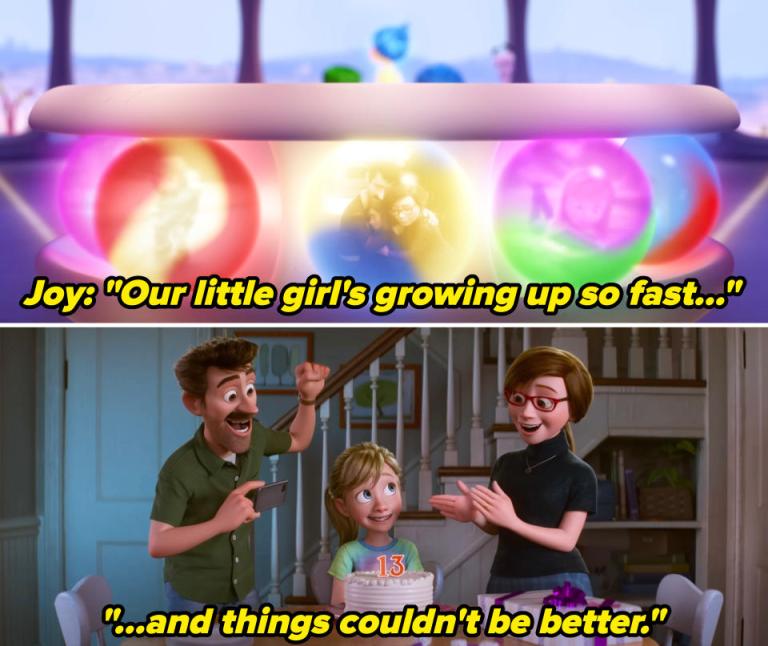
Scene from Inside Out 2, Disney, Pixar
Joy has been culling Riley’s positive memories in order to create her positive identity. But in the process, she launches the negative memories to the Back of the Mind. In this way, the internal splitting from the first Inside Out happens again. But this time, instead of relegating merely Sad memories to a lesser status, the negative memories are rejected altogether.
Creating the sense of self
The core of Riley’s self at this point is represented by strings of light that arise from the deep well of her soul and create a radiant, symmetric design. “I’m a good person” is the primary belief about herself and this creates a stable environment for all the emotions within her.
As a seminary professor, and one who went through seminary myself decades ago, I see parallels of this stage with students who first enter theological education.
They come to seminary with the faith they’ve already constructed. Many come because they already believe in and have dedicated their life to the God they know and worship. “My faith is strong” is often one of their primary beliefs.
The French philosopher Paul Ricœur calls this stage “first naiveté.” He says that when we initially approach a text of importance, such as the Bible, we read it with a certain innocence.
We think that we are taking the Bible at face value. But in truth, we may be reading into it what we want to be there. We’ve been conditioned to read in a way that affirms our worldview. Thus, we bring our presuppositions to the text.
But soon after entering seminary, students are hurtled into a new phase of development that rocks their world and their faith.
As seminarians study the Bible and their faith through a critical lens, they experience dissonance. And it can feel like their whole worldview is being deconstructed. Because that’s exactly what’s happening.
For Riley this happens with the onset of puberty that literally deconstructs her internal command center. Suddenly her stable world is “under construction” and new emotions appear: Embarrassment, Envy, Ennui, and Anxiety. Now there are nine emotions within Riley’s central command. In the span of a minute, she can go from fear to doubt to anxiety to anger to embarrassment with breakneck speed.
But Anxiety and Joy are the two emotions that compete for control.

Inside Out 2, Embarrassment, Anxiety, Envy, Ennui. Disney/Pixar
Outsmarting them all, Anxiety launches Riley’s core beliefs to the Back of the Mind. Then Anxiety jettisons the primary five emotions out of the command center and takes over the controls. Joy then leads her crew on the journey to find their way to the Back of the Mind, rescue Riley’s core self, and restore her beliefs.
For the Riley seen by the external world, the journey looks like a confused adolescent trying on different personas, overthinking everything, trying to impress new friends, and abandoning old ones.
For students in theological education, the process looks like questioning everything about the Bible, trying on different perspectives, overthinking everything, trying to impress professors, and sometimes abandoning old notions that don’t make sense anymore.
Students find out that their faith changes in seminary because they grow. But like Riley, it can feel like being in a world that no longer makes sense.
They begin to realize that God is even bigger, expansive, and more mysterious than they had imagined. Yet they also question what they really believe. And sometimes the challenge to one’s worldview can be too much. So some either deny what they’ve learned and devalue it altogether. Or they compartmentalize it and put it aside. Still others give too much power to their anxiety and doubts. They risk giving up on what they’ve believed in the first place: the core that constructed their faith.
This is the struggle we see with Riley – both internally and externally.
She lets Anxiety direct her choices which leads to some painful consequences. It all comes to a climax during an important hockey game that could determine her future in high school. Her drive to succeed and conquer her old fears propels her to a dangerous and violent move that injures one of her friends.
As she sits in the penalty box, all the emotions are finally back in her command center, but Anxiety has created a tornado within her. Joy cradles Riley’s core belief, but the new jagged one is firmly in place.
Instead of “I’m a good person,” her new belief is: “I’m not good enough.”
This scene is an excellent depiction of what happens in a panic attack. Riley experiences shortness of breath, pounding heart, and sweating while Anxiety realizes with horror what she’s set in motion and cannot stop. She wanted to protect Riley, which is a good thing. But in her zeal, she ended up putting Riley in an emotional whirlwind that could break her.
It’s only when all of the emotions rush to embrace Riley’s core that her sense of self begins to reintegrate.
The pieces start to come back together: her selfishness and kindness. Awkwardness and coolness. Sarcasm and sincerity. Doubt and faith. “Every bit makes her who she is,” says Joy.
In theological language, we use phrases such as being both sinner and saint, judged and justified, already and not yet. These are the paradoxes we must embrace if we are to construct a sense of self that is fully integrated in the faith journey.
Theology students who can integrate their new understanding of the Bible and their religion with their original core of faith can appropriate the new knowledge in such a way that it transforms them. They enter the process of reconstruction. Their understanding of the Bible, of God, the world, the church, and of themselves is born again. This new understanding leads to new behavior, new ways of doing, new ways of being.
In this way, the person experiences a second naiveté.
This is an informed, critical naiveté in which the person has been claimed by the new ideas in a way that leads to a renewed and more nuanced faith.
But the process doesn’t suddenly come to an end at that point. Rather, their renewed faith is open for still more transformation. Indeed, the second naiveté must remain open to revision and future change. The interpretive cycle is not a closed one. It is never finished.
Riley experiences this as she takes deep breaths and remembers her love of skating and the game of hockey that brought her here in the first place. She steps onto the rink and simply plays and glides with pure Joy – who is finally back at the console. All the other emotions step back and let Joy direct Riley’s every move.
It is a beautiful sight to behold.

Rev. Dr. Leah D. Schade with graduates from Lexington Theological Seminary, June 2024
Every June, our seminary holds a graduation ceremony where we celebrate our students who have finished all their courses, completed their competency exams, finished their theses and capstone projects, and earned their certificates and degrees. Watching them march down the aisle is a beautiful sight to behold. Joy is definitely at the helm!
But, of course, this isn’t the end of the story. Commencement means “beginning” as much as it celebrates a stage of completion.
In ministry, the spiral of first naivete, dissonance, deconstruction, and reconstruction is all part of spiritual growth. We repeatedly come upon something new that calls for reinterpretation and critical examination. This will lead to new perspectives, to dissonance within us. And finally, to reintegrating the ideas into a renewed faith and practices.
The spiral may not always be as intense as it is during seminary, but it will always be an aspect of ministry. The “hermeneutical circle,” as we call it in seminary, is like a series of spirals linked in a chain of faith.
What about the Deep Dark Secret?
One of the biggest teases in Inside Out 2 is the character of Deep Dark Secret. When Joy and company find themselves imprisoned in Riley’s secret memories, this mysterious lumbering figure helps them to escape. But when Joy urges him to leave the prison, too, he closes himself back in. “I’m not ready yet,” he whispers.

Inside Out 2, Deep Dark Secret. Disney/Pixar
I thought the Deep Dark Secret would make an appearance at the end of the movie and help Riley discover the source of her Anxiety. Oddly, however, he only makes an appearance in a post-credit scene.
Perhaps the Deep Dark Secret is a seed planted for the next sequel.
My daughter, Rachel, who is a communication major in college, theorizes that Inside Out 3 will be about the next stage of Riley’s development: self-disclosure. In this stage, we might see her as an older teen falling in love and deciding how much of herself to reveal to the object of her affection. She might then experience a crisis when the person she loves and trusts betrays her.
Rachel and I speculate that the next set of emotions will be along the lines of intimacy, perhaps involving romantic love, vulnerability, confidence, and trust. And Riley might experience a crisis of faith that leads her to doubt everything and everyone – her family, friends, paramour, and herself.
Ministers, too, can experience a crisis of faith.
Sometimes it happens when a Deep Dark Secret reveals itself after decades of being hidden away. Or it can take the shape of a toxic congregation or abusive denominational leadership that destroys our trust in the church. Over the last four years, the conflagration of the Covid-19 pandemic, political polarization, stress and burnout, and the effects of misinformation have driven some pastors out of ministry altogether.
Any of these can shake the foundations of our command center, our sense of self, our relationships, and our faith. And as Joy admits in the movie, it’s a lot of work to try to hold everything together when it all seems to be working against you. For some ministers, they realize they must leave ministry and seek Joy elsewhere.
And yet, our hope remains.
We hold onto hope for renewed purpose, a renewed faith, renewed relationships, and a renewed world.
Perhaps that’s the final character we’ll see in Inside Out 3: Hope.
My thanks to Rachel Schade who contributed to this article.
Read also:
Good Omens: An Antidote to Toxic Christian Apocalyptic Fiction
Will God Forgive Us? First Reformed Film Review
Blade Runner 2049: 5 Star Review

Leah D. Schade
The Rev. Dr. Leah D. Schade is the Associate Professor of Preaching and Worship at Lexington Theological Seminary in Kentucky and ordained in the ELCA. Dr. Schade does not speak for LTS or the ELCA; her opinions are her own. She is the author of Preaching in the Purple Zone: Ministry in the Red-Blue Divide (Rowman & Littlefield, 2019) and Creation-Crisis Preaching: Ecology, Theology, and the Pulpit (Chalice Press, 2015). She is the co-editor of Rooted and Rising: Voices of Courage in a Time of Climate Crisis (Rowman & Littlefield, 2019). Her newest book is Introduction to Preaching: Scripture, Theology, and Sermon Preparation, co-authored with Jerry L. Sumney and Emily Askew (Rowman & Littlefield, 2023).
General Christian
Religious Music and Entertainment
Education and Religion
Previous Post

May 31, 2024
Preaching & Ministry After Trump Conviction: 5 Key Messages
Next Post

July 3, 2024 How Should Clergy Respond to Presidential Immunity Ruling?
Recent Comments
Browse Our Archives
Select a Category Academy of Homiletics Addiction Advent AI (Artificial Intelligence) Animals Apocalypse Appalachia Ash Wednesday Baptism Bible Black Lives Matter Blade Runner Book review Children in church Christian Nationalism Christian/Islamic relations Christmas Church Clergy Climate change COVID-19 Creation Data Centers Death penalty Devotional Dialogue Doubt Earth Day Easter Ecofeminism EcoPreacher 1-2-3 ELCA ELCA Youth Gathering Election Environment/ecology Epiphany Faith Faith and Politics Feminism Film review Food Food and Faith Forgiveness Fracking Good Friday Good Omens Grief Gun violence Holy Humor Sunday Holy Week Howard Thurman ICE Immigration Indigenous wisdom Interview Jesus Kentucky Lafayette High School Marching Band Leadership Lent LGBTQIA+ Marching band Martin Luther Martin Luther King Jr. Mary Maundy Thursday Michael Sheen Mother of Jesus Nature New Year's Eve Palm Sunday Parables Pentecost Poem, Poetry Politics Poor People's Campaign Pop culture Prayers Preaching Progressive Christianity Public theology Purple Zone Racism and White Privilege Religion Religion and environment Religion and politics Religion and pop culture Religion and violence Rev. Nelson Rabell Gonzalez Sermons Spanish language resources for preaching Technology Thanksgiving Theological education theology Trees Trump Uncategorized Vegan War Women and religion Workshop Worship
Select a Month October 2026 September 2026 July 2026 June 2026 May 2026 April 2026 March 2026 February 2026 January 2026 December 2025 November 2025 October 2025 September 2025 May 2025 April 2025 March 2025 February 2025 January 2025 December 2024 November 2024 October 2024 September 2024 August 2024 July 2024 June 2024 May 2024 April 2024 March 2024 February 2024 January 2024 December 2023 November 2023 October 2023 September 2023 August 2023 July 2023 June 2023 May 2023 April 2023 March 2023 February 2023 January 2023 December 2022 November 2022 October 2022 August 2022 July 2022 June 2022 May 2022 April 2022 March 2022 February 2022 January 2022 December 2021 November 2021 October 2021 September 2021 August 2021 July 2021 June 2021 May 2021 April 2021 March 2021 January 2021 December 2020 November 2020 October 2020 September 2020 August 2020 July 2020 June 2020 May 2020 April 2020 February 2020 January 2020 December 2019 November 2019 October 2019 September 2019 August 2019 July 2019 June 2019 May 2019 April 2019 March 2019 January 2019 December 2018 November 2018 October 2018 September 2018 August 2018 July 2018 June 2018 May 2018 April 2018 March 2018 February 2018 January 2018 December 2017 November 2017 October 2017 September 2017 August 2017 July 2017 June 2017 May 2017 April 2017
Follow Us!
TAKE THE
Religious Wisdom Quiz
Who was made mute and only spoke God's word until Jerusalem fell?
Select your answer to see how you score.
Daniel Jonah Amos Ezekiel
Books by This Author Books by Leah D. Schade
Related posts from EcoPreacher

Do Not Be Overcome by Evil: Biblical Wisdom...

Why Did God Allow This to Happen? Post-election...

Purity & Pesticides: Protecting God's Creation, Human Health

Nye: A Review by an American in Kentucky
TRENDING AT PATHEOS Progressive Christian

What Being a Modern-Day Apostle Means to Me
In my last column, I discussed the ins and outs of modern-day...

Did Ancient China Once Worship the God of...
Across human history, a common thread weaves through the origins of the...

Love Your Neighbor – Including Earth-Kin: Lev. 19,...
God’s command to love your neighbor means acting in an ethical and...

Lead a Church Study of “Jesus and Lao...
Guest writer Jack Thomas (The Irreverent Reverend) reflects on leading his church...

Pastoral Wisdom for Responding to Sermon Pushback
Getting sermon pushback on your social justice sermon? Learn practical, Proverbs-based strategies...

Principles for Understanding the Apostolic Ministry Today
Whenever people discover that my formal ministry title is "apostle," as in...
view all Progressive Christian blogs
What Are Your Thoughts?leave a comment
Ad-Free & Subscriber Log-In Subscription Support
- About Us
- 2026 Calendar
- Videos
- Podcasts
- Library of World Religions
- Faith In Media Tracker
- Advertise With Us
- Write for Us
- Privacy Policy
- Terms of Service
- Do Not Sell My Data
- Contact Us
- Radiant Digital
- Manage Newsletter Subscriptions
- Unsubscribe From Notifications
- Sitemap
Copyright 2008-2026, Patheos. All rights reserved.
Subscription Support Ad-Free & Subscriber Log-In
Follow Patheos