
BuddhistCatholicContemplativeEvangelicalGeneral ChristianHinduJewishLatter-day SaintMuslimNew VisionsProgressive Christian
Beliefs
- Buddhist
- Catholic
- Contemplative
- Evangelical
- General Christian
- Hindu
- Jewish
- Latter-day Saint
- More Voices
- Muslim
- New Visions
- Pagan
- Progressive Christian
Topics
- Religion News
- Food and Religion
- Sports and Religion
- Religious Art
- Religious Music and Entertainment
- Religious Events
- History and Religion
- Style and Religion
- Politics and Religion
- Women in Religion
- Recreation Outdoors and Religion
- Business Finance and Religion
- Careers Workplace and Religion
- Education and Religion
- Family Parenting and Religion
- Health Fitness and Religion
- Home and Religion
- Relationships and Religion
- Technology and Religion
- Travel and Religion
Columnists
- Buddhist Columnists
- Business Finance and Religion Columnists
- Careers Workplace and Religion Columnists
- Catholic Columnists
- Contemplative Columnists
- Education and Religion Columnists
- Evangelists Columnists
- Family Parenting and Religion Columnists
- General Christian Columnists
- Health Fitness and Religion Columnists
- Hindu Columnists
- History and Religion Columnists
- Home and Religion Columnists
- Jewish Columnists
- More Voices Columnists
- Latter Day Columnists
- Muslim Columnists
- New Visions Columnists
- Nonreligious Columnists
- Pagan Columnists
- Politics and Religion Columnists
- Progressive Columnists
- Recreation Outdoors and Religion Columnists
- Relationships and Religion Columnists
- Religion News Columnists
- Religious Art Columnists
- Religious Events Columnists
- Religious Music and Entertainment Columnists
- Sports and Religion Columnists
- Style and Religion Columnists
- Technology and Religion Columnists
- Travel and Religion Columnists
- Women in Religion Columnists
Resource Library
- 2026 Calendar
- Library of World Religions
- The 100 Most Holy Places on Earth
- Patheos Answers
- Podcasts
- Videos
- Faith Leaders Database
- Anglican Episcopalian
- Bahai
- Baptist
- Buddhism
- Christianity
- Confucianism
- Eastern Orthodoxy
- Hinduism
- Holiness and Pentecostal
- ISKCON
- Islam
- Judaism
- Lutheran
- Methodist
- The Church of Jesus Christ of Latter-day Saints
- New Age
- Paganism
- Presbytarian and Reformed
- Protestantism
- Religion Behind the Scenes
- Roman Catholic
- Scientology
- Shia Islam
- Sikhism
- Sufism
- Sunni Islam
- Taoism
- Zen
- See all religions
Research Tools
 Ad-Free & Subscriber Log-In Subscription Support
Follow Patheos 

- Trending:
- Advent
- |
- Forgiveness
- |
- Thanksgiving
- |
- Election
- |
- Seasonal Holidays
- |
- Marriage

- Home
- Progressive Christian
- Recreation, Outdoors and Religion
- 10 Principles for Environmental Preaching and Eco-Sermons
10 Principles for Environmental Preaching and Eco-Sermons
Last updated on: November 19, 2025 at 10:36 am by Leah D. Schade
10 Principles for Environmental Preaching and Eco-Sermons 2025-11-19T10:36:41-04:00 Leah D. Schade
Patheos Explore the world's faith through different perspectives on religion and spirituality! Patheos has the views of the prevalent religions and spiritualities of the world.
If you want to craft eco-sermons to be part of protecting and healing God’s Creation, here are 10 Principles for Environmental Preaching.
[Lea la versión en español de este artículo aquí.]

Environmental preaching. Image by wirestock on Freepik. https://www.freepik.com/free-photo/closeup-shot-person-holding-bible-with-desk-globe-top_10722503.htm
Becoming an “EcoPreacher”
I first began my work as an “EcoPreacher” nearly twenty years ago when I started an eco-ministry in the Lutheran church I served just outside of Philadelphia, Pennsylvania. I believed it was important for people to connect their faith with the climate and environmental justice issues that are affecting our world and local communities.
One Sunday I was invited to preach an Earth Day sermon for a neighboring church and focused on the need to preserve natural lands. I highlighted a beautiful local land trust as an example of human beings obeying the command of God in the Garden of Eden: this far and no farther. At the end of the sermon, I said this:
Sometimes there is great blessing in establishing boundaries and protecting them. Sometimes the benefits of changing your lifestyle or business practices to reduce your carbon footprint outweigh the initial sacrifice. And sometimes foregoing profit in order to preserve a natural legacy reaps rewards far beyond monetary wealth. Acknowledging a dying Earth is the only way to save it. Because after coming through the scorched land of eco-crucifixion, God will bring us to the eco-resurrection in the new Eden – the garden of Easter morning.
Many congregants expressed curiosity about the nature preserve and indicated their intention to explore it. But the most moving comment came from a gentleman who shared that he and his family had a piece of property inherited from his parents, and they were debating what to do with it. He said that after hearing the sermon, he would suggest to his family that they turn it into a land trust to preserve it for posterity. He thanked me for planting the seed in his mind.
That experience taught me something that has stayed with me for twenty years.
God’s Creation needs good preaching, and good preaching needs God’s Creation.
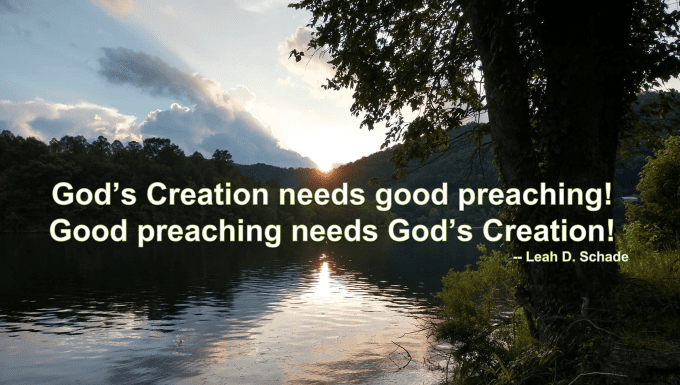
Good preaching needs God’s Creation. God’s Creation needs good preaching. Photo by Leah D. Schade. All rights reserved.
I believe that when preachers make a regular practice of connecting Scripture and environmental issues, we can proclaim justice for God’s Creation in the face of climate change and environmental devastation. Studies have shown that parishioners who hear sermons about climate change are more likely to want to take steps to prepare and protect communities than those who hear nothing from the pulpit about this issue.[1]
Yet, my own research has shown that many clergy are hesitant to address climate and other environmental issues.
In a 2017 survey of over 1,000 U.S. mainline Protestant clergy, I gave respondents a list of social issues and asked which ones they had addressed in the previous year. Environmental issues registered among the lowest priorities to address. Mostly, this is due to fear of getting pushback from parishioners who think these issues are “too political.”
Fortunately, the 2021 survey saw environmental issues rise to be in the top ten. [Read: Clergy Report Preaching More about Climate Change: National Survey] However, the survey still showed that less than half (47%) of the respondents had addressed things like pollution, extinction, climate change, or environmental justice in their sermons.
Concern about climate change
Yet, according to research by ecoAmerica in 2021, 78% of Americans are concerned about climate change.[2] In a similar finding, I recently conducted a study through the BTS Center surveying 172 congregational lay leaders representing more than ten different denominations from thirty congregations across sixteen states in the U.S. 75% of those congregational leaders indicated they were “very concerned” about the environment and climate change.[3]
Unfortunately, a 2022 report by the Pew Research Center indicated that 70% of Americans say they’re not hearing about climate change in sermons.[4] Without the biblical, theological, and ethical framing of climate and environmental issues for parishioners, how can churches be expected to take action to help protect God’s Creation?
Do you want to be an “EcoPreacher”?
If you’re a preacher wanting to craft sermons that make the biblical and theological case for protecting God’s Creation, here are 10 principles for environmental preaching. These will help you read and interpret Scripture in order to preach an “eco sermon.”
10 Principles for Environmental Preaching
Guiding Ecojustice Principles
These first six principles are drawn from Norman Habel’s work in The Earth Bible series.[5]
- The principle of intrinsic worth. The universe, Earth and all its components have intrinsic worth/value.
- The principle of interconnectedness. Earth is a community of interconnected living things that are mutually dependent on each other for life and survival.
- The principle of voice. Earth is a subject capable of raising its voice in celebration and against injustice.
- The principle of purpose. The universe, Earth, and all its components are part of a dynamic cosmic design within which each piece has a place in the overall goal of that design.
- The principle of mutual custodianship. Earth is a balanced and diverse domain where responsible custodians can function as partners with, rather than rulers over, Earth to sustain its balance and a diverse Earth community.
- The principle of resistance. Earth and its components not only suffer from human injustices but actively resist them in the struggle for justice.
Principles of an Ecofeminist Lens for Preaching
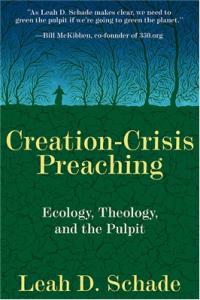
The last four principles are ones I have developed using an ecofeminist lens* in my book Creation-Crisis Preaching: Ecology, Theology, and the Pulpit.[6]
- Focus on Earth-orientation rather than focusing strictly on humans, and particularly male humans. Read Scripture through a “green lens” to ascertain how texts may be oppressive or liberating to women, children, those most vulnerable, and the Earth community.
- Proclaim the good news for both the human and other-than-human community of Earth. Analyze the impact and power that certain texts will have when preached in a community of faith within its ecological context.
- Practice a hermeneutic of remembrance. Recover biblical traditions so that we can view the biblical story from an ecofeminist perspective, moving away from the inherent human-centeredness and male-centeredness of texts that assume subordination of Earth and women.
- Engage creative actualization. Tell stories from Earth’s and women’s perspectives. Reformulate narratives lifting up the discipleship of equals among human communities and with our Earth kin.
To see examples of how these principles can be used in actual sermons, here are links to sermons here on my blog, EcoPreacher on Patheos:
Resurrection Sermon for an Earth-kin Congregation
Noah’s Ark and Climate Change: What Kind of Church Will We Be?
Also, see the sermons in my book, Creation-Crisis Preaching.
Putting the 10 Principles for Environmental Preaching to work: EcoPreacher 1-2-3
In an effort to encourage clergy to preach and teach on Christian ecology at least once a month, the Interfaith Center for Sustainable Development and I have partnered to develop a free resource called EcoPreacher 1-2-3. We provide sermon preparation for preaching about caring for God’s Creation and environmental justice that is short, accessible, and based on a solid biblical foundation.

Each installment of EcoPreacher 1-2-3 offers a brief “eco-exegesis” for interpreting a biblical text from the Revised Common Lectionary. This is followed by one “eco idea” for the basis of a sermon, two “eco questions” to go deeper, and three “eco actions” to help a congregation put their faith into action. With this resource, preachers can use the sermon ideas in their own context and make it relevant for their congregation.
EcoPreacher 1-2-3 is ecumenical, adaptable to your preaching context, and can spark ideas for sermon preparation and teaching. Sign up to receive the monthly EcoPreacher 1-2-3 resources at https://interfaithsustain.com/ecopreacher-123/.
I also publish each edition of EcoPreacher 1-2-3 on my blog. Here are a few examples:
Ash Wednesday and Lent: Fasting for Earth as Resistance to Oppression
Be Persistent! Wrestling a Blessing for Eco-Justice: Genesis 32, Luke 18
God’s Creation PREACHES! Psalm 19 Links Nature and Torah
In the face of eco-crucifixion, preach eco-resurrection
Remember that when preaching about God’s Creation, many will feel dismay because we are in the midst of what I call an “eco-crucifixion.” So one of the most effective strategies for eco-preaching is to share stories of people of faith and worshiping communities working to protect, heal, and restore Earth and communities damaged by environmental injustice. Show people how they can participate in God’s redemption of Creation not with wishful thinking, but with authentic hope in God’s “eco-resurrection.” This is the power of good preaching, and it is the power of God in and through Creation.
** Ecofeminists see a connection between the oppression of Earth and the oppression of women and those most vulnerable. They believe that the ecological crises cannot be addressed without simultaneously addressing patriarchal, hierarchical domination systems. Ecofeminists make a concerted effort to show how ecological issues are directly tied to issues of justice for women, the poor, people of color, Indigenous communities, and all marginalized and vulnerable individuals and groups.*
Read also:
How to Preach a Sermon about Climate Change and Your Congregation
Blessing Animals Sunday: Genesis 2:18-24 Sermon Ideas
ECO-WEDDING LITURGY: Ideas for a Creation-Centered Wedding
Churches Can Connect Faith and Creation Care for Lent

The Rev. Dr. Leah D. Schade is a seminary professor and ordained minister. Her opinions are her own.
Leah is the author of Preaching and Social Issues: Tools and Tactics for Empowering Your Prophetic Voice (Rowman & Littlefield, 2024), Preaching in the Purple Zone: Ministry in the Red-Blue Divide (Rowman & Littlefield, 2019) and Creation-Crisis Preaching: Ecology, Theology, and the Pulpit (Chalice Press, 2015). She is the co-editor of Rooted and Rising: Voices of Courage in a Time of Climate Crisis (Rowman & Littlefield, 2019). Her book, Introduction to Preaching: Scripture, Theology, and Sermon Preparation, was co-authored with Jerry L. Sumney and Emily Askew (Rowman & Littlefield, 2023).
[1] Robert P. Jones, Daniel Cox, Juhem Navarro-Rivera, Believers, Sympathizers, and Skeptics: Why Americans are Conflicted About Climate Change, Environmental Policy, and Science: Findings from the PRRI/AAR Religion, Values, and Climate Change Survey, (Washington, D.C.: Public Religion Research Institute and American Academy of Religion, 2014).
[2] American Climate Perspectives Survey 2021, Vol. IV. ecoAmerica. https://ecoamerica.org/american-climate-perspectives-survey-2021-vol-iv/
[3] Schade, Leah D., “EcoPreacher Congregational Leader Survey,” 2022, BTS Center, unpublished survey results.
[4] Alper, Becka A., “How Religion Intersects with Americans’ Views on the Environment,” Pew Research Center, Nov. 17, 2022. https://www.pewresearch.org/religion/2022/11/17/how-religion-intersects-with-americans-views-on-the-environment/
[5] Norman C. Habel, “Guiding Ecojustice Principles,” in Readings from the Perspective of Earth, ed. Norman C. Habel, The Earth Bible (Cleveland: Pilgrim Press, 2000), 2.
[6] Leah D. Schade, Creation-Crisis Preaching: Ecology, Theology, and the Pulpit, St. Louis, MO: Chalice.
General Christian
Recreation, Outdoors and Religion
Politics and Religion
Previous Post

February 8, 2023
Ash Wednesday and Lent: Fasting for Earth as Resistance to Oppression
Next Post

February 21, 2023 Countering the Temptations of Christian Nationalism: Matthew 4:1-11
Recent Comments
"I appreciate and agree with that Gaia-grounded exhortation! Along those lines, you might appreciate this ..."
Love Your Neighbor – Including Earth-Kin: ..."
"Or, people could just realize our planet is also a living organism, a 4.5 billion ..."
Love Your Neighbor – Including Earth-Kin: ..."
"Climate change is getting attention but not enough. The study of the issue needs to ..."
Preaching About Climate Change: What Clergy ..."
"Yes! The Season of Creation is a month-long liturgical season to focus on all aspects ..."
Making Space for Eco-Grief—and Hope—in Your ..."
Browse Our Archives
Select a Category Academy of Homiletics Addiction Advent AI (Artificial Intelligence) Animals Apocalypse Appalachia Ash Wednesday Baptism Bible Black Lives Matter Blade Runner Book review Children in church Christ the King Sunday Christian Nationalism Christian/Islamic relations Christmas Church Clergy Climate change COVID-19 Creation Data Centers Death penalty Devotional Dialogue Doubt Earth Day Easter Ecofeminism EcoPreacher 1-2-3 ELCA ELCA Youth Gathering Election Environment/ecology Epiphany Faith Faith and Politics Feminism Film review Food Food and Faith Forgiveness Fracking Good Friday Good Omens Grief Gun violence Holy Humor Sunday Holy Week Howard Thurman ICE Immigration Indigenous wisdom Interview Jesus Kentucky Lafayette High School Marching Band Leadership Lent LGBTQIA+ Marching band Martin Luther Martin Luther King Jr. Mary Maundy Thursday Michael Sheen Mother of Jesus Nature New Year's Eve Palm Sunday Parables Pentecost Poem, Poetry Politics Poor People's Campaign Pop culture Prayers Preaching Progressive Christianity Public theology Purple Zone Racism and White Privilege Religion Religion and environment Religion and politics Religion and pop culture Religion and violence Rev. Nelson Rabell Gonzalez Sermons Spanish language resources for preaching Technology Thanksgiving Theological education theology Trees Trump Uncategorized Vegan War Women and religion Workshop Worship
Select a Month November 2026 October 2026 September 2026 July 2026 June 2026 May 2026 April 2026 March 2026 February 2026 January 2026 December 2025 November 2025 October 2025 September 2025 May 2025 April 2025 March 2025 February 2025 January 2025 December 2024 November 2024 October 2024 September 2024 August 2024 July 2024 June 2024 May 2024 April 2024 March 2024 February 2024 January 2024 December 2023 November 2023 October 2023 September 2023 August 2023 July 2023 June 2023 May 2023 April 2023 March 2023 February 2023 January 2023 December 2022 November 2022 October 2022 August 2022 July 2022 June 2022 May 2022 April 2022 March 2022 February 2022 January 2022 December 2021 November 2021 October 2021 September 2021 August 2021 July 2021 June 2021 May 2021 April 2021 March 2021 January 2021 December 2020 November 2020 October 2020 September 2020 August 2020 July 2020 June 2020 May 2020 April 2020 February 2020 January 2020 December 2019 November 2019 October 2019 September 2019 August 2019 July 2019 June 2019 May 2019 April 2019 March 2019 January 2019 December 2018 November 2018 October 2018 September 2018 August 2018 July 2018 June 2018 May 2018 April 2018 March 2018 February 2018 January 2018 December 2017 November 2017 October 2017 September 2017 August 2017 July 2017 June 2017 May 2017 April 2017
Follow Us!
TAKE THE
Religious Wisdom Quiz
What does Paul tell Timothy to do with myths and old wives' tales?
Select your answer to see how you score.
Ignore them Correct them Have nothing to do with them Refute them
Books by This Author Books by Leah D. Schade
Related posts from EcoPreacher
Advent: Making Room for Earth’s Renewal: Isaiah 61,...

Thanksgiving and Gratitude for Creation: Deut. 8, Luke...

Pastoral Wisdom for Responding to Sermon Pushback

Love Your Neighbor – Including Earth-Kin: Lev. 19,...
TRENDING AT PATHEOS Progressive Christian

Can a Chatbot Touch Your Soul?
Can a chatbot offer genuine spiritual counsel? One conversation brought me to...

Religion and Politics: How Should We Then Live?
Two cultural axioms get repeated in polite company. Don't mix religion and...

7 Things We Get Wrong About Giving Thanks
It's a time of year when many of us turn to the...

Uncaging Truth: Spirituality Beyond Institutions
The Lost Connection: Why True Spirituality, Not Religion, Is the Key to...

Christ the King? Maybe We've Misunderstood the Crown
What do we mean when we say that Jesus is King? What...

Counter “Christ Is King” Nationalism with Christ THE...
Christ the King Sunday is an ideal time to address the heresy...
view all Progressive Christian blogs
What Are Your Thoughts?leave a comment
Ad-Free & Subscriber Log-In Subscription Support
- About Us
- 2026 Calendar
- Videos
- Podcasts
- Library of World Religions
- Faith In Media Tracker
- Advertise With Us
- Write for Us
- Privacy Policy
- Terms of Service
- Do Not Sell My Data
- Contact Us
- Radiant Digital
- Manage Newsletter Subscriptions
- Unsubscribe From Notifications
- Sitemap
Copyright 2008-2026, Patheos. All rights reserved.
Subscription Support Ad-Free & Subscriber Log-In
Follow Patheos