
BuddhistCatholicContemplativeEvangelicalGeneral ChristianHinduJewishLatter-day SaintMuslimNew VisionsProgressive Christian
Beliefs
- Buddhist
- Catholic
- Contemplative
- Evangelical
- General Christian
- Hindu
- Jewish
- Latter-day Saint
- More Voices
- Muslim
- New Visions
- Pagan
- Progressive Christian
Topics
- Religion News
- Food and Religion
- Sports and Religion
- Religious Art
- Religious Music and Entertainment
- Religious Events
- History and Religion
- Style and Religion
- Politics and Religion
- Women in Religion
- Recreation Outdoors and Religion
- Business Finance and Religion
- Careers Workplace and Religion
- Education and Religion
- Family Parenting and Religion
- Health Fitness and Religion
- Home and Religion
- Relationships and Religion
- Technology and Religion
- Travel and Religion
Columnists
- Buddhist Columnists
- Business Finance and Religion Columnists
- Careers Workplace and Religion Columnists
- Catholic Columnists
- Contemplative Columnists
- Education and Religion Columnists
- Evangelists Columnists
- Family Parenting and Religion Columnists
- General Christian Columnists
- Health Fitness and Religion Columnists
- Hindu Columnists
- History and Religion Columnists
- Home and Religion Columnists
- Jewish Columnists
- More Voices Columnists
- Latter Day Columnists
- Muslim Columnists
- New Visions Columnists
- Nonreligious Columnists
- Pagan Columnists
- Politics and Religion Columnists
- Progressive Columnists
- Recreation Outdoors and Religion Columnists
- Relationships and Religion Columnists
- Religion News Columnists
- Religious Art Columnists
- Religious Events Columnists
- Religious Music and Entertainment Columnists
- Sports and Religion Columnists
- Style and Religion Columnists
- Technology and Religion Columnists
- Travel and Religion Columnists
- Women in Religion Columnists
Resource Library
- 2026 Calendar
- Library of World Religions
- The 100 Most Holy Places on Earth
- Patheos Answers
- Podcasts
- Videos
- Faith Leaders Database
- Anglican Episcopalian
- Bahai
- Baptist
- Buddhism
- Christianity
- Confucianism
- Eastern Orthodoxy
- Hinduism
- Holiness and Pentecostal
- ISKCON
- Islam
- Judaism
- Lutheran
- Methodist
- The Church of Jesus Christ of Latter-day Saints
- New Age
- Paganism
- Presbytarian and Reformed
- Protestantism
- Religion Behind the Scenes
- Roman Catholic
- Scientology
- Shia Islam
- Sikhism
- Sufism
- Sunni Islam
- Taoism
- Zen
- See all religions
Research Tools
 Ad-Free & Subscriber Log-In Subscription Support
Ad-Free & Subscriber Log-In Subscription Support
Follow Patheos 

- Trending:
- Forgiveness
- |
- Marriage
- |
- Consciousness
- |
- Death Penalty
- |
- Election
- |
- Halloween

- Home
- Progressive Christian
- Politics and Religion
- It’s Okay to Be A Progressive Christian. Here’s Why.
It’s Okay to Be A Progressive Christian. Here’s Why.
Last updated on: October 19, 2022 at 12:19 pm by Leah D. Schade
It’s Okay to Be A Progressive Christian. Here’s Why. 2022-10-19T12:19:01-04:00 Leah D. Schade
Patheos Explore the world's faith through different perspectives on religion and spirituality! Patheos has the views of the prevalent religions and spiritualities of the world.
Here’s why you can – and should – claim your faith and identity as a Progressive Christian with confidence. And then act on it.

Photo by Miguel Bruna on Unsplash. https://unsplash.com/photos/TzVN0xQhWaQ
Are You Shy About Being a Progressive Christian?
I teach preaching and worship at a Progressive Christian seminary. Many of our students come to us from right-wing fundamentalist Christian upbringings that haunt them even years after leaving those churches behind. These students sometimes struggle with claiming their identity as a Progressive Christian because of the ways in which their family members, friends, and previous congregations mischaracterize this approach to Christianity. Others who have been in mainline Protestant denominations for decades sometimes shy away from being public about their Progressive Christian values because of the pushback they receive from politically conservative congregants.
But we’re at an inflection point in American history where the choices we make about the kind of Christian we’re going to be will have enormous ramifications for this country and the future of our democracy. The alternatives of merely “quiet quitting” fundamentalist Christianity or staying in the shadows because you cringe at being called a “snowflake” or “libtard” aren’t going to cut it anymore.
For far too long, Progressive Christians have stood on the sidelines while right-wing fundamentalists co-opted our religion. Being bashful about your identity as a Progressive Christian is no longer an option. We’re called to step into the work of transformation and spiritual renewal with urgency and unwavering commitment to the ethics of Jesus.
So if you are a Progressive Christian, it’s time to own that identity – and act on it – with confidence.
It’s About the Bible
Being a Progressive Christian means that you love the Bible. AND you recognize that there is no such thing as a “literal” interpretation of Scripture. We want to understand what the text meant to its original author, readers, and context. And we’re interested in hearing interpretations from historically underrepresented communities, such as women, people with disabilities, African Americans, and folks who are LGBTQIA.
Here’s the thing about biblical literalists. They tend to cherry-pick which verses to interpret literally and which ones to gloss over or ignore completely.
For example, they cite the “clobber passages” in the Bible to condemn people who are gay without taking into account the historical time and context in which these texts were originally written. (The passages include: Genesis 19, Leviticus 18:22, Leviticus 20:13, Romans 1, 1 Corinthians 6:9-10, and 1 Timothy 1:9-10.) Yet they take a wide berth around Jesus’s teaching about divorce (Matthew 19:3-12, Mark 10:2-12) and seem to be fine with serial marriages.
Progressive Christians don’t take the teaching about divorce literally either. But it’s not because we’re hypocrites. It’s because we recognize that condemning divorce in Jesus’s time was about protecting vulnerable women in a patriarchal society from getting ditched by men and left in poverty with no safety net.
So, if you’re a Progressive Christian, you’re willing to grapple with the Bible’s tough passages and hold yourself and your community accountable to its ethical teachings. You give Scripture just as much authority as your fundamentalist counterparts – but with your critical thinking skills intact.
It’s About Theology
Being a Progressive Christian means that you love God. AND you have a very different understanding of who God is and what God does than your fundamentalist siblings. For example, the interpretive method biblical literalists use has the agenda of strict control over its adherents so that any questioning, doubt, or scrutiny is equated with unfaithfulness and disobedience. This interpretive method is based on a distorted view of God as authoritarian, patriarchal, and exclusive.
Progressive Christians, in contrast, are gloriously messy and complicated when it comes to interpreting Scripture. There’s no one way to interpret the Bible if you’re a Progressive Christian. In fact, there are a multitude of lenses that we bring when we’re trying to understand Scripture.
This is because we see God as creative, gracious, forgiving, and yet protective of those most vulnerable.
As my colleagues, Dr. Jerry Sumney, Dr. Emily Askew, and I write in our forthcoming book, Introduction to Preaching: Scripture, Theology, and Sermon Preparation, this kind of theological orientation allows us to embrace what we call “perspective-explicit interpretations.” These are points of view that recognize, highlight, and take advantage of the observations and reactions that come when readers listen from their various social locations, identities, and ideologies.
Reading the Bible from a particular perspective has significant benefits. First, it helps us understand the Bible more clearly. Second, reading from varying perspectives helps us see how each text is shaped by the author’s unconscious and sometimes problematic presuppositions (like assuming that God is a human male). Third, it allows previously silenced or ignored voices to give us insights into God’s Word.
So, if you’re a Progressive Christian, you rejoice in the panoply of perspectives about God and the Bible, such as Latiné, Asian, post-colonial, and ecological lenses. You celebrate that each of them will expand the breadth and depth of your love for Scripture as well as your love for God!
It’s About Not Being a Christofascist
“Christofascist” is a strong word, I know. But it’s the only apt descriptor of what fundamentalist Christianity in America has become. In her book, The Seven Deadly Sins of White Christian Nationalism, Carter Heyward explains that Christofascism is “a seductive form of authoritarianism taking shape among us in the guise of Christian faith and all-American values, especially the value of liberty, or freedom, even at the expense of the common good” (xii).
First coined by the German theologian Dorothee Soelle, Christofascism is the unholy trinity of Christianity, capitalism, and Republican political power. As early as the 1980s, Soelle recognized the beginnings of theocracy made in the image of rich, white Christian men – exactly as she saw in fascist Germany in the 1930s.
What are the seven deadly sins of Christofascism?
Carter says they are: 1) the lust for omnipotence; 2) entitlement to privilege; 3) white supremacy; 4) misogyny; 5) capitalist spirituality; 6) domination of earth and its creatures; and 7) violence.
If you are a Progressive Christian, these things make you queasy. Or they make your blood boil. Or they make you want to go out and join a protest, write a letter to the editor, or preach a sermon encouraging people to vote in a way that reflects their Progressive Christian values.
However, if you read this list and get defensive, or worse, a tingle of excitement, you might be under the sway of Christofascism.
One of the things that is helpful about Heyward’s book is that she gives us seven corresponding calls to action to counter the seven deadly sins of White Christian Nationalism.
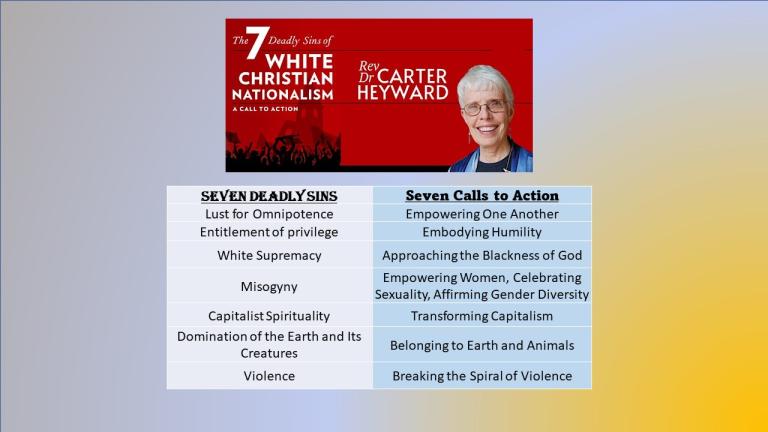
Seven Deadly Sins of White Christian Nationalism and Seven Calls to Action by Carter Heyward. Image by Leah D. Schade
What are the calls to action for a Progressive Christian?
According to Heyward, the calls to action are: 1) empowering one another; 2) embodying humility; 3) approaching the blackness of God; 4) empowering women, celebrating sexuality, affirming gender diversity; 5) transforming capitalism; 6) belonging to earth and animals; and 7) breaking the spiral of violence.
If you are a Progressive Christian, these things make your heart sing. Or they make your mind curious. Or they make you want to go out and get some anti-racism training, or encourage your congregation to affirm transgender and queer folks, or preach a sermon about protecting God’s Creation.
However, if you read this list and it makes you feel angry, or worse, like you want to punch someone or pull out a gun and start shooting, or stage an insurrection, you might be under the sway of Christofascism.
It’s About Justice
Progressive Christians share a commitment to helping each other and society understand the complexities and intersectionalities of different forms of oppression. We share a common orientation to values such as the ordination of women, LGBTQIA+ rights, racial and ethnic equity, attention to the marginalized, and care for God’s Creation. Why are these important to a Progressive Christian? Because we care about justice.
Justice in Hebrew is mishpat, which is about fairness and equity. In passages like Micah 6:8, God is telling those with power that they must share and follow God’s law so that everyone can have what they need to live, not just the rich and powerful who hoard their wealth for their own exclusive use.
God has told you, O mortal, what is good;
and what does the Lord require of you
but to do justice, and to love kindness,
and to walk humbly with your God? (Micah 6:8)
It’s About Being a Decent Human Being
Kindness in Hebrew is chesed which is about being merciful. Some people sneer and call this being “woke.” But respect, caring, inclusion, making an even playing field – those are not part of some “liberal snowflake agenda.” That’s called being a decent human being and creating a better society, the kind of society that God wants for us.
Walking humbly in Micah 6:8 is yalak sana and it is in direct contrast with the prideful strides of those who are powerful, arrogant, merciless, and ruthless. A Progressive Christian will strive to humbly orient themselves to an ethic of care that is open to other people’s pain – and especially to confronting the structural sins that lead to or exacerbate that pain.
It’s About Wanting the Planet and Human Beings to Survive
Unlike fundamentalist Christians, Progressive Christians do not see science as an enemy of faith. Nor do they see other faiths as an enemy of Christianity. Instead, Progressive Christians look to build bridges of respect, understanding, and common values in order to address the most pressing problems of our time.

Photo by Leah D. Schade
Whether it’s the public health crisis of a pandemic, the global climate crisis, or a local issue such as police brutality, Progressive Christians reach out to others who share their commitment to the common good. They do this because they follow the teachings of Jesus, the Hebrew prophets, and a core biblical value summed up by the two primary commandments:
Love God and love your neighbor.
If you’re a Progressive Christian, you get jazzed about the idea of a healthy, livable planet that we share with the plants and animals God has nurtured into existence over millions of years. You take your cue from Jesus to care for “the least of these” so that everyone has what they need to survive and flourish – not just the straight, white, wealthy Christians who live in America. And if you’re a Progressive Christian, you’re committed to the values of truth, nonviolence, equity, power-with rather than power-over, and healing and wholeness in mind, body, spirit, and society.
This isn’t to say that you’re a perfect human being. But it does mean that you strive for this kind of spiritual perfection. These values are important to you because you’re a Progressive Christian – you’re progressing toward the vision of the Beloved Community, the Realm of God proclaimed by and embodied within the teachings, life, death, and resurrection of Jesus.
It’s About Time You Claim Your Identity as a Progressive Christian – and Act On It
Heyward notes that many good, upstanding white Christians have not wished to be associated with white supremacy or male gender domination. Yet, they “have refused to join, much less lead, publicly in social struggles against injustice throughout much of American history,” (15). She likens this to “gazing out the window,” an experience Elie Wiesel described when good upstanding Germans simply watched as Jews were loaded onto boxcars and carried to the death camps.
If you’re a Progressive Christian, you’re not okay with just gazing out the window. You know that it’s time to name and claim who you are as a Progressive Christian. And then act on it. This goes for clergy and congregations alike. The stakes are too high to simply gaze out the window and watch as Christofascism destroys all that is sacred, including the planet itself.
It’s more than just okay to be a Progressive Christian. It is essential.
Join me for a conversation with Carter Heyward on Oct. 25th, co-hosted by the Clergy Emergency League and the Wisconsin Council of Churches!
Click here to register: https://www.wichurches.org/2022/09/carter-heyward/
Read also:
Preaching Across Divides: Purple Zone Strategies for Pulpit and Public Square
Pentecost & the Divine Purpose of Diversity: Genesis 11, Acts 2
The Politics of Faith – The Bible, Government, and Public Policy: Book Review

The Rev. Dr. Leah D. Schade is the Associate Professor of Preaching and Worship at Lexington Theological Seminary in Kentucky and ordained in the ELCA. Dr. Schade does not speak for LTS or the ELCA; her opinions are her own. She is the author of Preaching in the Purple Zone: Ministry in the Red-Blue Divide (Rowman & Littlefield, 2019) and Creation-Crisis Preaching: Ecology, Theology, and the Pulpit (Chalice Press, 2015). She is the co-editor of Rooted and Rising: Voices of Courage in a Time of Climate Crisis (Rowman & Littlefield, 2019) and co-wrote Apocalypse When?: A Guide to Interpreting and Preaching Apocalyptic Texts (Wipf & Stock, 2020). Her book, Introduction to Preaching: Scripture, Theology, and Sermon Preparation, co-written with Jerry L. Sumney and Emily Askew, will be released by Rowman & Littlefield in March 2023.
Politics and Religion
Previous Post

October 17, 2022
COP27 – Solidarity, Endurance for Climate Justice: Malachi 4, Luke 21
Next Post

November 6, 2022 8 Ways to Prepare Your Congregation for Sermons about Social Issues
Browse Our Archives
Select a Category Academy of Homiletics Addiction Advent AI (Artificial Intelligence) Animals Apocalypse Appalachia Ash Wednesday Baptism Bible Black Lives Matter Blade Runner Book review Children in church Christian Nationalism Christian/Islamic relations Christmas Church Clergy Climate change COVID-19 Creation Data Centers Death penalty Devotional Dialogue Doubt Earth Day Easter Ecofeminism EcoPreacher 1-2-3 ELCA ELCA Youth Gathering Election Environment/ecology Epiphany Faith Faith and Politics Feminism Film review Food Food and Faith Forgiveness Fracking Good Friday Good Omens Grief Gun violence Holy Humor Sunday Holy Week Howard Thurman ICE Immigration Indigenous wisdom Interview Jesus Kentucky Lafayette High School Marching Band Leadership Lent LGBTQIA+ Marching band Martin Luther Martin Luther King Jr. Mary Maundy Thursday Michael Sheen Mother of Jesus Nature New Year's Eve Palm Sunday Parables Pentecost Poem, Poetry Politics Poor People's Campaign Pop culture Prayers Preaching Progressive Christianity Public theology Purple Zone Racism and White Privilege Religion Religion and environment Religion and politics Religion and pop culture Religion and violence Rev. Nelson Rabell Gonzalez Sermons Spanish language resources for preaching Technology Thanksgiving Theological education theology Trees Trump Uncategorized Vegan War Women and religion Workshop Worship
Select a Month October 2026 September 2026 July 2026 June 2026 May 2026 April 2026 March 2026 February 2026 January 2026 December 2025 November 2025 October 2025 September 2025 May 2025 April 2025 March 2025 February 2025 January 2025 December 2024 November 2024 October 2024 September 2024 August 2024 July 2024 June 2024 May 2024 April 2024 March 2024 February 2024 January 2024 December 2023 November 2023 October 2023 September 2023 August 2023 July 2023 June 2023 May 2023 April 2023 March 2023 February 2023 January 2023 December 2022 November 2022 October 2022 August 2022 July 2022 June 2022 May 2022 April 2022 March 2022 February 2022 January 2022 December 2021 November 2021 October 2021 September 2021 August 2021 July 2021 June 2021 May 2021 April 2021 March 2021 January 2021 December 2020 November 2020 October 2020 September 2020 August 2020 July 2020 June 2020 May 2020 April 2020 February 2020 January 2020 December 2019 November 2019 October 2019 September 2019 August 2019 July 2019 June 2019 May 2019 April 2019 March 2019 January 2019 December 2018 November 2018 October 2018 September 2018 August 2018 July 2018 June 2018 May 2018 April 2018 March 2018 February 2018 January 2018 December 2017 November 2017 October 2017 September 2017 August 2017 July 2017 June 2017 May 2017 April 2017
Follow Us!
TAKE THE
Religious Wisdom Quiz
What Christian group is known for large-scale evangelistic crusades?
Select your answer to see how you score.
Orthodox Methodists Quakers Evangelicals
Books by This Author Books by Leah D. Schade
Related posts from EcoPreacher

"Render Unto Caesar": Faith, Politics, and Elections

What Matt. 21:23-32 Teaches About Integrity In An...

Workers in the Vineyard: Sermon Ideas for Matt....

When The Data Center Wolf Is At Your...
TRENDING AT PATHEOS Progressive Christian

What Being a Modern-Day Apostle Means to Me
In my last column, I discussed the ins and outs of modern-day...

Did Ancient China Once Worship the God of...
Across human history, a common thread weaves through the origins of the...

Love Your Neighbor – Including Earth-Kin: Lev. 19,...
God’s command to love your neighbor means acting in an ethical and...

Lead a Church Study of “Jesus and Lao...
Guest writer Jack Thomas (The Irreverent Reverend) reflects on leading his church...

Pastoral Wisdom for Responding to Sermon Pushback
Getting sermon pushback on your social justice sermon? Learn practical, Proverbs-based strategies...

Principles for Understanding the Apostolic Ministry Today
Whenever people discover that my formal ministry title is "apostle," as in...
view all Progressive Christian blogs
Ad-Free & Subscriber Log-In Subscription Support
- About Us
- 2026 Calendar
- Videos
- Podcasts
- Library of World Religions
- Faith In Media Tracker
- Advertise With Us
- Write for Us
- Privacy Policy
- Terms of Service
- Do Not Sell My Data
- Contact Us
- Radiant Digital
- Manage Newsletter Subscriptions
- Unsubscribe From Notifications
- Sitemap
Copyright 2008-2026, Patheos. All rights reserved.
Subscription Support Ad-Free & Subscriber Log-In
Follow Patheos