
BuddhistCatholicContemplativeEvangelicalGeneral ChristianHinduJewishLatter-day SaintMuslimNew VisionsProgressive Christian
Beliefs
- Buddhist
- Catholic
- Contemplative
- Evangelical
- General Christian
- Hindu
- Jewish
- Latter-day Saint
- More Voices
- Muslim
- New Visions
- Pagan
- Progressive Christian
Topics
- Religion News
- Food and Religion
- Sports and Religion
- Religious Art
- Religious Music and Entertainment
- Religious Events
- History and Religion
- Style and Religion
- Politics and Religion
- Women in Religion
- Recreation Outdoors and Religion
- Business Finance and Religion
- Careers Workplace and Religion
- Education and Religion
- Family Parenting and Religion
- Health Fitness and Religion
- Home and Religion
- Relationships and Religion
- Technology and Religion
- Travel and Religion
Columnists
- Buddhist Columnists
- Business Finance and Religion Columnists
- Careers Workplace and Religion Columnists
- Catholic Columnists
- Contemplative Columnists
- Education and Religion Columnists
- Evangelists Columnists
- Family Parenting and Religion Columnists
- General Christian Columnists
- Health Fitness and Religion Columnists
- Hindu Columnists
- History and Religion Columnists
- Home and Religion Columnists
- Jewish Columnists
- More Voices Columnists
- Latter Day Columnists
- Muslim Columnists
- New Visions Columnists
- Nonreligious Columnists
- Pagan Columnists
- Politics and Religion Columnists
- Progressive Columnists
- Recreation Outdoors and Religion Columnists
- Relationships and Religion Columnists
- Religion News Columnists
- Religious Art Columnists
- Religious Events Columnists
- Religious Music and Entertainment Columnists
- Sports and Religion Columnists
- Style and Religion Columnists
- Technology and Religion Columnists
- Travel and Religion Columnists
- Women in Religion Columnists
Resource Library
- 2026 Calendar
- Library of World Religions
- The 100 Most Holy Places on Earth
- Patheos Answers
- Podcasts
- Videos
- Faith Leaders Database
- Anglican Episcopalian
- Bahai
- Baptist
- Buddhism
- Christianity
- Confucianism
- Eastern Orthodoxy
- Hinduism
- Holiness and Pentecostal
- ISKCON
- Islam
- Judaism
- Lutheran
- Methodist
- The Church of Jesus Christ of Latter-day Saints
- New Age
- Paganism
- Presbytarian and Reformed
- Protestantism
- Religion Behind the Scenes
- Roman Catholic
- Scientology
- Shia Islam
- Sikhism
- Sufism
- Sunni Islam
- Taoism
- Zen
- See all religions
Research Tools
 Ad-Free & Subscriber Log-In Subscription Support
Ad-Free & Subscriber Log-In Subscription Support
Follow Patheos 

- Trending:
- Forgiveness
- |
- Marriage
- |
- Consciousness
- |
- Death Penalty
- |
- Election
- |
- Halloween

- Home
- Progressive Christian
- Food and Religion
- How to Love God in the Land Flowing with Milk and Honey
How to Love God in the Land Flowing with Milk and Honey
Last updated on: February 19, 2023 at 4:56 pm by Leah D. Schade
How to Love God in the Land Flowing with Milk and Honey 2023-02-19T16:56:36-04:00 Leah D. Schade
Patheos Explore the world's faith through different perspectives on religion and spirituality! Patheos has the views of the prevalent religions and spiritualities of the world.
The “land flowing with milk and honey” is a biblical term used twenty times in the Hebrew scriptures to describe the Promised Land. The descriptor brings to mind lush fields to support grazing animals as well as thriving hives dripping with sweet honey. But the Israelites faced the same challenge we do — how to sustain this land flowing with milk and honey as an act of faith and sustainability.

Honey, photo by Bermix Studio on Unsplash, https://unsplash.com/photos/beXS0Yun9AU
Here are EcoPreacher 1-2-3 sermon helps for reading, preaching, and teaching Deut. 6:1-9 using a green lens. Deuteronomy 6:1-9 is one of the readings for the twenty-third Sunday after Pentecost if neither All Saints Day nor Reformation Sunday are observed. Read the full biblical passage here.*
Focus on vv. Deut. 6:3—5
3Hear therefore, O Israel, and observe them diligently, so that it may go well with you, and so that you may multiply greatly in a land flowing with milk and honey, as the Lord, the God of your ancestors, has promised you. 4Hear, O Israel: The Lord is our God, the Lord alone. 5You shall love the Lord your God with all your heart, and with all your soul, and with all your might.
Eco-Exegesis
Eco-exegesis is a method of interpreting the biblical text through a green lens using the principles of ecological theology. For this passage, we turn to Eco Bible, a Jewish ecological commentary on the Hebrew texts.
Loving God means loving and protecting God’s Creation, including our fellow humans as well as animals, plants, and the very Earth itself. According to Eco Bible, “Rabbi Samson Raphael Hirsch (19th century) expands the obligation of loving one’s neighbor to considering the welfare of other living beings on the planet.[i] Thus, the obligation can be seen as a basis for all environmental protection. Being a good neighbor means taking good care of our environment/life support system to ensure that others can also benefit in a sustainable way.”
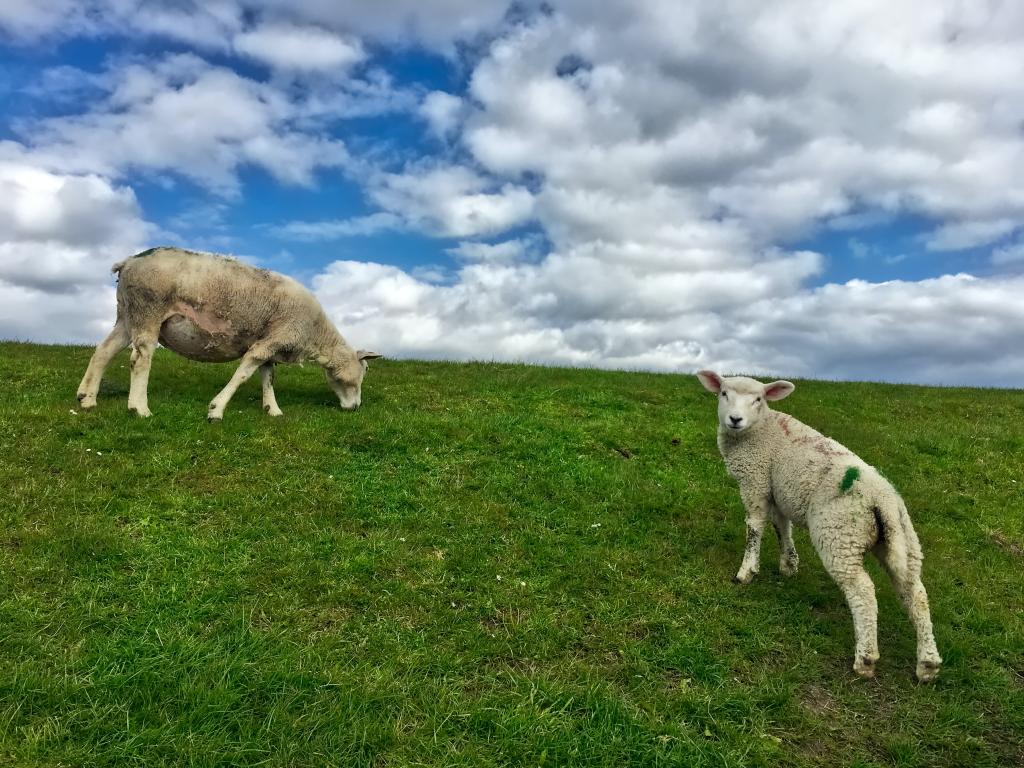
Sheep, photo by Joerg Diker on Unsplash, https://unsplash.com/photos/4QW6L6IBIPc
One of the ways the Israelites honored this command in the “land flowing with milk and honey” was to follow what today might be called the “sustainable path.” For example, the rabbinic sages instituted a ban on raising small livestock (goats and sheep) in the settled areas of Israel because they destroyed fields, gardens, and other green areas. So, even though these animals provided both milk and meat (which meant wealth for their owners), they understood that that which yields a profit for some damages others and can cause extensive, long-term ecological harm. Therefore, they implemented rules against inappropriate and unsustainable development.
As Dr. Akiva Wolff writes, “From this verse, we also clearly see how the same material abundance that is considered a blessing can lead to forgetting the Creator who provided it. If we allow ourselves to be corrupted materially and spiritually by the wealth and excess we accumulate, the land will no longer tolerate us.”[ii]
1 Eco-Idea
The Eco-Idea is one succinct statement that tells us who God is and/or what God does in relation to Creation and how we should respond as people of faith. The Eco-Idea for this sermon is:
Honoring and loving God means honoring, protecting, and loving God’s Creation so that the land and livelihoods are sustained for the long term instead of being sacrificed for short-term gain.
2 Eco-Questions
Eco-Questions are what we can ask to help a congregation draw out the implications of the Eco-Exegesis and Eco-Idea.

Wetlands, photo by Mason Field on Unsplash, https://unsplash.com/photos/_jIffwTAUbI
- What are examples of sustainable growth happening in our community? For example, where do we see environmental “buffer zones” that prevent damage from pollution, bad odors, dust, smoke, and loud noises? How do they parallel the kind of biblical restraint that the ancient Jewish sages instituted for their community?
- Where do we see restoration of local wetlands that help to filter toxins and produce fresh water for ecosystems? What can they teach us about long-term sustainability as an act of loving God and loving neighbor?
3 Eco-Actions
Eco-Actions are ways that a congregation might respond to the Eco-Idea and Eco-Questions. One of these possibilities may have salience for your preaching context.
- Plan an environmental advocacy day. Have a team research what environmental protection legislation is being considered at the local, state, or national level. Print out letters telling your elected officials that protecting God’s Creation is important to your faith and ask them to support the legislation and invite congregants to add their signatures. Then send the letters to these leaders on behalf of your congregation.
- Install rain barrels and/or plant a rain garden. Water run-off is a serious problem in many communities because it leads to increased flooding and pollution. Churches can help mitigate water run-off by installing rain barrels and/or planting a rain garden. Rain barrels minimize run-off from the building and the water can be used for plantings around the building. Rain gardens take planning and physical labor, but can significantly reduce water run-off, help to filter water, and are sources of beauty for the community. For instructions on how to plan and plant a rain garden, click here.
- Invite a financial expert to help the church consider investing in sustainable businesses. Churches often invest in funds to sustain the long-term ministry of the church. But if those investments are based in industries that do harm to people and planet, the church is unwittingly profiting from suffering. A financial expert specializing in sustainable and do-no-harm investments can help the leadership explore options for long-term financial stability that supports the health and well-being of the Earth and communities.
** EcoPreacher 1-2-3 is a Creation-centered preaching resource for busy pastors. To see more ideas, click here.*
Read also:
Food & Faith: Preaching Deuteronomy 4 Through a Green Lens
Eco Bible: A Must-Have Jewish Ecological Commentary on Genesis and Exodus
Clergy Report Preaching More about Climate Change: National Survey

Leah D. Schade
Drawing from Eco Bible, a Jewish ecological commentary on the Hebrew Scriptures, the Rev. Dr. Leah Schade, author of Creation-Crisis Preaching: Ecology, Theology and the Pulpit (Chalice Press, 2015), provides sermon preparation for preaching about caring for God’s Creation that is short, accessible, and based on a solid biblical foundation. Thanks to the Interfaith Center for Sustainable Development for supporting this work. To sign up to receive future EcoPreacher 1-2-3 installments, click here.
References
[i] Hirsch, commentary on Leviticus 19:18.
[ii] Eco Bible: Volume Two: An Ecological Commentary on Leviticus, Numbers, and Deuteronomy, edited by Rabbi Yonatan Neril and Rabbi Leo Dee, The Interfaith Center for Sustainable Development, 2021. Forthcoming.
General Christian
Food and Religion
land flowing with milk and honey
Previous Post
October 23, 2021
Clergy Report Preaching More about Climate Change: National Survey
Next Post

October 31, 2021 Lafayette Marching Band’s “Peace of Mind” Is What We Needed
Browse Our Archives
Select a Category Academy of Homiletics Addiction Advent AI (Artificial Intelligence) Animals Apocalypse Appalachia Ash Wednesday Baptism Bible Black Lives Matter Blade Runner Book review Children in church Christian Nationalism Christian/Islamic relations Christmas Church Clergy Climate change COVID-19 Creation Data Centers Death penalty Devotional Dialogue Doubt Earth Day Easter Ecofeminism EcoPreacher 1-2-3 ELCA ELCA Youth Gathering Election Environment/ecology Epiphany Faith Faith and Politics Feminism Film review Food Food and Faith Forgiveness Fracking Good Friday Good Omens Grief Gun violence Holy Humor Sunday Holy Week Howard Thurman ICE Immigration Indigenous wisdom Interview Jesus Kentucky Lafayette High School Marching Band Leadership Lent LGBTQIA+ Marching band Martin Luther Martin Luther King Jr. Mary Maundy Thursday Michael Sheen Mother of Jesus Nature New Year's Eve Palm Sunday Parables Pentecost Poem, Poetry Politics Poor People's Campaign Pop culture Prayers Preaching Progressive Christianity Public theology Purple Zone Racism and White Privilege Religion Religion and environment Religion and politics Religion and pop culture Religion and violence Rev. Nelson Rabell Gonzalez Sermons Spanish language resources for preaching Technology Thanksgiving Theological education theology Trees Trump Uncategorized Vegan War Women and religion Workshop Worship
Select a Month October 2026 September 2026 July 2026 June 2026 May 2026 April 2026 March 2026 February 2026 January 2026 December 2025 November 2025 October 2025 September 2025 May 2025 April 2025 March 2025 February 2025 January 2025 December 2024 November 2024 October 2024 September 2024 August 2024 July 2024 June 2024 May 2024 April 2024 March 2024 February 2024 January 2024 December 2023 November 2023 October 2023 September 2023 August 2023 July 2023 June 2023 May 2023 April 2023 March 2023 February 2023 January 2023 December 2022 November 2022 October 2022 August 2022 July 2022 June 2022 May 2022 April 2022 March 2022 February 2022 January 2022 December 2021 November 2021 October 2021 September 2021 August 2021 July 2021 June 2021 May 2021 April 2021 March 2021 January 2021 December 2020 November 2020 October 2020 September 2020 August 2020 July 2020 June 2020 May 2020 April 2020 February 2020 January 2020 December 2019 November 2019 October 2019 September 2019 August 2019 July 2019 June 2019 May 2019 April 2019 March 2019 January 2019 December 2018 November 2018 October 2018 September 2018 August 2018 July 2018 June 2018 May 2018 April 2018 March 2018 February 2018 January 2018 December 2017 November 2017 October 2017 September 2017 August 2017 July 2017 June 2017 May 2017 April 2017
Follow Us!
TAKE THE
Religious Wisdom Quiz
Rejoice in the Lord always. I will say it again: __!
Select your answer to see how you score.
Hope Rejoice Pray Believe
Books by This Author Books by Leah D. Schade
Related posts from EcoPreacher

Pastoral Wisdom for Responding to Sermon Pushback

Love Your Neighbor – Including Earth-Kin: Lev. 19,...

Preaching About Climate Change: What Clergy Need Most

Workers in the Vineyard: Sermon Ideas for Matt....
TRENDING AT PATHEOS Progressive Christian

What Being a Modern-Day Apostle Means to Me
In my last column, I discussed the ins and outs of modern-day...

Did Ancient China Once Worship the God of...
Across human history, a common thread weaves through the origins of the...

Love Your Neighbor – Including Earth-Kin: Lev. 19,...
God’s command to love your neighbor means acting in an ethical and...

Lead a Church Study of “Jesus and Lao...
Guest writer Jack Thomas (The Irreverent Reverend) reflects on leading his church...

Pastoral Wisdom for Responding to Sermon Pushback
Getting sermon pushback on your social justice sermon? Learn practical, Proverbs-based strategies...

Principles for Understanding the Apostolic Ministry Today
Whenever people discover that my formal ministry title is "apostle," as in...
view all Progressive Christian blogs
Ad-Free & Subscriber Log-In Subscription Support
- About Us
- 2026 Calendar
- Videos
- Podcasts
- Library of World Religions
- Faith In Media Tracker
- Advertise With Us
- Write for Us
- Privacy Policy
- Terms of Service
- Do Not Sell My Data
- Contact Us
- Radiant Digital
- Manage Newsletter Subscriptions
- Unsubscribe From Notifications
- Sitemap
Copyright 2008-2026, Patheos. All rights reserved.
Subscription Support Ad-Free & Subscriber Log-In
Follow Patheos