
BuddhistCatholicContemplativeEvangelicalGeneral ChristianHinduJewishLatter-day SaintMuslimNew VisionsProgressive Christian
Beliefs
- Buddhist
- Catholic
- Contemplative
- Evangelical
- General Christian
- Hindu
- Jewish
- Latter-day Saint
- More Voices
- Muslim
- New Visions
- Pagan
- Progressive Christian
Topics
- Religion News
- Food and Religion
- Sports and Religion
- Religious Art
- Religious Music and Entertainment
- Religious Events
- History and Religion
- Style and Religion
- Politics and Religion
- Women in Religion
- Recreation Outdoors and Religion
- Business Finance and Religion
- Careers Workplace and Religion
- Education and Religion
- Family Parenting and Religion
- Health Fitness and Religion
- Home and Religion
- Relationships and Religion
- Technology and Religion
- Travel and Religion
Columnists
- Buddhist Columnists
- Business Finance and Religion Columnists
- Careers Workplace and Religion Columnists
- Catholic Columnists
- Contemplative Columnists
- Education and Religion Columnists
- Evangelists Columnists
- Family Parenting and Religion Columnists
- General Christian Columnists
- Health Fitness and Religion Columnists
- Hindu Columnists
- History and Religion Columnists
- Home and Religion Columnists
- Jewish Columnists
- More Voices Columnists
- Latter Day Columnists
- Muslim Columnists
- New Visions Columnists
- Nonreligious Columnists
- Pagan Columnists
- Politics and Religion Columnists
- Progressive Columnists
- Recreation Outdoors and Religion Columnists
- Relationships and Religion Columnists
- Religion News Columnists
- Religious Art Columnists
- Religious Events Columnists
- Religious Music and Entertainment Columnists
- Sports and Religion Columnists
- Style and Religion Columnists
- Technology and Religion Columnists
- Travel and Religion Columnists
- Women in Religion Columnists
Resource Library
- 2026 Calendar
- Library of World Religions
- The 100 Most Holy Places on Earth
- Patheos Answers
- Podcasts
- Videos
- Faith Leaders Database
- Anglican Episcopalian
- Bahai
- Baptist
- Buddhism
- Christianity
- Confucianism
- Eastern Orthodoxy
- Hinduism
- Holiness and Pentecostal
- ISKCON
- Islam
- Judaism
- Lutheran
- Methodist
- The Church of Jesus Christ of Latter-day Saints
- New Age
- Paganism
- Presbytarian and Reformed
- Protestantism
- Religion Behind the Scenes
- Roman Catholic
- Scientology
- Shia Islam
- Sikhism
- Sufism
- Sunni Islam
- Taoism
- Zen
- See all religions
Research Tools
 Ad-Free & Subscriber Log-In Subscription Support
Ad-Free & Subscriber Log-In Subscription Support
Follow Patheos 

- Trending:
- Forgiveness
- |
- Marriage
- |
- Consciousness
- |
- Death Penalty
- |
- Election
- |
- Halloween

- Home
- Progressive Christian
- The Politics of Faith – The Bible, Government, and Public Policy: Book Review
The Politics of Faith – The Bible, Government, and Public Policy: Book Review
Last updated on: September 14, 2021 at 2:22 pm by Leah D. Schade
The Politics of Faith – The Bible, Government, and Public Policy: Book Review 2021-09-14T14:22:35-04:00 Leah D. Schade
Patheos Explore the world's faith through different perspectives on religion and spirituality! Patheos has the views of the prevalent religions and spiritualities of the world.
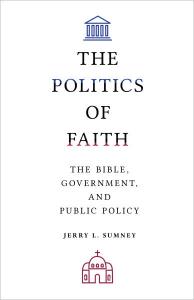
The Politics of Faith: The Bible, Government, and Public Policy, Jerry L. Sumney. Fortress Press. 200 pages. $16.99. Order at: https://www.fortresspress.com/store/product/9781506466996/The-Politics-of-Faith
Full disclosure: Dr. Jerry Sumney is my colleague at Lexington Theological Seminary (LTS) where he is Professor of Biblical Studies, and I am Assistant Professor of Preaching and Worship.
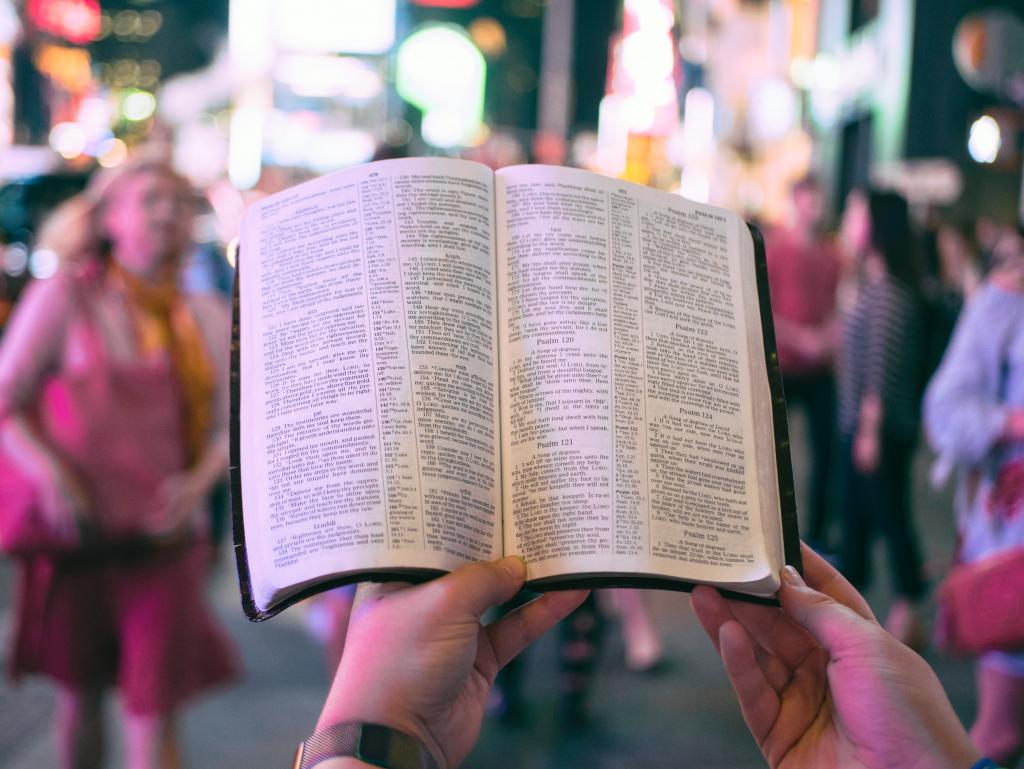
Photo credit: Aaron Burden on Unsplash. https://unsplash.com/photos/lW79kLuvl8E
“The Church should stay out of politics, and politics should stay out of the Church!”
In my experience as a preacher who has tackled social issues in the pulpit and encourages other clergy to do likewise, this is the kind of bromide I sometimes hear from those who wish that the church and the pastor would just keep quiet. Maybe it’s because the sermon interrupts their comfortable reverie on a Sunday morning. Or because they feel their ideology is being judged. Or they prefer to only hear about the “spiritual” aspects of the Bible. Whatever the reason, if they detect the preacher delving into public issues, they will not hesitate to voice their displeasure, anger, or threats.
Yet, the Bible is a political document, in the sense that it addressed the issues of public concern for its time.
Scripture talks about everything from taxes to immigrants to capital punishment, to name just a few “hot topics.” This means that if we take the Bible seriously and believe it should mean something for our lives and our society today, we need to discern its principles and values that can be applied to contemporary issues.
If you are a pastor or a lay person who is looking for solid reasons why the church should address policy issues, Jerry Sumney’s book, The Politics of Faith: The Bible, Government, and Public Policy, is just what you need.
In this highly readable book, Sumney uses robust biblical theology and exegesis to help readers understand the character and actions of God, the kind of public engagement God calls for in Scripture, and why Christians need to put their faith into action in the public square.
The reality is that Christians already use the Bible to help them think about their positions on social issues, whether they admit it or not. And, in fact, those who say that the church should stay out of politics when it comes to, say, protecting God’s Creation from pollution, are often the same ones who are fine with their church pushing to stop gay marriage or asking their pastor to write a Covid vaccine exemption letter for them “for religious reasons.” What Sumney does in The Politics of Faith is provide sound principles based on critical engagement with the Bible to guide readers to think about how faith can inform and shape the way we regard the relationship between the church and public policy.
In other words, it’s not a matter of whether the church and Christians should be involved in shaping laws and policy, but why and to what purpose.

Dr. Jerry Sumney, Professor of Biblical Studies, Lexington Theological Seminary
Sumney’s position clearly aligns with the progressive Christian viewpoint that the church should advocate for equitable social and economic policies. This position grows out of more than three decades of biblical scholarship. In Sumney’s view, scripture demonstrates that God cares about the poor, the vulnerable, the outcast, and the marginalized. Consequently, God calls people to not only practice personal morality, but to enact laws that provide for the common good. Sumney supports this view by repeatedly showing how both the Old and New Testament are suffused with an ethic that, if enacted, would result in a more equitable and caring society.
Appropriate for clergy and laity
Sumney is a Pauline scholar who has authored seven books and has led several scholarly groups within the Society for Biblical Literature. However, this volume is written in a conversational tone free of academic jargon which makes it accessible for both laity and clergy. His skills in making biblical scholarship user-friendly for a lay audience have been developed over decades of teaching Sunday School in his home church, Lay School classes at LTS, and Bible studies in churches across the country.
Chapters 2 and 3 provide an overview of the Mosaic Covenant and the Prophets. One might wish that a few more chapters could have been devoted to the political ethic in other Hebrew scriptures such as the Psalms or the Book of Esther, for example. Nevertheless, these essays help the reader to see how the Torah and the prophetic writings served as “a blueprint for how to construct the kind of society God wants” (15). The Israelites are charged with creating a society where immigrants are protected, widows and orphans are not left to fend for themselves, and economic predators are kept in check.
Especially noteworthy is that Sumney includes a section on the Levitical laws, often ignored, overlooked, or dismissed by most Christians. From a 30,000-foot view, we see that the Holiness Codes are not about micro-managing religious minutia. Rather, they are intended to give very practical and detailed ways for the Israelites to live their lives in community. This is not just because God is pleased by this kind of holy living, but because “God is these things” – justice, mercy, holiness, and compassion (19).
Who, then, is the intended audience of these biblical writings? Is it just the common people within the faith community? Or are they targeted toward those with more power, influence, and authority?
Sumney’s chapter on the prophets gives us an important insight regarding these questions. Prophets like Nathan, Elisha, Micah, and Obadiah were addressing the leaders. “Clearly, these prophets are not speaking primarily to the average person on the street. Their messages are spoken most directly to those in power, to the people who run the government,” (27). Once we have established that this practice of speaking truth to power has its roots in ancient Israel, it weakens the argument that the church has no role in politics. In fact, the only logical conclusion is that clergy and congregations should speak up when having an opportunity to shape social, economic, and judicial law so that it comes closer to reflecting God’s justice and mercy.
The next seven chapters in The Politics of Faith survey the Acts of the Apostles, the Gospels, Paul and his letters, and Revelation. What each of these chapters stress is the way in which the teachings of Christ and the expectations of the early church differed dramatically from the values of the Greek and Roman worlds. Sumney is not shy about Christians and the church living and acting in such a way that reflects “what God wants for the world” (41). In Acts, for example, this means redistributing wealth and rejecting economic systems that perpetuate exploitation and poverty. As well, the Gospels show Jesus modelling public interaction on social issues. For instance, his exorcising of demons illustrates the power of God (and, by extension, the church) to release people from evil “imposed by the outside” (45) through systems and structures that keep people in bondage.
Sumney is also adept at unraveling troublesome and troubling passages in the New Testament to unearth the underlying dynamics of justice.
The disturbing story of the death of Ananias and Sapphira in Acts 5, for instance, is really about rejecting “the accumulation of wealth that comes through the exploitation of others” (39). Jesus’ puzzling parable in Matt. 13:24-30 about “the weeds and the wheat” is actually helpful when we encounter those intent on subverting the forces of good. This parable tells us that “we should not be surprised to find that some people around us oppose God’s will. It should also not discourage us” (55).
Even the passion narratives are political. “Crucifixion was a political execution. . . In all four Gospels, Jesus is executed on a political charge” (70). This is because Jesus was a threat to the rulers of his day. The fact that he was resurrected is not just a story of God’s power over death (which, of course, it is). It is also a theological repudiation of the entire economic, military, and religious system that demanded his death in the first place.
As you and your congregation read The Politics of Faith, you may encounter voices who insist that the Bible teaches the faithful to passively accept whatever the government decides to do. Some insist that the church’s only job is to follow Jesus’ command to feed the hungry, care for the sick, clothe the naked, and visit those in prison (Matt. 25:31-46) – not question the policies that result in hunger, sickness, or unjust imprisonment in the first place. But Sumney refutes that limited view. “Since governments are the organized ways that people structure how they treat one another, the people in charge are expected to create systems that exhibit the values God demands of each person” (61).
But doesn’t Romans 13:1-7 argue that God is the one who establishes governments? And, as such, governments should be allowed to conduct their business without interference from the church?
Again, Sumney adroitly dissects this misinformed position. “Acknowledging that governments are set in place by God does not mean God’s people should not oppose their unjust policies” (89). Romans is clear that the government’s role is not only to punish evil but to be “servants of God for your good” (v. 4). So, it is perfectly appropriate for Christians, in the prophetic tradition, to “hold governments accountable to God for how they wield the power God has given them” (91).
The final chapter of The Politics of Faith is “Being a Faithful Church in Today’s World.” It summarizes what the reader will have learned so far and offers “a biblical framework for determining what participation might look like for us and our church communities” (115). Sumney points to predatory payday lending, oppressive immigration laws, unfair economic policies, and the questions around “big government” as areas in which Christians can help to shape just policies and laws. “The message of the prophets is clear: Governments and rulers are expected to enact laws and establish institutions that protect people who have fewer resources and less power,” Sumney asserts (119).
This last chapter also provides a corrective to those who claim that the church should not address public policy because of the “separation of church and state.” Sumney clarifies, “Separation of church and state does not mean that the church ignores the injustices that our laws allow or prescribe” (120). This is not to say that the our system of government should be converted to a theocracy or that churches should endorse certain candidates. Rather, “we should want churches to speak out when candidates support policies that move further from God’s will rather than toward it. We should clearly state that our cultural individualism has led us to give advantages to those who need it the least” (121).
Helpful discussion questions
Each of the eleven chapters contains several discussion questions which are sure to spark generative conversations for adult forums, clergy groups, and personal reflection. A pastor might consider inviting their governing board to read a chapter a month over the course of a year and pick one or two discussion questions that can guide decisions about the church’s ministry. A youth pastor working with senior high school students could lead a Bible study and draw on Sumney’s book for reflection and discussion. Denominational leaders could invite clergy to read and discuss The Politics of Faith in colleague groups within their judicatories or in ecumenical gatherings.
However this book is used, The Politics of Faith is a welcome corrective to misunderstandings about the Bible, what it meant to its original audience, and how it should be applied today. Sumney’s book is a helpful tool for informed civil discourse about the role of the church in an unjust world. And it can guide discernment and discussions about how congregations can live out their mission to reflect God’s justice, love, mercy, and compassion in our communities and society.
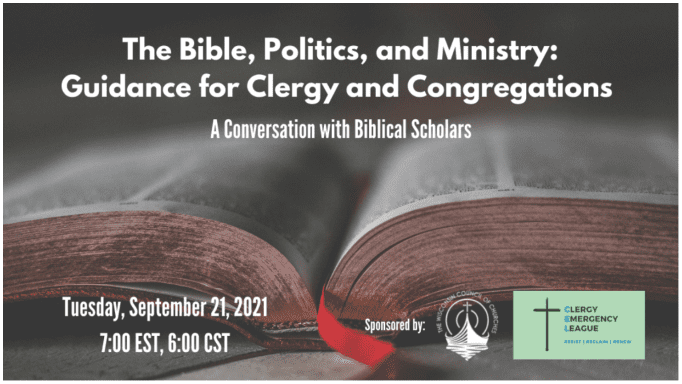
Want to hear more from Jerry Sumney about the Bible and public policy? Register for The Bible, Politics, and Ministry: Guidance for Clergy and Congregations, a conversation with Jerry Sumney and Efrain Agosto, biblical scholars who will explain how Scripture authorizes and compels us to engage public policy as part of our faith. Hosted by The Clergy Emergency League and the Wisconsin Council of Churches. Tuesday, September 21, 2021, 7:00 Eastern, 6:00 Central, 5:00 Mountain, 4:00 Pacific. To register, click here.
Read also:
Latinxs, the Bible, and Immigration
Abortion and the Progressive Church: Is It Time to Break the Silence?

The Rev. Dr. Leah D. Schade
The Rev. Dr. Leah D. Schade is the Assistant Professor of Preaching and Worship at Lexington Theological Seminary in Kentucky and ordained in the ELCA. Dr. Schade does not speak for LTS or the ELCA; her opinions are her own. She is the author of Preaching in the Purple Zone: Ministry in the Red-Blue Divide (Rowman & Littlefield, 2019) and Creation-Crisis Preaching: Ecology, Theology, and the Pulpit (Chalice Press, 2015). She is the co-editor of Rooted and Rising: Voices of Courage in a Time of Climate Crisis (Rowman & Littlefield, 2019). Her latest book, co-written with Jerry Sumney is Apocalypse When?: A Guide to Interpreting and Preaching Apocalyptic Texts (Wipf & Stock, 2020).
Twitter: @LeahSchade
Facebook: https://www.facebook.com/LeahDSchade/
Previous Post

September 8, 2021
Latinxs, the Bible, and Migration: Book Review
Next Post

September 18, 2021 Covidtown: A Tragic Parody on Billy Joel's "Allentown"
Browse Our Archives
Select a Category Academy of Homiletics Addiction Advent AI (Artificial Intelligence) Animals Apocalypse Appalachia Ash Wednesday Baptism Bible Black Lives Matter Blade Runner Book review Children in church Christian Nationalism Christian/Islamic relations Christmas Church Clergy Climate change COVID-19 Creation Data Centers Death penalty Devotional Dialogue Doubt Earth Day Easter Ecofeminism EcoPreacher 1-2-3 ELCA ELCA Youth Gathering Election Environment/ecology Epiphany Faith Faith and Politics Feminism Film review Food Food and Faith Forgiveness Fracking Good Friday Good Omens Grief Gun violence Holy Humor Sunday Holy Week Howard Thurman ICE Immigration Indigenous wisdom Interview Jesus Kentucky Lafayette High School Marching Band Leadership Lent LGBTQIA+ Marching band Martin Luther Martin Luther King Jr. Mary Maundy Thursday Michael Sheen Mother of Jesus Nature New Year's Eve Palm Sunday Parables Pentecost Poem, Poetry Politics Poor People's Campaign Pop culture Prayers Preaching Progressive Christianity Public theology Purple Zone Racism and White Privilege Religion Religion and environment Religion and politics Religion and pop culture Religion and violence Rev. Nelson Rabell Gonzalez Sermons Spanish language resources for preaching Technology Thanksgiving Theological education theology Trees Trump Uncategorized Vegan War Women and religion Workshop Worship
Select a Month October 2026 September 2026 July 2026 June 2026 May 2026 April 2026 March 2026 February 2026 January 2026 December 2025 November 2025 October 2025 September 2025 May 2025 April 2025 March 2025 February 2025 January 2025 December 2024 November 2024 October 2024 September 2024 August 2024 July 2024 June 2024 May 2024 April 2024 March 2024 February 2024 January 2024 December 2023 November 2023 October 2023 September 2023 August 2023 July 2023 June 2023 May 2023 April 2023 March 2023 February 2023 January 2023 December 2022 November 2022 October 2022 August 2022 July 2022 June 2022 May 2022 April 2022 March 2022 February 2022 January 2022 December 2021 November 2021 October 2021 September 2021 August 2021 July 2021 June 2021 May 2021 April 2021 March 2021 January 2021 December 2020 November 2020 October 2020 September 2020 August 2020 July 2020 June 2020 May 2020 April 2020 February 2020 January 2020 December 2019 November 2019 October 2019 September 2019 August 2019 July 2019 June 2019 May 2019 April 2019 March 2019 January 2019 December 2018 November 2018 October 2018 September 2018 August 2018 July 2018 June 2018 May 2018 April 2018 March 2018 February 2018 January 2018 December 2017 November 2017 October 2017 September 2017 August 2017 July 2017 June 2017 May 2017 April 2017
Follow Us!
TAKE THE
Religious Wisdom Quiz
True or False: James states that the tongue is a fire, a world of iniquity.
Select your answer to see how you score.
TRUE FALSE
Books by This Author Books by Leah D. Schade
Related posts from EcoPreacher

Pastoral Wisdom for Responding to Sermon Pushback

"Render Unto Caesar": Faith, Politics, and Elections

What Matt. 21:23-32 Teaches About Integrity In An...

Workers in the Vineyard: Sermon Ideas for Matt....
TRENDING AT PATHEOS Progressive Christian

What Being a Modern-Day Apostle Means to Me
In my last column, I discussed the ins and outs of modern-day...

Did Ancient China Once Worship the God of...
Across human history, a common thread weaves through the origins of the...

Love Your Neighbor – Including Earth-Kin: Lev. 19,...
God’s command to love your neighbor means acting in an ethical and...

Lead a Church Study of “Jesus and Lao...
Guest writer Jack Thomas (The Irreverent Reverend) reflects on leading his church...

Pastoral Wisdom for Responding to Sermon Pushback
Getting sermon pushback on your social justice sermon? Learn practical, Proverbs-based strategies...

Principles for Understanding the Apostolic Ministry Today
Whenever people discover that my formal ministry title is "apostle," as in...
view all Progressive Christian blogs
Ad-Free & Subscriber Log-In Subscription Support
- About Us
- 2026 Calendar
- Videos
- Podcasts
- Library of World Religions
- Faith In Media Tracker
- Advertise With Us
- Write for Us
- Privacy Policy
- Terms of Service
- Do Not Sell My Data
- Contact Us
- Radiant Digital
- Manage Newsletter Subscriptions
- Unsubscribe From Notifications
- Sitemap
Copyright 2008-2026, Patheos. All rights reserved.
Subscription Support Ad-Free & Subscriber Log-In
Follow Patheos