
BuddhistCatholicContemplativeEvangelicalGeneral ChristianHinduJewishLatter-day SaintMuslimNew VisionsProgressive Christian
Beliefs
- Buddhist
- Catholic
- Contemplative
- Evangelical
- General Christian
- Hindu
- Jewish
- Latter-day Saint
- More Voices
- Muslim
- New Visions
- Pagan
- Progressive Christian
Topics
- Religion News
- Food and Religion
- Sports and Religion
- Religious Art
- Religious Music and Entertainment
- Religious Events
- History and Religion
- Style and Religion
- Politics and Religion
- Women in Religion
- Recreation Outdoors and Religion
- Business Finance and Religion
- Careers Workplace and Religion
- Education and Religion
- Family Parenting and Religion
- Health Fitness and Religion
- Home and Religion
- Relationships and Religion
- Technology and Religion
- Travel and Religion
Columnists
- Buddhist Columnists
- Business Finance and Religion Columnists
- Careers Workplace and Religion Columnists
- Catholic Columnists
- Contemplative Columnists
- Education and Religion Columnists
- Evangelists Columnists
- Family Parenting and Religion Columnists
- General Christian Columnists
- Health Fitness and Religion Columnists
- Hindu Columnists
- History and Religion Columnists
- Home and Religion Columnists
- Jewish Columnists
- More Voices Columnists
- Latter Day Columnists
- Muslim Columnists
- New Visions Columnists
- Nonreligious Columnists
- Pagan Columnists
- Politics and Religion Columnists
- Progressive Columnists
- Recreation Outdoors and Religion Columnists
- Relationships and Religion Columnists
- Religion News Columnists
- Religious Art Columnists
- Religious Events Columnists
- Religious Music and Entertainment Columnists
- Sports and Religion Columnists
- Style and Religion Columnists
- Technology and Religion Columnists
- Travel and Religion Columnists
- Women in Religion Columnists
Resource Library
- 2026 Calendar
- Library of World Religions
- The 100 Most Holy Places on Earth
- Patheos Answers
- Podcasts
- Videos
- Faith Leaders Database
- Anglican Episcopalian
- Bahai
- Baptist
- Buddhism
- Christianity
- Confucianism
- Eastern Orthodoxy
- Hinduism
- Holiness and Pentecostal
- ISKCON
- Islam
- Judaism
- Lutheran
- Methodist
- The Church of Jesus Christ of Latter-day Saints
- New Age
- Paganism
- Presbytarian and Reformed
- Protestantism
- Religion Behind the Scenes
- Roman Catholic
- Scientology
- Shia Islam
- Sikhism
- Sufism
- Sunni Islam
- Taoism
- Zen
- See all religions
Research Tools
 Ad-Free & Subscriber Log-In Subscription Support
Ad-Free & Subscriber Log-In Subscription Support
Follow Patheos 

- Trending:
- Forgiveness
- |
- Marriage
- |
- Consciousness
- |
- Death Penalty
- |
- Election
- |
- Halloween

- Home
- Progressive Christian
- Latinxs, the Bible, and Migration: Book Review
Latinxs, the Bible, and Migration: Book Review
Last updated on: September 8, 2021 at 11:00 am by Leah D. Schade
Latinxs, the Bible, and Migration: Book Review 2021-09-08T11:00:51-04:00 Leah D. Schade
Patheos Explore the world's faith through different perspectives on religion and spirituality! Patheos has the views of the prevalent religions and spiritualities of the world.
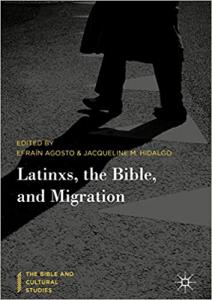
Latinxs, the Bible, and Migration, Efraín Agosto and Jacqueline M. Hidalgo, eds., The Bible and Cultural Studies series (Palgrave McMillan, 2018). 224 pages. Order the ebook here: https://www.amazon.com/Latinxs-Bible-Migration-Cultural-Studies-ebook-dp-B07JR6TGKL/dp/B07JR6TGKL/
“The Christian Bible is a collection of texts of and about migration.”
Is this the way your congregation understands the Bible? Depending on where your church is located and who worships there, this claim may seem audacious, perhaps even preposterous.

Photo by Priscilla Du Preez on Unsplash https://unsplash.com/photos/9CMUPez8wLo
But this is exactly the premise of the book, Latinxs, the Bible, and Migration, edited by Efraín Agosto and Jacqueline M. Hidalgo. Because of its authors’ rigorous scholarship and skilled hermeneutics, the reader emerges convinced that this premise (found on p. 11) is correct. Latinxs, the Bible, and Migration is a collection of 10 essays written by Latinx biblical scholars who explore not just how migrating peoples have used the Bible to frame their experiences, but to make the case that the Bible itself is a text of migration.
The Bible is “a space of migrant urgency.”
The editors’ and authors’ position is that the Bible is “a space of migrant urgency” and should be interpreted through “the lens of migration, exile, and diaspora with a focus on migrants and the children of migrants” (2). As such, the Bible should be read with those who are migrants, and our perspectives must be informed by their lived experiences. This should result in Christians calling for U.S. policies to be reshaped so that migrants are seen as human beings rather than “problems,” “animals,” “illegals,” or “aliens.”
For the growing number of congregations that serve immigrant communities, this is not news. This is their reality every day. And, as the authors in this volume note, the Bible companions migrants and frames their experiences. Scripture gives them a reference point as they are travelling and resettling, and speaks of their struggles with ancient stories that echo from across two millennia.
But why should congregations who have not lived through migration pay attention to this issue?
Why should pastors whose parishioners have no reference point for the migration experience read this book? What insights are in these pages that congregations made up of the descendants of colonizers need to hear?
In Latinxs, the Bible, and Migration, the authors are “showing how the Bible was not only produced by migrants but also affirms that settled communities are obligated to welcome, love, and affirm the humanity of migrants” (13). This is a more scholarly book that probably would not be as well suited for a lay audience. But what ministers will find in this collection is a window into the experiences of migrating peoples that they might otherwise have no access to. In turn, they can integrate these insights into their sermons, Bible studies, and pastoral conversations.
The Bible as a “homing device”
For example, Jacqueline M. Hidalgo recounts her ethnographic research with Cuban immigrants at Calvary Chapel at Claremont University in California. She describes how the Bible is like a “homing device” for those who experience “unhomeliness,” so that Scripture becomes “a basis from which to mediate and negotiate senses of home, especially for marginalized and migratory peoples” (22).
For another example, try reading the story of Ruth and Boaz from the perspective of farmworker women of Hispanic origin in the U.S. – 80% of whom experience some form of sexual violence in the fields. How do they interpret Boaz’s order to the men not to bother (i.e., sexually assault) Ruth, a foreign woman gleaning in the fields? This is the question Ahida Calderón Pilarski asks in her chapter, “Gendering (Im)migration in the Pentateuch’s Legal Codes: A Reading from a Latina Perspective.”
The importance of telling immigrant stories
One of the most poignant chapters is Gregory Lee Cuéllar’s “Channeling the Biblical Exile as an Art Task for Central American Refugee Children on the Texas-Mexico Border.” The author shares the story of Génesis, a young girl from El Salvador recounting her viaje a los Estados Unidos (trip to the United States) while drawing images using the paper and crayons provided to her. She draws the dehumanizing detention center crammed with babies, children, and parents shivering beneath thin plastic blankets. Yet hovering over the scene next to a yellow sun is an image of God smiling, reassuring her that God is with her.
As Cuéllar frames it, “For Génesis, the Rio Grande is a criminalizing landscape; at the same time, it is a place where her faith in God intervenes. Here, her faith narrative takes the form of a political theology in which God is believed to work beyond state sovereignty and mandatory detention in order to ensure the safe passage of asylum seekers” (78-79). In the same way, the Bible contains political theologies for peoples in exile, on the move, or seeking refuge. In sagas such as Joseph sold into slavery and taken to a foreign land, the Lamentations written in exile, and Psalm 137 raging that the Israelites are made to sing their song in a foreign land, the sacred Hebrew texts emerge from the pain and struggle of peoples forced from their homes and homeland. For immigrants then and now, narrative, poetry, and art serves as a healing vehicle for expressing what it is like to endure violent subjugation under a conquering people.
It’s not just the Hebrew Scriptures that can be counted as migration texts, however.
As Efrain Agosto points out in his chapter, “Islands, Borders, and Migration: Reading Paul in Light of the Crisis in Puerto Rico,” Paul was, in many ways, a migrant worker. He crossed borders repeatedly in his journeys to spread the gospel of Jesus Christ and endured numerous hardships to fulfill his mission. His letters not only recount his experience as a person “on the move,” but are his way of making meaning as a border-crosser. Agosto puts Paul’s experiences in conversation with those of his native Puerto Rico which has seen a mass exodus due to hurricanes, agricultural devastation, and economic deprivation. Whether forced or voluntary, those living as diaspora people can find solidarity with Paul’s migration experiences, whether through assimilation, accommodation, or alienation.
A groundbreaking, border-crossing collection
Among the authors of Latinxs, the Bible, and Migration are five biblical scholars, three theologians, and one professor of religion each coming from different points of origin, including Argentina, Costa Rica, Mexico, and Puerto Rico. The authors also locate themselves or emerge from various denominations including Presbyterian, Baptist, and Roman Catholic, to name a few. All this to say that the editors were careful to curate perspectives that represent a range of disciplines, cultures, and ecclesial traditions within the Latinx experience.
However, one of the most important realizations that comes from this book is how much a second volume is needed – one that includes perspectives that were not able to be included in this one. The editors note that due to economic, educational, and gender disparities within Latinx communities, female scholars, LGBTQIA+ scholars, and scholars from countries with underrepresented membership in the guild are not included. Thus, the volume itself is a call for voices of more Latinx scholars to be identified, nurtured, and lifted up so that both the guild and the wider public can benefit from their insights.
Order the ebook Latinxs, the Bible, and Migration here.
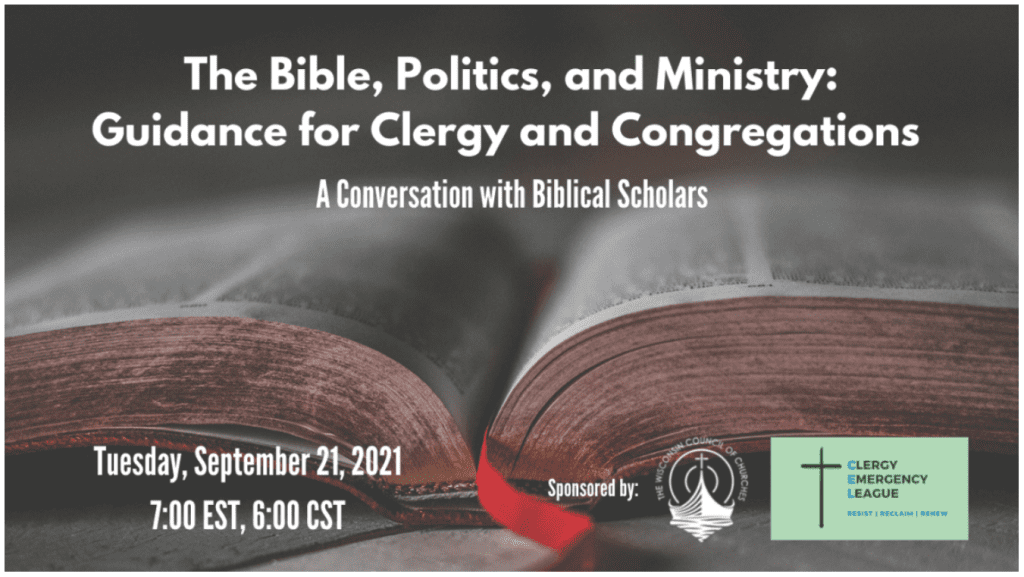
Want to hear more from Efrain Agosto about the Bible and migration policy? Register for The Bible, Politics, and Ministry: Guidance for Clergy and Congregations, a conversation with Agosto and Jerry Sumney, biblical scholars who will explain how Scripture authorizes and compels us to engage public policy as part of our faith. Hosted by the Clergy Emergency League and the Wisconsin Council of Churches. Tuesday, September 21, 2021, 7:00 Eastern, 6:00 Central, 5:00 Mountain, 4:00 Pacific. To register, click here.
Read also:
Climate Migration: How Should the Church Respond?
Shoes in the Vineyard: Immigration and Jesus’s Parable

The Rev. Dr. Leah D. Schade
The Rev. Dr. Leah D. Schade is the Assistant Professor of Preaching and Worship at Lexington Theological Seminary in Kentucky and ordained in the ELCA. Dr. Schade does not speak for LTS or the ELCA; her opinions are her own. She is the author of Preaching in the Purple Zone: Ministry in the Red-Blue Divide (Rowman & Littlefield, 2019) and Creation-Crisis Preaching: Ecology, Theology, and the Pulpit (Chalice Press, 2015). She is the co-editor of Rooted and Rising: Voices of Courage in a Time of Climate Crisis (Rowman & Littlefield, 2019). Her latest book, co-written with Jerry Sumney is Apocalypse When?: A Guide to Interpreting and Preaching Apocalyptic Texts (Wipf & Stock, 2020).
Twitter: @LeahSchade
Facebook: https://www.facebook.com/LeahDSchade/


Browse Our Archives
Select a Category Academy of Homiletics Addiction Advent AI (Artificial Intelligence) Animals Apocalypse Appalachia Ash Wednesday Baptism Bible Black Lives Matter Blade Runner Book review Children in church Christian Nationalism Christian/Islamic relations Christmas Church Clergy Climate change COVID-19 Creation Data Centers Death penalty Devotional Dialogue Doubt Earth Day Easter Ecofeminism EcoPreacher 1-2-3 ELCA ELCA Youth Gathering Election Environment/ecology Epiphany Faith Faith and Politics Feminism Film review Food Food and Faith Forgiveness Fracking Good Friday Good Omens Grief Gun violence Holy Humor Sunday Holy Week Howard Thurman ICE Immigration Indigenous wisdom Interview Jesus Kentucky Lafayette High School Marching Band Leadership Lent LGBTQIA+ Marching band Martin Luther Martin Luther King Jr. Mary Maundy Thursday Michael Sheen Mother of Jesus Nature New Year's Eve Palm Sunday Parables Pentecost Poem, Poetry Politics Poor People's Campaign Pop culture Prayers Preaching Progressive Christianity Public theology Purple Zone Racism and White Privilege Religion Religion and environment Religion and politics Religion and pop culture Religion and violence Rev. Nelson Rabell Gonzalez Sermons Spanish language resources for preaching Technology Thanksgiving Theological education theology Trees Trump Uncategorized Vegan War Women and religion Workshop Worship
Select a Month October 2026 September 2026 July 2026 June 2026 May 2026 April 2026 March 2026 February 2026 January 2026 December 2025 November 2025 October 2025 September 2025 May 2025 April 2025 March 2025 February 2025 January 2025 December 2024 November 2024 October 2024 September 2024 August 2024 July 2024 June 2024 May 2024 April 2024 March 2024 February 2024 January 2024 December 2023 November 2023 October 2023 September 2023 August 2023 July 2023 June 2023 May 2023 April 2023 March 2023 February 2023 January 2023 December 2022 November 2022 October 2022 August 2022 July 2022 June 2022 May 2022 April 2022 March 2022 February 2022 January 2022 December 2021 November 2021 October 2021 September 2021 August 2021 July 2021 June 2021 May 2021 April 2021 March 2021 January 2021 December 2020 November 2020 October 2020 September 2020 August 2020 July 2020 June 2020 May 2020 April 2020 February 2020 January 2020 December 2019 November 2019 October 2019 September 2019 August 2019 July 2019 June 2019 May 2019 April 2019 March 2019 January 2019 December 2018 November 2018 October 2018 September 2018 August 2018 July 2018 June 2018 May 2018 April 2018 March 2018 February 2018 January 2018 December 2017 November 2017 October 2017 September 2017 August 2017 July 2017 June 2017 May 2017 April 2017
Follow Us!
TAKE THE
Religious Wisdom Quiz
Who was Jephthah's daughter?
Select your answer to see how you score.
Unnamed Deborah Ruth Miriam
Books by This Author Books by Leah D. Schade
Related posts from EcoPreacher

"Render Unto Caesar": Faith, Politics, and Elections

What Matt. 21:23-32 Teaches About Integrity In An...

Workers in the Vineyard: Sermon Ideas for Matt....

When The Data Center Wolf Is At Your...
TRENDING AT PATHEOS Progressive Christian

What Being a Modern-Day Apostle Means to Me
In my last column, I discussed the ins and outs of modern-day...

Did Ancient China Once Worship the God of...
Across human history, a common thread weaves through the origins of the...

Love Your Neighbor – Including Earth-Kin: Lev. 19,...
God’s command to love your neighbor means acting in an ethical and...

Lead a Church Study of “Jesus and Lao...
Guest writer Jack Thomas (The Irreverent Reverend) reflects on leading his church...

Pastoral Wisdom for Responding to Sermon Pushback
Getting sermon pushback on your social justice sermon? Learn practical, Proverbs-based strategies...

Principles for Understanding the Apostolic Ministry Today
Whenever people discover that my formal ministry title is "apostle," as in...
view all Progressive Christian blogs
Ad-Free & Subscriber Log-In Subscription Support
- About Us
- 2026 Calendar
- Videos
- Podcasts
- Library of World Religions
- Faith In Media Tracker
- Advertise With Us
- Write for Us
- Privacy Policy
- Terms of Service
- Do Not Sell My Data
- Contact Us
- Radiant Digital
- Manage Newsletter Subscriptions
- Unsubscribe From Notifications
- Sitemap
Copyright 2008-2026, Patheos. All rights reserved.
Subscription Support Ad-Free & Subscriber Log-In
Follow Patheos