
BuddhistCatholicContemplativeEvangelicalGeneral ChristianHinduJewishLatter-day SaintMuslimNew VisionsProgressive Christian
Beliefs
- Buddhist
- Catholic
- Contemplative
- Evangelical
- General Christian
- Hindu
- Jewish
- Latter-day Saint
- More Voices
- Muslim
- New Visions
- Pagan
- Progressive Christian
Topics
- Religion News
- Food and Religion
- Sports and Religion
- Religious Art
- Religious Music and Entertainment
- Religious Events
- History and Religion
- Style and Religion
- Politics and Religion
- Women in Religion
- Recreation Outdoors and Religion
- Business Finance and Religion
- Careers Workplace and Religion
- Education and Religion
- Family Parenting and Religion
- Health Fitness and Religion
- Home and Religion
- Relationships and Religion
- Technology and Religion
- Travel and Religion
Columnists
- Buddhist Columnists
- Business Finance and Religion Columnists
- Careers Workplace and Religion Columnists
- Catholic Columnists
- Contemplative Columnists
- Education and Religion Columnists
- Evangelists Columnists
- Family Parenting and Religion Columnists
- General Christian Columnists
- Health Fitness and Religion Columnists
- Hindu Columnists
- History and Religion Columnists
- Home and Religion Columnists
- Jewish Columnists
- More Voices Columnists
- Latter Day Columnists
- Muslim Columnists
- New Visions Columnists
- Nonreligious Columnists
- Pagan Columnists
- Politics and Religion Columnists
- Progressive Columnists
- Recreation Outdoors and Religion Columnists
- Relationships and Religion Columnists
- Religion News Columnists
- Religious Art Columnists
- Religious Events Columnists
- Religious Music and Entertainment Columnists
- Sports and Religion Columnists
- Style and Religion Columnists
- Technology and Religion Columnists
- Travel and Religion Columnists
- Women in Religion Columnists
Resource Library
- 2026 Calendar
- Library of World Religions
- The 100 Most Holy Places on Earth
- Patheos Answers
- Podcasts
- Videos
- Faith Leaders Database
- Anglican Episcopalian
- Bahai
- Baptist
- Buddhism
- Christianity
- Confucianism
- Eastern Orthodoxy
- Hinduism
- Holiness and Pentecostal
- ISKCON
- Islam
- Judaism
- Lutheran
- Methodist
- The Church of Jesus Christ of Latter-day Saints
- New Age
- Paganism
- Presbytarian and Reformed
- Protestantism
- Religion Behind the Scenes
- Roman Catholic
- Scientology
- Shia Islam
- Sikhism
- Sufism
- Sunni Islam
- Taoism
- Zen
- See all religions
Research Tools
 Ad-Free & Subscriber Log-In Subscription Support
Ad-Free & Subscriber Log-In Subscription Support
Follow Patheos 

- Trending:
- Forgiveness
- |
- Marriage
- |
- Consciousness
- |
- Death Penalty
- |
- Election
- |
- Halloween

- Home
- Progressive Christian
- Composting Our Anger and Grief: Luke 13:1-9
Composting Our Anger and Grief: Luke 13:1-9
Last updated on: June 21, 2021 at 3:44 pm by Leah D. Schade
Composting Our Anger and Grief: Luke 13:1-9 2021-06-21T15:44:20-04:00 Leah D. Schade
Patheos Explore the world's faith through different perspectives on religion and spirituality! Patheos has the views of the prevalent religions and spiritualities of the world.
Jesus’s parable about a gardener composting to save a fruitless tree can teach us about composting our anger and grief.
Read: Luke 13:1-9
Watch the video of Leah preaching this sermon about composting as a spiritual practice from her backyard garden here.
A couple weeks ago, I dug up my garden to prepare for planting.
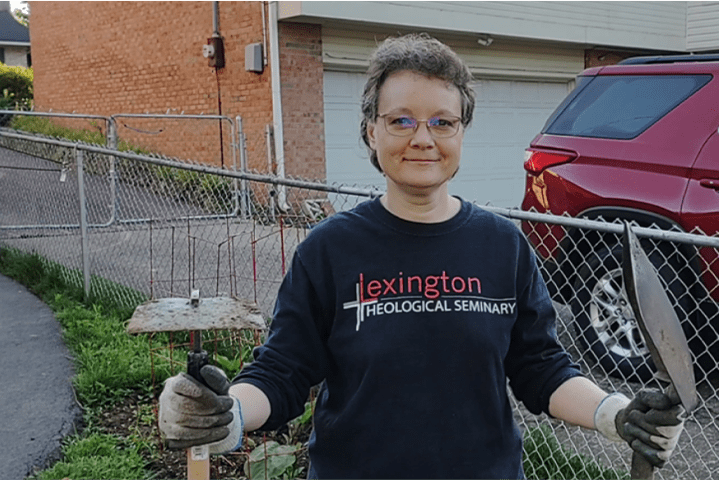
The Rev. Dr. Leah Schade, getting ready to compost
I grabbed my shovel and hoe and dug into the weeds that started to take root. Then I sorted through the compost that was in our bin. It’s a messy, gross job, but I spread it over the soil, and worked it into the garden. It’s hard work breaking up all those clumps of soil.
But I’ll let you in on a little secret.
For me, digging up the garden is therapy. Gardening is part of my anger management program.
Remember Mr. Roger’s song, “What do you do with the mad that you feel, when you feel so mad you could bite? When the whole wide world seems oh so wrong, And nothing you do seems very right?” Well, this is one of the things I do – I work it all into the dirt.
Last year, I had a lot to be angry about.
I was angry about the murders of George Floyd and Breonna Taylor and Ahmad Arbery. I was angry about what happened to those who protested the murders. The police brutality. The presidential invasion of St. John’s Episcopal Church. The growing wave of white Christian nationalism. All of that got worked into the garden last year.
And I was angry about what was happening with the pandemic. Certain leaders lying about the virus, downplaying the severity. All the conspiracy theories and disinformation. This year, when I worked the shovel and the hoe, I thought of the millions of people who got sick, the hundreds of thousands of people who died. And their families who are in mourning. It didn’t have to be this bad. Especially in communities of color that have been deliberately under-resourced in health care infrastructure for decades. All of this got worked into the garden as well.
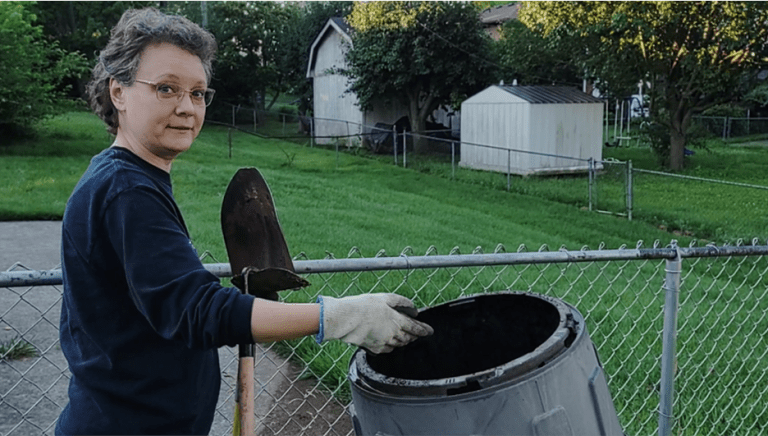
The Rev. Dr. Leah Schade, composting
I also have to admit, my personal anger toward certain people in my life is somewhere in this garden as well.
My frustration, the mad that I feel, my grief – all of it is somewhere in this soil.
One of the things I’ve come to appreciate about Jesus’ parables is the way he uses imagery from his agrarian culture to teach spiritual truths. Like the parable about the fruitless tree in Luke 13:1-9. While talking to the crowds, he gets into a discussion with them about why bad things happen to people. Apparently, some of them think that misfortune and accidents are a result of sin – even when it’s obvious that sometimes accidents just happen. Or sometimes people die because of political violence through no fault of their own.
So Jesus tells them this parable about a king who wants to cut down a tree because it won’t bear fruit.
‘A man had a fig tree planted in his vineyard; and he came looking for fruit on it and found none. 7So he said to the gardener, “See here! For three years I have come looking for fruit on this fig tree, and still I find none. Cut it down! Why should it be wasting the soil?” 8He replied, “Sir, let it alone for one more year, until I dig round it and put manure on it. 9If it bears fruit next year, well and good; but if not, you can cut it down.” ’ (Luke 13:6-9)
The king is judge and jury over this tree and is ready to sentence it to death.
The gardener, however, pleads with him to give it another year.
He tells the king that he’ll dig around the soil and work in fertilizer. Just like I do with my garden. Just like Jesus’s listeners did with their plots of soil and vineyards.
Jesus is like that gardener, pleading with us to relent from our harsh judgments against people and writing them off as unworthy. His parable challenges me, challenges the church, to rethink our approach to the people and the problems that frustrate us.
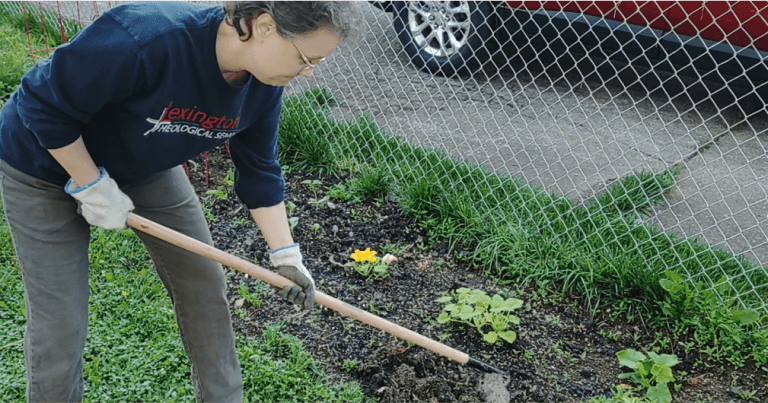
Composting in the garden
When I dug through the soil this year, it occurred to me that some of the things I was angry about last year no longer bother me. Some of the people who ticked me off have shifted in their approach to me, because, frankly, I shifted in my approach to them.
This isn’t to say that all of the grief and anger has gone away.
Far from it. All the compost I worked into the soil is still in here. But it became the fertilizer for the seeds and plants I put into the ground. This pepper plant is absorbing the nutrients from the composting I’ve worked into the soil over the past few years. It’s transforming that rotting, smelly stuff into food that will sustain me and my family.
Also, I used the anger about white Christian nationalism for the energy to create the Clergy Emergency League to help pastors in their prophetic ministry. We now have a network of more than 2,500 clergy – a fruitful harvest indeed!
That’s what the gardener hopes will happen in this parable, that we’ll see possibility instead of hopelessness.
Of course, we don’t know the end of the story. The parable leaves us with questions. Will the king listen to the wisdom of the gardener and learn patience? Will he trust the gardener? Or will he insist on his own way and order the gardener to chop down the tree?
Notice, the tree wasn’t dying. It just wasn’t getting the nutrients it needed to produce fruit. If the king has the tree chopped down, he’ll lose the chance for the fruit to appear. What a lost opportunity that would be.
Jesus is urging us to reconsider our approach, our attitude, our mindset.
The gardener is standing there with the shovel and hoe inviting us to dig, to compost, to do the hard work that can lead to transformation, to fruitfulness.
As I was composting, digging, and turning over the soil, turning over all these thoughts in my mind, I remembered a line from the hymn, “Come, Ye Disconsolate.”
“Earth has no sorrow that heaven cannot heal.”
I invite you to put your hands in some soil, to reconnect with the Earth God created. If you don’t have a garden, maybe you have a small yard where you can dig into the soil and plant some flowers or vegetables. Don’t have a small yard? Maybe you have a window where you can place a pot of soil and plant a few seeds. If you don’t have a place to plant a few seeds, maybe you can find a nearby park where you put your feet on the ground, or even sit and root yourself into the Earth. And there, you can give your anger and your grief over to the soil. Allow the Gardener to compost the mad that you feel, your frustration, your deep sadness.
“Earth has no sorrow that heaven cannot heal.”
Read also:
Gathering Up the Fragments: Sermon on Mark 13:24–37
The Heart of the Earth: Jesus, Land, and Hope
Leah D. Schade is the Assistant Professor of Preaching and Worship at Lexington Theological Seminary in Kentucky and ordained in the ELCA. Dr. Schade does not speak for LTS or the ELCA; her opinions are her own. She is the author of Preaching in the Purple Zone: Ministry in the Red-Blue Divide (Rowman & Littlefield, 2019) and Creation-Crisis Preaching: Ecology, Theology, and the Pulpit (Chalice Press, 2015). She is the co-editor of Rooted and Rising: Voices of Courage in a Time of Climate Crisis (Rowman & Littlefield, 2019). Her latest book, co-written with Jerry Sumney is Apocalypse When?: A Guide to Interpreting and Preaching Apocalyptic Texts (Wipf & Stock, 2020).
Twitter: @LeahSchade
Facebook: https://www.facebook.com/LeahDSchade/
Previous Post

May 23, 2021
Pentecost is Political – Thanks be to God!

Browse Our Archives
Select a Category Academy of Homiletics Addiction Advent AI (Artificial Intelligence) Animals Apocalypse Appalachia Ash Wednesday Baptism Bible Black Lives Matter Blade Runner Book review Children in church Christian Nationalism Christian/Islamic relations Christmas Church Clergy Climate change COVID-19 Creation Data Centers Death penalty Devotional Dialogue Doubt Earth Day Easter Ecofeminism EcoPreacher 1-2-3 ELCA ELCA Youth Gathering Election Environment/ecology Epiphany Faith Faith and Politics Feminism Film review Food Food and Faith Forgiveness Fracking Good Friday Good Omens Grief Gun violence Holy Humor Sunday Holy Week Howard Thurman ICE Immigration Indigenous wisdom Interview Jesus Kentucky Lafayette High School Marching Band Leadership Lent LGBTQIA+ Marching band Martin Luther Martin Luther King Jr. Mary Maundy Thursday Michael Sheen Mother of Jesus Nature New Year's Eve Palm Sunday Parables Pentecost Poem, Poetry Politics Poor People's Campaign Pop culture Prayers Preaching Progressive Christianity Public theology Purple Zone Racism and White Privilege Religion Religion and environment Religion and politics Religion and pop culture Religion and violence Rev. Nelson Rabell Gonzalez Sermons Spanish language resources for preaching Technology Thanksgiving Theological education theology Trees Trump Uncategorized Vegan War Women and religion Workshop Worship
Select a Month October 2026 September 2026 July 2026 June 2026 May 2026 April 2026 March 2026 February 2026 January 2026 December 2025 November 2025 October 2025 September 2025 May 2025 April 2025 March 2025 February 2025 January 2025 December 2024 November 2024 October 2024 September 2024 August 2024 July 2024 June 2024 May 2024 April 2024 March 2024 February 2024 January 2024 December 2023 November 2023 October 2023 September 2023 August 2023 July 2023 June 2023 May 2023 April 2023 March 2023 February 2023 January 2023 December 2022 November 2022 October 2022 August 2022 July 2022 June 2022 May 2022 April 2022 March 2022 February 2022 January 2022 December 2021 November 2021 October 2021 September 2021 August 2021 July 2021 June 2021 May 2021 April 2021 March 2021 January 2021 December 2020 November 2020 October 2020 September 2020 August 2020 July 2020 June 2020 May 2020 April 2020 February 2020 January 2020 December 2019 November 2019 October 2019 September 2019 August 2019 July 2019 June 2019 May 2019 April 2019 March 2019 January 2019 December 2018 November 2018 October 2018 September 2018 August 2018 July 2018 June 2018 May 2018 April 2018 March 2018 February 2018 January 2018 December 2017 November 2017 October 2017 September 2017 August 2017 July 2017 June 2017 May 2017 April 2017
Follow Us!
TAKE THE
Religious Wisdom Quiz
Which ancient city is famous for its towers and the confusion of languages?
Select your answer to see how you score.
Babylon Sodom Nineveh Babel
Books by This Author Books by Leah D. Schade
Related posts from EcoPreacher

Love Your Neighbor – Including Earth-Kin: Lev. 19,...

Eco-Wedding Liturgy: Creation-Centered Ideas for Weddings

Thieves and Bandits, Shepherds and Gates - John...
Reclaiming 1 Peter 2:19-25 From Abuse: Sermon for...
TRENDING AT PATHEOS Progressive Christian

What Being a Modern-Day Apostle Means to Me
In my last column, I discussed the ins and outs of modern-day...

Did Ancient China Once Worship the God of...
Across human history, a common thread weaves through the origins of the...

Love Your Neighbor – Including Earth-Kin: Lev. 19,...
God’s command to love your neighbor means acting in an ethical and...

Lead a Church Study of “Jesus and Lao...
Guest writer Jack Thomas (The Irreverent Reverend) reflects on leading his church...

Pastoral Wisdom for Responding to Sermon Pushback
Getting sermon pushback on your social justice sermon? Learn practical, Proverbs-based strategies...

Principles for Understanding the Apostolic Ministry Today
Whenever people discover that my formal ministry title is "apostle," as in...
view all Progressive Christian blogs
Ad-Free & Subscriber Log-In Subscription Support
- About Us
- 2026 Calendar
- Videos
- Podcasts
- Library of World Religions
- Faith In Media Tracker
- Advertise With Us
- Write for Us
- Privacy Policy
- Terms of Service
- Do Not Sell My Data
- Contact Us
- Radiant Digital
- Manage Newsletter Subscriptions
- Unsubscribe From Notifications
- Sitemap
Copyright 2008-2026, Patheos. All rights reserved.
Subscription Support Ad-Free & Subscriber Log-In
Follow Patheos