
BuddhistCatholicContemplativeEvangelicalGeneral ChristianHinduJewishLatter-day SaintMuslimNew VisionsProgressive Christian
Beliefs
- Buddhist
- Catholic
- Contemplative
- Evangelical
- General Christian
- Hindu
- Jewish
- Latter-day Saint
- More Voices
- Muslim
- New Visions
- Pagan
- Progressive Christian
Topics
- Religion News
- Food and Religion
- Sports and Religion
- Religious Art
- Religious Music and Entertainment
- Religious Events
- History and Religion
- Style and Religion
- Politics and Religion
- Women in Religion
- Recreation Outdoors and Religion
- Business Finance and Religion
- Careers Workplace and Religion
- Education and Religion
- Family Parenting and Religion
- Health Fitness and Religion
- Home and Religion
- Relationships and Religion
- Technology and Religion
- Travel and Religion
Columnists
- Buddhist Columnists
- Business Finance and Religion Columnists
- Careers Workplace and Religion Columnists
- Catholic Columnists
- Contemplative Columnists
- Education and Religion Columnists
- Evangelists Columnists
- Family Parenting and Religion Columnists
- General Christian Columnists
- Health Fitness and Religion Columnists
- Hindu Columnists
- History and Religion Columnists
- Home and Religion Columnists
- Jewish Columnists
- More Voices Columnists
- Latter Day Columnists
- Muslim Columnists
- New Visions Columnists
- Nonreligious Columnists
- Pagan Columnists
- Politics and Religion Columnists
- Progressive Columnists
- Recreation Outdoors and Religion Columnists
- Relationships and Religion Columnists
- Religion News Columnists
- Religious Art Columnists
- Religious Events Columnists
- Religious Music and Entertainment Columnists
- Sports and Religion Columnists
- Style and Religion Columnists
- Technology and Religion Columnists
- Travel and Religion Columnists
- Women in Religion Columnists
Resource Library
- 2026 Calendar
- Library of World Religions
- The 100 Most Holy Places on Earth
- Patheos Answers
- Podcasts
- Videos
- Faith Leaders Database
- Anglican Episcopalian
- Bahai
- Baptist
- Buddhism
- Christianity
- Confucianism
- Eastern Orthodoxy
- Hinduism
- Holiness and Pentecostal
- ISKCON
- Islam
- Judaism
- Lutheran
- Methodist
- The Church of Jesus Christ of Latter-day Saints
- New Age
- Paganism
- Presbytarian and Reformed
- Protestantism
- Religion Behind the Scenes
- Roman Catholic
- Scientology
- Shia Islam
- Sikhism
- Sufism
- Sunni Islam
- Taoism
- Zen
- See all religions
Research Tools
 Ad-Free & Subscriber Log-In Subscription Support
Follow Patheos 

- Trending:
- Advent
- |
- Forgiveness
- |
- Thanksgiving
- |
- Election
- |
- Seasonal Holidays
- |
- Marriage

- Home
- Progressive Christian
- Pentecost is Political – Thanks be to God!
Pentecost is Political – Thanks be to God!
Last updated on: May 23, 2021 at 1:59 pm by Leah D. Schade
Pentecost is Political – Thanks be to God! 2021-05-23T13:59:35-04:00 Leah D. Schade
Patheos Explore the world's faith through different perspectives on religion and spirituality! Patheos has the views of the prevalent religions and spiritualities of the world.
Pentecost is political? If you’ve clicked this far, you’re probably either angry, in agreement, or curious as to why I say that. I know that just mentioning the word “political” in a religious setting can be off-putting to some. Church should stay out of politics, right?
Allow me to clarify what I mean when I use the word “political.”
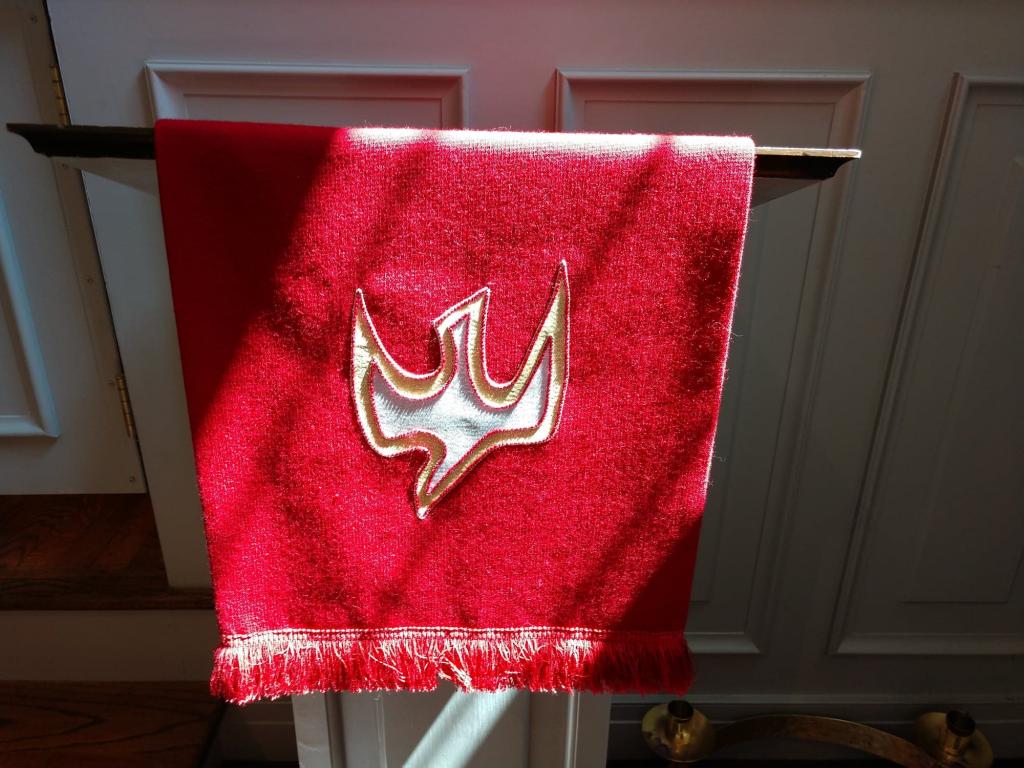
Pentecost dove. Photo by Leah D. Schade. All rights reserved.
Or, rather, what I don’t mean. I’m not talking about political parties or political affiliations – Democrats or Republicans, Independents or Libertarians. I’m talking about politics in its original sense: the concerns of the people. The Greek word polis means “citizenry.” It’s about how we live and work and make decisions together as a community.
So when I say Pentecost is political, I mean that this event that happened over two thousand years ago had implications for the public concerns of that time. I mean that the sending of the Holy Spirit to the disciples in that upper room had ramifications for the whole society. It started out as a private event of worship among a very small group of people. But the Holy Spirit blew them right out into the public square where they started speaking in the languages of people from faraway places. They began communicating with the public about the life-changing, world-freeing, death-breaking love of Jesus Christ.
So, yes, Pentecost is political – thanks be to God! Amen, right?
Wait. Why would we give thanks for Pentecost being political?
When the church engages in the public square, things can get uncomfortable quickly. Look what happened to those disciples when they started talking about the gospel to their community. People thought they were weird, that something was wrong with them. They started saying all kinds of mean things to them and about them. They accused them of being drunk, disparaging their character.
Later, when they started traveling across the Mediterranean region telling people that Jesus’ resurrection frees them from oppression, some of them were jailed. Others were beaten and even killed. All of them found themselves at odds with the culture and the social norms. The structures of sin both within the religious system and outside in the economic and military systems did everything they could to shut them up, shut them down, and shut them out.
Well. That’s no fun.
Can’t we just stay here in the upper room and watch the tongues of fire dance over our heads?
Isn’t it enough to just sing our nice hymns, and listen to the polite parts of Scripture? Can’t we just say nice prayers, and have coffee and donuts in the narthex when we’re done? Or just click off the livestream and go about our day?
Sure, we can do that. Many Christians do that. Most Christians do that.
But is that really the kind of Christian you want to be? Is that the kind of church you want to be?
What would it be like to belong to a church that is not afraid to invite the Holy Spirit into their hearts and minds, into their meetings and your Bible studies? How might it be to have a congregation explore the political nature of our Pentecost faith?
For example, I’m hearing about many churches who are engaging the Holy Spirit by trying to understand systemic racism. They’re doing book studies on James Cone’s The Cross and the Lynching Tree or Carolyn Helsel’s Anxious to Talk About It: Helping White Christians Talk Faithfully about Racism. Or Dear Church: A Love Letter from a Black Preacher to the Whitest Denomination in the U.S. by Lenny Duncan.
If your church is doing this, it means that your congregation as a whole is becoming aware of the ways in which the church in America has not only been complicit with slavery and racism but was actually one of the architects of these systems since this country’s founding. (Think this isn’t true? Read White Too Long: The Legacy of White Supremacy in American Christianity by Robert P. Jones.)
You’re also learning that just doing book studies isn’t enough. Just being nice to everyone no matter their skin color isn’t enough.
Those are good places to start. But the wind of the Holy Spirit is compelling you to go out into the public square to live out this faith so that it makes a difference for people who are harmed because of the color of their skin. Pentecost is political – thanks be to God!
That little tongue of fire dancing over your head is giving you the language and the courage to say important things that need to be said. Things like: the church must do its part to dismantle the systems of racism that are hurting and killing black and brown and Asian bodies. We as Christians must collectively speak out against discrimination and police brutality. We must call for restructuring our education and healthcare systems and our gerrymandered voting districts so that all communities are treated with equity. And we must advocate for justice, equity, diversity, and inclusion at every level – in our workplaces, in our government, in the business community, and especially in our churches.
Some of you are doing just that!
Many Christians joined protests after the murder of George Floyd last year. Those protests involved people from all walks of life to speak up and speak out for Black Lives Matter. Just like that day of Pentecost where a crowd gathered there in Jerusalem who had come from all nations for the Jewish celebration of Shavuot – God’s gift of the Ten Commandments given to Moses. You can imagine that scene – the street filled with light skin, dark skin, bronze skin, pale skin. Exotic clothing. All different styles of hair. And such a mish-mash of languages and dialects.
Pentecost is political – thanks be to God!
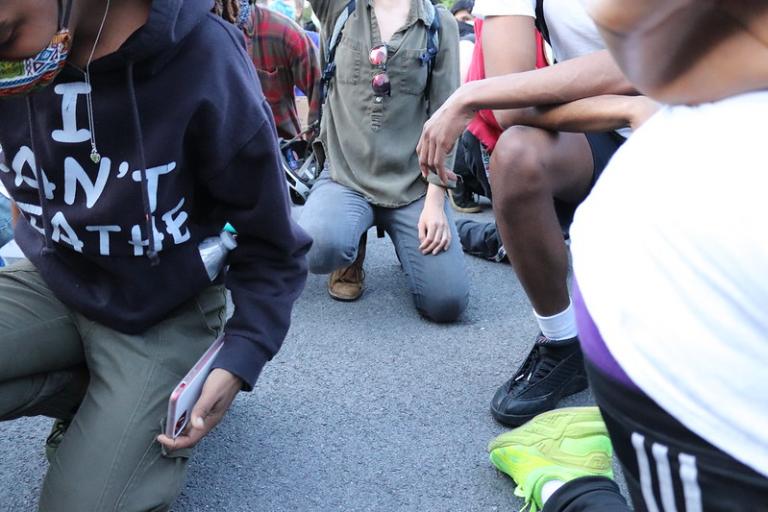
“Taking a knee.” Photo by Elvert Barnes. Some rights reserved. flickr.com https://www.flickr.com/photos/perspective/50004261792/
I think about that day of Shavuot/Pentecost when I look back on pictures of those scenes of people gathered in protest around the country over last year. Of course, the reasons for those gatherings were not to celebrate, but to protest the deaths of God’s precious children. People came to these protests from all walks of life. Streets were filled with skin colors of all kinds speaking out against the terror being inflicted upon the descendants of slaves. People are demanding that their leaders no longer ignore the injustices that exist in our communities.
That’s why I am always happy to hear about local ministeriums and faith-based community organizers who collectively address local justice issues.
For example, here in Lexington, Kentucky, where I live, there is an organization called BUILD – Building a United Interfaith Lexington through Direct-action. BUILD is comprised of diverse congregations in the Lexington area that come together to do justice and to powerfully address community problems. They hold community meetings and focus on a single issue to address each year, culminating in the Nehemiah Action event where they invite city officials to hear the concerns of people of faith.
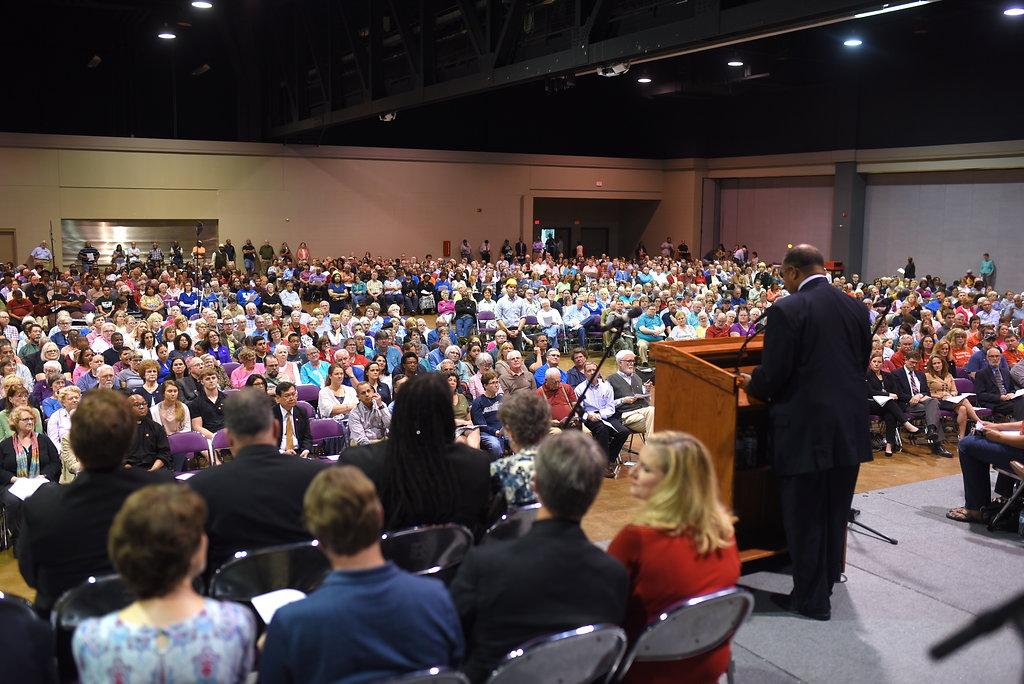
BUILD Lexington’s Nehemiah Action, 2017. Photo credit: Dana Rogers
I attended one of these events before Covid and it is an electrifying gathering with music and prayer and testimony. Hundreds of people from all kinds of congregations come together to hold our governing officials accountable and invite them to address the issue at hand, whether it’s violence, or lack of affordable house, or improved public transportation. We might say that this is a Pentecost-type event. People from all different races, cultures, and languages unite for a common call for justice. Pentecost is political – thanks be to God!
A Pentecost Church is one that stands with their siblings and speaks with one voice for peace and justice – even when those voices are in different languages.
And a Pentecost Church strives to listen and understand what it’s like for their neighbors who live with prejudice and unfair treatment.
What are we hearing? Who are we willing to listen to?
My guess is that if you’ve gotten this far in reading this essay, you are already doing a great deal to be a Pentecost church. And I’m going to challenge you to do even more. I’m challenging you to speak out alongside those who do not enjoy the same privileges as you whether that is because of skin color, or gender, or sexuality, or religion, or age, or body type, or country of origin.
I invite you to ask yourself: what are our next steps for being a Pentecost church?
Maybe you can join a movement such as the Poor People’s Campaign or SURJ (Standing Up for Racial Justice). These groups can help us become allies in dismantling the racist structures of our society. Maybe some of you who are ready to take your faith-in-action to the next level can explore the resources in the group Faith in Public Life, one of the largest public-action faith networks in the country. Or maybe you can ask a representative from your denomination working on racial justice to meet with your church. They can help you strategize for becoming an anti-racism congregation.
Whatever the next steps are for you individually or as a congregation, I think you’re ready!
Maybe your pastor is already raising these kinds of issues in their prayers and sermons. Or maybe you’re one of those pastors. And maybe people squirm a bit when the sermon “goes there.” But remember – this is what clergy promised to do in their ordination vows. For example, Presbyterian Church (USA) asks pastors at their ordinations: Will you in your own life seek to follow the Lord Jesus Christ, love your neighbors, and work for the reconciliation of the world? They promise with the help of God to do this, and to do this with their congregations.
We can, we must, be a Pentecost church that models itself on the first Pentecost church – a group of people who followed a crucified and risen Jesus.
Like them, we must confront injustice and political differences with ethical and moral resolve.
Remember that Jesus described the Holy Spirit as the Advocate – the one who acts for justice and righteousness (John 14:26). This is the role of the Holy Spirit out in the world bringing people together across cultures and religions and languages. Just like on the day of Pentecost when 3000 people from across the land were brought together by the work of Jesus Christ in and through the Holy Spirit.

Pentecost flame. Photo by Leah D. Schade. All rights reserved.
The gift of speaking the gospel of Jesus Christ did not end on that day of Pentecost. You can speak in your own tongue of fire about God’s deeds of power!
I pray that the Holy Spirit will touch you and the entire church this day. I pray the the Spirit of Pentecost will move through our breath and heart and mind and body to feel that power of God in Jesus Christ. Pentecost is political – thanks be to God!
Read also:
Will White Churches Find Their Pentecost Courage?
La Lengua de Dios: Pentecost and the Language of God
Leah D. Schade is the Assistant Professor of Preaching and Worship at Lexington Theological Seminary in Kentucky and ordained in the ELCA. Dr. Schade does not speak for LTS or the ELCA; her opinions are her own. She is the author of Preaching in the Purple Zone: Ministry in the Red-Blue Divide (Rowman & Littlefield, 2019) and Creation-Crisis Preaching: Ecology, Theology, and the Pulpit (Chalice Press, 2015). She is the co-editor of Rooted and Rising: Voices of Courage in a Time of Climate Crisis (Rowman & Littlefield, 2019). Her latest book, co-written with Jerry Sumney is Apocalypse When?: A Guide to Interpreting and Preaching Apocalyptic Texts (Wipf & Stock, 2020).
Twitter: @LeahSchade
Facebook: https://www.facebook.com/LeahDSchade/
Previous Post

April 25, 2021
Climate Migration: How Should the Church Respond?
Next Post
June 21, 2021 Composting Our Anger and Grief: Luke 13:1-9
Browse Our Archives
Select a Category Academy of Homiletics Addiction Advent AI (Artificial Intelligence) Animals Apocalypse Appalachia Ash Wednesday Baptism Bible Black Lives Matter Blade Runner Book review Children in church Christ the King Sunday Christian Nationalism Christian/Islamic relations Christmas Church Clergy Climate change COVID-19 Creation Data Centers Death penalty Devotional Dialogue Doubt Earth Day Easter Ecofeminism EcoPreacher 1-2-3 ELCA ELCA Youth Gathering Election Environment/ecology Epiphany Faith Faith and Politics Feminism Film review Food Food and Faith Forgiveness Fracking Good Friday Good Omens Grief Gun violence Holy Humor Sunday Holy Week Howard Thurman ICE Immigration Indigenous wisdom Interview Jesus Kentucky Lafayette High School Marching Band Leadership Lent LGBTQIA+ Marching band Martin Luther Martin Luther King Jr. Mary Maundy Thursday Michael Sheen Mother of Jesus Nature New Year's Eve Palm Sunday Parables Pentecost Poem, Poetry Politics Poor People's Campaign Pop culture Prayers Preaching Progressive Christianity Public theology Purple Zone Racism and White Privilege Religion Religion and environment Religion and politics Religion and pop culture Religion and violence Rev. Nelson Rabell Gonzalez Sermons Spanish language resources for preaching Technology Thanksgiving Theological education theology Trees Trump Uncategorized Vegan War Women and religion Workshop Worship
Select a Month November 2026 October 2026 September 2026 July 2026 June 2026 May 2026 April 2026 March 2026 February 2026 January 2026 December 2025 November 2025 October 2025 September 2025 May 2025 April 2025 March 2025 February 2025 January 2025 December 2024 November 2024 October 2024 September 2024 August 2024 July 2024 June 2024 May 2024 April 2024 March 2024 February 2024 January 2024 December 2023 November 2023 October 2023 September 2023 August 2023 July 2023 June 2023 May 2023 April 2023 March 2023 February 2023 January 2023 December 2022 November 2022 October 2022 August 2022 July 2022 June 2022 May 2022 April 2022 March 2022 February 2022 January 2022 December 2021 November 2021 October 2021 September 2021 August 2021 July 2021 June 2021 May 2021 April 2021 March 2021 January 2021 December 2020 November 2020 October 2020 September 2020 August 2020 July 2020 June 2020 May 2020 April 2020 February 2020 January 2020 December 2019 November 2019 October 2019 September 2019 August 2019 July 2019 June 2019 May 2019 April 2019 March 2019 January 2019 December 2018 November 2018 October 2018 September 2018 August 2018 July 2018 June 2018 May 2018 April 2018 March 2018 February 2018 January 2018 December 2017 November 2017 October 2017 September 2017 August 2017 July 2017 June 2017 May 2017 April 2017
Follow Us!
TAKE THE
Religious Wisdom Quiz
Who was the strongest man in the Bible?
Select your answer to see how you score.
Goliath Samson Moses David
Books by This Author Books by Leah D. Schade
Related posts from EcoPreacher
Counter “Christ Is King” Nationalism with Christ THE...

Why Christians Have a Sacred Duty to Vote:...
Pastoral Wisdom for Responding to Sermon Pushback

"Render Unto Caesar": Faith, Politics, and Elections
TRENDING AT PATHEOS Progressive Christian

The Secret behind A Charlie Brown Thanksgiving
Do you know the secret behind A Charlie Brown Thanksgiving? Sparky was...

Bridging the Gap Between God and Man
From Far Off to the Ultimate Embrace “God is a Spirit: and...

Let Matthew 25 Guide You to a Greater...
With the crisp feel of fall in the air, our minds quickly...

Can a Chatbot Touch Your Soul?
Can a chatbot offer genuine spiritual counsel? One conversation brought me to...

Religion and Politics: How Should We Then Live?
Two cultural axioms get repeated in polite company. Don't mix religion and...

7 Things We Get Wrong About Giving Thanks
It's a time of year when many of us turn to the...
view all Progressive Christian blogs
Ad-Free & Subscriber Log-In Subscription Support
- About Us
- 2026 Calendar
- Videos
- Podcasts
- Library of World Religions
- Faith In Media Tracker
- Advertise With Us
- Write for Us
- Privacy Policy
- Terms of Service
- Do Not Sell My Data
- Contact Us
- Radiant Digital
- Manage Newsletter Subscriptions
- Unsubscribe From Notifications
- Sitemap
Copyright 2008-2026, Patheos, part of the Radiant Digital network of media brands. All rights reserved.
Subscription Support Ad-Free & Subscriber Log-In
Follow Patheos