
BuddhistCatholicContemplativeEvangelicalGeneral ChristianHinduJewishLatter-day SaintMuslimNew VisionsProgressive Christian
Beliefs
- Buddhist
- Catholic
- Contemplative
- Evangelical
- General Christian
- Hindu
- Jewish
- Latter-day Saint
- More Voices
- Muslim
- New Visions
- Pagan
- Progressive Christian
Topics
- Religion News
- Food and Religion
- Sports and Religion
- Religious Art
- Religious Music and Entertainment
- Religious Events
- History and Religion
- Style and Religion
- Politics and Religion
- Women in Religion
- Recreation Outdoors and Religion
- Business Finance and Religion
- Careers Workplace and Religion
- Education and Religion
- Family Parenting and Religion
- Health Fitness and Religion
- Home and Religion
- Relationships and Religion
- Technology and Religion
- Travel and Religion
Columnists
- Buddhist Columnists
- Business Finance and Religion Columnists
- Careers Workplace and Religion Columnists
- Catholic Columnists
- Contemplative Columnists
- Education and Religion Columnists
- Evangelists Columnists
- Family Parenting and Religion Columnists
- General Christian Columnists
- Health Fitness and Religion Columnists
- Hindu Columnists
- History and Religion Columnists
- Home and Religion Columnists
- Jewish Columnists
- More Voices Columnists
- Latter Day Columnists
- Muslim Columnists
- New Visions Columnists
- Nonreligious Columnists
- Pagan Columnists
- Politics and Religion Columnists
- Progressive Columnists
- Recreation Outdoors and Religion Columnists
- Relationships and Religion Columnists
- Religion News Columnists
- Religious Art Columnists
- Religious Events Columnists
- Religious Music and Entertainment Columnists
- Sports and Religion Columnists
- Style and Religion Columnists
- Technology and Religion Columnists
- Travel and Religion Columnists
- Women in Religion Columnists
Resource Library
- 2026 Calendar
- Library of World Religions
- The 100 Most Holy Places on Earth
- Patheos Answers
- Podcasts
- Videos
- Faith Leaders Database
- Anglican Episcopalian
- Bahai
- Baptist
- Buddhism
- Christianity
- Confucianism
- Eastern Orthodoxy
- Hinduism
- Holiness and Pentecostal
- ISKCON
- Islam
- Judaism
- Lutheran
- Methodist
- The Church of Jesus Christ of Latter-day Saints
- New Age
- Paganism
- Presbytarian and Reformed
- Protestantism
- Religion Behind the Scenes
- Roman Catholic
- Scientology
- Shia Islam
- Sikhism
- Sufism
- Sunni Islam
- Taoism
- Zen
- See all religions
Research Tools
 Ad-Free & Subscriber Log-In Subscription Support
Ad-Free & Subscriber Log-In Subscription Support
Follow Patheos 

- Trending:
- Forgiveness
- |
- Marriage
- |
- Consciousness
- |
- Death Penalty
- |
- Election
- |
- Halloween

- Home
- Progressive Christian
- Gathering Up the Fragments: Sermon on Mark 13:24–37
Gathering Up the Fragments: Sermon on Mark 13:24–37
Last updated on: November 28, 2020 at 9:44 am by Leah D. Schade
Gathering Up the Fragments: Sermon on Mark 13:24–37 2020-11-28T09:44:07-04:00 Leah D. Schade
Patheos Explore the world's faith through different perspectives on religion and spirituality! Patheos has the views of the prevalent religions and spiritualities of the world.
This sermon, “Gathering up the Fragments,” is adapted from the book I co-wrote with Jerry Sumney, Apocalypse When?: A Guide to Interpreting and Preaching Apocalyptic Texts. Think about how you might take the images around fragments and brokenness and adapt them to your own context.
Have you noticed? There is a touch of melancholy in the late fall wind. It is a sad time of year.
I first felt this sadness a few weeks ago as I walked through the yard and kicked through the leaves blowing across the browning grass. Scattered fragments of the grand green trees of summer. I drive past the farmers’ fields which had been verdant and thriving for so many months, producing abundant harvests to feed the multitudes. Today the shriveled stalks are small and brown, draping limply to the cold ground.
“We all fade like a leaf,” says Isaiah, “and our iniquities, like the wind, take us away.” (Isaiah 64:6b.)

Gathering up the fragments. Photo by Daniel Lincoln on Unsplash. daniel-lincoln-c9pdpqiHVGw-unsplash
Oh, we try to not to worry. We try not to feel that melancholy.
Some try to drown it out with Christmas carols played round-the-clock since the day after Halloween. Others try to shine the holiday lights into it and dispel the sadness. Too many try to ignore the gathering darkness by crowding into malls and stores, hoping they can buy their way out of it. But here in the northern hemisphere, the melancholy descends on us as surely as the darkness of the winter solstice envelopes our ever-shortening days.
It’s no wonder we feel anxiety, especially in light of this past year that our country and the world have endured.
An unprecedented pandemic has infected millions and killed far too many. Climate-fueled natural disasters hit from all sides, with hurricanes, floods, and wildfires of epic proportions. The U.S. faced unabashed corruption and narrowly averted the loss of democracy in this polarized election season. Political upheaval, war, and violent conflict continue to ravage countries and regions around the globe. Poverty decimates entire populations of people. And protests against systemic racism swept across the U.S. in a long-overdue reckoning with America’s “original sin.”
It’s enough to make you feel as if we’re living in the end-times that Jesus spoke about in the Gospel of Mark.
“In those days, after that suffering, the sun will be darkened, and the moon will not give its light, and the stars will be falling from heaven, and the powers in the heavens will be shaken” (Mark 13:24–25).
Biblical scholars date Mark’s Gospel either to just before or just after the fall of the temple in Jerusalem, probably 40 years after Jesus’ death and resurrection. Mark was writing to a group of Christians who were wrestling with existential questions in light of this traumatic event. Is God not powerful after all? Has God rejected us? Does God not care about this sacred space?
As I stand looking at the remnants of our fields and gardens, it causes me to wonder about this passage from Mark.
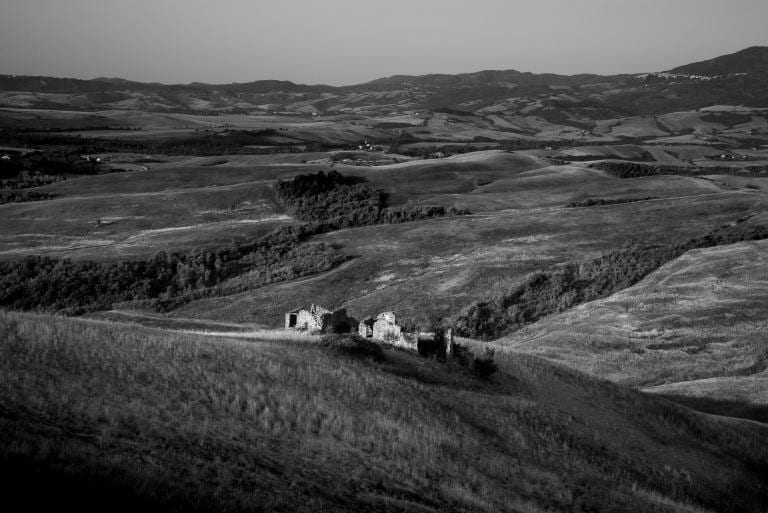
Photo by Lorenzo Schirato on Unsplash. lorenzo-schirato-pNpjlSy6ZN8-unsplash
What happens after the suffering?
After the sun goes dark, the moon fades away, and the stars fall? After the tremors of the heavens die down?
What happens to all those broken pieces of people’s lives?
What happens to all the torn and tattered shreds of the messes we have made? As the author Flora Slosson Wuellner puts it: “What does God do with the useless leftovers of the universe, the unwanted, unlovely brokenness…?” (“A Broken Piece of Barley Bread”; Weavings, 14, 6, November/December [2004]: 7-9.)
Jesus offers this answer.
“Then he will send out the angels, and gather his elect from the four winds, from the ends of the earth to the ends of heaven” (Mark 13:27).
Here is the key word: gather. God will gather up the fragments.
And once gathered, God will transform them into something new and beautiful. Something we would never have thought could come from such a motley assembly of brokenness.
As I stood in my yard contemplating this thought, I realized that it was as near to me as the cycle of life going on all around me. Because Jesus goes on to say this.
“From the fig tree learn its lesson: as its branch becomes tender and puts forth its leaves, you know that summer is near. So also, when you see these things taking place, you know that God is near, at the very gates” (Mark 13:28–29).
All these fallen leaves that I mourn will eventually become part of the soil and nutrients that feed the very tree from which they fell. All the broken pieces will be gathered and reassembled into something new and creative.
God is here, even in this troubled time, just as God was with the people who originally heard Mark’s Gospel. God gathers the pieces together.
In Mark’s community, they were dealing with their own trauma—the destruction of the temple in Jerusalem. This was the site where they worshipped God. It was the most sacred of buildings where God made Godself present on earth. Seeing it overrun and destroyed by Roman soldiers caused them to question everything they believed.
But Jesus’ words are meant to tell the hard truth so that we can receive a startling revelation.
God is not contained only in sacred buildings made by human hands. God’s power transcends even the temple. So we need not succumb to devastation when our temples fall. Because God is doing a new thing, bringing to us a future made up of these broken pieces.
This is good news for us who are the fragments of this world. Wuellner writes:
What better [message of hope] for our throw-away abandoned people, our broken, fragmented humanity; our own individual shattered dreams, hopes, trust; all the shards of lives which have never been realized or fulfilled in wholeness…The core of Jesus’ mission, more profound than even healing and restoration, is transformation . . . When re-formed by God’s hands [the world and we] are fulfilled and empowered in a way we had never thought possible. (Wuellner, 8, 9).
This is why Jesus’ words are so important. Because they help us understand what to do as we’re waiting for the fulfillment and the power to come from God. We are to remain alert, keep our eyes open and our minds attuned to catch glimpses of the God’s work.
When we used to live in Philadelphia, my husband and I would go to a place called South Street and see an old, run-down building that someone had covered with a gorgeous mosaic of discarded glass and tile. I thought, what a powerful message in the heart of the city.
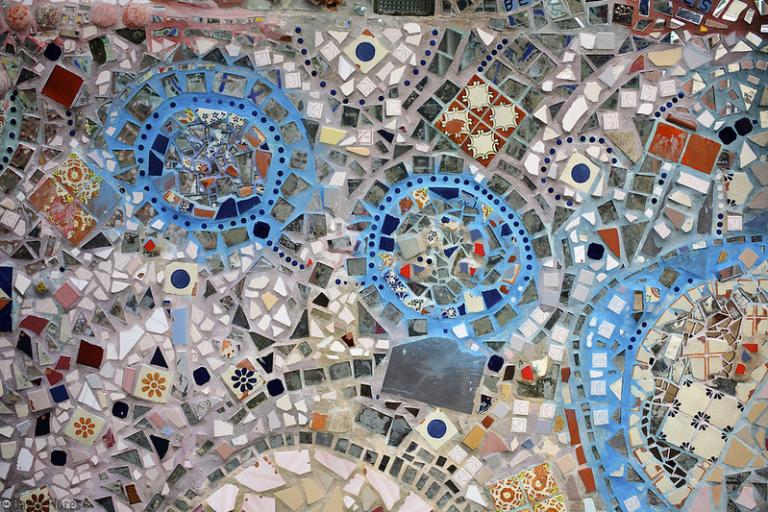
Mosaic in Philadephia. Photo by David Flores. https://www.flickr.com/photos/magdav/14681266168/
“Listen, Philadelphians,” it seemed to say, “there is no junk! You need only take the time to gather the pieces together and open your eyes to the vision that God wants you to see.”
Or think of the quilts that the church sewing group makes. They’re made up of discarded pieces of fabric that fell away from the cutting table, faded after years of use, outgrown like yesterday’s dresses. But like the mosaic on the side of that building, with the right vision these fragments can be gathered together and transformed into something that gives comfort and beauty as a quilted blanket for a baby or someone in need.
No fragment is worthless in God s eyes.
Like the patches of cloth in a colorful quilt. Like the side of this building on South Street covered in a mosaic of broken pieces, transforming the ugliness of a city block into a glimmering rainbow of artistic wonder. This is how God will gather up even us, broken and fragmented, and form us into the beautiful mosaic of the kingdom.

Quilting. Photo by Dinh Pham https://unsplash.com/photos/dG35-kUxv34
This is a life-giving message on this first Sunday of Advent.
Wedged between the holidays of Thanksgiving and Christmas, this is one of those awkward Sundays that we’re not quite sure what to do with. It is a fragment, a leaf fallen between the cracks. It’s a Sunday that reminds us of all that is broken and fragmented in this world.
This is a Sunday when we stand in our empty gardens and fields. We remember All Saints Sunday in the not-too-distant past, the empty places at our holiday tables where our loved ones once laughed and ate with us.
This is a Sunday that reminds us of what and who we have lost as well as the losses that are still to come.
But one of my former parishioners, Wanda, once reminded me of something important. There is a particular point in the liturgy which brings the memory of those saints into the very presence of God within our worship. It is the introduction to the Sanctus when the pastor concludes with these words: “And so with the hosts of heaven, we praise your name and join their unending hymn.”
“I like to make sure that people understand the significance of that phrase,” she wrote to me in a letter. “At this particular point in the liturgy my mind recalls family members who have died. Each Sunday it is a time when there is a feeling of closeness to those I knew and loved and especially those I shared communion with. They are now the hosts of heaven.” (Letter from E. Wanda Quay, Oct. 28, 2005).
This part of the liturgy is a reminder that we still share our life and our faith as we join in singing, “Holy, Holy, Holy.” In those moments of the Eucharist that follow, there is no gap that separates us from those who have gone ahead. That is a part of the mystery of Holy Communion—in and through and with and under.
Wanda’s letter reminds me that God gives us a tangible sign of this fragment-gathering, right here at the communion table, even as we are facing endings and brokenness.
Each one of us is like a fragment of Christ’s broken body. But when we share in this meal, we are rejoined and transformed into something miraculous and beautiful. Receiving communion is like being wrapped up in one of those quilts that the sewing group makes. Or being placed into a beautiful mosaic high on a building overlooking the city.
So, as we stand in our own darkened gardens, blown by the chilly, melancholy wind, we remember that God stands with us.
God surveys the landscape, looking for every fragment that might be gathered and transformed, like fallen leaves forming the soil for tomorrow’s grand green trees. Like broken pieces of tile and glass reworked into a magnificent piece of art on a city building. Like discarded swatches of fabric sewn into a beautiful, warm quilt.
…everything that is hurt, everything
that seemed to us dark, harsh, shameful,
maimed, ugly, irreparably damaged,
is in [God] transformed
and recognized as whole, as lovely,
and radiant in [God’s] light
we awaken as the Beloved in every last part of our body.
This is a poem by the theologian Symeon who lived in the first century. (Symeon [949–1022 C.E.], The Enlightened Heart: An Anthology of Sacred Poetry, 38–39). It captures the hope that we cling to in this first Sunday of Advent. When you receive communion, remember that you, too, are lovely and radiant in God’s light.
All the broken pieces, all the broken people, even the brokenness of Earth itself—all of it is beautiful in God’s sight.
In this holy meal, we remember that all of us are gathered and transformed by God. Awaken as the Beloved in every last part of your body. Amen.
Read also:
Learning to Welcome the Dark: Advent 1
Rooted and Rising in Advent: 28 Days for Connecting with Earth

Leah D. Schade is the Assistant Professor of Preaching and Worship at Lexington Theological Seminary in Kentucky and ordained in the ELCA. Dr. Schade does not speak for LTS or the ELCA; her opinions are her own. She is the author of Preaching in the Purple Zone: Ministry in the Red-Blue Divide (Rowman & Littlefield, 2019) and Creation-Crisis Preaching: Ecology, Theology, and the Pulpit (Chalice Press, 2015). She is the co-editor of Rooted and Rising: Voices of Courage in a Time of Climate Crisis (Rowman & Littlefield, 2019). Her latest book, co-written with Jerry Sumney is Apocalypse When?: A Guide to Interpreting and Preaching Apocalyptic Texts (Wipf & Stock, 2020).
Leah is also co-founder of the Clergy Emergency League, a grassroots network of clergy that provides support, accountability, resources, and networking for clergy to prophetically minister in their congregations and the public square in this time of political upheaval, social unrest, and partisan division.
Twitter: @LeahSchade
Facebook: https://www.facebook.com/LeahDSchade/
Previous Post

November 23, 2020
Ideas for Preaching Advent 1 - Mark 13:24–37
Next Post

December 6, 2020 Trumpism is a Starfish, not a Spider. How should churches respond?
Browse Our Archives
Select a Category Academy of Homiletics Addiction Advent AI (Artificial Intelligence) Animals Apocalypse Appalachia Ash Wednesday Baptism Bible Black Lives Matter Blade Runner Book review Children in church Christian Nationalism Christian/Islamic relations Christmas Church Clergy Climate change COVID-19 Creation Data Centers Death penalty Devotional Dialogue Doubt Earth Day Easter Ecofeminism EcoPreacher 1-2-3 ELCA ELCA Youth Gathering Election Environment/ecology Epiphany Faith Faith and Politics Feminism Film review Food Food and Faith Forgiveness Fracking Good Friday Good Omens Grief Gun violence Holy Humor Sunday Holy Week Howard Thurman ICE Immigration Indigenous wisdom Interview Jesus Kentucky Lafayette High School Marching Band Leadership Lent LGBTQIA+ Marching band Martin Luther Martin Luther King Jr. Mary Maundy Thursday Michael Sheen Mother of Jesus Nature New Year's Eve Palm Sunday Parables Pentecost Poem, Poetry Politics Poor People's Campaign Pop culture Prayers Preaching Progressive Christianity Public theology Purple Zone Racism and White Privilege Religion Religion and environment Religion and politics Religion and pop culture Religion and violence Rev. Nelson Rabell Gonzalez Sermons Spanish language resources for preaching Technology Thanksgiving Theological education theology Trees Trump Uncategorized Vegan War Women and religion Workshop Worship
Select a Month October 2026 September 2026 July 2026 June 2026 May 2026 April 2026 March 2026 February 2026 January 2026 December 2025 November 2025 October 2025 September 2025 May 2025 April 2025 March 2025 February 2025 January 2025 December 2024 November 2024 October 2024 September 2024 August 2024 July 2024 June 2024 May 2024 April 2024 March 2024 February 2024 January 2024 December 2023 November 2023 October 2023 September 2023 August 2023 July 2023 June 2023 May 2023 April 2023 March 2023 February 2023 January 2023 December 2022 November 2022 October 2022 August 2022 July 2022 June 2022 May 2022 April 2022 March 2022 February 2022 January 2022 December 2021 November 2021 October 2021 September 2021 August 2021 July 2021 June 2021 May 2021 April 2021 March 2021 January 2021 December 2020 November 2020 October 2020 September 2020 August 2020 July 2020 June 2020 May 2020 April 2020 February 2020 January 2020 December 2019 November 2019 October 2019 September 2019 August 2019 July 2019 June 2019 May 2019 April 2019 March 2019 January 2019 December 2018 November 2018 October 2018 September 2018 August 2018 July 2018 June 2018 May 2018 April 2018 March 2018 February 2018 January 2018 December 2017 November 2017 October 2017 September 2017 August 2017 July 2017 June 2017 May 2017 April 2017
Follow Us!
TAKE THE
Religious Wisdom Quiz
I saw the Promised Land from a mountain but was not allowed to enter it. Who am I?
Select your answer to see how you score.
Joshua Caleb Aaron Moses
Books by This Author Books by Leah D. Schade
Related posts from EcoPreacher
Thieves and Bandits, Shepherds and Gates - John...
Reclaiming 1 Peter 2:19-25 From Abuse: Sermon for...
Resist Christian Nationalism in Lent, Matthew 4:1-11
Adviento y arrepentimiento ambiental: Salmo 72, Mateo 3:1-12
TRENDING AT PATHEOS Progressive Christian

Why Christians Have a Sacred Duty to Vote:...
The Bible offers strong support for the sacred duty to vote. Here...

What Being a Modern-Day Apostle Means to Me
In my last column, I discussed the ins and outs of modern-day...

Did Ancient China Once Worship the God of...
Across human history, a common thread weaves through the origins of the...

Love Your Neighbor – Including Earth-Kin: Lev. 19,...
God’s command to love your neighbor means acting in an ethical and...

Lead a Church Study of “Jesus and Lao...
Guest writer Jack Thomas (The Irreverent Reverend) reflects on leading his church...

Principles for Understanding the Apostolic Ministry Today
Whenever people discover that my formal ministry title is "apostle," as in...
view all Progressive Christian blogs
Ad-Free & Subscriber Log-In Subscription Support
- About Us
- 2026 Calendar
- Videos
- Podcasts
- Library of World Religions
- Faith In Media Tracker
- Advertise With Us
- Write for Us
- Privacy Policy
- Terms of Service
- Do Not Sell My Data
- Contact Us
- Radiant Digital
- Manage Newsletter Subscriptions
- Unsubscribe From Notifications
- Sitemap
Copyright 2008-2026, Patheos. All rights reserved.
Subscription Support Ad-Free & Subscriber Log-In
Follow Patheos