
BuddhistCatholicContemplativeEvangelicalGeneral ChristianHinduJewishLatter-day SaintMuslimNew VisionsProgressive Christian
Beliefs
- Buddhist
- Catholic
- Contemplative
- Evangelical
- General Christian
- Hindu
- Jewish
- Latter-day Saint
- More Voices
- Muslim
- New Visions
- Pagan
- Progressive Christian
Topics
- Religion News
- Food and Religion
- Sports and Religion
- Religious Art
- Religious Music and Entertainment
- Religious Events
- History and Religion
- Style and Religion
- Politics and Religion
- Women in Religion
- Recreation Outdoors and Religion
- Business Finance and Religion
- Careers Workplace and Religion
- Education and Religion
- Family Parenting and Religion
- Health Fitness and Religion
- Home and Religion
- Relationships and Religion
- Technology and Religion
- Travel and Religion
Columnists
- Buddhist Columnists
- Business Finance and Religion Columnists
- Careers Workplace and Religion Columnists
- Catholic Columnists
- Contemplative Columnists
- Education and Religion Columnists
- Evangelists Columnists
- Family Parenting and Religion Columnists
- General Christian Columnists
- Health Fitness and Religion Columnists
- Hindu Columnists
- History and Religion Columnists
- Home and Religion Columnists
- Jewish Columnists
- More Voices Columnists
- Latter Day Columnists
- Muslim Columnists
- New Visions Columnists
- Nonreligious Columnists
- Pagan Columnists
- Politics and Religion Columnists
- Progressive Columnists
- Recreation Outdoors and Religion Columnists
- Relationships and Religion Columnists
- Religion News Columnists
- Religious Art Columnists
- Religious Events Columnists
- Religious Music and Entertainment Columnists
- Sports and Religion Columnists
- Style and Religion Columnists
- Technology and Religion Columnists
- Travel and Religion Columnists
- Women in Religion Columnists
Resource Library
- 2026 Calendar
- Library of World Religions
- The 100 Most Holy Places on Earth
- Patheos Answers
- Podcasts
- Videos
- Faith Leaders Database
- Anglican Episcopalian
- Bahai
- Baptist
- Buddhism
- Christianity
- Confucianism
- Eastern Orthodoxy
- Hinduism
- Holiness and Pentecostal
- ISKCON
- Islam
- Judaism
- Lutheran
- Methodist
- The Church of Jesus Christ of Latter-day Saints
- New Age
- Paganism
- Presbytarian and Reformed
- Protestantism
- Religion Behind the Scenes
- Roman Catholic
- Scientology
- Shia Islam
- Sikhism
- Sufism
- Sunni Islam
- Taoism
- Zen
- See all religions
Research Tools
 Ad-Free & Subscriber Log-In Subscription Support
Ad-Free & Subscriber Log-In Subscription Support
Follow Patheos 

- Trending:
- Forgiveness
- |
- Marriage
- |
- Consciousness
- |
- Death Penalty
- |
- Election
- |
- Halloween

- Home
- Progressive Christian
- The Heart of the Earth: Jesus, Land, and Hope
The Heart of the Earth: Jesus, Land, and Hope
Last updated on: July 28, 2020 at 4:57 pm by Leah D. Schade
The Heart of the Earth: Jesus, Land, and Hope 2020-07-28T16:57:27-04:00 Leah D. Schade
Patheos Explore the world's faith through different perspectives on religion and spirituality! Patheos has the views of the prevalent religions and spiritualities of the world.
This sermon, “The Heart of the Earth: Jesus, Land, and Hope,” is part of a four-part series in the Season of Creation. This sermon is for Land and Prairie Sunday.
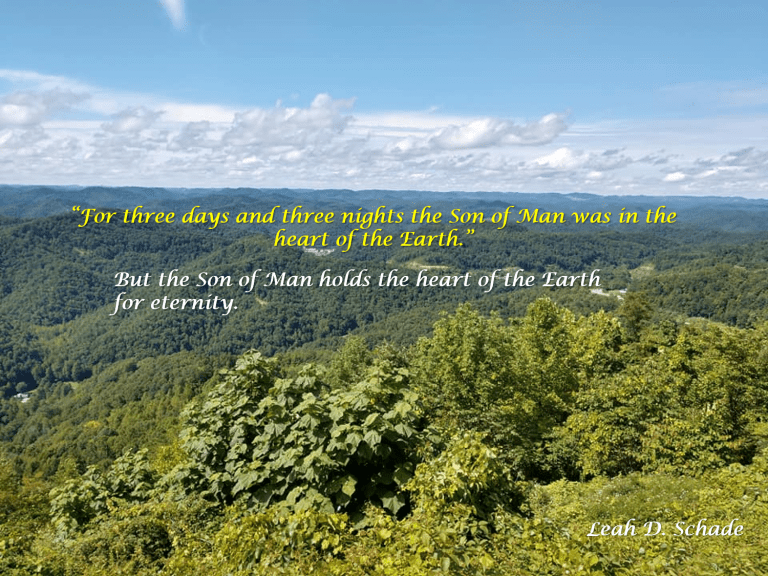
Heart of the Earth. Photo credit: Leah D. Schade. All rights reserved.
Texts: Genesis Chapters 3 and 4; Matthew 12:38-40
In January of this year, I visited the Northern Illinois Synod of the ELCA to preach, lead a workshop, and participate in a working group that created the Season of Creation liturgy we are using during these four weeks. I was hosted by Rev. Jeff Schlesinger, pastor of Heart of Illinois Lutheran Parish who took me to see the 4,000-acres Nachusa Grasslands preserve during my visit.
Jeff explained to me that Illinois used to be prairie, woodlands, and wetlands up until the mid-1800’s. But because of its rich soils, the state was gradually converted to agriculture to support the growing and hungry population of the United States.
Much of the forests and prairie are gone. They’ve been replaced with acres upon acres of crops in an industrialized economy of Big Agriculture.
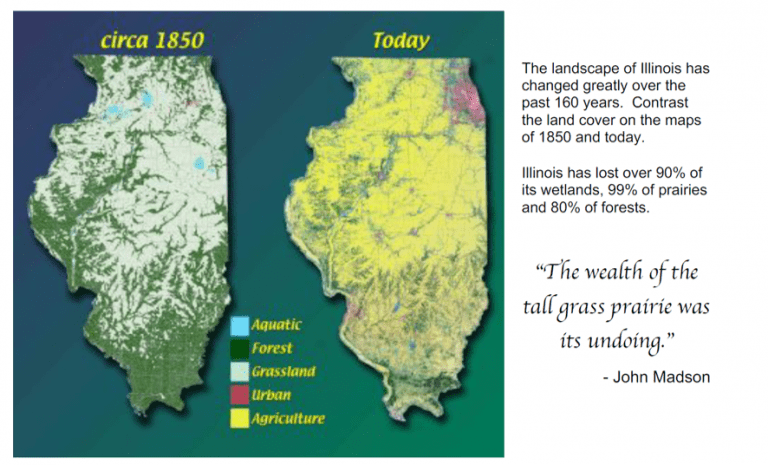
But a handful of people began to advocate for returning some of the land to its natural prairie state. The result is the Nachusa Grasslands that protects and preserves this remnant of land to help restore habitat for one of the largest and most biologically diverse ecosystems in the state. Working hand–in–hand with the Nature Conservancy staff, the volunteers collect and plant seeds, manage invasive species, repair wetlands, and conduct controlled burns. All this and more is done to preserve, protect, and share this precious endangered ecosystem.
But here’s the really exciting part. In 2014, the Nachusa Grasslands reintroduced an endangered species back to its natural habitat – the American bison.
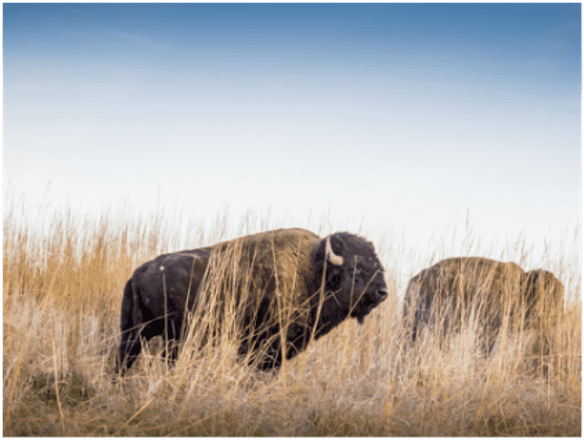
Photo by Charles Larry. All rights reserved. Used with permission.
The Nature Conservancy, which operates the Grasslands, brought 30 bison to the preserve and the herd is now over 90 with more calves expected each spring.
For Jeff, his work with Nachusa Grasslands is part of how he lives out his faith.
Caring for the land that God fashioned over millions of years is a sacred trust. Helping to restore the creeks and streams while educating his parishioners and other church folk throughout the synod about this precious and fragile ecosystem is part of his vocation as a pastor and as a Christian.
I think about Nachusa when I read Genesis Chapters 3 and 4. In Genesis, there is a rupture in the relationships between man and woman, humans and animals, humans and Earth, humans and God. Adam and Eve choose to know the difference between good and evil. Cain chooses to act on the difference between good and evil.
The conflict between Cain and Abel echoes in the tension and bloodshed over the use of land that still exists today. Cain was so angry that his brother’s sacrifice found favor with God that he murdered his own flesh and blood.
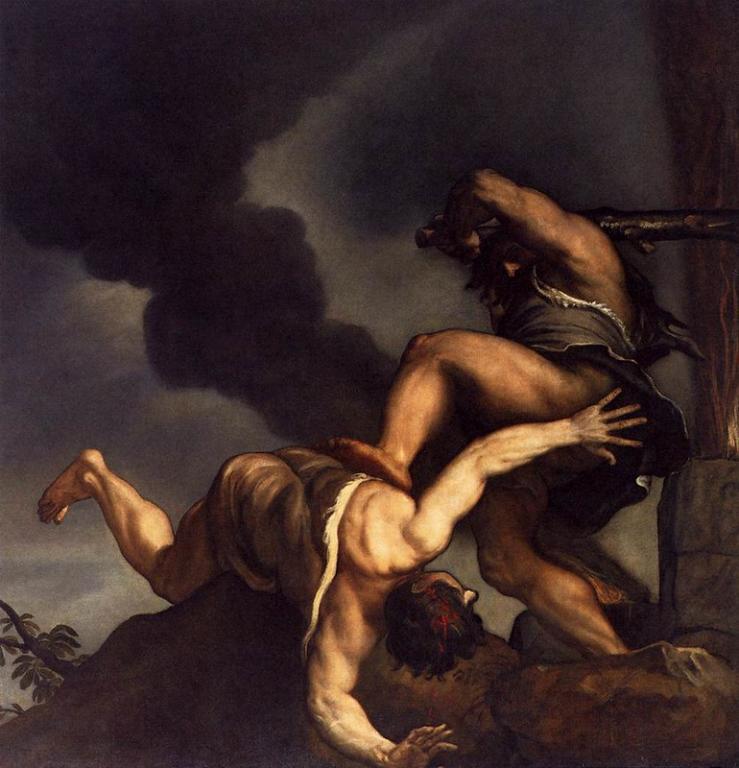
Cain and Abel, Titian, ca. 1542-1544. Public domain.
The blood cries out from the soil.
And that blood cried out from the very soil itself, just as the land always cries out when humans kill each other. Later, when Cain founded a city, he set up a tension between those who live in cities and those who live in rural areas. That tension, too, continues to this day.
We often think of land as real estate, as property to be used however we desire, often without considering our neighbors or the land itself. But here’s the question: is the land ours or does it continue to belong to God? Creation suffers because of human choices throughout history. So can we make different choices that allow for healing and restoration between humans, the land, and God?
In what ways can the land be our teacher?
As we observe the balance within ecosystems – the cycles of production and sabbath, regeneration and renewal – what we can we learn from the land about how to live in community?
Here in Kentucky, we also have a groups of dedicated volunteers who work to protect and restore the land as God had intended it. One that I have come to appreciate is Kentucky Natural Land Trust (KNLT). Established in 1995, KNLT is a state-wide land trust committed to preserving the commonwealth’s diminishing natural places, protecting our rich biodiversity, and ensuring a future that will continue to inspire new generations of environmental stewards.
KNLT works to protect the Pine Mountain Wildlands Corridor that stretches across three states, running right through the southwestern border of Kentucky. Over the past two decades, they have protected more than 3,000 acres of old-growth forests. Pine Mountain is home to a mixed mesophytic forest, which means that it is one of the most diverse temperate forests in the world. It’s the largest conservation effort in Kentucky’s history.
Hiking on holy ground
Three years ago, my son and I were invited to hike Blanton Forest Preserve near Harlan, Ky., on Pine Mountain to see for ourselves just how awe-inspiring this natural lands trust is. It’s the largest tract of old-growth forest remaining in the Commonwealth of Kentucky.
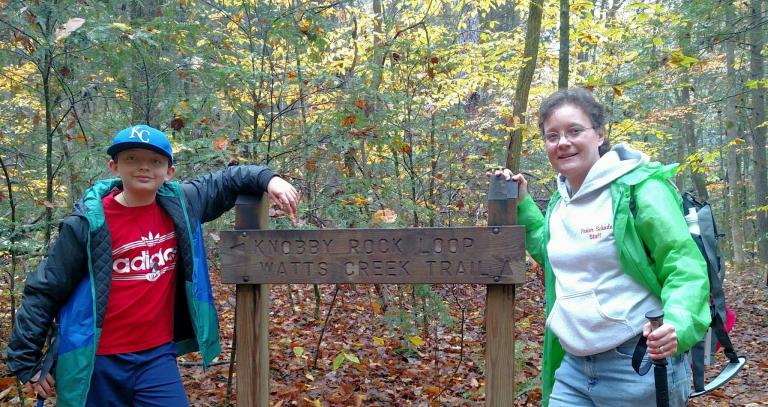
Leah Schade and son Benjamin, Blanton Forest, Ky.
It was as if we were making a pilgrimage into a place of holiness. I breathed in the oxygen-rich air and marveled at the array of life before us. 350-year-old trees arched over us like the vaulted ceiling of a sanctuary. A stream with darting minnows (including some endangered species) flowed down the mountain as we hiked up, its fresh waters reminding me of the source of my own baptism. The congregants were rocks and boulders robed in lichen. Spiders weaving their altar linens. And rhododendrons kneeling in prayer. All of them hushed and reverent. We were standing on holy ground.
Since then, I’ve taken a group of students from Lexington Theological Seminary to Blanton Forest on an immersion trip in Appalachia.
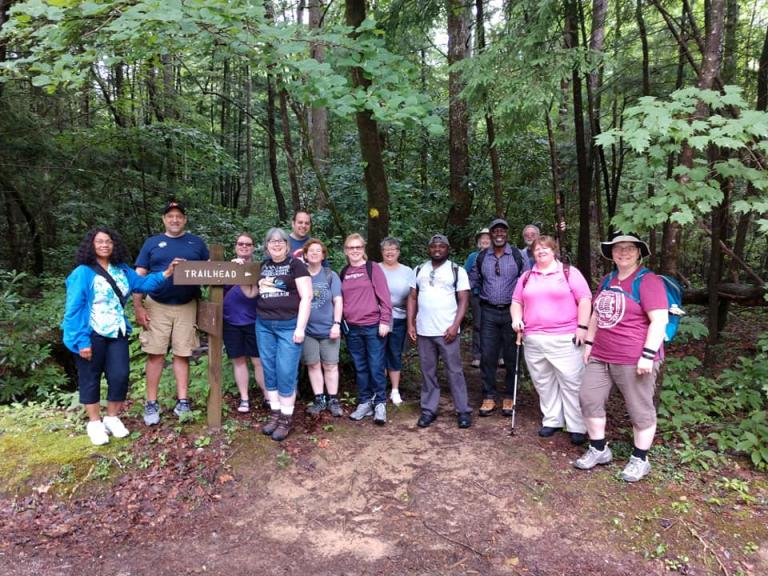
Students from Lexington Theological Seminary visit Blanton Forest in the Kentucky Natural Lands Preserve, 2019.
Baptized in the forest cathedral
As we walked, the thunderclouds rolled over the shoulders of the mountains and baptized us right there in the forest cathedral. For some of the students, it was the first time they had ever been in an old-growth forest. The reverence they felt that day has helped many of them to understand their Christian calling as including advocacy for God’s Creation.
This is why I find these words of Jesus in Matthew 12:40 so profound. “[F]or three days and three nights the Son of Man will be in the heart of the earth.” The Greek phrase is en kardia ge, literally “in the heart of the earth.” And “heart” here does not just mean in the center of the earth. Jesus is saying that he is going to that place within the Earth that is the seat of physical life, just like a human heart. This is extremely important for our concept of the created world. These words evoke the notion that Earth is a living entity, for one thing. And that Earth has a center of spiritual, intellectual, and physical life.
This is a revolutionary change in attitude toward Earth from what we see in Genesis. After Eve and Adam violated the Tree of Knowledge, they were forced into an adversarial relationship with the land. Yet in this passage of Matthew, Jesus is saying that he will not rule over Earth, but allow himself to be taken in by it. His crucifixion and resurrection, therefore, is not just for the salvation of human beings, but for the very Earth itself.
This prompts us to ask: what is our individual vocation to reconcile with Creation? What is the church’s vocation to care for and steward the land entrusted to us?
Many churches have large grass plots that are ecological dead zones. They are mowed so there is no animal habitat, no nectar for bees and butterflies. Plus the gas of the lawn mower is destructive to the air and unnecessary use of fossil fuels. What if this land was allowed to return to its natural state? What if butterfly gardens were planted? How might we reconsider our relationship with the very land the supports the church building?
Especially as the climate crisis worsens, we need ecosystems like tall grass prairies and old growth forests to draw down the carbon dioxide that is causing global warming. Trees absorb carbon dioxide and produce the oxygen we need to live. And the deep root systems of prairies allow them to develop resilience to droughts, floods, and wildfires. Reestablishing prairies and protecting forests is one of the best ways to mitigate climate change.
Good for the climate. Good for our Earth-kin.
Plus, the habitats for insects, amphibians, birds, and mammals are vital in these ecosystems. Since the restoration of the Nachusa Grasslands, the ponds have become a natural area that attracts an abundance of diverse species. Even endangered whooping cranes and Sandhill cranes are finding a home for feeding and nesting.
In Blanton Forest, Pine Mountain has become a critical refuge and migratory route that runs through a region. The ridge is a 125-mile intact natural lands corridor where nearly 100 species of rare plants and animals live, some found nowhere else on the planet.
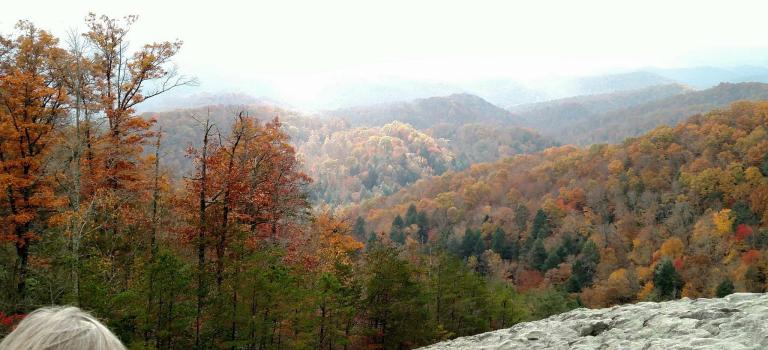
Sun breaking through clouds at Blanton Forest, Pine Mountain, Ky. Photo credit: Leah D. Schade. All rights reserved.
What do you think might happen if the land around the church were able to host threatened species of butterflies, bird, and bees? Could we think expansively about what it means to be a congregation and include God’s Creation as part of that? Imagine our young people and future generations connecting with the beauty of nature right in our own backyard. Imagine church services held amidst the buzzing, chirping, and singing of our fellow worshipers in God’s Creation.
Jesus was taken in by Earth and was resurrected from deep within the tomb. Jesus’ resurrection was for all the cosmos.
Earth, too, experiences a kind of resurrection when we attend to these wild places. We must protect and restore God’s good Creation, and teach our children to love and care for the land.
As it is written, “for three days and three nights the Son of Man was in the heart of the earth.” But the Son of Man holds the heart of the earth for eternity. Amen.
Read also:
Preserving the Holy Remnant: Kentucky Natural Lands Trust
Appalachia doesn’t need saving. It needs solidarity.
Finding Eden’s Forests in the Midst of COVID19
Leah D. Schade is the Assistant Professor of Preaching and Worship at Lexington Theological Seminary in Kentucky and ordained in the ELCA. Dr. Schade does not speak for LTS or the ELCA; her opinions are her own. She is the author of Preaching in the Purple Zone: Ministry in the Red-Blue Divide (Rowman & Littlefield, 2019) and Creation-Crisis Preaching: Ecology, Theology, and the Pulpit (Chalice Press, 2015). She is also the co-editor of Rooted and Rising: Voices of Courage in a Time of Climate Crisis (Rowman & Littlefield, 2019).
Twitter: @LeahSchade
Facebook: https://www.facebook.com/LeahDSchade/
Previous Post
July 20, 2020
Finding Eden’s Forests in the Midst of COVID19
Next Post

July 28, 2020 #CloudOfClergy: The Many Ways Faith Leaders Show Up for Justice
Browse Our Archives
Select a Category Academy of Homiletics Addiction Advent AI (Artificial Intelligence) Animals Apocalypse Appalachia Ash Wednesday Baptism Bible Black Lives Matter Blade Runner Book review Children in church Christian Nationalism Christian/Islamic relations Christmas Church Clergy Climate change COVID-19 Creation Data Centers Death penalty Devotional Dialogue Doubt Earth Day Easter Ecofeminism EcoPreacher 1-2-3 ELCA ELCA Youth Gathering Election Environment/ecology Epiphany Faith Faith and Politics Feminism Film review Food Food and Faith Forgiveness Fracking Good Friday Good Omens Grief Gun violence Holy Humor Sunday Holy Week Howard Thurman ICE Immigration Indigenous wisdom Interview Jesus Kentucky Lafayette High School Marching Band Leadership Lent LGBTQIA+ Marching band Martin Luther Martin Luther King Jr. Mary Maundy Thursday Michael Sheen Mother of Jesus Nature New Year's Eve Palm Sunday Parables Pentecost Poem, Poetry Politics Poor People's Campaign Pop culture Prayers Preaching Progressive Christianity Public theology Purple Zone Racism and White Privilege Religion Religion and environment Religion and politics Religion and pop culture Religion and violence Rev. Nelson Rabell Gonzalez Sermons Spanish language resources for preaching Technology Thanksgiving Theological education theology Trees Trump Uncategorized Vegan War Women and religion Workshop Worship
Select a Month October 2026 September 2026 July 2026 June 2026 May 2026 April 2026 March 2026 February 2026 January 2026 December 2025 November 2025 October 2025 September 2025 May 2025 April 2025 March 2025 February 2025 January 2025 December 2024 November 2024 October 2024 September 2024 August 2024 July 2024 June 2024 May 2024 April 2024 March 2024 February 2024 January 2024 December 2023 November 2023 October 2023 September 2023 August 2023 July 2023 June 2023 May 2023 April 2023 March 2023 February 2023 January 2023 December 2022 November 2022 October 2022 August 2022 July 2022 June 2022 May 2022 April 2022 March 2022 February 2022 January 2022 December 2021 November 2021 October 2021 September 2021 August 2021 July 2021 June 2021 May 2021 April 2021 March 2021 January 2021 December 2020 November 2020 October 2020 September 2020 August 2020 July 2020 June 2020 May 2020 April 2020 February 2020 January 2020 December 2019 November 2019 October 2019 September 2019 August 2019 July 2019 June 2019 May 2019 April 2019 March 2019 January 2019 December 2018 November 2018 October 2018 September 2018 August 2018 July 2018 June 2018 May 2018 April 2018 March 2018 February 2018 January 2018 December 2017 November 2017 October 2017 September 2017 August 2017 July 2017 June 2017 May 2017 April 2017
Follow Us!
TAKE THE
Religious Wisdom Quiz
Who is known for teaching that "faith without works is dead"?
Select your answer to see how you score.
Jude Peter James Paul
Books by This Author Books by Leah D. Schade
Related posts from EcoPreacher

Love Your Neighbor – Including Earth-Kin: Lev. 19,...

What Matt. 21:23-32 Teaches About Integrity In An...

Preaching About Climate Change: What Clergy Need Most
When The Data Center Wolf Is At Your...
TRENDING AT PATHEOS Progressive Christian

What Being a Modern-Day Apostle Means to Me
In my last column, I discussed the ins and outs of modern-day...

Did Ancient China Once Worship the God of...
Across human history, a common thread weaves through the origins of the...

Love Your Neighbor – Including Earth-Kin: Lev. 19,...
God’s command to love your neighbor means acting in an ethical and...

Lead a Church Study of “Jesus and Lao...
Guest writer Jack Thomas (The Irreverent Reverend) reflects on leading his church...

Pastoral Wisdom for Responding to Sermon Pushback
Getting sermon pushback on your social justice sermon? Learn practical, Proverbs-based strategies...

Principles for Understanding the Apostolic Ministry Today
Whenever people discover that my formal ministry title is "apostle," as in...
view all Progressive Christian blogs
Ad-Free & Subscriber Log-In Subscription Support
- About Us
- 2026 Calendar
- Videos
- Podcasts
- Library of World Religions
- Faith In Media Tracker
- Advertise With Us
- Write for Us
- Privacy Policy
- Terms of Service
- Do Not Sell My Data
- Contact Us
- Radiant Digital
- Manage Newsletter Subscriptions
- Unsubscribe From Notifications
- Sitemap
Copyright 2008-2026, Patheos. All rights reserved.
Subscription Support Ad-Free & Subscriber Log-In
Follow Patheos