
BuddhistCatholicContemplativeEvangelicalGeneral ChristianHinduJewishLatter-day SaintMuslimNew VisionsProgressive Christian
Beliefs
- Buddhist
- Catholic
- Contemplative
- Evangelical
- General Christian
- Hindu
- Jewish
- Latter-day Saint
- More Voices
- Muslim
- New Visions
- Pagan
- Progressive Christian
Topics
- Religion News
- Food and Religion
- Sports and Religion
- Religious Art
- Religious Music and Entertainment
- Religious Events
- History and Religion
- Style and Religion
- Politics and Religion
- Women in Religion
- Recreation Outdoors and Religion
- Business Finance and Religion
- Careers Workplace and Religion
- Education and Religion
- Family Parenting and Religion
- Health Fitness and Religion
- Home and Religion
- Relationships and Religion
- Technology and Religion
- Travel and Religion
Columnists
- Buddhist Columnists
- Business Finance and Religion Columnists
- Careers Workplace and Religion Columnists
- Catholic Columnists
- Contemplative Columnists
- Education and Religion Columnists
- Evangelists Columnists
- Family Parenting and Religion Columnists
- General Christian Columnists
- Health Fitness and Religion Columnists
- Hindu Columnists
- History and Religion Columnists
- Home and Religion Columnists
- Jewish Columnists
- More Voices Columnists
- Latter Day Columnists
- Muslim Columnists
- New Visions Columnists
- Nonreligious Columnists
- Pagan Columnists
- Politics and Religion Columnists
- Progressive Columnists
- Recreation Outdoors and Religion Columnists
- Relationships and Religion Columnists
- Religion News Columnists
- Religious Art Columnists
- Religious Events Columnists
- Religious Music and Entertainment Columnists
- Sports and Religion Columnists
- Style and Religion Columnists
- Technology and Religion Columnists
- Travel and Religion Columnists
- Women in Religion Columnists
Resource Library
- 2026 Calendar
- Library of World Religions
- The 100 Most Holy Places on Earth
- Patheos Answers
- Podcasts
- Videos
- Faith Leaders Database
- Anglican Episcopalian
- Bahai
- Baptist
- Buddhism
- Christianity
- Confucianism
- Eastern Orthodoxy
- Hinduism
- Holiness and Pentecostal
- ISKCON
- Islam
- Judaism
- Lutheran
- Methodist
- The Church of Jesus Christ of Latter-day Saints
- New Age
- Paganism
- Presbytarian and Reformed
- Protestantism
- Religion Behind the Scenes
- Roman Catholic
- Scientology
- Shia Islam
- Sikhism
- Sufism
- Sunni Islam
- Taoism
- Zen
- See all religions
Research Tools
 Ad-Free & Subscriber Log-In Subscription Support
Ad-Free & Subscriber Log-In Subscription Support
Follow Patheos 

- Trending:
- Forgiveness
- |
- Marriage
- |
- Consciousness
- |
- Death Penalty
- |
- Election
- |
- Halloween

- Home
- Progressive Christian
- We Are ‘Hosanna People’: Palm Sunday and Coronavirus
We Are ‘Hosanna People’: Palm Sunday and Coronavirus
Last updated on: July 20, 2020 at 8:27 am by Leah D. Schade
We Are ‘Hosanna People’: Palm Sunday and Coronavirus 2020-07-20T08:27:33-04:00 Leah D. Schade
Patheos Explore the world's faith through different perspectives on religion and spirituality! Patheos has the views of the prevalent religions and spiritualities of the world.
Palm Sunday’s “Hosanna” takes on a new meaning in the time of the coronavirus epidemic.
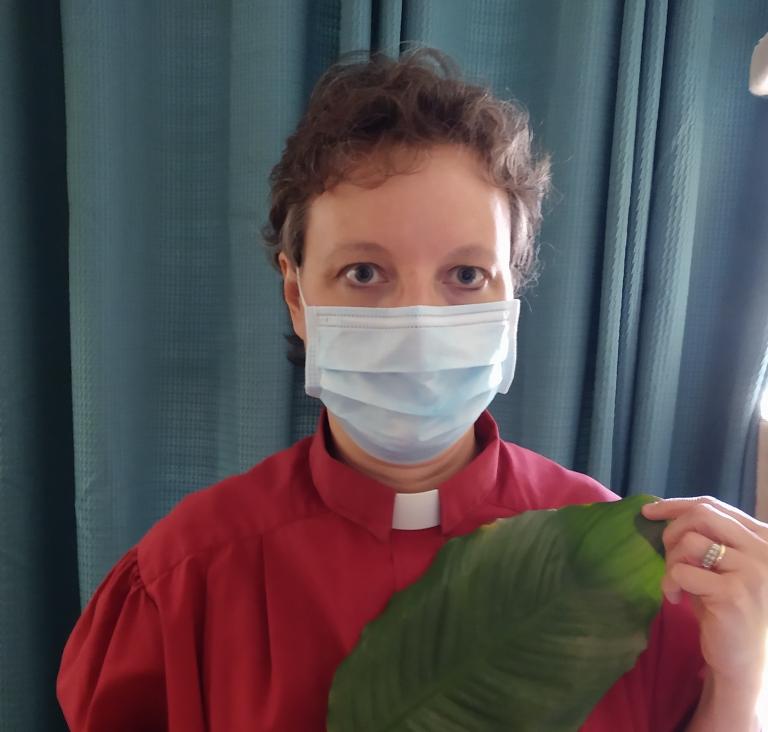
Palm Sunday’s ‘Hosanna’ in the Age of Coronavirus. Photo: Leah D. Schade. All rights reserved.
For many of us who have heard the story of Palm Sunday so many times, we may miss the political significance of what is happening here. This is a provocative scene – Jesus coming into Jerusalem with crowds of people announcing him as a king. This is a dangerous thing, because in the Roman Empire, there can be no king but Caesar. What’s more, Jesus is actually mocking earthly rulers by what he’s doing – riding on a donkey.
Why is riding a donkey a problem?
Well, the crowds call Jesus, “Son of David.” This means they regarded him as the rightful heir of the throne of Israel. They thought of him as a king. They knew the stories about Jesus’ power – healing the sick, casting out demons, bravely confronting the religious authorities. To the crowd, this was their hoped-for Messiah. This was the Anointed One whom they had been longing for since the glory days when King David ruled over Israel and conquered the surrounding lands.
But does this “king” come riding into Jerusalem on a gilded chariot befitting someone of his stature? No. Does he ride a fabulously decorated steed and regally trot through the gate? No. He’s sitting on a donkey.
For a contemporary comparison, think of how the president of a country travels.
In the U.S., they use Air Force One, a private military jet. And they ride in an armored limo surrounded by an armored motorcade that speeds through the city.
Now imagine if, instead of this stately motorcade, a president was riding in one of those little clown cars. All political jokes aside, this would be a comical sight, wouldn’t it?
The humor in this situation would not have been lost on the crowds gathered along the roadside. In fact, they might have been a little put off by what they saw. What does Jesus think he’s doing, riding a donkey into Jerusalem?
This is not befitting the king of Israel. What’s going on here?
There they are, spreading their cloaks and palm branches in front of him. They’re indicating how highly they regard Jesus. It would be like laying out the red carpet at the Oscars only to have the movie star walk in wearing muddy boots and work clothes. They are throwing down their cloaks and palms for this man they adore, but he’s acting like a commoner. See, Jesus is actually poking fun at himself. He’s satirizing the pedestal upon which they are trying to place him.
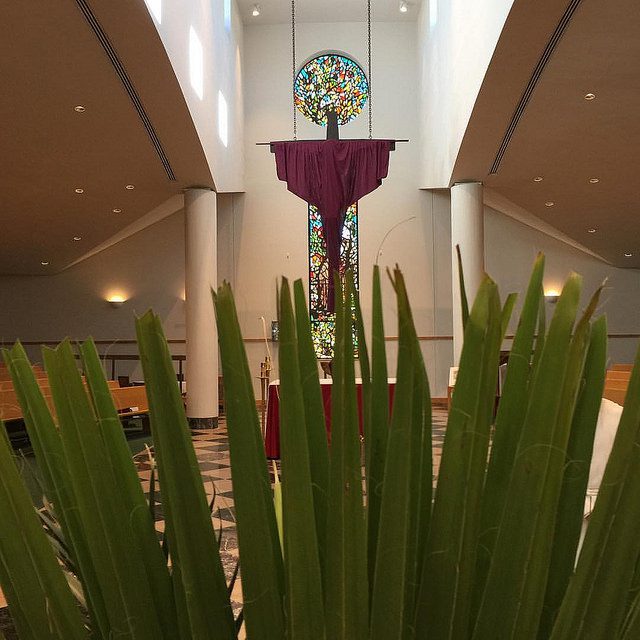
Palm Sunday. Photo by Tony Alter. Some rights reserved. www.flikr.com
But this doesn’t stop them. Undeterred by the comic discrepancy, the crowd is shouting, “Hosanna to the Son of David! Blessed is the one who comes in the name of the Lord! Hosanna in the highest heaven!”
I want to pause on this word, “Hosanna.” Do you know what the word “hosanna” means?
In Hebrew and Aramaic, Hosanna means, “Save us, we pray.”
That is a prayer that has been on the lips of millions, perhaps billions of people across the globe these last few months. As the coronavirus has spread throughout the world, taking down country after country like some kind of biblical plague, many have been overwhelmed with fear and anxiety. Those who succumb to the virus are often wracked by pain in their bodies, their lungs attacked and scarred. And families who have lost loved ones are devastated.
For the rest of us, many are facing unprecedented pressures in a world that feels like it’s been turned upside down. Households are disrupted by spouses and loved ones out of work. Or pulling extra shifts if they’re in essential personnel. Young kids are now at home during school hours. College students have scrambled to leave campus. The constraints of social distancing seem to stretch on without end. And many are facing a precarious economic situation all the way around.
In the midst of this, congregations are trying to figure out what it means to be church in this unprecedented time.
When we most need to be together, we can’t even gather in our sacred spaces and hold each other’s hands or offer a comforting embrace. Collectively, we are crying out or simply whispering through tears, “Save us, we pray.”
Image by Irina Patrusca. Some rights reserved, flickr.com
So where is God in the midst of this?
In these last few weeks and right now, we are all experiencing a time when things have changed in ways we could never have imagined only a few weeks ago. We’re feeling disoriented. And for some, it can be a crisis of faith.
So, it turns out that Holy Week could not be coming at a better time.
The week leading up to Jesus’s last supper, his arrest in the garden, his trial, and his crucifixion – this was a crisis of faith for the disciples. Their world was completely upended. Violence, corruption, the heartlessness of certain religious and government leaders, the grandstanding of Pilate, the injustice of sentencing an innocent man to death – all of it echoes so loudly in our own time.
So where is God in all this?
I submit to you that Jesus has indeed come into our midst in ways we might not immediately recognize. Jesus comes to us through what we might call our “Hosanna people.”
Who are our Hosanna people?
They are the medical workers who are literally saving lives.
Doctors, nurses, pharmacists, all medical personnel are trying to keep the life-breath in us. And many of them are doing this work without sufficient resources, beds, and personal protective equipment. They are fighting for our lives. And through them, Jesus is answering the prayer, “Save us, we pray.”
Our Hosanna people are the ones who grow and harvest our food.
They are the truckers who bring the goods we need driving endless hours and stretches of road. They are the grocery workers who stock our shelves. And the drivers who deliver food to the homes of people who are quarantined. They are working to keep us alive by bringing us the food we need – including the very bread you will eat and the wine or juice you will drink for communion. Through them, Jesus is answering the prayer, “Save us, we pray.”
Our Hosanna people are the utility workers.
They make sure we have clean, flowing water and electricity to power our homes and the ventilators that are keeping people alive. They are unseen, but they are vital to our survival.
Our Hosanna people are the first responders.
Military, police, fire fighters, emergency personnel. They are the ones who put themselves in danger in order to save lives.
And our Hosanna people are those who clean.
The sanitation workers, the janitors and cleaning crews who are literally saving lives by washing and wiping and sanitizing and deep cleaning. Through them, Jesus is answering the prayer, “Save us, we pray.”

Cleaning. Photo by Leah D. Schade. Public domain.
Remember them on Maundy Thursday when we tell the story of Jesus washing the feet of his disciples. These people who clean our toilets, who sweep our floors and empty our trash, who clean our hotel rooms and sort through our recycling. Always on the lowest economic rung, often female, sometimes undocumented – they are washing our feet and we don’t even realize it.
These are people we often look down upon and the ones we pay the least. But they are our Hosanna people. They are responding to needs. Theirs is holy work. They are the answer to someone’s prayer, “Save us, pray.” Theirs is a divine vocation.
You see, Jesus comes through them and for them.
If someone of his social status – a rabbi – came into town on a lowly donkey and did common foot washing, what did that mean for everyone else? Those with a higher social status were brought down a notch. And those who were lowly, their status was lifted by virtue of Jesus performing this act and doing this work.
So I encourage you to lay down your cloaks and palms for the Hosanna people, knowing that Jesus is coming through them and for them, and for us. We can see and hear that there are far too many people crying out, “Save us, we pray.” These are people we often ignore and dismiss. Many of them do not receive enough pay for a living wage. Many do not even have the benefit of basic healthcare.
Yet they are responding to this call: “Save us, we pray!”
So we can work to rebuild our world, our financial systems, our healthcare systems, our communities, and yes, even our churches, in a way that comes closer to the Realm of God that Jesus initiated on the back of that donkey.
Jesus comes right into a broken and upside-down world so that we may see with new eyes, discover compassion within our hearts, and devote our minds and hands to creating something new and just and good.
We who receive God’s love in Jesus are called to love each other, to be servants to each other, just as Jesus became our servant. When we share this worship service – we are doing this together, even though we are separated by time and distance.
It is in these moments—in washing, serving, and sharing worship—that we experience God’s love. And we extend this love to those who are so selflessly giving of their time, their health, their labor, and their commitment to their neighbors.
When we advocate for them, for those who have served us, then we, too, will be an answer to their prayer, “Save us, we pray.”
Then, together, we will all be a Hosanna people.
Amen.
Read also:
When Earth Demands Sabbath: Learning from the Coronavirus Pandemic
More than Eco-Palms: Ecojustice and Palm Sunday
Those Who Wash: The Divine Disorientation of Maundy Thursday
 Leah D. Schade is the Assistant Professor of Preaching and Worship at Lexington Theological Seminary in Kentucky and ordained in the ELCA. Dr. Schade does not speak for LTS or the ELCA; her opinions are her own. She is the author of Preaching in the Purple Zone: Ministry in the Red-Blue Divide (Rowman & Littlefield, 2019), Rooted and Rising: Voices of Courage in a Time of Climate Crisis (Rowman & Littlefield, 2019), and Creation-Crisis Preaching: Ecology, Theology, and the Pulpit (Chalice Press, 2015).
Leah’s latest book is a Lenten devotional centered on Creation: For the Beauty of the Earth (Chalice Press, 2020).
Twitter: @LeahSchade
Facebook: https://www.facebook.com/LeahDSchade/
Previous Post

April 3, 2020
6 Tips for Avoiding Zoom Fatigue in the Age of COVID-19
Next Post

April 9, 2020 Living in a Maundy Thursday World: COVID-19 and Holy Week
Browse Our Archives
Select a Category Academy of Homiletics Addiction Advent AI (Artificial Intelligence) Animals Apocalypse Appalachia Ash Wednesday Baptism Bible Black Lives Matter Blade Runner Book review Children in church Christian Nationalism Christian/Islamic relations Christmas Church Clergy Climate change COVID-19 Creation Data Centers Death penalty Devotional Dialogue Doubt Earth Day Easter Ecofeminism EcoPreacher 1-2-3 ELCA ELCA Youth Gathering Election Environment/ecology Epiphany Faith Faith and Politics Feminism Film review Food Food and Faith Forgiveness Fracking Good Friday Good Omens Grief Gun violence Holy Humor Sunday Holy Week Howard Thurman ICE Immigration Indigenous wisdom Interview Jesus Kentucky Lafayette High School Marching Band Leadership Lent LGBTQIA+ Marching band Martin Luther Martin Luther King Jr. Mary Maundy Thursday Michael Sheen Mother of Jesus Nature New Year's Eve Palm Sunday Parables Pentecost Poem, Poetry Politics Poor People's Campaign Pop culture Prayers Preaching Progressive Christianity Public theology Purple Zone Racism and White Privilege Religion Religion and environment Religion and politics Religion and pop culture Religion and violence Rev. Nelson Rabell Gonzalez Sermons Spanish language resources for preaching Technology Thanksgiving Theological education theology Trees Trump Uncategorized Vegan War Women and religion Workshop Worship
Select a Month October 2026 September 2026 July 2026 June 2026 May 2026 April 2026 March 2026 February 2026 January 2026 December 2025 November 2025 October 2025 September 2025 May 2025 April 2025 March 2025 February 2025 January 2025 December 2024 November 2024 October 2024 September 2024 August 2024 July 2024 June 2024 May 2024 April 2024 March 2024 February 2024 January 2024 December 2023 November 2023 October 2023 September 2023 August 2023 July 2023 June 2023 May 2023 April 2023 March 2023 February 2023 January 2023 December 2022 November 2022 October 2022 August 2022 July 2022 June 2022 May 2022 April 2022 March 2022 February 2022 January 2022 December 2021 November 2021 October 2021 September 2021 August 2021 July 2021 June 2021 May 2021 April 2021 March 2021 January 2021 December 2020 November 2020 October 2020 September 2020 August 2020 July 2020 June 2020 May 2020 April 2020 February 2020 January 2020 December 2019 November 2019 October 2019 September 2019 August 2019 July 2019 June 2019 May 2019 April 2019 March 2019 January 2019 December 2018 November 2018 October 2018 September 2018 August 2018 July 2018 June 2018 May 2018 April 2018 March 2018 February 2018 January 2018 December 2017 November 2017 October 2017 September 2017 August 2017 July 2017 June 2017 May 2017 April 2017
Follow Us!
TAKE THE
Religious Wisdom Quiz
Who was Jephthah's daughter?
Select your answer to see how you score.
Unnamed Deborah Ruth Miriam
Books by This Author Books by Leah D. Schade
Related posts from EcoPreacher

What Matt. 21:23-32 Teaches About Integrity In An...

Making Space for Eco-Grief—and Hope—in Your Church
VBS Murder Skit: When a Church Teaches Children...
Cancer Alley Prophets: Jeremiah 20, Matthew 10
TRENDING AT PATHEOS Progressive Christian

What Being a Modern-Day Apostle Means to Me
In my last column, I discussed the ins and outs of modern-day...

Did Ancient China Once Worship the God of...
Across human history, a common thread weaves through the origins of the...

Love Your Neighbor – Including Earth-Kin: Lev. 19,...
God’s command to love your neighbor means acting in an ethical and...

Lead a Church Study of “Jesus and Lao...
Guest writer Jack Thomas (The Irreverent Reverend) reflects on leading his church...

Pastoral Wisdom for Responding to Sermon Pushback
Getting sermon pushback on your social justice sermon? Learn practical, Proverbs-based strategies...

Principles for Understanding the Apostolic Ministry Today
Whenever people discover that my formal ministry title is "apostle," as in...
view all Progressive Christian blogs
Ad-Free & Subscriber Log-In Subscription Support
- About Us
- 2026 Calendar
- Videos
- Podcasts
- Library of World Religions
- Faith In Media Tracker
- Advertise With Us
- Write for Us
- Privacy Policy
- Terms of Service
- Do Not Sell My Data
- Contact Us
- Radiant Digital
- Manage Newsletter Subscriptions
- Unsubscribe From Notifications
- Sitemap
Copyright 2008-2026, Patheos. All rights reserved.
Subscription Support Ad-Free & Subscriber Log-In
Follow Patheos