
BuddhistCatholicContemplativeEvangelicalGeneral ChristianHinduJewishLatter-day SaintMuslimNew VisionsProgressive Christian
Beliefs
- Buddhist
- Catholic
- Contemplative
- Evangelical
- General Christian
- Hindu
- Jewish
- Latter-day Saint
- More Voices
- Muslim
- New Visions
- Pagan
- Progressive Christian
Topics
- Religion News
- Food and Religion
- Sports and Religion
- Religious Art
- Religious Music and Entertainment
- Religious Events
- History and Religion
- Style and Religion
- Politics and Religion
- Women in Religion
- Recreation Outdoors and Religion
- Business Finance and Religion
- Careers Workplace and Religion
- Education and Religion
- Family Parenting and Religion
- Health Fitness and Religion
- Home and Religion
- Relationships and Religion
- Technology and Religion
- Travel and Religion
Columnists
- Buddhist Columnists
- Business Finance and Religion Columnists
- Careers Workplace and Religion Columnists
- Catholic Columnists
- Contemplative Columnists
- Education and Religion Columnists
- Evangelists Columnists
- Family Parenting and Religion Columnists
- General Christian Columnists
- Health Fitness and Religion Columnists
- Hindu Columnists
- History and Religion Columnists
- Home and Religion Columnists
- Jewish Columnists
- More Voices Columnists
- Latter Day Columnists
- Muslim Columnists
- New Visions Columnists
- Nonreligious Columnists
- Pagan Columnists
- Politics and Religion Columnists
- Progressive Columnists
- Recreation Outdoors and Religion Columnists
- Relationships and Religion Columnists
- Religion News Columnists
- Religious Art Columnists
- Religious Events Columnists
- Religious Music and Entertainment Columnists
- Sports and Religion Columnists
- Style and Religion Columnists
- Technology and Religion Columnists
- Travel and Religion Columnists
- Women in Religion Columnists
Resource Library
- 2026 Calendar
- Library of World Religions
- The 100 Most Holy Places on Earth
- Patheos Answers
- Podcasts
- Videos
- Faith Leaders Database
- Anglican Episcopalian
- Bahai
- Baptist
- Buddhism
- Christianity
- Confucianism
- Eastern Orthodoxy
- Hinduism
- Holiness and Pentecostal
- ISKCON
- Islam
- Judaism
- Lutheran
- Methodist
- The Church of Jesus Christ of Latter-day Saints
- New Age
- Paganism
- Presbytarian and Reformed
- Protestantism
- Religion Behind the Scenes
- Roman Catholic
- Scientology
- Shia Islam
- Sikhism
- Sufism
- Sunni Islam
- Taoism
- Zen
- See all religions
Research Tools
 Ad-Free & Subscriber Log-In Subscription Support
Ad-Free & Subscriber Log-In Subscription Support
Follow Patheos 

- Trending:
- Forgiveness
- |
- Marriage
- |
- Consciousness
- |
- Death Penalty
- |
- Election
- |
- Halloween

- Home
- Progressive Christian
- Love Touches Fear: Transfiguration Sunday
Love Touches Fear: Transfiguration Sunday
Last updated on: July 20, 2020 at 8:31 am by Leah D. Schade
Love Touches Fear: Transfiguration Sunday 2020-07-20T08:31:32-04:00 Leah D. Schade
Patheos Explore the world's faith through different perspectives on religion and spirituality! Patheos has the views of the prevalent religions and spiritualities of the world.
On Transfiguration Sunday, divinity touches humanity. Transcendence touches immanence. Love touches fear.

Photo by Joshua Earle on Unsplash
During the Sundays of Lent, I’ve been invited to First Presbyterian Church in Lexington, Kentucky, to lead a deliberative dialogue series on “The Role of the Church in a Divided Society.” In preparation for this series, I preached this sermon on Transfiguration Sunday to frame the dialogue from a biblical and theological perspective.
When you look at this image, what do you see?

Rubin’s vase. By John smithson 2007, Public Domain, https://commons.wikimedia.org/w/index.php?curid=13901986
I remember the first time I saw this picture and the person told me that it wasn’t just a vase in the picture. There are two faces as well. I just didn’t see it at first. Then they showed me – here is the nose, the chin, the eyes, the forehead. And the light went on in my mind. I could actually feel something click in my brain. An a-ha moment. I could see the faces.

Have you ever had one of those moments? Something happens when, all of a sudden, you see. You get it. You understand.
The disciples had one of those moments on the mountain of Transfiguration. Up until this point, they had only seen Jesus in one way—as a human being. Certainly he is a miraculous human being—an amazing man who casts out demons, heals the sick, and preaches captivating sermons. But still, just a human being.
However, Peter was starting to understand that there was something more to Jesus than meets the eye. In the previous chapter, Jesus had asked the disciples, “Who do you say that I am?” Peter correctly answered, “You are the Christ, the son of God.” But when Jesus explained that this meant he must suffer death on the cross and be resurrected, Peter chastised Jesus for saying this. So Jesus tells him that he has his mind only on human things rather than the realm of the divine. He’s seeing only the vase instead of the faces, so to speak.
But here on the mountain, Peter’s mind is forced to reckon with divine things.
These three disciples have ascended the mountain with their teacher and found themselves in the very presence of God. Eyes wide, mouths agape, they see Jesus standing beside the two pillars of the Jewish faith. Moses, the great leader and warrior, the one who led the people out of Egypt and slavery. The one who presented the Torah, God’s holy law, to the people. And Elijah, Israel’s greatest prophet. The one who called the people back to the Torah and into a right relationship with God and neighbor.
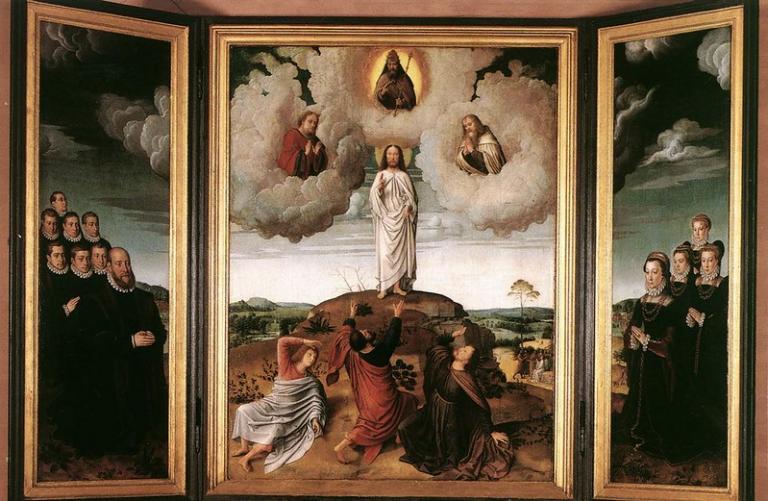
“The Transfiguration of Christ,” Gerard David, 1520. Public domain.
Certainly as they gazed on these two figures, the disciples would have remembered the story we heard in the first reading. Moses ascends to Mt. Sinai to receive the commandments of God. He leaves the people at the foot of the mountain while he climbs higher and higher until they can no longer see him. Notice that they each see different things. Moses enters a billowing, all-engulfing cloud of the divine presence that shrouds him from his people. But from the bottom of the mountain, the people see a devouring fire—a fierce, all-engulfing light that seems to consume the whole mountain. So what it is – cloud or fire? Vase or face?
Of course, it is both.
This is what’s known as a *theophany—*God revealing Godself in an indescribable event of transcendence and immanence all at once.
God is both the pillar of cloud by day and the pillar of fire by night. God is the blazing fire of the burning bush that does not consume. And God is mysterious fog that surrounds Moses in divine secrecy and revelation. This means that Moses is in a liminal space, an in-between place. His feet are touching the earth, but his face is looking to God.
The Celtic people had a name for such a place where heaven and earth come so close to each other that you can catch a glimpse of God’s holiness. They call it “a thin place.” It’s a place where the distance between the sacred and the profane becomes a thin membrane through which the spiritual realm enters into the earthly realm. It’s also a place of disorientation and confusion. We lose our bearings because we are being reoriented. We are seeing the world in a new way. We are seeing God in a new way.
On the Mount of Transfiguration, the disciples are seeing Christ in a new way.
C.S. Lewis once said, “What you see . . . depends a good deal on where you are standing: It also depends on what sort of person you are.” (C. S. Lewis, The Magicians Nephew, in The Chronicles of Narnia [New York: HarperCollins, 2001], 75). This is certainly true for the disciples. After seeing Jesus shining with a brightness that surpassed anything they had ever seen, and seeing Moses and Elijah standing their with teacher, their response is, well, anticlimactic at best. At worst, it’s inappropriate, silly, even sacrilegious.
They want to build three little tabernacles for the holy figures. As if their shelters of branches could house the divine eminence before them. Do they really think they can pin down the sacred and build a tent around it? Hold onto the divine moment for all time in this one place? Are they that audacious to think they can contain the divinity before them? Or are they just that clueless?
Maybe we shouldn’t be too hard on Peter, James and John.
After all, they are encountering something that no other human being has ever seen. Sometimes when you see something for the first time that is completely outside your frame of reference, you just don’t have the mental, emotional and experiential template to make sense out of what you’re seeing.
The disciples were so astounded, so caught off guard, so frightened by the vision in front of them that they just started blubbering whatever came to their minds. They failed to grasp the full importance of what they were seeing.
So the voice of God has to speak to them, spell out for them exactly what they are missing, show them what it is they are supposed to see. A great cloud envelops them. It is similar to the divine cloud that enshrouded Moses on Mt. Sinai. It’s the same kind of thunderous cloud that pulled Elijah up in a whirlwind of glory.
The voice speaks. “This is my Son, the Beloved. Listen to him.”
Here is what you have been missing, says God. This is what you need to see. Now open your ears as well. Follow his teachings.
Peter, James and John are given a vision and their eyes are opened. They see the divinity of Jesus. They see Jesus as the unique Son of God.
The transfiguration is the lens through which they will observe and participate in the rest of Jesus’s ministry and teaching. His arrest, trial, crucifixion and resurrection will all be seen with the light of the Transfiguration behind them. This is a moment of clarity as they prepare for a tumultuous time ahead. The Transfiguration is about the identity of Jesus, his relationship with his disciples, and what they will face when they come down off the mountain.
Transfiguration Sunday is also a moment of clarity for us as we prepare for a tumultuous time ahead.
We live in a time of divisiveness in a country that is in the midst of a crucial reckoning about who we are as a nation and who we want to lead us. All of this has important ramifications for us at the church today.
What is the church’s role in the public square when we are grappling with all this? What is our role as Christians when we’re trying to decide how we live community together? How will we be the church in the midst of this divisive and fractious time? How will we be in ministry together when some of us see vases and others see faces?
Over the next five weeks of Lent, we will have an opportunity to explore these questions. We’ll be undertaking a process called deliberative dialogue in which we will gather for Adult Sunday School using an issue guide called “The Church’s Role in a Divided Society.”
Deliberative dialogue is a form of civil discourse that brings people together to discuss an issue of public concern.
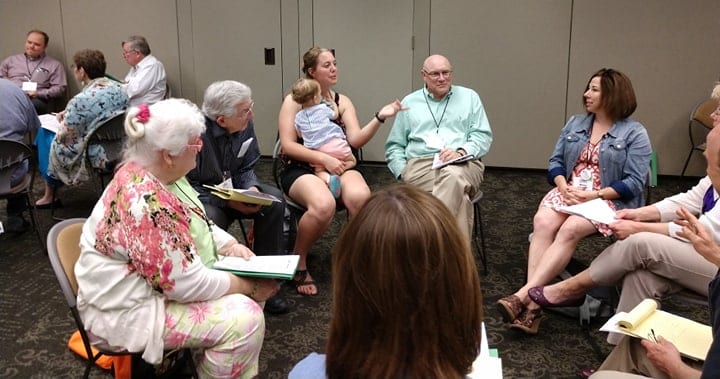
Deliberative dialogue at the Indiana-Kentucky Synod Assembly, 2019
It was developed by a group of research associates at the Kettering Foundation and National Issues Forum Institute, organizations that helps ordinary citizens learn how to do democracy better. The purpose is to listen deeply to each other’s experiences, weigh the benefits and drawbacks to different approaches to the issue, and discern common values we share. The hope is that we might determine different actions for the future that are in alignment with who we are and what God has called us to be.
You see, being the church means being with people who have different values, different perspectives, even misdirected commitments (like the disciples wanting to build tabernacles).
But notice – Jesus does not kick them off the mountain when they get it wrong.
In fact, you can see how much Jesus cares for the disciples by looking at the verbs used. He “takes” and “leads” them up to the mountain. And after they hear the voice of God and are cowering in fear, what does he do? He “touches” them. He says, “Arise. Do not be afraid.”
There in that thin place, divinity touches humanity. Transcendence touches immanence. Love touches fear.
I don’t know if our deliberative dialogue over the next five weeks will take us to a “thin place.” But it might. Encounters with the holy don’t just happen on mountaintops amidst billowing clouds or consuming brightness.
Sometimes we encounter the sacred in the taking and leading, in the touching with tenderness. And in the listening.
God speaks to all of them about who Jesus is (my Son, the Beloved) and what they are to do in response (listen to him). So The primary question I will want us to ponder over the next five weeks is this. How do we listen to the voice of Jesus in the midst of our dialogues, our sacred exchanges, our holy discussions?
It’s not easy to do. Our limited human minds have difficulty overlaying two seemingly opposing visions. Face or vase? It’s a paradox, a mystery.
But even when we are afraid as we enter into highly-charged holy moments (as many dialogues can be), we can trust Jesus’s presence among us, assuring us not to fear. The disciples saw the light radiating from their teacher and they heard the voice of God saying that this was indeed God’s Son. It was a moment of wonder and awe.
What it takes in order to see these two opposing visions is . . . holy imagination.
Because we don’t just see with our physical eyes. We see with our minds, with our hearts. What Jesus is trying to do with the disciples, he’s also trying to do with us. He’s trying to help us see. He’s trying to open our eyes, open our ears, open our hearts to perceive the possibilities that God is showing us for healing this world, for transfiguring this world.
So I invite you to enter this “thin place,” this holy conversation with each other, being guided by Jesus, being touched by his hand and listening to his voice: Arise. Fear not. The presence of God is here.
Read also:
Reading Matthew 17:1-9, Transfiguration of Jesus, Through a Dialogical Lens
Choose Life, Hope at the River’s Edge: Moses’s Final Sermon
Leah D. Schade is the Assistant Professor of Preaching and Worship at Lexington Theological Seminary in Kentucky and ordained in the ELCA. Dr. Schade does not speak for LTS or the ELCA; her opinions are her own. She is the author of Preaching in the Purple Zone: Ministry in the Red-Blue Divide (Rowman & Littlefield, 2019), Rooted and Rising: Voices of Courage in a Time of Climate Crisis (Rowman & Littlefield, 2019), and Creation-Crisis Preaching: Ecology, Theology, and the Pulpit (Chalice Press, 2015).
Leah’s latest book is a Lenten devotional centered on Creation: For the Beauty of the Earth (Chalice Press, 2020).
Twitter: @LeahSchade
Facebook: https://www.facebook.com/LeahDSchade/
Previous Post

February 21, 2020
Matt. 17:1-9, Transfiguration of Jesus, With Dialogical Lens
Next Post

February 24, 2020 Soil + Breath = Life. Ash Wednesday Reflection
Browse Our Archives
Select a Category Academy of Homiletics Addiction Advent AI (Artificial Intelligence) Animals Apocalypse Appalachia Ash Wednesday Baptism Bible Black Lives Matter Blade Runner Book review Children in church Christian Nationalism Christian/Islamic relations Christmas Church Clergy Climate change COVID-19 Creation Data Centers Death penalty Devotional Dialogue Doubt Earth Day Easter Ecofeminism EcoPreacher 1-2-3 ELCA ELCA Youth Gathering Election Environment/ecology Epiphany Faith Faith and Politics Feminism Film review Food Food and Faith Forgiveness Fracking Good Friday Good Omens Grief Gun violence Holy Humor Sunday Holy Week Howard Thurman ICE Immigration Indigenous wisdom Interview Jesus Kentucky Lafayette High School Marching Band Leadership Lent LGBTQIA+ Marching band Martin Luther Martin Luther King Jr. Mary Maundy Thursday Michael Sheen Mother of Jesus Nature New Year's Eve Palm Sunday Parables Pentecost Poem, Poetry Politics Poor People's Campaign Pop culture Prayers Preaching Progressive Christianity Public theology Purple Zone Racism and White Privilege Religion Religion and environment Religion and politics Religion and pop culture Religion and violence Rev. Nelson Rabell Gonzalez Sermons Spanish language resources for preaching Technology Thanksgiving Theological education theology Trees Trump Uncategorized Vegan War Women and religion Workshop Worship
Select a Month October 2026 September 2026 July 2026 June 2026 May 2026 April 2026 March 2026 February 2026 January 2026 December 2025 November 2025 October 2025 September 2025 May 2025 April 2025 March 2025 February 2025 January 2025 December 2024 November 2024 October 2024 September 2024 August 2024 July 2024 June 2024 May 2024 April 2024 March 2024 February 2024 January 2024 December 2023 November 2023 October 2023 September 2023 August 2023 July 2023 June 2023 May 2023 April 2023 March 2023 February 2023 January 2023 December 2022 November 2022 October 2022 August 2022 July 2022 June 2022 May 2022 April 2022 March 2022 February 2022 January 2022 December 2021 November 2021 October 2021 September 2021 August 2021 July 2021 June 2021 May 2021 April 2021 March 2021 January 2021 December 2020 November 2020 October 2020 September 2020 August 2020 July 2020 June 2020 May 2020 April 2020 February 2020 January 2020 December 2019 November 2019 October 2019 September 2019 August 2019 July 2019 June 2019 May 2019 April 2019 March 2019 January 2019 December 2018 November 2018 October 2018 September 2018 August 2018 July 2018 June 2018 May 2018 April 2018 March 2018 February 2018 January 2018 December 2017 November 2017 October 2017 September 2017 August 2017 July 2017 June 2017 May 2017 April 2017
Follow Us!
TAKE THE
Religious Wisdom Quiz
What did Jesus do just before raising Lazarus from the dead?
Select your answer to see how you score.
He prayed He wept He preached He climbed a hill
Books by This Author Books by Leah D. Schade
Related posts from EcoPreacher

"Render Unto Caesar": Faith, Politics, and Elections

What Matt. 21:23-32 Teaches About Integrity In An...

Making Space for Eco-Grief—and Hope—in Your Church
VBS Murder Skit: When a Church Teaches Children...
TRENDING AT PATHEOS Progressive Christian

What Being a Modern-Day Apostle Means to Me
In my last column, I discussed the ins and outs of modern-day...

Did Ancient China Once Worship the God of...
Across human history, a common thread weaves through the origins of the...

Love Your Neighbor – Including Earth-Kin: Lev. 19,...
God’s command to love your neighbor means acting in an ethical and...

Lead a Church Study of “Jesus and Lao...
Guest writer Jack Thomas (The Irreverent Reverend) reflects on leading his church...

Pastoral Wisdom for Responding to Sermon Pushback
Getting sermon pushback on your social justice sermon? Learn practical, Proverbs-based strategies...

Principles for Understanding the Apostolic Ministry Today
Whenever people discover that my formal ministry title is "apostle," as in...
view all Progressive Christian blogs
Ad-Free & Subscriber Log-In Subscription Support
- About Us
- 2026 Calendar
- Videos
- Podcasts
- Library of World Religions
- Faith In Media Tracker
- Advertise With Us
- Write for Us
- Privacy Policy
- Terms of Service
- Do Not Sell My Data
- Contact Us
- Radiant Digital
- Manage Newsletter Subscriptions
- Unsubscribe From Notifications
- Sitemap
Copyright 2008-2026, Patheos. All rights reserved.
Subscription Support Ad-Free & Subscriber Log-In
Follow Patheos