
BuddhistCatholicContemplativeEvangelicalGeneral ChristianHinduJewishLatter-day SaintMuslimNew VisionsProgressive Christian
Beliefs
- Buddhist
- Catholic
- Contemplative
- Evangelical
- General Christian
- Hindu
- Jewish
- Latter-day Saint
- More Voices
- Muslim
- New Visions
- Pagan
- Progressive Christian
Topics
- Religion News
- Food and Religion
- Sports and Religion
- Religious Art
- Religious Music and Entertainment
- Religious Events
- History and Religion
- Style and Religion
- Politics and Religion
- Women in Religion
- Recreation Outdoors and Religion
- Business Finance and Religion
- Careers Workplace and Religion
- Education and Religion
- Family Parenting and Religion
- Health Fitness and Religion
- Home and Religion
- Relationships and Religion
- Technology and Religion
- Travel and Religion
Columnists
- Buddhist Columnists
- Business Finance and Religion Columnists
- Careers Workplace and Religion Columnists
- Catholic Columnists
- Contemplative Columnists
- Education and Religion Columnists
- Evangelists Columnists
- Family Parenting and Religion Columnists
- General Christian Columnists
- Health Fitness and Religion Columnists
- Hindu Columnists
- History and Religion Columnists
- Home and Religion Columnists
- Jewish Columnists
- More Voices Columnists
- Latter Day Columnists
- Muslim Columnists
- New Visions Columnists
- Nonreligious Columnists
- Pagan Columnists
- Politics and Religion Columnists
- Progressive Columnists
- Recreation Outdoors and Religion Columnists
- Relationships and Religion Columnists
- Religion News Columnists
- Religious Art Columnists
- Religious Events Columnists
- Religious Music and Entertainment Columnists
- Sports and Religion Columnists
- Style and Religion Columnists
- Technology and Religion Columnists
- Travel and Religion Columnists
- Women in Religion Columnists
Resource Library
- 2026 Calendar
- Library of World Religions
- The 100 Most Holy Places on Earth
- Patheos Answers
- Podcasts
- Videos
- Faith Leaders Database
- Anglican Episcopalian
- Bahai
- Baptist
- Buddhism
- Christianity
- Confucianism
- Eastern Orthodoxy
- Hinduism
- Holiness and Pentecostal
- ISKCON
- Islam
- Judaism
- Lutheran
- Methodist
- The Church of Jesus Christ of Latter-day Saints
- New Age
- Paganism
- Presbytarian and Reformed
- Protestantism
- Religion Behind the Scenes
- Roman Catholic
- Scientology
- Shia Islam
- Sikhism
- Sufism
- Sunni Islam
- Taoism
- Zen
- See all religions
Research Tools
 Ad-Free & Subscriber Log-In Subscription Support
Follow Patheos 

- Trending:
- Advent
- |
- Forgiveness
- |
- Thanksgiving
- |
- Election
- |
- Seasonal Holidays
- |
- Marriage

- Home
- Progressive Christian
- Rapture Me This: 2 Books for Progressive Preaching about the Apocalypse
Rapture Me This: 2 Books for Progressive Preaching about the Apocalypse
Last updated on: January 8, 2020 at 5:17 pm by Leah D. Schade
Rapture Me This: 2 Books for Progressive Preaching about the Apocalypse 2020-01-08T17:17:12-04:00 Leah D. Schade
Patheos Explore the world's faith through different perspectives on religion and spirituality! Patheos has the views of the prevalent religions and spiritualities of the world.
It is a surreal experience to be writing a book on preaching about apocalyptic texts in the midst of what feels like a very apocalyptic time. Escalating military tensions with Iran. Australia burning with fires fueled by the climate crisis. Gun violence rampant in our homes and public spaces. Every day seems to bring another portent of the apocalypse reaching biblical proportions. Is the Rapture upon us?
The book I’m writing with my colleague, Jerry Sumney, is called Apocalypse When? A Guide to Interpreting and Preaching Apocalyptic Texts.
As we’ve been plumbing the depths of scriptural passages that contain “end-times” imagery, we’re seeing a rise in apocalyptic language within the culture as well as from political and religious figures. We think mainline churches have allowed these passages to be highjacked by those who use them for fearmongering rather than to encourage and strengthen the church. Because preachers often struggle with how to understand and preach on these passages, our book intends to provide exegetical and homiletical guidance to enable ministers and others to preach from and teach about these texts.
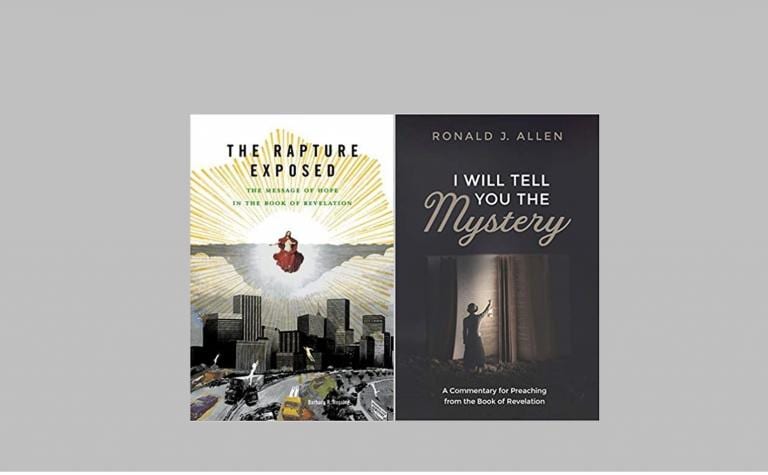
As we’re completing this book, I have found two volumes to be helpful which I commend to preachers and lay readers alike. One is Barbara Rossing’s The Rapture Exposed: The Message of Hope in the Book of Revelation (2004). The second is Ronald J. Allen’s I Will Tell You the Mystery: A Commentary for Preaching from the Book of Revelation (2019). In this essay, I’ll discuss how these books can be helpful for clergy and congregations as we’re facing cataclysmic events and unprecedented challenges.
Opportunity Hidden in the Crisis
For clergy, preaching apocalyptic texts is fraught with unease about the real fears alluded to in the book of Revelation and passages such as Daniel 7, Mark 13, Matthew 24, 1 Corinthians 15, and 1 Thessalonians 4 and 5. Their warnings of impending cosmic upheaval ricochet sharply off contemporary headlines about war, natural disasters, and threats to the fabric of civilization. Add to this the disconcerting news about the effects of climate disruption and global environmental disasters, and the task of preaching good news in the face of seemingly immanent doom can feel overwhelming to pastor and congregation alike.
However, New Testament scholar Barbara Rossing notes that apocalyptic texts provide unique opportunities for preachers and are, in fact, essential because they “empower radical witness. They give us a sacramental imagination, taking us on a journey into the heart of God’s vision for the world” (141). The word apokalypsis in Greek literally means, “pulling back the curtain.” When biblical texts (and the sermons that utilize them) pull back this veil, it allows us to see a deeper reality that is not immediately visible. We receive a vision that reveals “both the beauty of creation and also the pathologies of empire” – whether these empires originate in Assyria, Babylonia, Rome, or the United States of America.[2]
Double vision
Equipped with this double vision, the preacher is able to name and critique the underlying oppressive assumptions of empire and how they manifest in society, the natural world, and the lived experiences of the hearers. But a third move is needed – proclaiming the divine eschatological vision that has the power to transform our imaginations, renew hope, and empower collective action to live into this vision.
Eschatology comes from the Greek word “eschaton,” meaning end times. The visionary world of the apocalypses “can help us see both the perils we face and the urgency of God’s promised future,” says Rossing, “turning the world for justice and healing, ‘on Earth as in heaven.’ The preacher cultivates an apocalyptic imagination by helping people recognize God’s future breaking into the present, even in times of despair.”

Photo by Yohan Joy on Unsplash
The Rapture Exposed
The problem with apocalyptic texts, says Rossing, is the way they have been used by Fundamentalist Christians to try to predict – and manipulate – world events. The story they tell is that the Bible predicts an event called The Rapture in which Christ comes to sweep up the faithful into heaven, leaving everyone else in a kind of hellish purgatory on earth. For millions of people, Christian apocalyptic books such as The Late, Great Planet Earth and the Left Behind series are akin to the Bible itself. An entire multimillion-dollar industry has been created around graphic Christian horror that grips the faithful in fear and fantasy.
Worse, Rapture-theology peddles a narrative that supports a political agenda of war-making in the Middle East, environmental degradation, patriarchal control over women and their bodies, and anti-Semitic and Islamophobic white nationalism. 80 million copies of the Left Behind books, along with numerous Rapture websites, movies, and spin-offs threaten to drown out the gospel of hope, renewal and love. The preacher on a Sunday morning has about 15-20 minutes to proclaim that Jesus’ return is about justice, transformation, and healing. So it’s important to make these sermons count for deconstructing harmful theology and reconstructing a theology of nonviolence and an ethic of care for those most vulnerable.
Why Rapture Theology is so Dangerous
Understanding the recent history of the influence of Rapture theology on U.S. politics and civil discourse is important when preaching on Revelation or any apocalyptic text for that matter.
- In the 1980s, President Ronald Reagan speculated that the violence in the Middle East was an indication that biblical prophecy was coming to fulfillment.
- In the 1990s after the first Left Behind book was published, prophecy groups sprung up that encouraged members to see correlations between world events and the biblical “timeline” for the end-times.
- During the 2000s, President George W. Bush, a born-again Christian, invoked apocalyptic language in the lead up to the Iraq War. Among his cabinet members were fundamentalist Christians whose beliefs shaped U.S. foreign policy in the Middle East. And when peace negotiations between Israel and Palestine were underway, Pat Robertson, Jerry Falwell, and Tim LeHaye opposed these efforts because they believed they would delay Christ’s return and the beginning of Armageddon.
Today, the Trump administration is filled with evangelicals who attend weekly Bible studies led by Ralph Drollinger of the conservative right-wing Capitol Ministries. Trump’s Vice President Mike Pence is a staunch conservative Christian, and his Secretary of State Mike Pompeo has unashamedly confessed that his evangelical Christian beliefs influence his diplomacy. Evangelicals see Trump as the “Chosen One” – a triumphantly apocalyptic figure who, though morally flawed, initiates the Second Coming. Even now, evangelicals are cheering for Trump’s attack on Iran, believing that a war with the enemy of Israel is key to setting up the conditions wherein the Rapture will begin.
As Barbara Rossing describes their position, this “version of the biblical storyline requires tribulation and war in the Middle East, not peace plans. That is the most terrifying aspect of the distorted theology.” Rossing asserts, and I concur, that this is “the very reason why we cannot afford to give in to the dispensationalist version of the biblical storyline – because real people’s lives are at stake” (46).
With this in mind, preachers should help their congregations unpack the imagery and symbolism of Revelation and other apocalyptic texts in order to gain historical perspective and properly situate the Bible as a book of faith rather than as a crystal ball of doom.
Rossing’s book provides the historical context to help preachers and parishioners better understand apocalyptic texts as they were heard by the original Christians who were being persecuted under oppressive empires. She carefully explains the symbolism and metaphors as the writers intended them to be – a vision of God’s healing for the world. Preachers will find her book to be an important resource for countering the destructive reading of scripture by fundamentalists and proclaiming God’s beloved community of nonviolence and peace.

Bible, sky, clouds. Photo by Leah D. Schade. All rights reserved.
I Will Tell You the Mystery
Like Rossing, Ron Allen provides helpful exegesis to understand the world and times of John of Patmos, author of Revelation. However, whereas Rossing’s chapters are divided into themes and address a panorama of apocalyptic thought in scripture, Allen goes in depth verse-by-verse with Revelation. He meticulously explains the “word pictures” used by John and addresses issues and questions that arise in light of contemporary theology. Allen’s commitment to process theology is evident throughout the book in the way he interprets Revelation as God’s invitation to co-create a better world rather than to destroy it.
There are times, however, when John’s words do not support the values of love, peace, justice, mutuality, and abundance. Images of violence, misogyny, judgement, and damnation within Revelation are problematic. Allen clearly states his disagreement with John’s writings at these points and invites preachers to name and critique them as well.
Preachers who follow the Revised Common Lectionary will not find many passages from Revelation in the three-year cycle.
There are only six pericopes from five chapters that are covered, and only 7 Sundays when passages from Revelation are included in the readings. However, because the symbols and imagery from Revelation have found their way into popular culture and political discourse, preachers may want to consider preaching on Revelation as part of a sermon series on this enigmatic book. Allen’s book is a useful resource for pastors wanting to help their parishioners understand Revelation’s complex imagery and make sense of it for our world today.
Like Rossing, Allen highlights the fact that Revelation actually counters the premillennialist theory of a “rapture.” Allen notes how the downward movement of God through the New Jerusalem in Chapter 21 “embodies grace itself: God takes the initiative to bring the holy city down from heaven” (200). Thus, hope for the new creation is neither a spiritualized wishful thinking nor an escape from the reality of our crucified world. There is both transcendence and immanence in Christ’s return and the new creation. They are not mutually exclusive, but instead inform each other in a dialectic exchange in which one points to the other and back again. The challenge for preachers, says Allen, is to “help the congregation look for signs of [the holy city’s] appearance” (200).
One of the most important points in both books is that readers must resist succumbing to the fear that can either paralyze folks or spur them to react with violence, hatred, rabid self-protection, and tribalism.
Allen urges preachers not to neglect speaking concretely about God’s promises even while critiquing contemporary empires. “Many people are more motivated for long-term commitment by promise and possibility than by fear, threat, and anger. While the critique is important, preaching is often especially empowering when it aims towards a vision of the positively possible and toward helping people imagine how to get from there to here” (198).
Key to this vision-casting is not looking to the skies to see souls raptured up to heaven, but to notice how God’s holy city is coming down to Earth. To this end, Allen does not provide sample sermons, but throughout each chapter offers questions, observations, and suggestions for preachers to attune their listeners to God’s actions here and now. In this way, Allen provides the exegetical and homiletical tools for preachers to create the time and space for the seeds of apocalyptic vision to grow into the fruits of community-building for the sake of God’s Realm. Led by Jesus, the Lamb of God, both preacher and congregation are strengthened to live “faithfully towards the coming of the new heaven and new earth” (198).
As your congregation grapples with finding purpose and meaning in this apocalyptic time, may you be blessed with insight, courage, compassion, and a vision for participating in this Realm of God.

Leah D. Schade is the Assistant Professor of Preaching and Worship at Lexington Theological Seminary in Kentucky. She is the author of Preaching in the Purple Zone: Ministry in the Red-Blue Divide (Rowman & Littlefield, 2019), Rooted and Rising: Voices of Courage in a Time of Climate Crisis (Rowman & Littlefield, 2019), and Creation-Crisis Preaching: Ecology, Theology, and the Pulpit (Chalice Press, 2015).
Twitter: @LeahSchade
Facebook: https://www.facebook.com/LeahDSchade/
Read also:
Jesus, Apocalyptic Discourse, and the Climate Crisis: Ideas for Preaching Matthew 24:36-44
Previous Post

January 5, 2020
Light, Not Heat: Epiphany for a Burning World

Browse Our Archives
Select a Category Academy of Homiletics Addiction Advent AI (Artificial Intelligence) Animals Apocalypse Appalachia Ash Wednesday Baptism Bible Black Lives Matter Blade Runner Book review Children in church Christ the King Sunday Christian Nationalism Christian/Islamic relations Christmas Church Clergy Climate change COVID-19 Creation Data Centers Death penalty Devotional Dialogue Doubt Earth Day Easter Ecofeminism EcoPreacher 1-2-3 ELCA ELCA Youth Gathering Election Environment/ecology Epiphany Faith Faith and Politics Feminism Film review Food Food and Faith Forgiveness Fracking Good Friday Good Omens Grief Gun violence Holy Humor Sunday Holy Week Howard Thurman ICE Immigration Indigenous wisdom Interview Jesus Kentucky Lafayette High School Marching Band Leadership Lent LGBTQIA+ Marching band Martin Luther Martin Luther King Jr. Mary Maundy Thursday Michael Sheen Mother of Jesus Nature New Year's Eve Palm Sunday Parables Pentecost Poem, Poetry Politics Poor People's Campaign Pop culture Prayers Preaching Progressive Christianity Public theology Purple Zone Racism and White Privilege Religion Religion and environment Religion and politics Religion and pop culture Religion and violence Rev. Nelson Rabell Gonzalez Sermons Spanish language resources for preaching Technology Thanksgiving Theological education theology Trees Trump Uncategorized Vegan War Women and religion Workshop Worship
Select a Month November 2026 October 2026 September 2026 July 2026 June 2026 May 2026 April 2026 March 2026 February 2026 January 2026 December 2025 November 2025 October 2025 September 2025 May 2025 April 2025 March 2025 February 2025 January 2025 December 2024 November 2024 October 2024 September 2024 August 2024 July 2024 June 2024 May 2024 April 2024 March 2024 February 2024 January 2024 December 2023 November 2023 October 2023 September 2023 August 2023 July 2023 June 2023 May 2023 April 2023 March 2023 February 2023 January 2023 December 2022 November 2022 October 2022 August 2022 July 2022 June 2022 May 2022 April 2022 March 2022 February 2022 January 2022 December 2021 November 2021 October 2021 September 2021 August 2021 July 2021 June 2021 May 2021 April 2021 March 2021 January 2021 December 2020 November 2020 October 2020 September 2020 August 2020 July 2020 June 2020 May 2020 April 2020 February 2020 January 2020 December 2019 November 2019 October 2019 September 2019 August 2019 July 2019 June 2019 May 2019 April 2019 March 2019 January 2019 December 2018 November 2018 October 2018 September 2018 August 2018 July 2018 June 2018 May 2018 April 2018 March 2018 February 2018 January 2018 December 2017 November 2017 October 2017 September 2017 August 2017 July 2017 June 2017 May 2017 April 2017
Follow Us!
TAKE THE
Religious Wisdom Quiz
I am a sea that parted to let my people cross on dry ground but drowned their enemies. What am I?
Select your answer to see how you score.
The Red Sea The Mediterranean Sea The Sea of Galilee The Jordan River
Books by This Author Books by Leah D. Schade
Related posts from EcoPreacher

Pastoral Wisdom for Responding to Sermon Pushback

"Render Unto Caesar": Faith, Politics, and Elections

Preaching About Climate Change: What Clergy Need Most

Making Space for Eco-Grief—and Hope—in Your Church
TRENDING AT PATHEOS Progressive Christian

The Secret behind A Charlie Brown Thanksgiving
Do you know the secret behind A Charlie Brown Thanksgiving? Sparky was...

Bridging the Gap Between God and Man
From Far Off to the Ultimate Embrace “God is a Spirit: and...

Let Matthew 25 Guide You to a Greater...
With the crisp feel of fall in the air, our minds quickly...

Can a Chatbot Touch Your Soul?
Can a chatbot offer genuine spiritual counsel? One conversation brought me to...

Religion and Politics: How Should We Then Live?
Two cultural axioms get repeated in polite company. Don't mix religion and...

7 Things We Get Wrong About Giving Thanks
It's a time of year when many of us turn to the...
view all Progressive Christian blogs
Ad-Free & Subscriber Log-In Subscription Support
- About Us
- 2026 Calendar
- Videos
- Podcasts
- Library of World Religions
- Faith In Media Tracker
- Advertise With Us
- Write for Us
- Privacy Policy
- Terms of Service
- Do Not Sell My Data
- Contact Us
- Radiant Digital
- Manage Newsletter Subscriptions
- Unsubscribe From Notifications
- Sitemap
Copyright 2008-2026, Patheos, part of the Radiant Digital network of media brands. All rights reserved.
Subscription Support Ad-Free & Subscriber Log-In
Follow Patheos