
BuddhistCatholicContemplativeEvangelicalGeneral ChristianHinduJewishLatter-day SaintMuslimNew VisionsProgressive Christian
Beliefs
- Buddhist
- Catholic
- Contemplative
- Evangelical
- General Christian
- Hindu
- Jewish
- Latter-day Saint
- More Voices
- Muslim
- New Visions
- Pagan
- Progressive Christian
Topics
- Religion News
- Food and Religion
- Sports and Religion
- Religious Art
- Religious Music and Entertainment
- Religious Events
- History and Religion
- Style and Religion
- Politics and Religion
- Women in Religion
- Recreation Outdoors and Religion
- Business Finance and Religion
- Careers Workplace and Religion
- Education and Religion
- Family Parenting and Religion
- Health Fitness and Religion
- Home and Religion
- Relationships and Religion
- Technology and Religion
- Travel and Religion
Columnists
- Buddhist Columnists
- Business Finance and Religion Columnists
- Careers Workplace and Religion Columnists
- Catholic Columnists
- Contemplative Columnists
- Education and Religion Columnists
- Evangelists Columnists
- Family Parenting and Religion Columnists
- General Christian Columnists
- Health Fitness and Religion Columnists
- Hindu Columnists
- History and Religion Columnists
- Home and Religion Columnists
- Jewish Columnists
- More Voices Columnists
- Latter Day Columnists
- Muslim Columnists
- New Visions Columnists
- Nonreligious Columnists
- Pagan Columnists
- Politics and Religion Columnists
- Progressive Columnists
- Recreation Outdoors and Religion Columnists
- Relationships and Religion Columnists
- Religion News Columnists
- Religious Art Columnists
- Religious Events Columnists
- Religious Music and Entertainment Columnists
- Sports and Religion Columnists
- Style and Religion Columnists
- Technology and Religion Columnists
- Travel and Religion Columnists
- Women in Religion Columnists
Resource Library
- 2026 Calendar
- Library of World Religions
- The 100 Most Holy Places on Earth
- Patheos Answers
- Podcasts
- Videos
- Faith Leaders Database
- Anglican Episcopalian
- Bahai
- Baptist
- Buddhism
- Christianity
- Confucianism
- Eastern Orthodoxy
- Hinduism
- Holiness and Pentecostal
- ISKCON
- Islam
- Judaism
- Lutheran
- Methodist
- The Church of Jesus Christ of Latter-day Saints
- New Age
- Paganism
- Presbytarian and Reformed
- Protestantism
- Religion Behind the Scenes
- Roman Catholic
- Scientology
- Shia Islam
- Sikhism
- Sufism
- Sunni Islam
- Taoism
- Zen
- See all religions
Research Tools
 Ad-Free & Subscriber Log-In Subscription Support
Ad-Free & Subscriber Log-In Subscription Support
Follow Patheos 

- Trending:
- Forgiveness
- |
- Marriage
- |
- Consciousness
- |
- Death Penalty
- |
- Election
- |
- Halloween

- Home
- Progressive Christian
- You Brood of Vipers! John the Baptist Gives Us Permission Not to Be Nice
You Brood of Vipers! John the Baptist Gives Us Permission Not to Be Nice
Last updated on: December 5, 2019 at 2:10 pm by Leah D. Schade
You Brood of Vipers! John the Baptist Gives Us Permission Not to Be Nice 2019-12-05T14:10:26-04:00 Leah D. Schade
Patheos Explore the world's faith through different perspectives on religion and spirituality! Patheos has the views of the prevalent religions and spiritualities of the world.
“You brood of vipers!” This year in the midst of the impeachment hearings, we hear the words of John the Baptist knowing that a brood of vipers is running our country.

Viper. Photo by tontantravel. Some rights reserved. https://flickr.com/photos/tontantravel/23631208976/
Text: Matthew 3:1-12
We’re a few weeks away from Christmas and some of us are feeling pretty good about ourselves. Most people I’ve talked to have at least started on their Christmas decorations and shopping. This is the time of year when people are willing to open up their hearts and wallets and go that extra mile to give a little more. Then you sit in the pew and you hear the words of John the Baptist: “You brood of vipers!”
Well. That’s not very nice, is it?
This year, we encounter this text in the midst of the impeachment hearings of the President of the United States.
Witness after witness has testified that, in effect, there is a brood of vipers running this country. They have invited foreign interference in our country’s democracy. Their venom has toxified our communal discourse. It has stirred up hate crimes and emboldened white supremacists. Their sickening rhetoric has justified the caging of children. And it has opened the floodgates for the literal poisoning of our water, air, and land.
Well, that’s not very nice, is it?
John the Baptist shows us that when it comes to confronting the toxic poison in our society and culture, we can’t be “nice.” We must be truthful, assertive, and courageous.
In her article, “In Praise of Empathic Anger,” Assertive Spirituality writer D.S. Leiter explains why being “nice” is not what is called for when your in the midst of a brood of vipers.
“The toxic forms of “Christian nice” often tell people to suppress their “negative emotions” by promoting a form of “toxic positivity.” The same forms of Christian Nice often end up unwittingly supporting oppressors and abusers at the expense of victims by too-quickly calling for the kind of “cheap forgiveness” from abuse survivors and oppressed peoples.”
“Christian nice” is exactly what John the Baptist is not.
According to Matthew, John was the son of Elizabeth and Zachariah and cousin to Jesus. When he came of age, he went into the wilderness where he received the word of God. He then reappeared looking like a wild man, preaching about repentance.
At the Jordan River people came out to this strange prophet to be baptized. These were ordinary people like you and me – office workers and bankers, people who work for the government, people who’ve served in the military. Men and women, teachers, parents, builders, lawyers and healers. And just like us, these are basically good people. These are not hardened criminals.

Photo by mostafa meraji on Unsplash
So why is John calling them a brood of vipers?
Well, even though John didn’t know Martin Luther, but he probably would have agreed with a phrase that Luther used to describe people like us:
simul justus et peccatore
It means, at the same time justified and sinning. Simultaneously saved and condemned, healed and broken.
It’s the paradox of the human condition. We are at once loved and embraced by the grace of God, yet we exist in a world and time where we hurt each other. We damage our planet, both individually and as a global human system.
So when John describes us as a brood of vipers, we know there is some truth to what he is saying.
He goes on to say that just because you have received the inheritance of God’s chosen people, don’t think that you can just sit back comfortably and expect the kingdom to come to you on a silver platter. The tree that doesn’t bear good fruit will be chopped thrown into the fire.
The curious thing about this scene is that the people do not turn away when they hear this scathing indictment.
They stick around to hear what John has to say next. And I think the people deserve some credit for this. They recognized the inherent truth in John’s words and were willing to pay attention to what he had to say.
Perhaps that is why we stick around as well. To our credit, many of us keep coming back to hear the hard truths, even when we know it’s going to be uncomfortable. We know that at some level, John is addressing us. And as good as we are, we have that capacity to be a brood of vipers.
Then John goes even further with his provocative rhetoric.
I baptize you with water. But one who is more powerful than I is coming. It would be a big deal for me just to tie his shoelaces. You have no idea what you’re in for. He will baptize you with the Holy Spirit and fire.
Fire? Why would God send a messiah who would burn us?
His winnowing fork is in his hand, to clear his threshing floor and to gather the wheat into his granary; but the chaff he will burn with unquenchable fire.
Winnowing fork? Chaff? Unquenchable fire? What is John talking about?
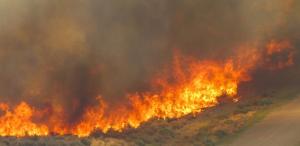
Wildfire. Public domain.
This is not the messiah we had in mind. This is not what we signed up for.
You see, when John received the word of God, he received a revelation. What is ultimately required of humanity in order to unite with God is a giving over of oneself, a complete offering of one’s heart and soul. A willingness to completely entrust one’s entire being to the God of Creation.
What this Messiah wants is your heart — your soul — the very essence of your being.
And that — that is the one thing we cannot bring ourselves to do.
Because of simul justus et peccatore, this is the one thing we cannot sign up for. Oh we may want to, we may have a genuine desire.
But the truth here is that there is nothing we can do to get to God.
Which means that this Messiah will have to get to us.
This will not be an easy process, says John. This Messiah will have to burn through layers of our hardened hearts, will have to cut through the thicket of weeds and thorns that choke our human community. This Messiah is an unquenchable fire that seeks to penetrate and purify. To smelt us down, and burn away all that keeps us from true union with God.
It appears that our own nation is in the midst of this purifying fire. This impeachment process is a fire that is kindled by what D.S. Leiter calls empathic anger.
“Empathic anger is grounded in love and empathy and clearly grounded in clear evidence . . . it is the polar opposite of unhealthy aggression and needs to be treated very differently.”
And let there be no doubt — the impeachment process is not about unhealthy aggression. It is about stopping unhealthy aggression. And this process will not be “nice.” It will not be comfortable.
We will experience pain. We will come to know deep sorrow. We will come in contact with that sinful part of our own nature. We will see the brood of vipers in all their poisonous power.
But that discomfort will serve as a gateway. Empathic anger will break down our defenses and allow the realm of the transcendent to penetrate our souls and prepare us for the coming of Christ.
It is agonizing to witness and experience this process. Because the way of God is not an easy way. And the embrace of God does bring pain.
But if you hold on, if you keep coming back, if you stand strong in the fire of God, you will come to the other side fully engulfed in the love and justice of God in a way you had not experienced before.
So brace yourselves for the impact. And be on the lookout for the fire.
It starts with only a small spark…
in a manger…
full of dry hay.

Leah D. Schade is the Assistant Professor of Preaching and Worship at Lexington Theological Seminary in Kentucky. She is the author of Preaching in the Purple Zone: Ministry in the Red-Blue Divide (Rowman & Littlefield, 2019), Rooted and Rising: Voices of Courage in a Time of Climate Crisis (Rowman & Littlefield, 2019), and Creation-Crisis Preaching: Ecology, Theology, and the Pulpit (Chalice Press, 2015).
Twitter: @LeahSchade
Facebook: https://www.facebook.com/LeahDSchade/
Read also:
Rooted and Rising in Advent: 28 Days for Connecting with Earth
Learning to Welcome the Dark: Advent 1
Previous Post

December 1, 2019
Imagine the Child – Reflection from Rev. Fred Small
Next Post

December 8, 2019 The Unbearable Whiteness of Preaching
Browse Our Archives
Select a Category Academy of Homiletics Addiction Advent AI (Artificial Intelligence) Animals Apocalypse Appalachia Ash Wednesday Baptism Bible Black Lives Matter Blade Runner Book review Children in church Christian Nationalism Christian/Islamic relations Christmas Church Clergy Climate change COVID-19 Creation Data Centers Death penalty Devotional Dialogue Doubt Earth Day Easter Ecofeminism EcoPreacher 1-2-3 ELCA ELCA Youth Gathering Election Environment/ecology Epiphany Faith Faith and Politics Feminism Film review Food Food and Faith Forgiveness Fracking Good Friday Good Omens Grief Gun violence Holy Humor Sunday Holy Week Howard Thurman ICE Immigration Indigenous wisdom Interview Jesus Kentucky Lafayette High School Marching Band Leadership Lent LGBTQIA+ Marching band Martin Luther Martin Luther King Jr. Mary Maundy Thursday Michael Sheen Mother of Jesus Nature New Year's Eve Palm Sunday Parables Pentecost Poem, Poetry Politics Poor People's Campaign Pop culture Prayers Preaching Progressive Christianity Public theology Purple Zone Racism and White Privilege Religion Religion and environment Religion and politics Religion and pop culture Religion and violence Rev. Nelson Rabell Gonzalez Sermons Spanish language resources for preaching Technology Thanksgiving Theological education theology Trees Trump Uncategorized Vegan War Women and religion Workshop Worship
Select a Month October 2026 September 2026 July 2026 June 2026 May 2026 April 2026 March 2026 February 2026 January 2026 December 2025 November 2025 October 2025 September 2025 May 2025 April 2025 March 2025 February 2025 January 2025 December 2024 November 2024 October 2024 September 2024 August 2024 July 2024 June 2024 May 2024 April 2024 March 2024 February 2024 January 2024 December 2023 November 2023 October 2023 September 2023 August 2023 July 2023 June 2023 May 2023 April 2023 March 2023 February 2023 January 2023 December 2022 November 2022 October 2022 August 2022 July 2022 June 2022 May 2022 April 2022 March 2022 February 2022 January 2022 December 2021 November 2021 October 2021 September 2021 August 2021 July 2021 June 2021 May 2021 April 2021 March 2021 January 2021 December 2020 November 2020 October 2020 September 2020 August 2020 July 2020 June 2020 May 2020 April 2020 February 2020 January 2020 December 2019 November 2019 October 2019 September 2019 August 2019 July 2019 June 2019 May 2019 April 2019 March 2019 January 2019 December 2018 November 2018 October 2018 September 2018 August 2018 July 2018 June 2018 May 2018 April 2018 March 2018 February 2018 January 2018 December 2017 November 2017 October 2017 September 2017 August 2017 July 2017 June 2017 May 2017 April 2017
Follow Us!
TAKE THE
Religious Wisdom Quiz
What was the name of the disciple who doubted Jesus' resurrection?
Select your answer to see how you score.
John Thomas James Peter
Books by This Author Books by Leah D. Schade
Related posts from EcoPreacher

Pastoral Wisdom for Responding to Sermon Pushback

"Render Unto Caesar": Faith, Politics, and Elections

What Matt. 21:23-32 Teaches About Integrity In An...

When The Data Center Wolf Is At Your...
TRENDING AT PATHEOS Progressive Christian

What Being a Modern-Day Apostle Means to Me
In my last column, I discussed the ins and outs of modern-day...

Did Ancient China Once Worship the God of...
Across human history, a common thread weaves through the origins of the...

Love Your Neighbor – Including Earth-Kin: Lev. 19,...
God’s command to love your neighbor means acting in an ethical and...

Lead a Church Study of “Jesus and Lao...
Guest writer Jack Thomas (The Irreverent Reverend) reflects on leading his church...

Pastoral Wisdom for Responding to Sermon Pushback
Getting sermon pushback on your social justice sermon? Learn practical, Proverbs-based strategies...

Principles for Understanding the Apostolic Ministry Today
Whenever people discover that my formal ministry title is "apostle," as in...
view all Progressive Christian blogs
Ad-Free & Subscriber Log-In Subscription Support
- About Us
- 2026 Calendar
- Videos
- Podcasts
- Library of World Religions
- Faith In Media Tracker
- Advertise With Us
- Write for Us
- Privacy Policy
- Terms of Service
- Do Not Sell My Data
- Contact Us
- Radiant Digital
- Manage Newsletter Subscriptions
- Unsubscribe From Notifications
- Sitemap
Copyright 2008-2026, Patheos. All rights reserved.
Subscription Support Ad-Free & Subscriber Log-In
Follow Patheos