
BuddhistCatholicContemplativeEvangelicalGeneral ChristianHinduJewishLatter-day SaintMuslimNew VisionsProgressive Christian
Beliefs
- Buddhist
- Catholic
- Contemplative
- Evangelical
- General Christian
- Hindu
- Jewish
- Latter-day Saint
- More Voices
- Muslim
- New Visions
- Pagan
- Progressive Christian
Topics
- Religion News
- Food and Religion
- Sports and Religion
- Religious Art
- Religious Music and Entertainment
- Religious Events
- History and Religion
- Style and Religion
- Politics and Religion
- Women in Religion
- Recreation Outdoors and Religion
- Business Finance and Religion
- Careers Workplace and Religion
- Education and Religion
- Family Parenting and Religion
- Health Fitness and Religion
- Home and Religion
- Relationships and Religion
- Technology and Religion
- Travel and Religion
Columnists
- Buddhist Columnists
- Business Finance and Religion Columnists
- Careers Workplace and Religion Columnists
- Catholic Columnists
- Contemplative Columnists
- Education and Religion Columnists
- Evangelists Columnists
- Family Parenting and Religion Columnists
- General Christian Columnists
- Health Fitness and Religion Columnists
- Hindu Columnists
- History and Religion Columnists
- Home and Religion Columnists
- Jewish Columnists
- More Voices Columnists
- Latter Day Columnists
- Muslim Columnists
- New Visions Columnists
- Nonreligious Columnists
- Pagan Columnists
- Politics and Religion Columnists
- Progressive Columnists
- Recreation Outdoors and Religion Columnists
- Relationships and Religion Columnists
- Religion News Columnists
- Religious Art Columnists
- Religious Events Columnists
- Religious Music and Entertainment Columnists
- Sports and Religion Columnists
- Style and Religion Columnists
- Technology and Religion Columnists
- Travel and Religion Columnists
- Women in Religion Columnists
Resource Library
- 2026 Calendar
- Library of World Religions
- The 100 Most Holy Places on Earth
- Patheos Answers
- Podcasts
- Videos
- Faith Leaders Database
- Anglican Episcopalian
- Bahai
- Baptist
- Buddhism
- Christianity
- Confucianism
- Eastern Orthodoxy
- Hinduism
- Holiness and Pentecostal
- ISKCON
- Islam
- Judaism
- Lutheran
- Methodist
- The Church of Jesus Christ of Latter-day Saints
- New Age
- Paganism
- Presbytarian and Reformed
- Protestantism
- Religion Behind the Scenes
- Roman Catholic
- Scientology
- Shia Islam
- Sikhism
- Sufism
- Sunni Islam
- Taoism
- Zen
- See all religions
Research Tools
 Ad-Free & Subscriber Log-In Subscription Support
Ad-Free & Subscriber Log-In Subscription Support
Follow Patheos 

- Trending:
- Forgiveness
- |
- Marriage
- |
- Consciousness
- |
- Death Penalty
- |
- Election
- |
- Halloween

- Home
- Progressive Christian
- Jesus, Apocalyptic Discourse, and the Climate Crisis: Ideas for Preaching Matthew 24:36-44
Jesus, Apocalyptic Discourse, and the Climate Crisis: Ideas for Preaching Matthew 24:36-44
Last updated on: November 29, 2019 at 10:19 am by Leah D. Schade
Jesus, Apocalyptic Discourse, and the Climate Crisis: Ideas for Preaching Matthew 24:36-44 2019-11-29T10:19:34-04:00 Leah D. Schade
Patheos Explore the world's faith through different perspectives on religion and spirituality! Patheos has the views of the prevalent religions and spiritualities of the world.
I am co-authoring a book tentatively titled, Apocalypse When? A Guide to Interpreting and Preaching Apocalyptic Texts, with my colleague Jerry Sumney. He teaches biblical studies and I teach preaching and worship at Lexington Theological Seminary. Each chapter will include biblical exegesis followed by ideas for preaching and a sample sermon. One chapter will be looking at Matthew 24:36-44, Jesus’s apocalyptic discourse, and what it means for the church in light of the climate crisis. Here is an excerpt from that chapter in which we explore ideas for preaching this text.

Photo by Tyler Lastovich on Unsplash
Matthew 24:36-44
‘But about that day and hour no one knows, neither the angels of heaven, nor the Son, but only the Father. 37For as the days of Noah were, so will be the coming of the Son of Man. 38For as in those days before the flood they were eating and drinking, marrying and giving in marriage, until the day Noah entered the ark, 39and they knew nothing until the flood came and swept them all away, so too will be the coming of the Son of Man.
40Then two will be in the field; one will be taken and one will be left. 41Two women will be grinding meal together; one will be taken and one will be left. 42Keep awake therefore, for you do not know on what day your Lord is coming. 43But understand this: if the owner of the house had known in what part of the night the thief was coming, he would have stayed awake and would not have let his house be broken into. 44Therefore you also must be ready, for the Son of Man is coming at an unexpected hour.
The End is Near
In his exegesis, Jerry notes that “while Matthew probably thinks the end is near, it is clear that speculation about its timing is useless. What is really important is the certainty of its coming.” For Matthew, referencing the well-known story of Noah’s building of the ark underscores this point. While the crowds mocked Noah’s efforts, and while he could not give them an exact timetable for the coming of the flood, the fact that it was coming was still certain. The point Matthew has Jesus emphasize in this passage is that being prepared for that which we cannot predict is the key for the church. The same is as true for the church today as it was in Matthew’s time.
The Uninhabitable Earth
Today’s Christians may find Noah’s story, as well as Jesus’s warnings, to be similar to warnings we hear about what our world is facing with climate change. Certainly, there are important differences between the coming of the Son of Man and the growing climate crisis. However, the call for being prepared is applicable in both cases.
While climate scientists cannot predict exactly what will happen or when, the apocalyptic scenarios are of frighteningly biblical proportions. David Wallis-Wells’ book, The Uninhabitable Earth: Life After Warming, lays out in explicit terms what human society will face when it comes to damage to our planet, including crop failures, increases in heat deaths, wars over resources, a surge of climate refugees, exotic diseases, unbreathable air, oceans unable to sustain life, and economic collapse.
Those in the pews may hear biblical calls for preparedness now echoed by those urging preparations for the consequences of global warming and climate change. While proponents of Rapture-theology hope for a magical whisking away of the faithful before the onslaught beings, as Sumney notes, “the people of God are not removed from tribulations but are rather called to endure them faithfully.”
The question for Christians, then, is: what is the role of the church in the face of the climate crisis?
How can we help prepare congregations and communities as part of our mission to the world? A sermon on Matthew 24:36-44 can explore the image of the church as a kind of ark offering refuge and safety in the midst of cataclysmic climate change.
The Church as the Ark
Christian writers from Cyprian to Augustine to Luther to Calvin compared the church to Noah’s ark, noting that the church should be a place of refuge, safety, and salvation. Frederick Buechner, too, picked up on the metaphor of the church as Noah’s ark, which he describes in his book, Beyond Words: Daily Readings in the ABC’s of Faith:
In one as in the other, just about everything imaginable is aboard, the clean and the unclean both. They are all piled in together helter-skelter, the predators and the prey, the wild and the tame, the sleek and beautiful ones and the ones that are ugly as sin. There are sly young foxes and impossible old cows. There are the catty and the piggish and the peacock-proud. There are hawks and there are doves. Some are wise as owls, some silly as geese; some meek as lambs and others fire-breathing dragons.
There are times when they all cackle and grunt and roar and sing together, and there are times when you could hear a pin drop. Most of them have no clear idea just where they’re supposed to be heading or how they’re supposed to get there or what they’ll find if and when they finally do, but they figure the people in charge must know and in the meanwhile sit back on their haunches and try to enjoy the ride.[ii]
Buechner points out that the ark is, in fact, no joyride.
“But even at its worst, there’s at least one thing that makes it bearable within, and that is the storm without — the wild winds and terrible waves and in all the watery waste no help in sight.”
What keeps the ship afloat and the inhabitants from killing each other is a certain trust that even in the midst of the watery blasts, there will be peace at the last and safe harbor in which to rest. Reminding a congregation that the shelter afforded by the church in the midst of the waves and wind is no small thing. That they can cling to each other and their faith in God is what can help sustain them during the trying times.
By extension, the “ark” of Christianity can, and must, in good faith join scientists and community activists in helping communities prepare for the inevitable effects of climate and environmental collapse.
[See also my chapter, “Building the Eco-Ethical Ark in the Age of Climate Disruption” in the book Rooted and Rising: Voices of Courage in a Time of Climate Crisis.]
In addition to a clean energy transition, scientists have called for “rapid decarbonization, plus a revolution in food production, plus a sustainability revolution, plus a massive engineering scale-up [for carbon removal],” according to Johan Rockström, lead author of “A roadmap for rapid decarbonization,” a 2017 paper in the journal Science. A pastor preaching on this text may want to have materials available for parishioners to learn more about how houses of worship can reduce energy use, build resilience in communities for dealing with the effects of climate change.
The faith-and-climate organization Blessed Tomorrow, for example, has well-researched resources on how congregations can become places of safety and resettlement for climate refugees, and encourage support for policies at the local, state, and federal level that protect Creation. (See their guide “Let’s Talk Faith & Climate: Communication Guidance for Faith Leaders” for developing successful messages and utilizing strong talking points on climate change as a faith issue.)
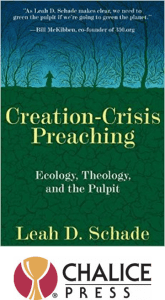
[For more ideas on preaching about climate and environmental issues, see my book Creation-Crisis Preaching: Ecology, Theology, and the Pulpit.]
The preacher can emphasize the good news that, thankfully, more and more followers of Jesus and other faith communities are making Creation-care a priority.
An increasing number of religious groups are working to create healthy and safe communities for our families as they come to view ecological issues as a matter of living out the Golden Rule. Nine different denominations have moved to divest from fossil fuels, including the ELCA, the United Church of Christ, and the Disciples of Christ (Christian Church). There are also ecumenical and interfaith organizations that are advocating for protecting God’s Creation, such as Interfaith Power & Light, ecoAmerica’s Blessed Tomorrow, Greenfaith, and the Poor People’s Campaign.
Of course, just as there were naysayers and deniers among Noah’s neighbors, Jesus’ listeners, and Matthew’s readers, so there will be such individuals in congregations who refuse to accept the realities of the climate crisis.
This does not mean, however, that a pastor should give up or avoid preaching about the need to prepare for the worsening climate crisis.
In fact, research from a 2014 survey conducted by the Public Religion Research Institute (PRRI) and the Academy of Religion (AAR) indicated that parishioners who attend churches where the pastor speaks publicly about climate change are more likely to take the issue seriously than those who attend churches where pastors say nothing on the topic. In other words, the sermon can make a difference in helping cultivate a spirit of preparedness in the congregation.
[To see an example of how climate change can be integrated into a sermon-dialogue-sermon series, check out chapter 10 of my book Preaching in the Purple Zone: Ministry in the Red-Blue Divide.]

Leah D. Schade is the Assistant Professor of Preaching and Worship at Lexington Theological Seminary in Kentucky. She is the author of Preaching in the Purple Zone: Ministry in the Red-Blue Divide (Rowman & Littlefield, 2019), Rooted and Rising: Voices of Courage in a Time of Climate Crisis (Rowman & Littlefield, 2019), and Creation-Crisis Preaching: Ecology, Theology, and the Pulpit (Chalice Press, 2015).
Twitter: @LeahSchade
Facebook: https://www.facebook.com/LeahDSchade/
Read also:
Noah’s Ark and Climate Change: What Kind of Church Will We Be?
Preaching as Resistance: Encountering Pharaoh—and Climate Change
See also: “Scientists made a detailed “roadmap” for meeting the Paris climate goals. It’s eye-opening.” Brad Plumer, Vox.com, March 24, 2017 https://www.vox.com/energy-and-environment/2017/3/23/15028480/roadmap-paris-climate-goals

Next Post

December 1, 2019 Imagine the Child – Reflection from Rev. Fred Small
Browse Our Archives
Select a Category Academy of Homiletics Addiction Advent AI (Artificial Intelligence) Animals Apocalypse Appalachia Ash Wednesday Baptism Bible Black Lives Matter Blade Runner Book review Children in church Christian Nationalism Christian/Islamic relations Christmas Church Clergy Climate change COVID-19 Creation Data Centers Death penalty Devotional Dialogue Doubt Earth Day Easter Ecofeminism EcoPreacher 1-2-3 ELCA ELCA Youth Gathering Election Environment/ecology Epiphany Faith Faith and Politics Feminism Film review Food Food and Faith Forgiveness Fracking Good Friday Good Omens Grief Gun violence Holy Humor Sunday Holy Week Howard Thurman ICE Immigration Indigenous wisdom Interview Jesus Kentucky Lafayette High School Marching Band Leadership Lent LGBTQIA+ Marching band Martin Luther Martin Luther King Jr. Mary Maundy Thursday Michael Sheen Mother of Jesus Nature New Year's Eve Palm Sunday Parables Pentecost Poem, Poetry Politics Poor People's Campaign Pop culture Prayers Preaching Progressive Christianity Public theology Purple Zone Racism and White Privilege Religion Religion and environment Religion and politics Religion and pop culture Religion and violence Rev. Nelson Rabell Gonzalez Sermons Spanish language resources for preaching Technology Thanksgiving Theological education theology Trees Trump Uncategorized Vegan War Women and religion Workshop Worship
Select a Month October 2026 September 2026 July 2026 June 2026 May 2026 April 2026 March 2026 February 2026 January 2026 December 2025 November 2025 October 2025 September 2025 May 2025 April 2025 March 2025 February 2025 January 2025 December 2024 November 2024 October 2024 September 2024 August 2024 July 2024 June 2024 May 2024 April 2024 March 2024 February 2024 January 2024 December 2023 November 2023 October 2023 September 2023 August 2023 July 2023 June 2023 May 2023 April 2023 March 2023 February 2023 January 2023 December 2022 November 2022 October 2022 August 2022 July 2022 June 2022 May 2022 April 2022 March 2022 February 2022 January 2022 December 2021 November 2021 October 2021 September 2021 August 2021 July 2021 June 2021 May 2021 April 2021 March 2021 January 2021 December 2020 November 2020 October 2020 September 2020 August 2020 July 2020 June 2020 May 2020 April 2020 February 2020 January 2020 December 2019 November 2019 October 2019 September 2019 August 2019 July 2019 June 2019 May 2019 April 2019 March 2019 January 2019 December 2018 November 2018 October 2018 September 2018 August 2018 July 2018 June 2018 May 2018 April 2018 March 2018 February 2018 January 2018 December 2017 November 2017 October 2017 September 2017 August 2017 July 2017 June 2017 May 2017 April 2017
Follow Us!
TAKE THE
Religious Wisdom Quiz
Which Christian group is known for pacifism?
Select your answer to see how you score.
Methodists Pentecostals Baptists Quakers
Books by This Author Books by Leah D. Schade
Related posts from EcoPreacher

Pastoral Wisdom for Responding to Sermon Pushback

Love Your Neighbor – Including Earth-Kin: Lev. 19,...

Preaching About Climate Change: What Clergy Need Most

Making Space for Eco-Grief—and Hope—in Your Church
TRENDING AT PATHEOS Progressive Christian

What Being a Modern-Day Apostle Means to Me
In my last column, I discussed the ins and outs of modern-day...

Did Ancient China Once Worship the God of...
Across human history, a common thread weaves through the origins of the...

Love Your Neighbor – Including Earth-Kin: Lev. 19,...
God’s command to love your neighbor means acting in an ethical and...

Lead a Church Study of “Jesus and Lao...
Guest writer Jack Thomas (The Irreverent Reverend) reflects on leading his church...

Pastoral Wisdom for Responding to Sermon Pushback
Getting sermon pushback on your social justice sermon? Learn practical, Proverbs-based strategies...

Principles for Understanding the Apostolic Ministry Today
Whenever people discover that my formal ministry title is "apostle," as in...
view all Progressive Christian blogs
Ad-Free & Subscriber Log-In Subscription Support
- About Us
- 2026 Calendar
- Videos
- Podcasts
- Library of World Religions
- Faith In Media Tracker
- Advertise With Us
- Write for Us
- Privacy Policy
- Terms of Service
- Do Not Sell My Data
- Contact Us
- Radiant Digital
- Manage Newsletter Subscriptions
- Unsubscribe From Notifications
- Sitemap
Copyright 2008-2026, Patheos. All rights reserved.
Subscription Support Ad-Free & Subscriber Log-In
Follow Patheos