
BuddhistCatholicContemplativeEvangelicalGeneral ChristianHinduJewishLatter-day SaintMuslimNew VisionsProgressive Christian
Beliefs
- Buddhist
- Catholic
- Contemplative
- Evangelical
- General Christian
- Hindu
- Jewish
- Latter-day Saint
- More Voices
- Muslim
- New Visions
- Pagan
- Progressive Christian
Topics
- Religion News
- Food and Religion
- Sports and Religion
- Religious Art
- Religious Music and Entertainment
- Religious Events
- History and Religion
- Style and Religion
- Politics and Religion
- Women in Religion
- Recreation Outdoors and Religion
- Business Finance and Religion
- Careers Workplace and Religion
- Education and Religion
- Family Parenting and Religion
- Health Fitness and Religion
- Home and Religion
- Relationships and Religion
- Technology and Religion
- Travel and Religion
Columnists
- Buddhist Columnists
- Business Finance and Religion Columnists
- Careers Workplace and Religion Columnists
- Catholic Columnists
- Contemplative Columnists
- Education and Religion Columnists
- Evangelists Columnists
- Family Parenting and Religion Columnists
- General Christian Columnists
- Health Fitness and Religion Columnists
- Hindu Columnists
- History and Religion Columnists
- Home and Religion Columnists
- Jewish Columnists
- More Voices Columnists
- Latter Day Columnists
- Muslim Columnists
- New Visions Columnists
- Nonreligious Columnists
- Pagan Columnists
- Politics and Religion Columnists
- Progressive Columnists
- Recreation Outdoors and Religion Columnists
- Relationships and Religion Columnists
- Religion News Columnists
- Religious Art Columnists
- Religious Events Columnists
- Religious Music and Entertainment Columnists
- Sports and Religion Columnists
- Style and Religion Columnists
- Technology and Religion Columnists
- Travel and Religion Columnists
- Women in Religion Columnists
Resource Library
- 2026 Calendar
- Library of World Religions
- The 100 Most Holy Places on Earth
- Patheos Answers
- Podcasts
- Videos
- Faith Leaders Database
- Anglican Episcopalian
- Bahai
- Baptist
- Buddhism
- Christianity
- Confucianism
- Eastern Orthodoxy
- Hinduism
- Holiness and Pentecostal
- ISKCON
- Islam
- Judaism
- Lutheran
- Methodist
- The Church of Jesus Christ of Latter-day Saints
- New Age
- Paganism
- Presbytarian and Reformed
- Protestantism
- Religion Behind the Scenes
- Roman Catholic
- Scientology
- Shia Islam
- Sikhism
- Sufism
- Sunni Islam
- Taoism
- Zen
- See all religions
Research Tools
 Ad-Free & Subscriber Log-In Subscription Support
Ad-Free & Subscriber Log-In Subscription Support
Follow Patheos 

- Trending:
- Forgiveness
- |
- Marriage
- |
- Consciousness
- |
- Death Penalty
- |
- Election
- |
- Halloween

- Home
- Progressive Christian
- Seeking Refuge: Surprising Prophetic Vision of Marching Band
Seeking Refuge: Surprising Prophetic Vision of Marching Band
Last updated on: October 27, 2024 at 12:20 pm by Leah D. Schade
Seeking Refuge: Surprising Prophetic Vision of Marching Band 2024-10-27T12:20:14-04:00 Leah D. Schade
Patheos Explore the world's faith through different perspectives on religion and spirituality! Patheos has the views of the prevalent religions and spiritualities of the world.
The 2019 high school marching band season in Kentucky has come to an end and the Lafayette High School Marching Band from Lexington has once again earned first place in the 5A category at the Kentucky Music Educators Association (KMEA) state marching band competition. They performed their show, Seeking Refuge, at Western Kentucky University on October 26, 2019. This is the third year in a row of winning the competition and marks the band’s 21st state championship. They also won the Bands of America Regional Championship in Tennessee earlier this month.

Lafayette’s show, “Seeking Refuge,” was notable not just for the amazing performance by the students, but because of the provocative theme and music.
The Lafayette Marching Band performed a show that some might say made a political statement. But, more importantly, it was prophetic, because it presented not just a critique of the world as it is but lifted up a vision of what it can and should be. Not only that, but the show included musical “quotes” from powerful hymns that added a layer of sacredness that I have not ever experienced in watching a marching band show before.
[View the video here.]
My daughter is in the Lafayette Marching Band, and my husband is one of the instructors for the drum line. That being the case, I have attended countless marching band competitions and watched close to 100 shows in my life, if not more.
I have never seen the kind of show like Seeking Refuge that Lafayette put together for their 2019 season.*
The show begins with the band members on the outer edges of the field and the color guard in the center. In their black field caps, uniforms, and visors, the musicians look like soldiers who are moving in on the children – the color guard who are dressed in white outfits that symbolize the innocence of youth.

The children are playing with each other in the center of the field until the soldiers rush in, hitting them, throwing them to the ground, and attacking them. During this opening, an eerie Gregorian chant and music from a flute ensemble float over the scene, creating a surreal and ominous effect.
The whole band then surrounds the children, their instruments pointed like weapons.
The set pieces are huge curved spikes jutting into the air. They are moved into a “wall” in one section of the field as the battery hammers out a militaristic rhythm that electrifies the troops in a unified line. The dramatic first movement ends with a group of soldiers chasing a child across the field to the wall where they surround her and point their “guns.” She falls to the ground.
Every time I watch this, I am reminded of children at the southern border of the United States. I am reminded of children separated from their families, locked in cages. I am reminded of Kurdish children screaming in agony, their bodies burned by chemical weapons launched by the Turkish army. I am reminded of Iraqi children, Vietnamese children, African children, attacked by soldiers. I think of children all over the world who have been caught in the cross-fire or deliberately attacked by men in uniforms with weapons.
In just under three minutes, the band captured this horrific reality with dramatic and perfectly-executed precision.
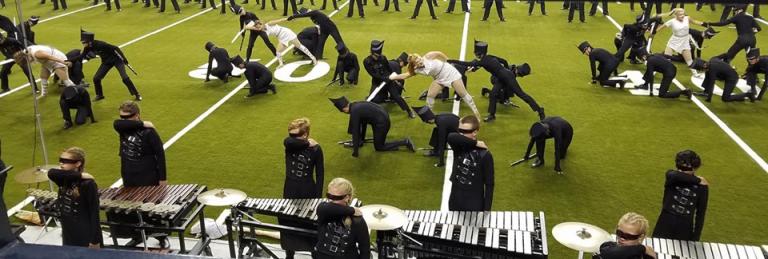
The second movement is almost like a ballet. The soldiers sit in suspended animation while a flute solo accompanies the dance of the children in front of the wall. It is in this movement where we hear the first hymn. The first two stanzas of Martin Luther’s “A Mighty Fortress is Our God” rises from the front ensemble of xylophones, vibraphones and marimbas like an ethereal music box lullaby. As a Lutheran pastor, I recall the words from our hymnal:
A mighty fortress is our God,
a sword and shield victorious;
he breaks the cruel oppressor’s rod
and wins salvation glorious.
When the soldiers finally rise from their positions, their movements are slow and majestic, indicating that perhaps a transformation is beginning.
The final movement begins with an organ solo accompanied by the front ensemble as the children emerge wearing white and gold, another sign that transformation is happening – from fearfulness to fearlessness, even as the soldiers continue their intricate drills across the field.
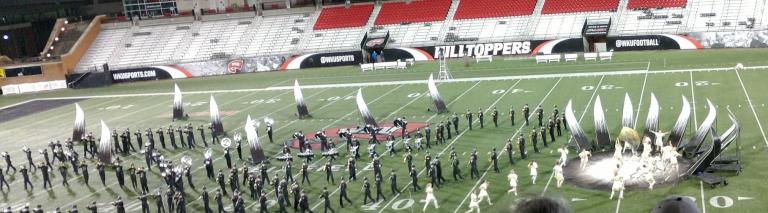
In this movement the low brass gives us the second hymn– “O God, Our Help in Ages Past.” This 18th century hymn by Isaac Watts contains these lyrics:
O God, our help in ages past,
our hope for years to come,
our shelter from the stormy blast,
and our eternal home.
The use of sacred music in this show invokes the notion of divine intervention as a primary source of justice when those who are vulnerable are seeking refuge. This brings to mind the sanctuary movement of churches advocating for and protecting refugees (including the ELCA that declared itself a “sanctuary denomination”). Or churches serving as hospitals during the Civil War. Or as way stations along the Underground Railroad.
As the movement comes to its climax, the giant spikes are turned into a circular refuge. In other words, the walls of pain are transformed into a sanctuary. Swords become plowshares, instruments of death are changed into protectors of life.
Yet the soldiers move in to surround the refuge. They encircle the sanctuary like a dark, menacing swarm.
But then something happens.
As a rising wall of otherworldly sound fills the stadium, the soldiers remove their caps and place them on the ground as the sanctuary lights up in a glorious transformation. The soldiers turn around to reveal that they are human, they are flesh and blood. Not military automatons, but real people – young women and men whose humanity is finally set free. At the conclusion, the sanctuary door opens to reveal a soldier lifting a child up onto his shoulders and the musicians remove their visors. Their eyes and faces beam. The transformation is complete.
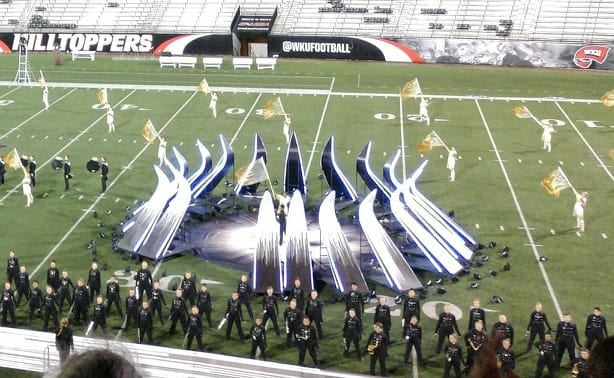
It is a powerfully emotional moment that makes me cry every time I see it, because it reminds me of the vision of Isaiah 11:6:
The wolf shall dwell with the lamb, and the leopard shall lie down with the kid; and the calf and the young lion … together; and a little child shall lead them.
Indeed, a child shall lead us. These high school students have put their heart and soul into a prophetic vision that shows us what it looks like when the soldiers put down their weapons, take off their masks of violence, and become the protectors of children. No longer pawns of war, they are now instruments of peace.
Transformation is possible – from fear to courage, from violence to peace, from hatred to love.
I am grateful to Lafayette Marching Band’s director, Chuck Smith, and his entire staff for putting together a show like this. From the music arranger, to the drill writer, to the assistant directors and instructors, to the parent volunteers, to the students – it takes courage to do what you’ve done in this show. You have shown us how music and a marching band can offer both prophetic critique as well as a hopeful vision of what is possible.
Seeking Refuge is the refuge we seek.
** Disclaimer: To be clear – this is my own interpretation of this marching band’s show and is not representative of the views of the Lafayette High School Marching Band, its director, the school’s principal, or the district’s superintendent. Others may see the show differently. Works of art are always open to different interpretations.*

Leah D. Schade is the Assistant Professor of Preaching and Worship at Lexington Theological Seminary in Kentucky. She is the author of Preaching in the Purple Zone: Ministry in the Red-Blue Divide (Rowman & Littlefield, 2019) and Creation-Crisis Preaching: Ecology, Theology, and the Pulpit (Chalice Press, 2015).
Twitter: @LeahSchade
Facebook: https://www.facebook.com/LeahDSchade/
Read also:
Lafayette Marching Band’s “Peace of Mind” Is What We Needed
A New Dawn: Lafayette High School Marching Band Brings Us Home
4 Nations: Lafayette Marching Band Brings the Fire!
General Christian
Lafayette High School Marching Band
Lafayette High School Marching Band
Previous Post

October 20, 2019
3 Lessons from Jacob Wrestling at the Jabbok. Genesis 32:20-32
Next Post

November 3, 2019 Monsters and Saints: STRANGER THINGS Meets Daniel 7
Browse Our Archives
Select a Category Academy of Homiletics Addiction Advent AI (Artificial Intelligence) Animals Apocalypse Appalachia Ash Wednesday Baptism Bible Black Lives Matter Blade Runner Book review Children in church Christian Nationalism Christian/Islamic relations Christmas Church Clergy Climate change COVID-19 Creation Data Centers Death penalty Devotional Dialogue Doubt Earth Day Easter Ecofeminism EcoPreacher 1-2-3 ELCA ELCA Youth Gathering Election Environment/ecology Epiphany Faith Faith and Politics Feminism Film review Food Food and Faith Forgiveness Fracking Good Friday Good Omens Grief Gun violence Holy Humor Sunday Holy Week Howard Thurman ICE Immigration Indigenous wisdom Interview Jesus Kentucky Lafayette High School Marching Band Leadership Lent LGBTQIA+ Marching band Martin Luther Martin Luther King Jr. Mary Maundy Thursday Michael Sheen Mother of Jesus Nature New Year's Eve Palm Sunday Parables Pentecost Poem, Poetry Politics Poor People's Campaign Pop culture Prayers Preaching Progressive Christianity Public theology Purple Zone Racism and White Privilege Religion Religion and environment Religion and politics Religion and pop culture Religion and violence Rev. Nelson Rabell Gonzalez Sermons Spanish language resources for preaching Technology Thanksgiving Theological education theology Trees Trump Uncategorized Vegan War Women and religion Workshop Worship
Select a Month October 2026 September 2026 July 2026 June 2026 May 2026 April 2026 March 2026 February 2026 January 2026 December 2025 November 2025 October 2025 September 2025 May 2025 April 2025 March 2025 February 2025 January 2025 December 2024 November 2024 October 2024 September 2024 August 2024 July 2024 June 2024 May 2024 April 2024 March 2024 February 2024 January 2024 December 2023 November 2023 October 2023 September 2023 August 2023 July 2023 June 2023 May 2023 April 2023 March 2023 February 2023 January 2023 December 2022 November 2022 October 2022 August 2022 July 2022 June 2022 May 2022 April 2022 March 2022 February 2022 January 2022 December 2021 November 2021 October 2021 September 2021 August 2021 July 2021 June 2021 May 2021 April 2021 March 2021 January 2021 December 2020 November 2020 October 2020 September 2020 August 2020 July 2020 June 2020 May 2020 April 2020 February 2020 January 2020 December 2019 November 2019 October 2019 September 2019 August 2019 July 2019 June 2019 May 2019 April 2019 March 2019 January 2019 December 2018 November 2018 October 2018 September 2018 August 2018 July 2018 June 2018 May 2018 April 2018 March 2018 February 2018 January 2018 December 2017 November 2017 October 2017 September 2017 August 2017 July 2017 June 2017 May 2017 April 2017
Follow Us!
TAKE THE
Religious Wisdom Quiz
Who said, "Vanity of vanities, all is vanity"?
Select your answer to see how you score.
Job David Isaiah Solomon
Books by This Author Books by Leah D. Schade
Related posts from EcoPreacher

Why Christians Have a Sacred Duty to Vote:...

"Render Unto Caesar": Faith, Politics, and Elections

What Matt. 21:23-32 Teaches About Integrity In An...

Workers in the Vineyard: Sermon Ideas for Matt....
TRENDING AT PATHEOS Progressive Christian

Why Christians Have a Sacred Duty to Vote:...
The Bible offers strong support for the sacred duty to vote. Here...

What Being a Modern-Day Apostle Means to Me
In my last column, I discussed the ins and outs of modern-day...

Did Ancient China Once Worship the God of...
Across human history, a common thread weaves through the origins of the...

Love Your Neighbor – Including Earth-Kin: Lev. 19,...
God’s command to love your neighbor means acting in an ethical and...

Lead a Church Study of “Jesus and Lao...
Guest writer Jack Thomas (The Irreverent Reverend) reflects on leading his church...

Principles for Understanding the Apostolic Ministry Today
Whenever people discover that my formal ministry title is "apostle," as in...
view all Progressive Christian blogs
Ad-Free & Subscriber Log-In Subscription Support
- About Us
- 2026 Calendar
- Videos
- Podcasts
- Library of World Religions
- Faith In Media Tracker
- Advertise With Us
- Write for Us
- Privacy Policy
- Terms of Service
- Do Not Sell My Data
- Contact Us
- Radiant Digital
- Manage Newsletter Subscriptions
- Unsubscribe From Notifications
- Sitemap
Copyright 2008-2026, Patheos. All rights reserved.
Subscription Support Ad-Free & Subscriber Log-In
Follow Patheos