
BuddhistCatholicContemplativeEvangelicalGeneral ChristianHinduJewishLatter-day SaintMuslimNew VisionsProgressive Christian
Beliefs
- Buddhist
- Catholic
- Contemplative
- Evangelical
- General Christian
- Hindu
- Jewish
- Latter-day Saint
- More Voices
- Muslim
- New Visions
- Pagan
- Progressive Christian
Topics
- Religion News
- Food and Religion
- Sports and Religion
- Religious Art
- Religious Music and Entertainment
- Religious Events
- History and Religion
- Style and Religion
- Politics and Religion
- Women in Religion
- Recreation Outdoors and Religion
- Business Finance and Religion
- Careers Workplace and Religion
- Education and Religion
- Family Parenting and Religion
- Health Fitness and Religion
- Home and Religion
- Relationships and Religion
- Technology and Religion
- Travel and Religion
Columnists
- Buddhist Columnists
- Business Finance and Religion Columnists
- Careers Workplace and Religion Columnists
- Catholic Columnists
- Contemplative Columnists
- Education and Religion Columnists
- Evangelists Columnists
- Family Parenting and Religion Columnists
- General Christian Columnists
- Health Fitness and Religion Columnists
- Hindu Columnists
- History and Religion Columnists
- Home and Religion Columnists
- Jewish Columnists
- More Voices Columnists
- Latter Day Columnists
- Muslim Columnists
- New Visions Columnists
- Nonreligious Columnists
- Pagan Columnists
- Politics and Religion Columnists
- Progressive Columnists
- Recreation Outdoors and Religion Columnists
- Relationships and Religion Columnists
- Religion News Columnists
- Religious Art Columnists
- Religious Events Columnists
- Religious Music and Entertainment Columnists
- Sports and Religion Columnists
- Style and Religion Columnists
- Technology and Religion Columnists
- Travel and Religion Columnists
- Women in Religion Columnists
Resource Library
- 2026 Calendar
- Library of World Religions
- The 100 Most Holy Places on Earth
- Patheos Answers
- Podcasts
- Videos
- Faith Leaders Database
- Anglican Episcopalian
- Bahai
- Baptist
- Buddhism
- Christianity
- Confucianism
- Eastern Orthodoxy
- Hinduism
- Holiness and Pentecostal
- ISKCON
- Islam
- Judaism
- Lutheran
- Methodist
- The Church of Jesus Christ of Latter-day Saints
- New Age
- Paganism
- Presbytarian and Reformed
- Protestantism
- Religion Behind the Scenes
- Roman Catholic
- Scientology
- Shia Islam
- Sikhism
- Sufism
- Sunni Islam
- Taoism
- Zen
- See all religions
Research Tools
 Ad-Free & Subscriber Log-In Subscription Support
Ad-Free & Subscriber Log-In Subscription Support
Follow Patheos 

- Trending:
- Forgiveness
- |
- Marriage
- |
- Consciousness
- |
- Death Penalty
- |
- Election
- |
- Halloween

- Home
- Progressive Christian
- 3 Lessons from Jacob Wrestling at the Jabbok. Genesis 32:20-32
3 Lessons from Jacob Wrestling at the Jabbok. Genesis 32:20-32
Last updated on: October 20, 2019 at 3:01 pm by Leah D. Schade
3 Lessons from Jacob Wrestling at the Jabbok. Genesis 32:20-32 2019-10-20T15:01:19-04:00 Leah D. Schade
Patheos Explore the world's faith through different perspectives on religion and spirituality! Patheos has the views of the prevalent religions and spiritualities of the world.
Jacob wrestling with the mysterious stranger at the river Jabbok is one of my favorite stories from the Bible. One of the reasons it’s always resonated with me is because my maiden name is Jacobs, so I always felt an affinity for the character of Jacob. This passage about the wrestling match has been important for me because there have been times in my life when I’ve felt like I’ve been wrestling with myself, or my past, or even with God.
Maybe you’ve experienced that kind of wrestling, too.
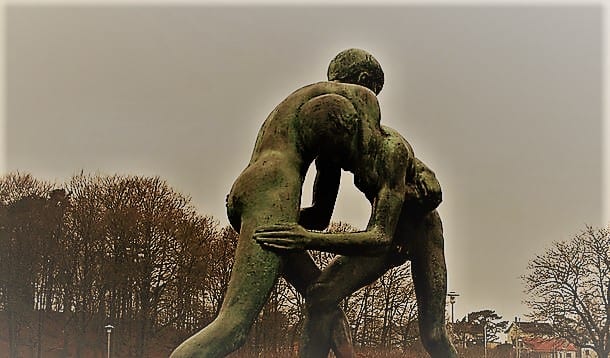
Wrestling. Bronze sculpture by Stig Blomberg. Photo by Blondinrikard Fröberg. https://flickr.com/photos/blondinrikard/. Some rights reserved.
I liked this passage so much, in fact, that I wrote paper on it for my Old Testament class in seminary many years ago. In my research, I examined the original Hebrew text and found some interesting things about puns and word plays used in the passage.
But before I get into that, let me give you the backstory leading up to Jacob at the Jabbok.
If you’ll recall, Jacob is a man of cunning and trickery.
From the moment he emerges from the womb, grabbing the heel of his twin brother, Esau, Jacob seeks to gain the upper hand in life through underhanded means. Using dirty tricks, he went after his brother’s birthright and the blessing from his father that should have been for Esau. So he has to flee from his home to escape the murderous anger of Esau.
At a place called Bethel, he finds himself alone in the desert and dreams of a ladder reaching to heaven. In the dream, God promises to be with him no matter what. God also promises to eventually bring him back to his homeland.
Jacob goes onto the country of his Uncle Laban where he marries his daughters, Leah and Rachel. [See the personal connection here? Leah married Jacob — Leah Jacobs. Also, my husband and I named our daughter Rachel. Biblical names and sagas are apparently a thing in our families.] Jacob acquires great wealth while working for his uncle. Then, true to the promise, God tells him to return to his home country. Jacob sends word to his brother that he wants to come home. His messengers return with the news that Esau is coming to meet him – with 400 men! Jacob is understandably afraid for his life and that of his family after what he did to Esau.
So Jacob resorts to his old tricks when preparing to meet his brother.
He divides his entourage in two and keeps one group back to protect at least half his property from his brother, whom he fears might seek revenge. Then he sent gifts of flocks ahead as a buffer between him and Esau.
Now here’s where we get to the interesting puns. There are three of them.
The first pun is Jabbok/Jacob.
Jabbok is the name of the river he is about to cross in order to meet Esau. The Hebrew verb y’baq means “to wrestle.” Both words are twists on the name “Jacob.” Jabbok is the river that borders the frontier to the land promised to Jacob and his ancestors — the land of Canaan. So the setting is crucial for the wrestling match.
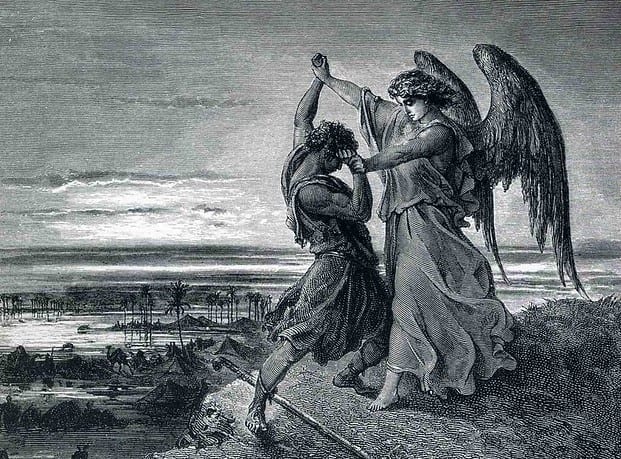
Jacob wrestling. Public domain.
When I researched this passage for my seminary paper, I learned that there is some debate among scholars about who it is that Jacob wrestles. Some say it is just a river demon. Others say it’s an angel sent by God to test Jacob. There is even the possibility that Jacob is wrestling with Esau, which would make sense – the two twins wrestling with each other, equal in strength.
Perhaps Jacob is actually wrestling with himself – his alter ego. The blow to the hollow of his thigh is a dirty trick – one that Jacob himself might use. And it would make sense as an origin story for the nation of Israel which has a history of wrestling with itself as well as with outsiders. The tribes of Israel often fought amongst themselves, to which Jacob’s internal battle may allude.
In any case, there is certainly deliberate ambiguity in the text.
But of all the possibilities as to who the stranger might be, I find one to be the most intriguing.
Jacob is wrestling with God.
At first, this doesn’t make sense. Why would God want to attack Jacob and wrestle with him? Well, if we look carefully, we find that this is exactly the encounter that Jacob is seeking.
Jacob deliberately sends his family and possessions across the river. It signifies that he is separate from “the tangible evidence of [his] blessing,” (Weis, 106). He is isolated from his identity which puts him in a state of vulnerability. It parallels his situation at Bethel, but this time he is choosing to be alone. He’s not running away; he’s going back. This shows that he is willing to face his past – as well as his destiny – without any help or protection.
Up until his wrestling match at the river Jabbok, Jacob’s methods of avoiding direct confrontation and outsmarting his opponents have been successful. He’s garnered women, children, and material wealth.
But here is what Jacob is about to find out: the very God who enabled Jacob to achieve such success requires more.
Let’s just pause here and think about the implications for our own lives, our own faith, our own church.
No matter where we have been, no matter our successes or sins, God does not abandon us. But there comes a time when God wrestles with us, and we wrestle with God, because something more is required of us. We come face to face with who we are – all our misdeeds, all our fears, the most vulnerable part of ourselves that we keep protected and hidden. And that’s where we meet God, often in a painful, and yet transformative way.
During that fateful night alone beside the river, Jacob finally faces the darkest parts of his personality and the sins of his past. More importantly, he confronts the future that God has destined for him. So this confrontation with God becomes the gift of grace that Jacob so desperately needs.
How does this grace come to Jacob? It comes in the form of a new name.
At dawn, after they have been wrestling all night, the mysterious man strikes Jacob in the groin. You can imagine the pain! Then the shadowy figure asks Jacob to release him. But Jacob will not let him go until he receives a blessing.
What does the mysterious figure do? He asks Jacob’s name. This is not just a random question. It was intended to remind Jacob of another time when Isaac, his father, asked his name. Jacob, the deceiver, had lied and said he was Esau so that he could receive his father’s blessing.

But here at the river Jabbok, Jacob admits who he really is – all his sins, all his arrogance, all his deception. This shows that he is repenting, making a decision to turn from his deceptive ways. (Homgren, p. 9).
So the mysterious stranger gives Jacob a new name – Israel. This is the second pun.
The Hebrew word is yisre’eli, which has several meanings:
“May God contend,” “May God rule,” and “Persevere.”
This name is appropriate in several ways. Jacob persevered with humans and prevailed. He persevered with God and received a blessing. Even with that very painful injury, he would not let go without wrestling a blessing from God. This name has significance for the Jewish people, for history has shown that just as their forefather persevered with humans and with God, the Chosen People have done the same.
This brings us to the third pun, which is on the name Jacob gives that place by the river — Penuel.
The Hebrew root is panim, meaning “face”. This works on three levels. First, Jacob is coming face-to-face with his brother Esau. Second, he is coming face-to-face with the sins of his past. Third, and most importantly, he is coming face-to-face with God. He is finally being honest. He is willing to be transformed.
So God responds by giving Jacob a blessing – not one stolen from his older brother, but a genuine blessing.
And yet, this blessing does not come without pain. Jacob sustains an injury to his groin – the most vulnerable part of his body – which will have long-lasting effects. Remember, Jacob struck others where they were most vulnerable. Now God has struck him in his most vulnerable spot.
From now on, Jacob will walk with a limp, signifying that he can no longer stride with arrogance, but must take his steps with humility. It also means that his time of fathering children is coming to an end. He is only able to have one more child after this – his last son, Benjamin [which happens to be my son’s name!].
The injury is a visible reminder to all who see Jacob/Israel that he is a man who finally submitted to God. “May God rule.”
Of course, as is often the case after an epiphany, the change is not fully realized right away. Remnants of the person’s old ways remain. Jacob is still not completely mature. Only in the ensuing years will Jacob grow into his new identity as a man of God. But there are several lessons we can draw from this story. And depending on where you are in your life and where you are in your faith journey, you may find one of these lessons resonates for you.
Lesson #1**: Perseverance can lead to blessing**.
There will be many times when we face “demons” or mysterious forces whom we cannot see or identify. Fighting in the dark against an unknown adversary is a common experience. Yet time and again, we somehow survive the battles and look back in awe at the blessing that came out of it. Remember, at the very moment when Jacob was at his most vulnerable and enduring the worst pain, a new day dawned.
Lesson #2: Blessing can emerge from pain.
Many people suffer physical, mental and spiritual woundedness. Perhaps you bear the scars of life’s “wrestling matches.” Sometimes there is a tendency to misdirect the anger, pain, and negative feelings in ways that hurt others or ourselves. But it is actually God whom you should confront when you are in pain. Only God can truly handle our woundedness and transform it into something useful and meaningful. Jacob was willing to learn what God might do with a person who is lame. To learn that is one of the greatest lesson for a human soul. Whatever your pain is, wherever your wound lies, wrestle with God about it and don’t let go until you get a blessing out of it.
And finally . . .
Lesson #3: Don’t be afraid to come to Penuel, “face-to-face.”

Photo credit: Sandro Lombardo. https://flickr.com/photos/sandrovet/. Some rights reserved.
What is it, or who is it, that you have been avoiding? As we see from Jacob’s history, using questionable means to attain what we want and avoiding direct confrontation with someone or with God can mean not only risking what you already have, but can stunt your spiritual growth.
This applies not just to individuals, but to faith communities as well. Especially as a church, we can be encouraged by this text to grapple with our differences, our difficult histories, and the ways we have failed in the past. We can wrestle with injustice, contend with the forces that keep us from being all that God calls us to be. Because when we do this, we will be spiritually alive and find ourselves encountering God. (Weis, p. 109.)
Coming to Penuel means coming face-to-face with yourself – being honest with yourself, others, and God. There was an honesty in Jacob’s struggle. And this is what God was looking for.
This honesty is what God wants from us, too. If you want to receive a blessing, you must be honest – especially with God! Shortcuts and tricks are not the way to receive God’s grace. And evading the consequences of our sin will only make the inevitable more painful.
God cannot be conquered; to think otherwise is a sin of extreme hubris or pride. Yet we are not to run away from meeting God face-to-face; this is a sin of cowardice. We are challenged to come down to the river Jabbok and wrestle for the blessing.
Yes, we may walk with a limp at the end of this struggle. But we will emerge transformed, changed by the blessing of God.
Come to Penuel. Because that is where we will encounter the transforming grace of God.
Sources:
Holmgren, Frederick C; “Holding Your Own Against God”; Interpretation, Vol. 44, January, 1990
Weis, Richard D.; “Lessons on Wrestling with the Unseen”; Reformed Review, Vol. 42, Winter 1988
Leah D. Schade is the Assistant Professor of Preaching and Worship at Lexington Theological Seminary in Kentucky. She is the author of Preaching in the Purple Zone: Ministry in the Red-Blue Divide (Rowman & Littlefield, 2019) and Creation-Crisis Preaching: Ecology, Theology, and the Pulpit (Chalice Press, 2015).
Twitter: @LeahSchade
Facebook: https://www.facebook.com/LeahDSchade/
Read also:
Prodigal Sisters, Prodigal God: The Surprise Party
Abraham and Isaac, Guns and God
Sermon: Finding the Mustard Seed in the Arboretum of Faith
Previous Post

October 13, 2019
Naaman Gets Schooled. And So Do We. 2 Kings 5:1-15c
Next Post
October 27, 2019 Seeking Refuge: Surprising Prophetic Vision of Marching Band
Browse Our Archives
Select a Category Academy of Homiletics Addiction Advent AI (Artificial Intelligence) Animals Apocalypse Appalachia Ash Wednesday Baptism Bible Black Lives Matter Blade Runner Book review Children in church Christian Nationalism Christian/Islamic relations Christmas Church Clergy Climate change COVID-19 Creation Data Centers Death penalty Devotional Dialogue Doubt Earth Day Easter Ecofeminism EcoPreacher 1-2-3 ELCA ELCA Youth Gathering Election Environment/ecology Epiphany Faith Faith and Politics Feminism Film review Food Food and Faith Forgiveness Fracking Good Friday Good Omens Grief Gun violence Holy Humor Sunday Holy Week Howard Thurman ICE Immigration Indigenous wisdom Interview Jesus Kentucky Lafayette High School Marching Band Leadership Lent LGBTQIA+ Marching band Martin Luther Martin Luther King Jr. Mary Maundy Thursday Michael Sheen Mother of Jesus Nature New Year's Eve Palm Sunday Parables Pentecost Poem, Poetry Politics Poor People's Campaign Pop culture Prayers Preaching Progressive Christianity Public theology Purple Zone Racism and White Privilege Religion Religion and environment Religion and politics Religion and pop culture Religion and violence Rev. Nelson Rabell Gonzalez Sermons Spanish language resources for preaching Technology Thanksgiving Theological education theology Trees Trump Uncategorized Vegan War Women and religion Workshop Worship
Select a Month October 2026 September 2026 July 2026 June 2026 May 2026 April 2026 March 2026 February 2026 January 2026 December 2025 November 2025 October 2025 September 2025 May 2025 April 2025 March 2025 February 2025 January 2025 December 2024 November 2024 October 2024 September 2024 August 2024 July 2024 June 2024 May 2024 April 2024 March 2024 February 2024 January 2024 December 2023 November 2023 October 2023 September 2023 August 2023 July 2023 June 2023 May 2023 April 2023 March 2023 February 2023 January 2023 December 2022 November 2022 October 2022 August 2022 July 2022 June 2022 May 2022 April 2022 March 2022 February 2022 January 2022 December 2021 November 2021 October 2021 September 2021 August 2021 July 2021 June 2021 May 2021 April 2021 March 2021 January 2021 December 2020 November 2020 October 2020 September 2020 August 2020 July 2020 June 2020 May 2020 April 2020 February 2020 January 2020 December 2019 November 2019 October 2019 September 2019 August 2019 July 2019 June 2019 May 2019 April 2019 March 2019 January 2019 December 2018 November 2018 October 2018 September 2018 August 2018 July 2018 June 2018 May 2018 April 2018 March 2018 February 2018 January 2018 December 2017 November 2017 October 2017 September 2017 August 2017 July 2017 June 2017 May 2017 April 2017
Follow Us!
TAKE THE
Religious Wisdom Quiz
In Roman armor, what purpose did the belt serve?
Select your answer to see how you score.
A weapon storage A decorative piece Protecting the waist Holding the rest of the armor together
Books by This Author Books by Leah D. Schade
Related posts from EcoPreacher
Thieves and Bandits, Shepherds and Gates - John...
Reclaiming 1 Peter 2:19-25 From Abuse: Sermon for...
Resist Christian Nationalism in Lent, Matthew 4:1-11

75th Anniversary Sermon, Reformation Lutheran, Media, PA
TRENDING AT PATHEOS Progressive Christian

What Being a Modern-Day Apostle Means to Me
In my last column, I discussed the ins and outs of modern-day...

Did Ancient China Once Worship the God of...
Across human history, a common thread weaves through the origins of the...

Love Your Neighbor – Including Earth-Kin: Lev. 19,...
God’s command to love your neighbor means acting in an ethical and...

Lead a Church Study of “Jesus and Lao...
Guest writer Jack Thomas (The Irreverent Reverend) reflects on leading his church...

Pastoral Wisdom for Responding to Sermon Pushback
Getting sermon pushback on your social justice sermon? Learn practical, Proverbs-based strategies...

Principles for Understanding the Apostolic Ministry Today
Whenever people discover that my formal ministry title is "apostle," as in...
view all Progressive Christian blogs
Ad-Free & Subscriber Log-In Subscription Support
- About Us
- 2026 Calendar
- Videos
- Podcasts
- Library of World Religions
- Faith In Media Tracker
- Advertise With Us
- Write for Us
- Privacy Policy
- Terms of Service
- Do Not Sell My Data
- Contact Us
- Radiant Digital
- Manage Newsletter Subscriptions
- Unsubscribe From Notifications
- Sitemap
Copyright 2008-2026, Patheos. All rights reserved.
Subscription Support Ad-Free & Subscriber Log-In
Follow Patheos