
BuddhistCatholicContemplativeEvangelicalGeneral ChristianHinduJewishLatter-day SaintMuslimNew VisionsProgressive Christian
Beliefs
- Buddhist
- Catholic
- Contemplative
- Evangelical
- General Christian
- Hindu
- Jewish
- Latter-day Saint
- More Voices
- Muslim
- New Visions
- Pagan
- Progressive Christian
Topics
- Religion News
- Food and Religion
- Sports and Religion
- Religious Art
- Religious Music and Entertainment
- Religious Events
- History and Religion
- Style and Religion
- Politics and Religion
- Women in Religion
- Recreation Outdoors and Religion
- Business Finance and Religion
- Careers Workplace and Religion
- Education and Religion
- Family Parenting and Religion
- Health Fitness and Religion
- Home and Religion
- Relationships and Religion
- Technology and Religion
- Travel and Religion
Columnists
- Buddhist Columnists
- Business Finance and Religion Columnists
- Careers Workplace and Religion Columnists
- Catholic Columnists
- Contemplative Columnists
- Education and Religion Columnists
- Evangelists Columnists
- Family Parenting and Religion Columnists
- General Christian Columnists
- Health Fitness and Religion Columnists
- Hindu Columnists
- History and Religion Columnists
- Home and Religion Columnists
- Jewish Columnists
- More Voices Columnists
- Latter Day Columnists
- Muslim Columnists
- New Visions Columnists
- Nonreligious Columnists
- Pagan Columnists
- Politics and Religion Columnists
- Progressive Columnists
- Recreation Outdoors and Religion Columnists
- Relationships and Religion Columnists
- Religion News Columnists
- Religious Art Columnists
- Religious Events Columnists
- Religious Music and Entertainment Columnists
- Sports and Religion Columnists
- Style and Religion Columnists
- Technology and Religion Columnists
- Travel and Religion Columnists
- Women in Religion Columnists
Resource Library
- 2026 Calendar
- Library of World Religions
- The 100 Most Holy Places on Earth
- Patheos Answers
- Podcasts
- Videos
- Faith Leaders Database
- Anglican Episcopalian
- Bahai
- Baptist
- Buddhism
- Christianity
- Confucianism
- Eastern Orthodoxy
- Hinduism
- Holiness and Pentecostal
- ISKCON
- Islam
- Judaism
- Lutheran
- Methodist
- The Church of Jesus Christ of Latter-day Saints
- New Age
- Paganism
- Presbytarian and Reformed
- Protestantism
- Religion Behind the Scenes
- Roman Catholic
- Scientology
- Shia Islam
- Sikhism
- Sufism
- Sunni Islam
- Taoism
- Zen
- See all religions
Research Tools
 Ad-Free & Subscriber Log-In Subscription Support
Ad-Free & Subscriber Log-In Subscription Support
Follow Patheos 

- Trending:
- Forgiveness
- |
- Marriage
- |
- Consciousness
- |
- Death Penalty
- |
- Election
- |
- Halloween

- Home
- Progressive Christian
- What Toni Morrison Taught Me About Racism in Her Book ‘Beloved’
What Toni Morrison Taught Me About Racism in Her Book ‘Beloved’
Last updated on: August 6, 2019 at 1:20 pm by Leah D. Schade
What Toni Morrison Taught Me About Racism in Her Book ‘Beloved’ 2019-08-06T13:20:44-04:00 Leah D. Schade
Patheos Explore the world's faith through different perspectives on religion and spirituality! Patheos has the views of the prevalent religions and spiritualities of the world.
Toni Morrison has just died at the age of 88. Here’s why her book Beloved helped form me as a Christian confronting my own racism and constructing my understanding of public theology.
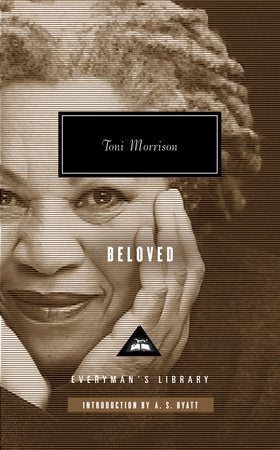
When I was a PhD student at the Lutheran Theological Seminary in Philadelphia, Toni Morrison’s book Beloved was on the reading list for the Public Theology portion of my program. Initially I wondered why, since it’s a work of fiction. It’s not a theological treatise, but rather a novel about a group of former slaves and their children surviving antebellum America. In the midst of dehumanizing white supremacy, with its horrific crimes against black men, women and children, the story focuses on Sethe. She is a woman with a secret anguish that haunts her family and surrounding community.
The story begins with the sudden convergence of people from Sethe’s past arriving at her home. Paul D is a friend from her former enslavement at Sweet Home. Then the mysterious Beloved arrives just after Paul D banishes a destructive, haunting spirit from Sethe’s house. What follows is an evocative, troubling saga. In Beloved, Toni Morrison poetically and poignantly portrays the power of incarnate love to enter into the most broken and scarred places of our lives to nurture tentative tendrils of hope and redemption.
Beloved had a profound effect on me, a white, female Christian and preacher preparing for a vocation of public theology and teaching.
I happened to be reading Beloved as I was ministering to an African-American congregation, Spirit and Truth, in Yeadon, Pa., while working on my PhD program. Morrison’s book helped me recognize my own complicity with the racist system that still exists in this country. She was able to articulate for me the source of fear that whites have of blacks.
In the book, Sethe is accused of being an animal, not just by her white owners, but also by the man she loves. Whites see within blacks a primal, chaotic, jungle-like nature that threatens to overcome “civilized “white society with its untamed power. What whites do not recognize – Morrison’s book makes clear – is that the jungle they fear within blacks is the one they planted there by their enslavement of the people of Africa.
Here is a quote from Chapter 19 of Beloved:
Whitepeople believed that whatever the manners, under every dark skin was a jungle. Swift unnavigable waters, swinging screaming baboons, sleeping snakes, red gums ready for their sweet white blood. In a way, he thought, they were right. The more colored people spent their strength trying to convince them how gentle they were, how clever and loving, how human, the more they used themselves up to persuade whites of something Negroes believed could not be questioned, the deeper and more tangled the jungle grew inside.
But it wasn’t the jungle blacks brought with them to this place from the other (livable) place. It was the jungle whitefolks planted in them. And it grew. It spread. In, through and after life, it spread, until it invaded the whites who had made it. Touched them every one. Changed and altered them. Made them bloody, silly, worse than even they wanted to be, so scared were they of the jungle they had made. The screaming baboon lived under their own white skin; the red gums were their own.
This is the “heart of darkness” jungle (to borrow Joseph Conrad’s term) that imposes ruthless domination on a people.
This domination results not just in their enslavement, but in the ongoing institutional racism and internalized oppression blacks experience today. In this way, the jungle whites fear is the jungle we put there ourselves. This means that the jungle is actually within us. We have projected onto dark-skinned people the “shadow self” of our own evil proclivities.
So what does Morrison’s novel have to do with public theology?
An important term I learned in grad school was epistemology – the study of how we know what we think we know. I learned that experience is a powerful form of knowledge. Beloved demonstrated that knowledge of the experience of the most violating kind of evil is necessary to create a public theology. Such a theology can listen to the victims of evil and stand in solidarity with them as they struggle to regain their identity, define their personhood, and defend their right of existence and speech.
Reading Beloved helped to put a human face on why Christians must do the work of public theology. We need to try to deeply understand those who have been “othered” by white supremacy in order to experience a conviction of our souls. In this way, we can begin to repent of our arrogance and the way we create hierarchies based on perceived difference. Only in this way can we begin to work on our recovery from our addiction to privilege, humble ourselves, and undertake the work of a theology in the public square.
But Beloved also shows us another kind of epistemology.
It’s a way knowing that enables us to understand deep, embodied, and sensuous grace. Mark Wallace, in his book, Green Christianity, uses the love story of Sethe and Paul D to illustrate what he sees as a necessary corrective of a hardened intellectual epistemology. In Beloved, we experience the embrace of a radical, flesh-loving, Creation-loving theology that honors bodies – human bodies, plant and animal bodies, and the body of Earth herself.
Tragically, it is Sethe’s desperation to protect the precious body of her daughter that leads her to commit murder. Because of what she suffered as a slave, she sees no other option for her daughter than to have her in heaven rather than in hell on this earth. Thus the violence of white supremacy is turned on Sethe’s own child.
Yet Sethe is not beyond redemption.
“I will call them my people, which were not my people; and her beloved, which was not beloved” (Romans 9:25).
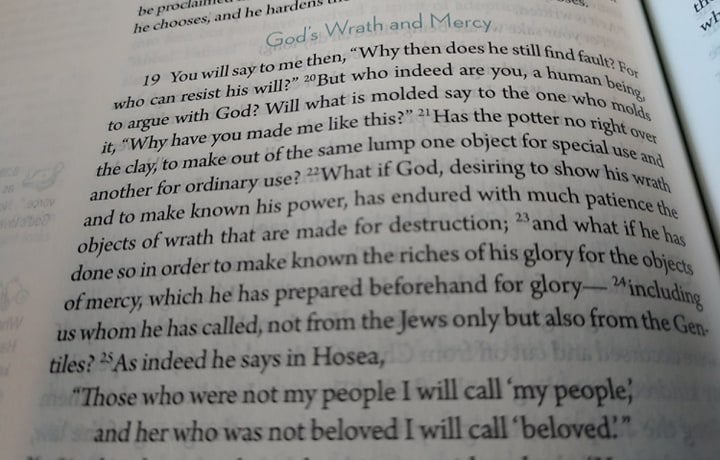
We have to understand Sethe’s story in light of this verse from Romans. This belovedness is the quiet hand of God running through the story. It’s the tender hands rubbing the swollen feet of pregnant Sethe and binding the festering whip-wounds on her back. It’s the female preacher Baby Suggs raising holy hands above the gathering of children, men, and women in the clearing, blessing them holy words that urge them to love the very bodies that whites have colonized and terrorized.
“You got to love your hands. You got to love your heart,” she declares to them in an outdoor sermon amidst a sacred grove of trees. As a preacher and a teacher of preachers at a seminary, the character of Baby Suggs showed me the power of connecting a broken people with the healing power of God.
So, yes, Beloved should be required reading for Christians.
This is a book for any Christian intent on asking public theology’s hard questions about how power is wielded by the privileged as well as the oppressed. Sethe had power to kill her own child, despite her love for her daughter. When Paul D asserted that there must have been another way, Sethe insisted that the only way to save her baby was to kill her.
Only with Beloved’s return for a reckoning with Sethe, does she begin to learn that there is another way through the evil.
It comes by way of the community of women gathered to exorcise the demon-spirit-child and free Sethe and her other daughter, Denver, from its unrelenting rage. It also comes when Sethe turns her rage on Mr. Bodwin (whom she mistakes for her former slave-owner, Schoolteacher). She redirects her protective violence where it should have been in the first place – against the source of her oppression, instead of against the innocent child who might be the oppressor’s next victim. This redirection aids the exorcism as well.
Being a Christian means we have to listen to these stories, attend to the pain, confront the evil, and – with humility in the public square – invite our communities into the working of the Spirit.
Beloved brought this to light and life for me. Toni Morrison’s exquisite writing has the power to open minds, change hearts, and transform lives. I am grateful to be one of them.
Leah D. Schade is the Assistant Professor of Preaching and Worship at Lexington Theological Seminary in Kentucky. She is the author of Preaching in the Purple Zone: Ministry in the Red-Blue Divide (Rowman & Littlefield, 2019) and Creation-Crisis Preaching: Ecology, Theology, and the Pulpit (Chalice Press, 2015).
Twitter: @LeahSchade
Facebook: https://www.facebook.com/LeahDSchade/
Read more:
Hi, I’m Leah. I’m a Recovering Racist.
The Healing Power of ‘Moonlight’: Race, Erotic Love, and Baptism
Previous Post

August 4, 2019
Blackjewel and the Rich Fool: A Parable for Our Time
Next Post

August 7, 2019 Throwing Your Bag on the Train: Heart Follows Treasure
Browse Our Archives
Select a Category Academy of Homiletics Addiction Advent AI (Artificial Intelligence) Animals Apocalypse Appalachia Ash Wednesday Baptism Bible Black Lives Matter Blade Runner Book review Children in church Christian Nationalism Christian/Islamic relations Christmas Church Clergy Climate change COVID-19 Creation Data Centers Death penalty Devotional Dialogue Doubt Earth Day Easter Ecofeminism EcoPreacher 1-2-3 ELCA ELCA Youth Gathering Election Environment/ecology Epiphany Faith Faith and Politics Feminism Film review Food Food and Faith Forgiveness Fracking Good Friday Good Omens Grief Gun violence Holy Humor Sunday Holy Week Howard Thurman ICE Immigration Indigenous wisdom Interview Jesus Kentucky Lafayette High School Marching Band Leadership Lent LGBTQIA+ Marching band Martin Luther Martin Luther King Jr. Mary Maundy Thursday Michael Sheen Mother of Jesus Nature New Year's Eve Palm Sunday Parables Pentecost Poem, Poetry Politics Poor People's Campaign Pop culture Prayers Preaching Progressive Christianity Public theology Purple Zone Racism and White Privilege Religion Religion and environment Religion and politics Religion and pop culture Religion and violence Rev. Nelson Rabell Gonzalez Sermons Spanish language resources for preaching Technology Thanksgiving Theological education theology Trees Trump Uncategorized Vegan War Women and religion Workshop Worship
Select a Month October 2026 September 2026 July 2026 June 2026 May 2026 April 2026 March 2026 February 2026 January 2026 December 2025 November 2025 October 2025 September 2025 May 2025 April 2025 March 2025 February 2025 January 2025 December 2024 November 2024 October 2024 September 2024 August 2024 July 2024 June 2024 May 2024 April 2024 March 2024 February 2024 January 2024 December 2023 November 2023 October 2023 September 2023 August 2023 July 2023 June 2023 May 2023 April 2023 March 2023 February 2023 January 2023 December 2022 November 2022 October 2022 August 2022 July 2022 June 2022 May 2022 April 2022 March 2022 February 2022 January 2022 December 2021 November 2021 October 2021 September 2021 August 2021 July 2021 June 2021 May 2021 April 2021 March 2021 January 2021 December 2020 November 2020 October 2020 September 2020 August 2020 July 2020 June 2020 May 2020 April 2020 February 2020 January 2020 December 2019 November 2019 October 2019 September 2019 August 2019 July 2019 June 2019 May 2019 April 2019 March 2019 January 2019 December 2018 November 2018 October 2018 September 2018 August 2018 July 2018 June 2018 May 2018 April 2018 March 2018 February 2018 January 2018 December 2017 November 2017 October 2017 September 2017 August 2017 July 2017 June 2017 May 2017 April 2017
Follow Us!
TAKE THE
Religious Wisdom Quiz
True or False: James states that the tongue is a fire, a world of iniquity.
Select your answer to see how you score.
TRUE FALSE
Books by This Author Books by Leah D. Schade
Related posts from EcoPreacher
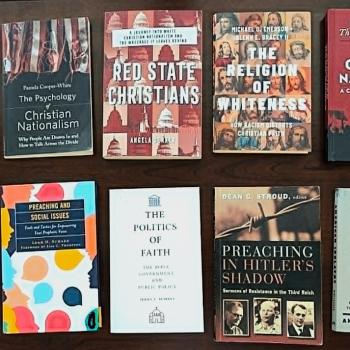
10 Books to Address Christian Nationalism in Your...
Palm Sunday Was a Protest March! Analysis of...

Ezekiel 37 Counters White Christian Nationalism

The Murder of Renee Good is an Apocalyptic...
TRENDING AT PATHEOS Progressive Christian

What Being a Modern-Day Apostle Means to Me
In my last column, I discussed the ins and outs of modern-day...

Did Ancient China Once Worship the God of...
Across human history, a common thread weaves through the origins of the...

Love Your Neighbor – Including Earth-Kin: Lev. 19,...
God’s command to love your neighbor means acting in an ethical and...

Lead a Church Study of “Jesus and Lao...
Guest writer Jack Thomas (The Irreverent Reverend) reflects on leading his church...

Pastoral Wisdom for Responding to Sermon Pushback
Getting sermon pushback on your social justice sermon? Learn practical, Proverbs-based strategies...

Principles for Understanding the Apostolic Ministry Today
Whenever people discover that my formal ministry title is "apostle," as in...
view all Progressive Christian blogs
Ad-Free & Subscriber Log-In Subscription Support
- About Us
- 2026 Calendar
- Videos
- Podcasts
- Library of World Religions
- Faith In Media Tracker
- Advertise With Us
- Write for Us
- Privacy Policy
- Terms of Service
- Do Not Sell My Data
- Contact Us
- Radiant Digital
- Manage Newsletter Subscriptions
- Unsubscribe From Notifications
- Sitemap
Copyright 2008-2026, Patheos. All rights reserved.
Subscription Support Ad-Free & Subscriber Log-In
Follow Patheos