
BuddhistCatholicContemplativeEvangelicalGeneral ChristianHinduJewishLatter-day SaintMuslimNew VisionsProgressive Christian
Beliefs
- Buddhist
- Catholic
- Contemplative
- Evangelical
- General Christian
- Hindu
- Jewish
- Latter-day Saint
- More Voices
- Muslim
- New Visions
- Pagan
- Progressive Christian
Topics
- Religion News
- Food and Religion
- Sports and Religion
- Religious Art
- Religious Music and Entertainment
- Religious Events
- History and Religion
- Style and Religion
- Politics and Religion
- Women in Religion
- Recreation Outdoors and Religion
- Business Finance and Religion
- Careers Workplace and Religion
- Education and Religion
- Family Parenting and Religion
- Health Fitness and Religion
- Home and Religion
- Relationships and Religion
- Technology and Religion
- Travel and Religion
Columnists
- Buddhist Columnists
- Business Finance and Religion Columnists
- Careers Workplace and Religion Columnists
- Catholic Columnists
- Contemplative Columnists
- Education and Religion Columnists
- Evangelists Columnists
- Family Parenting and Religion Columnists
- General Christian Columnists
- Health Fitness and Religion Columnists
- Hindu Columnists
- History and Religion Columnists
- Home and Religion Columnists
- Jewish Columnists
- More Voices Columnists
- Latter Day Columnists
- Muslim Columnists
- New Visions Columnists
- Nonreligious Columnists
- Pagan Columnists
- Politics and Religion Columnists
- Progressive Columnists
- Recreation Outdoors and Religion Columnists
- Relationships and Religion Columnists
- Religion News Columnists
- Religious Art Columnists
- Religious Events Columnists
- Religious Music and Entertainment Columnists
- Sports and Religion Columnists
- Style and Religion Columnists
- Technology and Religion Columnists
- Travel and Religion Columnists
- Women in Religion Columnists
Resource Library
- 2026 Calendar
- Library of World Religions
- The 100 Most Holy Places on Earth
- Patheos Answers
- Podcasts
- Videos
- Faith Leaders Database
- Anglican Episcopalian
- Bahai
- Baptist
- Buddhism
- Christianity
- Confucianism
- Eastern Orthodoxy
- Hinduism
- Holiness and Pentecostal
- ISKCON
- Islam
- Judaism
- Lutheran
- Methodist
- The Church of Jesus Christ of Latter-day Saints
- New Age
- Paganism
- Presbytarian and Reformed
- Protestantism
- Religion Behind the Scenes
- Roman Catholic
- Scientology
- Shia Islam
- Sikhism
- Sufism
- Sunni Islam
- Taoism
- Zen
- See all religions
Research Tools
 Ad-Free & Subscriber Log-In Subscription Support
Ad-Free & Subscriber Log-In Subscription Support
Follow Patheos 

- Trending:
- Forgiveness
- |
- Marriage
- |
- Consciousness
- |
- Death Penalty
- |
- Election
- |
- Halloween

- Home
- Progressive Christian
- Blackjewel and the Rich Fool: A Parable for Our Time
Blackjewel and the Rich Fool: A Parable for Our Time
Last updated on: August 7, 2019 at 8:35 pm by Leah D. Schade
Blackjewel and the Rich Fool: A Parable for Our Time 2019-08-07T20:35:22-04:00 Leah D. Schade
Patheos Explore the world's faith through different perspectives on religion and spirituality! Patheos has the views of the prevalent religions and spiritualities of the world.
Blackjewel is a coal company that abruptly filed for bankruptcy in July, leaving hundreds of non-union miners in Kentucky without their jobs, health benefits, severance pay, and even their last paycheck. How can Jesus’ parable of the Rich Fool (Luke 12:13-21) offer insight for the church’s role in this community, state, and national issue? This sermon is one example of using the ‘dialogical lens‘ for preaching on this text.

Blackjewel and the Rich Fool: A Parable for Our Time
Last month, I took a group of students from Lexington Theological Seminary on a 4-day immersion trip to the Appalachian region of eastern Kentucky. The title of the course was “Witness and Testimony in Appalachia: Environment, Community, and Purple Zone Preaching.” Guided my by colleague Lon Oliver who served as our mentor, the trip was made possible through a grant from AMERC, Appalachian Ministry Education Resource Center. The course gave these twelve students from across the United States the opportunity to learn first-hand the complex intersections of environmental and socioeconomic issues in the coal fields of Appalachia.
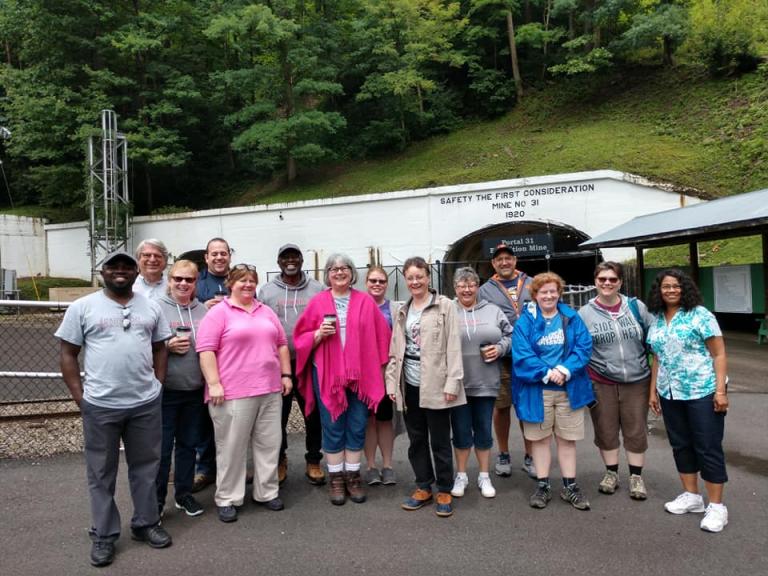
Students from Lexington Theological Seminary visited Portal 31, an historic mine near Cumberland, KY.
Personally, I came away with a humbled appreciation for an area of Kentucky and the U.S. that has been stereotyped by television and media portrayals that both ridicule and pity the residents.
As we visited places like Whitesburg, Hazard, and Pine Mountain, we asked questions, We engaged in deep, pastoral listening to a variety of voices within those communities. And we discerned how we can preach the gospel in the midst of contentious social issues. During our travels, we drove through the town of Cumberland. It was like a ghost town. The once thriving mining town was nothing but abandoned buildings, businesses that had closed up shop, and residents with few prospects for employment.
The demise of the coal industry has hit hard in places like Harlan, Benham, and Cumberland.
Yet when we talked with residents, they told us of their love for the beauty of the mountains and the friends and family who have lived there for generations.
But what greatly troubled us is the way the coal industry has ravaged these once majestic mountains. Poisoned its streams. Polluted the landscape. And afflicted the miners with health issues like black lung disease. Since the 1800s, America’s power has come at the cost of environmental health and miner’s health – even their very lives lost to mining accidents due to companies neglecting safety regulations. What we saw was the effects of corporate greed destroying lives, communities, and God’s Creation itself.
Though the course ended a month ago, what we learned continues to have an impact. Just in the last few days, we heard the story of Blackjewel, a coal company that abruptly filed for bankruptcy in July, leaving hundreds of miners in Kentucky without their jobs, health benefits, severance pay, and even their last paycheck. The money that had been direct-deposited to their accounts was pulled out without warning. The desperate workers are now protesting on the train tracks in Cumberland, blocking a million-dollar shipment of coal from leaving the mine.
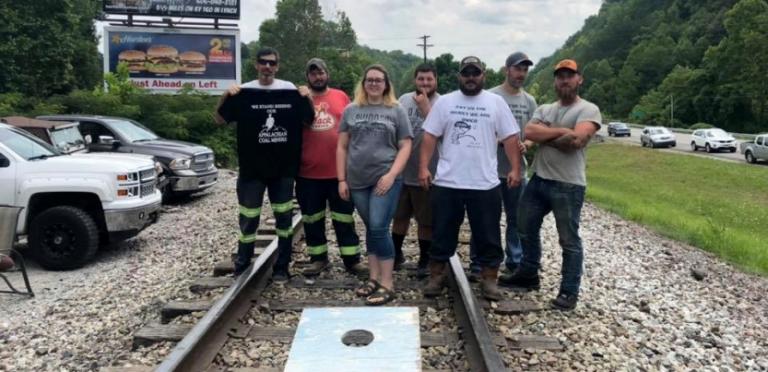
Blackjewel protest. Photo by Megan Roark-Halcomb. https://labornotes.org/2019/07/kentucky-miners-are-camped-out-railroad-tracks-blocking-coal-train-demanding-their-stolen
No matter what anyone may think of the coal industry, we can certainly agree that the workers themselves deserve better than this.
While the CEOs and their shareholders amassed millions of dollars’ worth of wealth by extracting the coal – and the labor – of these communities, they destroyed the delicate ecological balance of the mountains and created a socioeconomic nightmare for these communities. Now that the coal industry is collapsing, Blackjewel is trying to skip town and default on its obligations.
As Kentucky State Representative Cherlynn Stevenson said in a post on her Facebook page: “Stories are coming out of the protest site about a family that cannot afford the needed chemo treatments for one of their children. [They are dealing with] threats of foreclosure and repossession. The greed of this company and their lack of human decency has put an unimaginable strain on people’s lives.”
In the midst of this, we hear today these words from Jesus in Luke Chapter 12:
Then Jesus said to them, ‘Take care! Be on your guard against all kinds of greed; for one’s life does not consist in the abundance of possessions.’ Then he told them a parable: ‘The land of a rich man produced abundantly. And he thought to himself, “What should I do, for I have no place to store my crops?” Then he said, “I will do this: I will pull down my barns and build larger ones, and there I will store all my grain and my goods. And I will say to my soul, Soul, you have ample goods laid up for many years; relax, eat, drink, be merry.”
But God said to him, “You fool! This very night your life is being demanded of you. And the things you have prepared, whose will they be?”
Jesus tells this parable in response to a man obsessed with wanting more and more – even if it means destroying his relationship with his brother.
But his warning to this man about his greed, and this parable about the Rich Fool are not just about this one man. There are three other groups of people listening to this conversation. At the beginning of this chapter, we see that there is a crowd of thousands of people who have all gathered to hear Jesus (12:1). Within that crowd are his disciples, and he is teaching them as the crowd listens.
But there is also a third group – the Pharisees and lawyers who Jesus has been criticizing in the previous chapter. In chapter 11, he accuses them of neglecting justice (11:42) and “loading people with burdens hard to bear” while they themselves “do not lift a finger to ease them” (11:46).
So when Jesus is having this conversation about greed with this man, it’s not just about him. It’s about the lawyers and Pharisees, it’s about the disciples, it’s about the crowd. And – it’s about us. That crowd extends into time to include us as listeners today.
This Parable of the Rich Fool raises important questions for us a church as we consider this situation with the Blackjewel miners in eastern Kentucky.
What is Jesus teaching us about what it means to be the church and faithful Christians in the midst of contentious public issues like this? In what way can we learn about being God’s people who engage the conflicts and sin of the world, while maintaining the commitment to grace, hope, and love? What does God intend for us based on this passage?
The “pleonexia” of Blackjewel
Walter Brueggemann in his book Money and Possessions points out that when Jesus is talking about greed, the term he uses means to grow bigger, to maximize abundance, to yearn for increase (192). In Greek it’s pleonexia, and it’s a word used to describe the insatiable desire for more and more, to the point where a person – or, perhaps, a company – will commit fraud and extortion in order to gain more and more profit.
Rep. Stevenson noted in her post that Blackjewel broke the law by neglecting to put up a bond required by law. Such a bond would have put aside money for a situation of bankruptcy like this in order to provide for the workers. Of course, we have to wonder – how did the CEO and the of Blackjewel and its board of directors get away with breaking the law? Who in our government looked the other way? Who was complicit in the greed and the corporate criminality that has left these miners, their families, and their communities suffering and afraid?
Like modern day Pharisees and lawyers, they are neglecting justice and “loading people with burdens hard to bear” while they themselves “do not lift a finger to ease them.”
Brueggemann notes that “The man in the parable addresses himself as ‘soul’ (psyche). But God addresses him as ‘fool’ . . . It turns out that his great accumulation designed to secure his life only led to his death” (192-193). In the case of Blackjewel – and any company that profits from extraction – it’s not just one individual’s death. It’s the death of workers, the death of communities, the death even of God’s Creation itself.
As a church, we have to ask ourselves important questions in light of Jesus’ parable and how it relates to Blackjewel, the miners, and any communities suffering from the criminal negligence of corporate greed.
Do we as Christians, as a church, have a responsibility to call the company and our government to accountability?
In what ways can we help these miners and their families who have sacrificed so much so that we can have the electricity we need and enjoy?
How can we listen and speak, respond and take action when it comes to issues of public concern like this?
At the end of the parable, Jesus concludes by making a distinction between storing up treasures for ourselves instead of being “rich towards God” (v. 21).
I wonder what it would look like to be ‘rich towards God’ when it comes to this situation with Blackjewel?
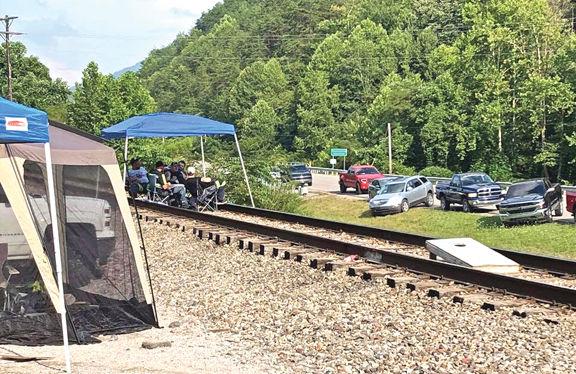
Blackjewel miners camping on train tracks to block coal shipments. Photo taken from Facebook support group for displaced miners.
Perhaps we can help them by making donations to the GoFundMe site that has been set up to assist them.
Maybe we can contact our legislators and demand accountability for the gross negligence on behalf of the Kentucky Labor Cabinet who did not enforce the bond.
Perhaps we’ll reconsider how we vote in upcoming elections. Maybe we’ll vote for the values of responsibility and accountability instead of empty promises, negligence, and greed.
A few Christians and pastors are visiting the miners’ blockade to bring them homemade meals and supplies, pray with them, spend time with them, listen to their stories. One priest has donated $20,000 to the struggling miners.
Some of us may write letters to the editor expressing our outrage that the CEO was able to jump ship with a golden parachute. All while hundreds of families are themselves filing for bankruptcy, pleading with bill collectors, selling off personal property, and doing without the basics of food, medicine, and household necessities.
Maybe you have ideas for responding to this situation that you would like to suggest. After the service today, we can take some time to talk and engage in dialogue together.
But I want to point out that what’s happening in Kentucky is pointing to the need for bigger changes in our culture and our society.
We need to ask if we’re okay with a culture of greed that benefits a few while oppressing the many?Perhaps it’s time to rethink our culture and economy of extraction and consumption and envision a different way to live.
A way of life that trusts the generosity of God and ensures a community where everyone has enough to live and pay their bills and care for their families.
A culture where we do not normalize and glorify greed, but, in fact, are ashamed of it, ashamed by it, and shame those who practice it. A culture where we focus less on I, me, mine and more on the basic human values that we need to survive as a species. Values like compassion, sharing, a sense of fairness and community, and the moral obligation to care for our neighbors.
A society where our leaders hold the powerful to a higher level of accountability. And where we hold our leaders accountable.
A planet where the mountains and the people are honored as creations of God, rather than commodities to be bought and sold.
Here’s what I don’t want you to miss about Jesus’ parable. I don’t want you to miss the urgency of his message: This very night your life is being demanded of you. It’s a life-and-death situation.
People of God, people of Kentucky, people of America – it’s a life-and-death situation for the desperate miners in Cumberland. And for the mountains and the streams in Kentucky and throughout Appalachia. For me, a seminary professor, a pastor, and a parent, Jesus’ parable calls me to examine how my teaching and preaching aligns with my own actions.
What I learned from my students and from the people we visited in eastern Kentucky is that this is not something I can do alone.
This is not work I can take on by myself. Jesus’ parable was not addressed to just one man. It was addressed to the crowds, to the disciples, to the Pharisees and lawyers of his time. And today it is addressed to the miners, and coal company CEOs, and legislators and citizens of Kentucky. It is a parable addressed to our nation and our planet.
You and I are part of this planet, this nation, this state, this church. I hope we will heed the urgency of this parable and talk about what it means for us as the people of God. What it means to be rich toward God.
Want to help the miners in Cumberland, Kentucky? According to Kentucky State Representative Cherlynn Stevenson:
Online donations to benefit the Harlan County miners affected by the recent bankruptcy of Black Jewel can be made to [email protected] via PayPal. Go Fund Me Links:
WithLovefromHarlan > > > https://www.gofundme.com/f/blackjewel-bankruptcy-victims
Cash and check donations can be dropped off to the Harlan County Community Action Agency, Inc. at 319 Camden Street Harlan, Ky or mailed to With Love from Harlan at P.O. Box 1621 Harlan, KY 40831.
You can also use this link and write “For Blackjewel Miners” in the notes section! https://harlancountycaa.com/make-a-donation/

Leah D. Schade is the Assistant Professor of Preaching and Worship at Lexington Theological Seminary in Kentucky. She is the author of Preaching in the Purple Zone: Ministry in the Red-Blue Divide (Rowman & Littlefield, 2019) and Creation-Crisis Preaching: Ecology, Theology, and the Pulpit (Chalice Press, 2015).
Twitter: @LeahSchade
Facebook: https://www.facebook.com/LeahDSchade/
Read more:
Dialogue and Justice: Preaching the Rich Fool with a Dialogical Lens
Using a ‘Dialogical Lens’ for Scripture and Preaching
Previous Post

August 3, 2019
Dialogical Lens for Preaching Luke 12:13-21, the Rich Fool
Next Post

August 6, 2019 What Toni Morrison Taught Me About Racism in Her Book 'Beloved'
Browse Our Archives
Select a Category Academy of Homiletics Addiction Advent AI (Artificial Intelligence) Animals Apocalypse Appalachia Ash Wednesday Baptism Bible Black Lives Matter Blade Runner Book review Children in church Christian Nationalism Christian/Islamic relations Christmas Church Clergy Climate change COVID-19 Creation Data Centers Death penalty Devotional Dialogue Doubt Earth Day Easter Ecofeminism EcoPreacher 1-2-3 ELCA ELCA Youth Gathering Election Environment/ecology Epiphany Faith Faith and Politics Feminism Film review Food Food and Faith Forgiveness Fracking Good Friday Good Omens Grief Gun violence Holy Humor Sunday Holy Week Howard Thurman ICE Immigration Indigenous wisdom Interview Jesus Kentucky Lafayette High School Marching Band Leadership Lent LGBTQIA+ Marching band Martin Luther Martin Luther King Jr. Mary Maundy Thursday Michael Sheen Mother of Jesus Nature New Year's Eve Palm Sunday Parables Pentecost Poem, Poetry Politics Poor People's Campaign Pop culture Prayers Preaching Progressive Christianity Public theology Purple Zone Racism and White Privilege Religion Religion and environment Religion and politics Religion and pop culture Religion and violence Rev. Nelson Rabell Gonzalez Sermons Spanish language resources for preaching Technology Thanksgiving Theological education theology Trees Trump Uncategorized Vegan War Women and religion Workshop Worship
Select a Month October 2026 September 2026 July 2026 June 2026 May 2026 April 2026 March 2026 February 2026 January 2026 December 2025 November 2025 October 2025 September 2025 May 2025 April 2025 March 2025 February 2025 January 2025 December 2024 November 2024 October 2024 September 2024 August 2024 July 2024 June 2024 May 2024 April 2024 March 2024 February 2024 January 2024 December 2023 November 2023 October 2023 September 2023 August 2023 July 2023 June 2023 May 2023 April 2023 March 2023 February 2023 January 2023 December 2022 November 2022 October 2022 August 2022 July 2022 June 2022 May 2022 April 2022 March 2022 February 2022 January 2022 December 2021 November 2021 October 2021 September 2021 August 2021 July 2021 June 2021 May 2021 April 2021 March 2021 January 2021 December 2020 November 2020 October 2020 September 2020 August 2020 July 2020 June 2020 May 2020 April 2020 February 2020 January 2020 December 2019 November 2019 October 2019 September 2019 August 2019 July 2019 June 2019 May 2019 April 2019 March 2019 January 2019 December 2018 November 2018 October 2018 September 2018 August 2018 July 2018 June 2018 May 2018 April 2018 March 2018 February 2018 January 2018 December 2017 November 2017 October 2017 September 2017 August 2017 July 2017 June 2017 May 2017 April 2017
Follow Us!
TAKE THE
Religious Wisdom Quiz
What was rebuilt in Jerusalem under Zerubbabel and Joshua the high priest?
Select your answer to see how you score.
The wall The city gates The altar and Temple The palace
Books by This Author Books by Leah D. Schade
Related posts from EcoPreacher

Pastoral Wisdom for Responding to Sermon Pushback

Love Your Neighbor – Including Earth-Kin: Lev. 19,...

Preaching About Climate Change: What Clergy Need Most
When The Data Center Wolf Is At Your...
TRENDING AT PATHEOS Progressive Christian

Why Christians Have a Sacred Duty to Vote:...
The Bible offers strong support for the sacred duty to vote. Here...

What Being a Modern-Day Apostle Means to Me
In my last column, I discussed the ins and outs of modern-day...

Did Ancient China Once Worship the God of...
Across human history, a common thread weaves through the origins of the...

Love Your Neighbor – Including Earth-Kin: Lev. 19,...
God’s command to love your neighbor means acting in an ethical and...

Lead a Church Study of “Jesus and Lao...
Guest writer Jack Thomas (The Irreverent Reverend) reflects on leading his church...

Principles for Understanding the Apostolic Ministry Today
Whenever people discover that my formal ministry title is "apostle," as in...
view all Progressive Christian blogs
Ad-Free & Subscriber Log-In Subscription Support
- About Us
- 2026 Calendar
- Videos
- Podcasts
- Library of World Religions
- Faith In Media Tracker
- Advertise With Us
- Write for Us
- Privacy Policy
- Terms of Service
- Do Not Sell My Data
- Contact Us
- Radiant Digital
- Manage Newsletter Subscriptions
- Unsubscribe From Notifications
- Sitemap
Copyright 2008-2026, Patheos. All rights reserved.
Subscription Support Ad-Free & Subscriber Log-In
Follow Patheos