
BuddhistCatholicContemplativeEvangelicalGeneral ChristianHinduJewishLatter-day SaintMuslimNew VisionsProgressive Christian
Beliefs
- Buddhist
- Catholic
- Contemplative
- Evangelical
- General Christian
- Hindu
- Jewish
- Latter-day Saint
- More Voices
- Muslim
- New Visions
- Pagan
- Progressive Christian
Topics
- Religion News
- Food and Religion
- Sports and Religion
- Religious Art
- Religious Music and Entertainment
- Religious Events
- History and Religion
- Style and Religion
- Politics and Religion
- Women in Religion
- Recreation Outdoors and Religion
- Business Finance and Religion
- Careers Workplace and Religion
- Education and Religion
- Family Parenting and Religion
- Health Fitness and Religion
- Home and Religion
- Relationships and Religion
- Technology and Religion
- Travel and Religion
Columnists
- Buddhist Columnists
- Business Finance and Religion Columnists
- Careers Workplace and Religion Columnists
- Catholic Columnists
- Contemplative Columnists
- Education and Religion Columnists
- Evangelists Columnists
- Family Parenting and Religion Columnists
- General Christian Columnists
- Health Fitness and Religion Columnists
- Hindu Columnists
- History and Religion Columnists
- Home and Religion Columnists
- Jewish Columnists
- More Voices Columnists
- Latter Day Columnists
- Muslim Columnists
- New Visions Columnists
- Nonreligious Columnists
- Pagan Columnists
- Politics and Religion Columnists
- Progressive Columnists
- Recreation Outdoors and Religion Columnists
- Relationships and Religion Columnists
- Religion News Columnists
- Religious Art Columnists
- Religious Events Columnists
- Religious Music and Entertainment Columnists
- Sports and Religion Columnists
- Style and Religion Columnists
- Technology and Religion Columnists
- Travel and Religion Columnists
- Women in Religion Columnists
Resource Library
- 2026 Calendar
- Library of World Religions
- The 100 Most Holy Places on Earth
- Patheos Answers
- Podcasts
- Videos
- Faith Leaders Database
- Anglican Episcopalian
- Bahai
- Baptist
- Buddhism
- Christianity
- Confucianism
- Eastern Orthodoxy
- Hinduism
- Holiness and Pentecostal
- ISKCON
- Islam
- Judaism
- Lutheran
- Methodist
- The Church of Jesus Christ of Latter-day Saints
- New Age
- Paganism
- Presbytarian and Reformed
- Protestantism
- Religion Behind the Scenes
- Roman Catholic
- Scientology
- Shia Islam
- Sikhism
- Sufism
- Sunni Islam
- Taoism
- Zen
- See all religions
Research Tools
 Ad-Free & Subscriber Log-In Subscription Support
Ad-Free & Subscriber Log-In Subscription Support
Follow Patheos 

- Trending:
- Forgiveness
- |
- Marriage
- |
- Consciousness
- |
- Death Penalty
- |
- Election
- |
- Halloween

- Home
- Progressive Christian
- Ask, Seek, Knock: Seeking the Goods or The Good?
Ask, Seek, Knock: Seeking the Goods or The Good?
Last updated on: July 28, 2019 at 2:37 pm by Leah D. Schade
Ask, Seek, Knock: Seeking the Goods or The Good? 2019-07-28T14:37:32-04:00 Leah D. Schade
Patheos Explore the world's faith through different perspectives on religion and spirituality! Patheos has the views of the prevalent religions and spiritualities of the world.
Ask, Seek, Knock: Seeking The Goods or ‘The Good’?
Matthew 7:7-11 and Luke 11:1-13
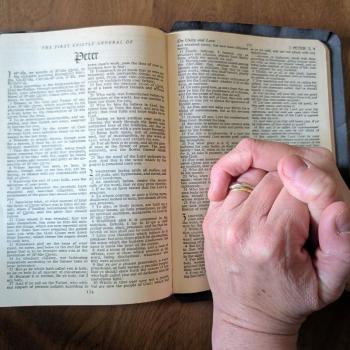
“So I say to you, Ask, and it will be given you; search, and you will find; knock, and the door will be opened for you. For everyone who asks receives, and everyone who searches finds, and for everyone who knocks, the door will be opened.”

Photo credit: Leah D. Schade. Public domain.
Jesus seems pretty confident when he gives these instructions about praying. Audacious, even! Ask, seek, knock – those are our instructions. And Jesus assures us that whatever is being sought is there for the finding.
But what are we to be seeking?
For what are we to ask? What is it we hope to find on the other side of the door?
It’s not immediately clear what we are to be searching for. I think this is intentional on Jesus’ part. He’s creating a clever set-up to invite our inevitable questions. And these questions can lead to a deeper understanding about what we are to seek and receive from God. They help us understand who God is, what God does, and how we can be in prayerful relationship to God.
If Jesus would have paused for a moment after these imperatives and assertions, I wonder if he would have gotten the same kinds of responses I once heard from a group of Confirmation students? We were studying prayer, and I simply read these two verses aloud to see how they would respond. “If this is true,” they said, “then let’s ask for (fill in the latest techno-device, brand-name clothing, trip to exotic destination, etc.).”
Go ahead, I told them. Ask for those things right now. Ask, seek, knock.
They happily called out to God their ever-growing list of desires. After their boisterous voices quieted, they went on to bemoan the fact that such magical asking produced no results. God is not Aladdin’s Genie, it turns out.
“But Jesus doesn’t say those things are what we should ask for,” one astute 8th grade girl responded. Aha! So what does Jesus say? He goes on to give an illustration that any child and parent can understand – asking for something to eat. He poses a rhetorical question that provokes laughter if we imagine a child asking for toast and getting a slab of slate on a plate, or receiving a hissing snake instead of wholesome fish. Would this happen in your households, I asked the students? Of course not! Our parents wouldn’t do that. Except when they make me eat brussel sprouts, one of them joked.
Then they were ready to hear the truth about what they are pray to pray for – to ask , seek, knock.
Tois agatha. In Greek, “The Good.”
They are to ask for good things. And what are “good things?” The students reverted back to their wish list from earlier in our conversation. A new phone! The latest clothing brand! A cruise!
But are these extravagances good, I pressed them? “They are to me!” one boy responded to the amusement of his peers.
I pointed out that perhaps we are confusing “goods” with “the good.” Reinhold Niebuhr in Moral Man and Immoral Society elucidates what happens when the distinction between the two gets mistaken:
Man [sic], unlike other creatures, is gifted and cursed with an imagination which extends his appetites beyond the requirements of subsistence. Human society will never escape the problem of the equitable distribution of the physical and cultural goods which provide for the preservation and fulfillment of human life.[1]
In other words, “the good” of the preservation and fulfillment of human life is threatened by the uneven distribution of “goods” within human society.
The students and I talked about how our consumerist society has led to increased poverty, environmental depletion, and wars over the distribution of goods.
They began to see that at the heart of their selfish desires listed earlier is a kernel of egotistical evil that seeks only its own pleasure at the expense of others. At this point I introduced a bit of process theology to the students, explaining that God is not a Santa Claus or genie in the sky, but the One whose initial aim of goodness continually invites us, or lures us to respond in kind. God wants “the good” for us. And we are to ask for “the good” for others.
Then the light bulb went off for one student. “So when Jesus is telling us to ask, seek, and knock for the good, it isn’t just about us, but for other people!” Now we’re onto something! Ask, seek, knock for those in need – not just ourselves.
What is “the good” that you’d like to ask God for on behalf of others?
“Maybe we should pray for kids who actually don’t get enough to eat, and kids whose parents really are abusive to them, like giving them stones and snakes when they should be giving them bread and fish,” said the boy who had earlier insisted on wanting “the goods.” His peers nodded thoughtfully.
Well, go ahead. Ask for those things right now, I invited them. This time there was no rambunctious calling out. Their voices were more subdued. There were spaces of quietness between their petitions. “I want peace in the world.” “I want healing for my grandmother.” “We should pray for the disaster victims.” “We need to pray for less pollution and an end to climate change.” The list was long and heavy with emotion, intentionality, and hope.
When it felt like they were done, I repeated once again Jesus’ words: “Everyone who asks receives, and everyone who searches finds, and for everyone who knocks, the door will be opened.” Ask, seek, knock.
But that was not the end.
“How can we be sure that what Jesus is saying is true?” a girl asked. “How will we know that we’ve gotten what we asked for? Because there are still a lot of abused kids and pollution and war and stuff,” she pointed out.
Yes, how will we know?
Was Jesus being naïve? Unrealistic? Or worse, was he lying to us?
The astute 8th grader chimed in once again. “But it doesn’t say when all these things will happen.” Another good point! Stretching them even further, I explained how the Greek verb tense for those words is indicative future, meaning that they have not happened yet. And there is no specific indication of the time when they will come to pass.
I introduced them to the paradoxical phrase “already and not yet” to describe God’s work in the world, even when the ultimate fulfillment has not yet arrived.
So you’ve recognized the ‘not yet’ aspect of all this, I said. Where is the ‘already’?
We began making a third list – evidence that prayers were being answered, doors were being opened, people were finding the agatha they were seeking. Our church’s food boxes for the hungry. A collection for Lutheran Disaster Response that morning in church. The ecology ministry’s work on protecting God’s Creation. Church members bringing meals to the student’s grandmother recovering from surgery. The abused foster child being adopted by a loving family in our congregation. The soldiers coming home.
The young theologians decided to continue in the weeks thereafter praying for the good. Each week, they asked. They sought. They knocked. And they found doors opening – signs that the future indicative of Jesus’ promises was already making itself known.
This sermon was adapted from my essay in Feasting on the Gospels: Year A, Matthew. Vol. 1, Chapters 1-13. Cynthia A. Jarvis and E. Elizabeth Johnson, general editors. Louisville, Kentucky: Westminster John Knox Press, 2013, 158-162.
[1] Niebuhr, Reinhold, Moral Man and Immoral Society, C. Scribner’s Sons, New York, 1946, 1.

Leah D. Schade is the Assistant Professor of Preaching and Worship at Lexington Theological Seminary in Kentucky. She is the author of Preaching in the Purple Zone: Ministry in the Red-Blue Divide (Rowman & Littlefield, 2019) and Creation-Crisis Preaching: Ecology, Theology, and the Pulpit (Chalice Press, 2015).
Twitter: @LeahSchade
Facebook: https://www.facebook.com/LeahDSchade/
Read also:
What is Good Preaching? A Sermon about Sermons
Sermon: Finding the Mustard Seed in the Arboretum of Faith
Receiving the Right Yoke: A Sermon on Burdens and Stress
Previous Post

July 25, 2019
Like Tears in Rain: Rutger Hauer, Blade Runner, and Being Fully Human
Next Post

July 30, 2019 Using a 'Dialogical Lens' for Scripture and Preaching
Browse Our Archives
Select a Category Academy of Homiletics Addiction Advent AI (Artificial Intelligence) Animals Apocalypse Appalachia Ash Wednesday Baptism Bible Black Lives Matter Blade Runner Book review Children in church Christian Nationalism Christian/Islamic relations Christmas Church Clergy Climate change COVID-19 Creation Data Centers Death penalty Devotional Dialogue Doubt Earth Day Easter Ecofeminism EcoPreacher 1-2-3 ELCA ELCA Youth Gathering Election Environment/ecology Epiphany Faith Faith and Politics Feminism Film review Food Food and Faith Forgiveness Fracking Good Friday Good Omens Grief Gun violence Holy Humor Sunday Holy Week Howard Thurman ICE Immigration Indigenous wisdom Interview Jesus Kentucky Lafayette High School Marching Band Leadership Lent LGBTQIA+ Marching band Martin Luther Martin Luther King Jr. Mary Maundy Thursday Michael Sheen Mother of Jesus Nature New Year's Eve Palm Sunday Parables Pentecost Poem, Poetry Politics Poor People's Campaign Pop culture Prayers Preaching Progressive Christianity Public theology Purple Zone Racism and White Privilege Religion Religion and environment Religion and politics Religion and pop culture Religion and violence Rev. Nelson Rabell Gonzalez Sermons Spanish language resources for preaching Technology Thanksgiving Theological education theology Trees Trump Uncategorized Vegan War Women and religion Workshop Worship
Select a Month October 2026 September 2026 July 2026 June 2026 May 2026 April 2026 March 2026 February 2026 January 2026 December 2025 November 2025 October 2025 September 2025 May 2025 April 2025 March 2025 February 2025 January 2025 December 2024 November 2024 October 2024 September 2024 August 2024 July 2024 June 2024 May 2024 April 2024 March 2024 February 2024 January 2024 December 2023 November 2023 October 2023 September 2023 August 2023 July 2023 June 2023 May 2023 April 2023 March 2023 February 2023 January 2023 December 2022 November 2022 October 2022 August 2022 July 2022 June 2022 May 2022 April 2022 March 2022 February 2022 January 2022 December 2021 November 2021 October 2021 September 2021 August 2021 July 2021 June 2021 May 2021 April 2021 March 2021 January 2021 December 2020 November 2020 October 2020 September 2020 August 2020 July 2020 June 2020 May 2020 April 2020 February 2020 January 2020 December 2019 November 2019 October 2019 September 2019 August 2019 July 2019 June 2019 May 2019 April 2019 March 2019 January 2019 December 2018 November 2018 October 2018 September 2018 August 2018 July 2018 June 2018 May 2018 April 2018 March 2018 February 2018 January 2018 December 2017 November 2017 October 2017 September 2017 August 2017 July 2017 June 2017 May 2017 April 2017
Follow Us!
TAKE THE
Religious Wisdom Quiz
What is the meaning of "Immanuel" in the prophecy of Isaiah?
Select your answer to see how you score.
God with Us God Provides God the Redeemer God the Healer
Books by This Author Books by Leah D. Schade
Related posts from EcoPreacher

Thieves and Bandits, Shepherds and Gates - John...
Reclaiming 1 Peter 2:19-25 From Abuse: Sermon for...

Resist Christian Nationalism in Lent, Matthew 4:1-11

10 Principios para la Predicación Ecológica
TRENDING AT PATHEOS Progressive Christian

What Being a Modern-Day Apostle Means to Me
In my last column, I discussed the ins and outs of modern-day...

Did Ancient China Once Worship the God of...
Across human history, a common thread weaves through the origins of the...

Love Your Neighbor – Including Earth-Kin: Lev. 19,...
God’s command to love your neighbor means acting in an ethical and...

Lead a Church Study of “Jesus and Lao...
Guest writer Jack Thomas (The Irreverent Reverend) reflects on leading his church...

Pastoral Wisdom for Responding to Sermon Pushback
Getting sermon pushback on your social justice sermon? Learn practical, Proverbs-based strategies...

Principles for Understanding the Apostolic Ministry Today
Whenever people discover that my formal ministry title is "apostle," as in...
view all Progressive Christian blogs
Ad-Free & Subscriber Log-In Subscription Support
- About Us
- 2026 Calendar
- Videos
- Podcasts
- Library of World Religions
- Faith In Media Tracker
- Advertise With Us
- Write for Us
- Privacy Policy
- Terms of Service
- Do Not Sell My Data
- Contact Us
- Radiant Digital
- Manage Newsletter Subscriptions
- Unsubscribe From Notifications
- Sitemap
Copyright 2008-2026, Patheos. All rights reserved.
Subscription Support Ad-Free & Subscriber Log-In
Follow Patheos