
BuddhistCatholicContemplativeEvangelicalGeneral ChristianHinduJewishLatter-day SaintMuslimNew VisionsProgressive Christian
Beliefs
- Buddhist
- Catholic
- Contemplative
- Evangelical
- General Christian
- Hindu
- Jewish
- Latter-day Saint
- More Voices
- Muslim
- New Visions
- Pagan
- Progressive Christian
Topics
- Religion News
- Food and Religion
- Sports and Religion
- Religious Art
- Religious Music and Entertainment
- Religious Events
- History and Religion
- Style and Religion
- Politics and Religion
- Women in Religion
- Recreation Outdoors and Religion
- Business Finance and Religion
- Careers Workplace and Religion
- Education and Religion
- Family Parenting and Religion
- Health Fitness and Religion
- Home and Religion
- Relationships and Religion
- Technology and Religion
- Travel and Religion
Columnists
- Buddhist Columnists
- Business Finance and Religion Columnists
- Careers Workplace and Religion Columnists
- Catholic Columnists
- Contemplative Columnists
- Education and Religion Columnists
- Evangelists Columnists
- Family Parenting and Religion Columnists
- General Christian Columnists
- Health Fitness and Religion Columnists
- Hindu Columnists
- History and Religion Columnists
- Home and Religion Columnists
- Jewish Columnists
- More Voices Columnists
- Latter Day Columnists
- Muslim Columnists
- New Visions Columnists
- Nonreligious Columnists
- Pagan Columnists
- Politics and Religion Columnists
- Progressive Columnists
- Recreation Outdoors and Religion Columnists
- Relationships and Religion Columnists
- Religion News Columnists
- Religious Art Columnists
- Religious Events Columnists
- Religious Music and Entertainment Columnists
- Sports and Religion Columnists
- Style and Religion Columnists
- Technology and Religion Columnists
- Travel and Religion Columnists
- Women in Religion Columnists
Resource Library
- 2026 Calendar
- Library of World Religions
- The 100 Most Holy Places on Earth
- Patheos Answers
- Podcasts
- Videos
- Faith Leaders Database
- Anglican Episcopalian
- Bahai
- Baptist
- Buddhism
- Christianity
- Confucianism
- Eastern Orthodoxy
- Hinduism
- Holiness and Pentecostal
- ISKCON
- Islam
- Judaism
- Lutheran
- Methodist
- The Church of Jesus Christ of Latter-day Saints
- New Age
- Paganism
- Presbytarian and Reformed
- Protestantism
- Religion Behind the Scenes
- Roman Catholic
- Scientology
- Shia Islam
- Sikhism
- Sufism
- Sunni Islam
- Taoism
- Zen
- See all religions
Research Tools
 Ad-Free & Subscriber Log-In Subscription Support
Ad-Free & Subscriber Log-In Subscription Support
Follow Patheos 

- Trending:
- Forgiveness
- |
- Marriage
- |
- Consciousness
- |
- Death Penalty
- |
- Election
- |
- Halloween

- Home
- Progressive Christian
- The Proximity of Hope: An Easter Sermon
The Proximity of Hope: An Easter Sermon
Last updated on: April 21, 2019 at 6:45 am by Leah D. Schade
The Proximity of Hope: An Easter Sermon 2019-04-21T06:45:05-04:00 Leah D. Schade
Patheos Explore the world's faith through different perspectives on religion and spirituality! Patheos has the views of the prevalent religions and spiritualities of the world.
In the midst of black holes, burning churches, and political corruption, how can Easter put us in the proximity of hope?
Have you noticed the eerie similarities between the events of Holy Week and the events of our own world in the past ten days?
As we watched the burning of Notre Dame Cathedral from an accidental electrical fire, I recalled Jesus’s words after he came into Jerusalem on Palm Sunday and gazed at the temple with his disciples. “‘You see all these, do you not? Truly I tell you, not one stone will be left here upon another; all will be thrown down’” (Matthew 24:2). I thought of those words as I watched that giant heavenward spire blazing red and orange from within, and then collapsing into the plumes of smoke.
Just a few days earlier, three other churches were burned – not on accident, but with malevolent intent, the result of racial hatred. The historically black churches in Louisiana were deliberately torched by a white supremacist hell-bent on burning those sacred buildings to the ground. I thought of Jesus praying in the Garden of Gethsemane as the mob came with torches in the night. I thought of burning crosses and white hoods coming to kill an innocent man, to hang him on what James Cone called “the lynching tree.”
And just this morning we woke up to the news of three churches along with hotels bombed in Sri Lanka, a country off the coast of India. Close to two hundred killed, hundreds wounded, sanctuaries destroyed on the high holy day of the church year, Easter Sunday. Add these barbaric acts of violence to the mosque shooting in New Zealand, the synagogue shooting in Pittsburgh, and it seems as if religion itself is under attack.
Our news cycle has also been dominated by the release of the Mueller Report that recounted stories of corruption, obstruction of justice, blatant and unrepentant lies, and the abuse of power. All of this was set against the backdrop of the stories of Holy Week where Jesus was sentenced to death by religious and political leaders who were also corrupt, who obstructed justice, told blatant and unrepentant lies, and abused their power.
But what has really grabbed hold of me this week was the story about a black hole. Scientists for the first time found a way to photograph a black hole in space. Black holes are the result of collapsed stars that result in this frightening abyss of nothingness where existence is simply snuffed out. Up until last week, they had previously been invisible. But now they’ve captured an image of that ring of fire around an eye of sheer darkness. It was both really cool, and really unsettling. I don’t know about you, but the thought of a gravitational pull so strong that not even light can escape it is both awe-inspiring and terrifying.

Messier 87 black hole image, public domain. Easter tomb image from Worship House Media. Used with permission.
I wonder if that’s how the women felt coming to the tomb on Easter morning – a combination of awe and terror.
Standing before the dark entryway of that cave, they held the spices and fragrances to anoint Jesus’ body as an act of honor and love. But all they saw was a black hole where the stone had been rolled away. They must have been both awe-struck and terrified.
All week they had followed behind Jesus, watching his body being tortured, his dignity stripped away, and his entire being consumed by the hatred and evil of powerful men. Maybe standing at the cross was like watching those churches burn – you can’t stand to watch, but you also can’t stand to look away.
When I think about that 850-year-old church spire collapsing in flames;
When I think about black churches and communities of color engulfed in flames of racism;
When I think about immigrant children separated from their parents and caged like animals;
When I think about the tens of thousands of lives cut short at the end of a gun – including children in schools and their own homes, and worshipers in their sacred buildings;
When I think about every day that goes by when we lose another endangered species, another glacier, another coral reef, as the climate crisis marches us closer to an apocalyptic future;
All of this sometimes feels to me like we are right at the edge of a terrifying abyss where the gravitational pull of evil is so strong that not even light can escape it.
This is where we find ourselves this Easter morning – at the juxtaposition between these extremes of awe and terror.
We stand beside those women who have been devastated by loss and who dread what is in that black hole of a tomb. Like those women, we are in the presence of forces that are so much bigger than we are, forces that care nothing about truth, or goodness, or the respect for life. Forces that have the gravitational pull of a collapsed star and threaten us with a powerful cosmic violence.
It’s no wonder those women trembled. I have trembled, too. Maybe you also know what it feels like to tremble.
Even when they discover that the tomb is empty, when they learn that Christ is risen, the women still can’t stop trembling. It’s this moment of disorientation when they’re not quite sure where to go, or what to do, or what to say.
Each of the Gospels has a different perspective on this.
Matthew tells of the ground shaking and a dazzling angel appearing to the two Marys telling them that Jesus has been raised from the dead (Matt. 28:1-7).
In John, it’s just Mary weeping in utter despondency when she first encounters Jesus. And she doesn’t even recognize him at first, thinking him to be the gardener (John 20:11-15).
In Luke, the women were “terrified and bowed their faces to the ground” when they saw the two angels announcing Jesus’ resurrection (Luke 24:5). But when they try to tell the male disciples of this miracle, no one believes them. They consider it an “idle tale” (Luke 24:11).
In Mark’s original ending, the women don’t even say a word to anyone. “They went out and fled from the tomb, for terror and amazement had seized them; and they said nothing to anyone, for they were afraid.” (Mark 16:9).
I understand this fear. It disorients me. It rearranges my thoughts in ways that I can’t always control. It shakes up all the puzzle pieces in my brain, and I have to remember where all the pieces go. Sometimes this fear even takes some of the pieces away, leaving me frustrated, paralyzed, and feeling like I’m teetering at the edge of the abyss.
Perhaps I’m just overly sensitive, but I find myself in this grief-stricken state of disorientation more times than I care to admit.
One time it happened when I was talking with my friend and colleague Emily Askew who teaches theology at Lexington Theological Seminary. We were talking about Earth Day and how the celebrations of flowers and greenery seem insignificant when the truth is that people are being murdered in places like the Amazon and Central America for trying to protect the environment. I was feeling overwhelmed by the terrifying news about the state of our planet’s climate and the relentless stories about God’s precious creatures blinking out like stars sucked into the black hole of extinction.
As we were talking, I just began weeping with sadness and grief. I feel so powerless, I said. But I have children to raise, and a husband who is my beloved life partner, and students who count on me to teach them how to be pastors, and for heaven’s sake, I am a Christian preacher! How can I encourage people to believe the gospel when I myself am struggling in the face of this reality?
Emily was quiet at first and just sat with me in my grief. Then she said this:
“What I do when I feel this way is to put myself in the proximity of hope.”
She said, “If I can’t generate hope on my own, then I find something or someone who can pull me back into their orbit and keep me from falling into the abyss. You don’t always have to be the strong one. That’s what God’s grace is all about. Just put yourself in the proximity of hope.”
And so I have taken her advice. I pick up those burial spices and I follow the women who followed Jesus. I put myself in their proximity, the proximity of hope. And I find myself gently pulled into their orbit, and I watch where they point me.
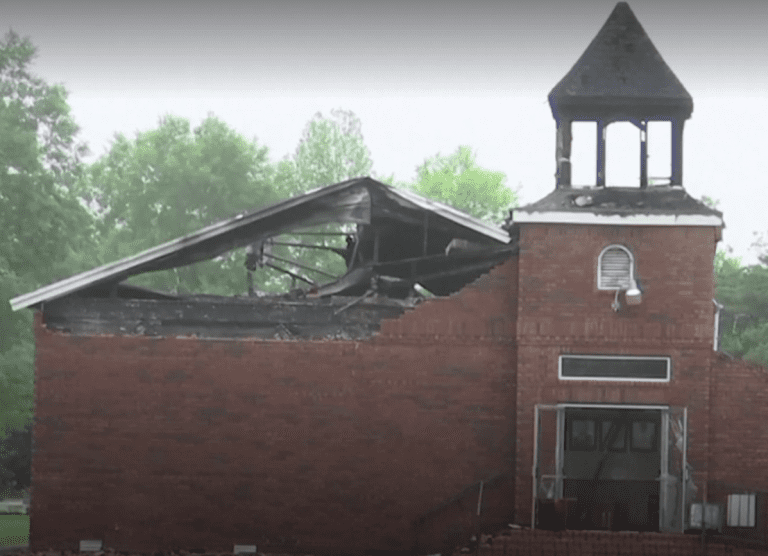
One of the Louisiana churches burned by a white supremacist arsonist. Click the link below for the GoFundMe page to donate.
This week as the churches burned, I also I learned of a father and daughter who had reconciled after a long period of estrangement that was like a cold void between them and everyone else around them. The father shared with me that they had found a way to be in relationship with each other – something I was not sure possible when I had last talked to them. This reconciliation between a father and daughter is a small thing, perhaps. But it was a resurrection moment for me that I clung to in the midst of the earthquakes that shook our world this week.
I also read about wealthy donors who have pledged millions of dollars to rebuild Notre Dame. But the real story for me is that over $2 million has been raised through a GoFundMe account for the Louisiana churches. As one of the pastors said, “What had been intended for evil, God has transformed into good.” I choose to believe that these are words of resurrection and not counted as an idle tale.
And then I watched a video of Greta Thunberg, the teenage climate activist from Sweden, who urged those same billionaires to use their wealth to help find solutions for the climate crisis. I see Jesus, the Gardener of this planet, in her bold and fearless witness.
Putting yourself in the proximity of hope means that when, like those women in Mark’s Gospel, you find yourself frozen in fear or paralyzed by depression, you can remember that it’s not always up to you to solve everything, to fix everything.
Retired homiletics professor John Holbert said it this way:
What Easter asks of all of us is to exchange our story of death and anger and hatred and division, our tale of rejected immigrants, ostracized LGBTQIA siblings, vast disparities between rich and poor, denial of basic rights to those different from us, denial of the obviously eroding planet – exchange that for the story of the resurrection of Jesus, that tale that announces that death is not the final word, that life can be hopeful and rich and fulfilling, that love triumphs in the end. (“The Peripatetic Preacher: Easter for Progressive Preachers,” John C. Holbert, Patheos. April 9, 2019.)
So I put myself in the proximity of hope that this God, this Jesus, is sovereign even over the crushing nothingness of black holes.
I put myself in the proximity of hope that God is sovereign over the forces of evil that gaslight us, and lie to us, and cage our children, and stoke fires of hatred, and pit us against each other, and make us afraid.
I put myself in the proximity of hope that Jesus is sovereign over the forces of fear and anger that want to arm themselves in order to shoot and kill, bomb, burn, and destroy.
The Easter story tells me the gravitational pull of the man on the outside of that tomb is stronger than the pull of the black hole within that tomb.
So I put myself in the proximity of hope that this same Jesus will give me, and you, and all of us, just enough courage to stand at the edge of the abyss and shout
or sing
or just whisper these words:
Christ is risen! He is risen indeed! Alleluia!
Leah D. Schade is the Assistant Professor of Preaching and Worship at Lexington Theological Seminary in Kentucky and author of the book Creation-Crisis Preaching: Ecology, Theology, and the Pulpit (Chalice Press, 2015).
Twitter: @LeahSchade
Facebook: https://www.facebook.com/LeahDSchade/
Read also:
Holy Humor Sunday: Ideas for Celebrating the ‘Easter Laugh’
Turning Earth into Golgotha – We Need an Eco-Resurrection
A Dozen Bible Passages for Preaching a Creation-Care Sermon
Previous Post

April 19, 2019
Impeach Trump To Send Russia a Clear Message: Not on Our Watch!

Browse Our Archives
Select a Category Academy of Homiletics Addiction Advent AI (Artificial Intelligence) Animals Apocalypse Appalachia Ash Wednesday Baptism Bible Black Lives Matter Blade Runner Book review Children in church Christian Nationalism Christian/Islamic relations Christmas Church Clergy Climate change COVID-19 Creation Data Centers Death penalty Devotional Dialogue Doubt Earth Day Easter Ecofeminism EcoPreacher 1-2-3 ELCA ELCA Youth Gathering Election Environment/ecology Epiphany Faith Faith and Politics Feminism Film review Food Food and Faith Forgiveness Fracking Good Friday Good Omens Grief Gun violence Holy Humor Sunday Holy Week Howard Thurman ICE Immigration Indigenous wisdom Interview Jesus Kentucky Lafayette High School Marching Band Leadership Lent LGBTQIA+ Marching band Martin Luther Martin Luther King Jr. Mary Maundy Thursday Michael Sheen Mother of Jesus Nature New Year's Eve Palm Sunday Parables Pentecost Poem, Poetry Politics Poor People's Campaign Pop culture Prayers Preaching Progressive Christianity Public theology Purple Zone Racism and White Privilege Religion Religion and environment Religion and politics Religion and pop culture Religion and violence Rev. Nelson Rabell Gonzalez Sermons Spanish language resources for preaching Technology Thanksgiving Theological education theology Trees Trump Uncategorized Vegan War Women and religion Workshop Worship
Select a Month October 2026 September 2026 July 2026 June 2026 May 2026 April 2026 March 2026 February 2026 January 2026 December 2025 November 2025 October 2025 September 2025 May 2025 April 2025 March 2025 February 2025 January 2025 December 2024 November 2024 October 2024 September 2024 August 2024 July 2024 June 2024 May 2024 April 2024 March 2024 February 2024 January 2024 December 2023 November 2023 October 2023 September 2023 August 2023 July 2023 June 2023 May 2023 April 2023 March 2023 February 2023 January 2023 December 2022 November 2022 October 2022 August 2022 July 2022 June 2022 May 2022 April 2022 March 2022 February 2022 January 2022 December 2021 November 2021 October 2021 September 2021 August 2021 July 2021 June 2021 May 2021 April 2021 March 2021 January 2021 December 2020 November 2020 October 2020 September 2020 August 2020 July 2020 June 2020 May 2020 April 2020 February 2020 January 2020 December 2019 November 2019 October 2019 September 2019 August 2019 July 2019 June 2019 May 2019 April 2019 March 2019 January 2019 December 2018 November 2018 October 2018 September 2018 August 2018 July 2018 June 2018 May 2018 April 2018 March 2018 February 2018 January 2018 December 2017 November 2017 October 2017 September 2017 August 2017 July 2017 June 2017 May 2017 April 2017
Follow Us!
TAKE THE
Religious Wisdom Quiz
On what mountain did God give the Ten Commandments?
Select your answer to see how you score.
Mount Moriah Mount Sinai Mount Ararat Mount Zion
Books by This Author Books by Leah D. Schade
Related posts from EcoPreacher

Pastoral Wisdom for Responding to Sermon Pushback

What Matt. 21:23-32 Teaches About Integrity In An...

Preaching About Climate Change: What Clergy Need Most

Cancer Alley Prophets: Jeremiah 20, Matthew 10
TRENDING AT PATHEOS Progressive Christian

What Being a Modern-Day Apostle Means to Me
In my last column, I discussed the ins and outs of modern-day...

Did Ancient China Once Worship the God of...
Across human history, a common thread weaves through the origins of the...

Love Your Neighbor – Including Earth-Kin: Lev. 19,...
God’s command to love your neighbor means acting in an ethical and...

Lead a Church Study of “Jesus and Lao...
Guest writer Jack Thomas (The Irreverent Reverend) reflects on leading his church...

Pastoral Wisdom for Responding to Sermon Pushback
Getting sermon pushback on your social justice sermon? Learn practical, Proverbs-based strategies...

Principles for Understanding the Apostolic Ministry Today
Whenever people discover that my formal ministry title is "apostle," as in...
view all Progressive Christian blogs
Ad-Free & Subscriber Log-In Subscription Support
- About Us
- 2026 Calendar
- Videos
- Podcasts
- Library of World Religions
- Faith In Media Tracker
- Advertise With Us
- Write for Us
- Privacy Policy
- Terms of Service
- Do Not Sell My Data
- Contact Us
- Radiant Digital
- Manage Newsletter Subscriptions
- Unsubscribe From Notifications
- Sitemap
Copyright 2008-2026, Patheos. All rights reserved.
Subscription Support Ad-Free & Subscriber Log-In
Follow Patheos