
BuddhistCatholicContemplativeEvangelicalGeneral ChristianHinduJewishLatter-day SaintMuslimNew VisionsProgressive Christian
Beliefs
- Buddhist
- Catholic
- Contemplative
- Evangelical
- General Christian
- Hindu
- Jewish
- Latter-day Saint
- More Voices
- Muslim
- New Visions
- Pagan
- Progressive Christian
Topics
- Religion News
- Food and Religion
- Sports and Religion
- Religious Art
- Religious Music and Entertainment
- Religious Events
- History and Religion
- Style and Religion
- Politics and Religion
- Women in Religion
- Recreation Outdoors and Religion
- Business Finance and Religion
- Careers Workplace and Religion
- Education and Religion
- Family Parenting and Religion
- Health Fitness and Religion
- Home and Religion
- Relationships and Religion
- Technology and Religion
- Travel and Religion
Columnists
- Buddhist Columnists
- Business Finance and Religion Columnists
- Careers Workplace and Religion Columnists
- Catholic Columnists
- Contemplative Columnists
- Education and Religion Columnists
- Evangelists Columnists
- Family Parenting and Religion Columnists
- General Christian Columnists
- Health Fitness and Religion Columnists
- Hindu Columnists
- History and Religion Columnists
- Home and Religion Columnists
- Jewish Columnists
- More Voices Columnists
- Latter Day Columnists
- Muslim Columnists
- New Visions Columnists
- Nonreligious Columnists
- Pagan Columnists
- Politics and Religion Columnists
- Progressive Columnists
- Recreation Outdoors and Religion Columnists
- Relationships and Religion Columnists
- Religion News Columnists
- Religious Art Columnists
- Religious Events Columnists
- Religious Music and Entertainment Columnists
- Sports and Religion Columnists
- Style and Religion Columnists
- Technology and Religion Columnists
- Travel and Religion Columnists
- Women in Religion Columnists
Resource Library
- 2026 Calendar
- Library of World Religions
- The 100 Most Holy Places on Earth
- Patheos Answers
- Podcasts
- Videos
- Faith Leaders Database
- Anglican Episcopalian
- Bahai
- Baptist
- Buddhism
- Christianity
- Confucianism
- Eastern Orthodoxy
- Hinduism
- Holiness and Pentecostal
- ISKCON
- Islam
- Judaism
- Lutheran
- Methodist
- The Church of Jesus Christ of Latter-day Saints
- New Age
- Paganism
- Presbytarian and Reformed
- Protestantism
- Religion Behind the Scenes
- Roman Catholic
- Scientology
- Shia Islam
- Sikhism
- Sufism
- Sunni Islam
- Taoism
- Zen
- See all religions
Research Tools
 Ad-Free & Subscriber Log-In Subscription Support
Ad-Free & Subscriber Log-In Subscription Support
Follow Patheos 

- Trending:
- Forgiveness
- |
- Marriage
- |
- Consciousness
- |
- Death Penalty
- |
- Election
- |
- Halloween

- Home
- Progressive Christian
- Will God Forgive Us? ‘First Reformed’ Film Review
Will God Forgive Us? ‘First Reformed’ Film Review
Last updated on: March 19, 2019 at 8:06 am by Leah D. Schade
Will God Forgive Us? ‘First Reformed’ Film Review 2019-03-19T08:06:54-04:00 Leah D. Schade
Patheos Explore the world's faith through different perspectives on religion and spirituality! Patheos has the views of the prevalent religions and spiritualities of the world.
Spoiler alert: this review of the film First Reformed is from my remarks at a panel discussion at Swarthmore College and discusses key plot points, reveals, and the ending of the movie. My thanks to Yvonne Chireau, Mark Wallace, and Joyce Tompkins for the opportunity to be part of this panel. [This movie is rated R and is not suitable for children. There are scenes of graphic violence and the film deals with adult issues and themes.]
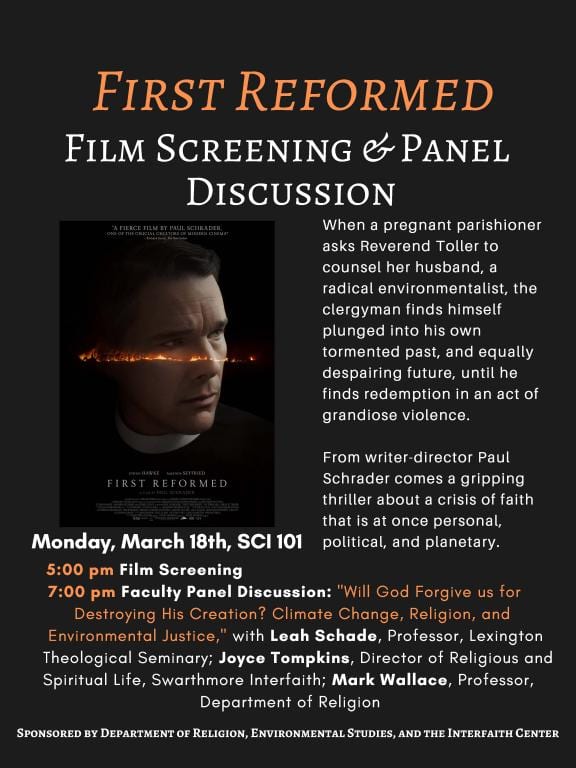
First Reformed depicts the two extremes of Christianity in America.
On one end is the super-slick, corporate-sponsored megachurch with a charismatic pastor, Rev. Jeffers (played appropriately enough by Cecil the Entertainer), who functions as a media personality, middle-manager, and – when necessary – a spiritual counselor. However, that role is tainted by ulterior motives of greed, keeping up appearances, and an unwillingness to wrestle with existential pain and theological angst.
At the other extreme is the museum-church, carefully preserved but showing its age with maintenance issues and a handful of parishioners who attend worship more out of pity than any sense of mission or religious vitality. The pastor of this church, Rev. Toller (played by a convincingly pensive Ethan Hawke), functions as a conveyor of ancient rituals, a historical tour guide, and – when necessary – a spiritual counselor. However, that role is tainted by alcoholism and boundary violations born out of existential pain and theological angst.
Writer-director Paul Schrader masterfully portrays these two extremes with vivid details. The opening shot of the Take-and-Read rack with its amalgam of leaflets about the church’s history juxtaposed against the slick tracts from “Abundant Life in Christ and Christian Fellowship,” along with brochures about addiction recovery and end-of-life services is a visual foreshadowing of the themes of the movie.
The problem is that First Reformed’s portrayal of the two extremes of the church in America misses the truth about the rest of the vast landscape of Christianity in the United States. As a parish pastor who has served three congregations, in addition to attending churches all my life, my perspective is that First Reformed paints a lopsided picture of what it’s like to be a minister in the church and what life is like for congregations.
Why does this matter?
Because for the growing number of people who have negative opinions of the church, or who have no knowledge of what healthy congregational life is like, watching this movie may reinforce negative stereotypes.
- The church is a dying dinosaur that offers nothing of value to the faithful or to society.
- Christians are intolerant, clueless hypocrites whose actions do not align with their supposed values.
- Ministers are so overridden with loneliness and anguish that they succumb to alcoholism and fail to respect boundaries with their parishioners.
Is there some truth to these familiar tropes? Of course. But there is a much larger story to tell about the church, ministers, and congregations that is rarely portrayed in films like these.
At the same time, First Reformed also paints a lopsided picture of environmental activism in America.
Michael (Philip Ettinger) is portrayed as the stereotypical lone wolf eco-terrorist mired in and obsessed with the stew of news articles about climate change. Are there crazed radicals out there prepared to engage in violence for the sake of their cause of protecting the planet? Of course. And I sympathize with their willingness to sacrifice in order to spur humanity into action.
But people like Michael are a small percentage of what makes up environmental activists in America and around the world. In my own experience as a Christian environmental activist and in my conversations with eco-activists – both religious and secular – I see a different side. The whole point of this work is to build community. We’re trying to make connections and build relationships between people and God’s Creation, between people and God, between people and each other.
But community is precisely what is lacking in First Reformed. Both churches in the film are devoid of people making meaningful connections with each other and with the God they supposedly worship. At Michael’s funeral, only a handful of people stand witness to an apocalyptic scene of human and environmental death while the youth choir sings a stark rendition of Neil Young’s “Who Will Stand Up?” As Mary spreads Michael’s ashes into the brackish waters polluted by Balq industries, his fateful question hangs in the air.
Will God forgive us?
This is the primary theological question of First Reformed. This ecological sin, this eco-crucifixion we perpetrate against this planet – will God forgive us for what we have done? Michael first poses the question to Rev. Toller. Michael’s wife, Mary, is pregnant with their first child, but Michael wants her to abort the fetus in order to save her or him from the ecological devastation they will surely suffer. The couple attend a worship service at First Reformed Church, and Rev. Toller, agrees to Mary’s request meet with her husband for pastoral counseling.
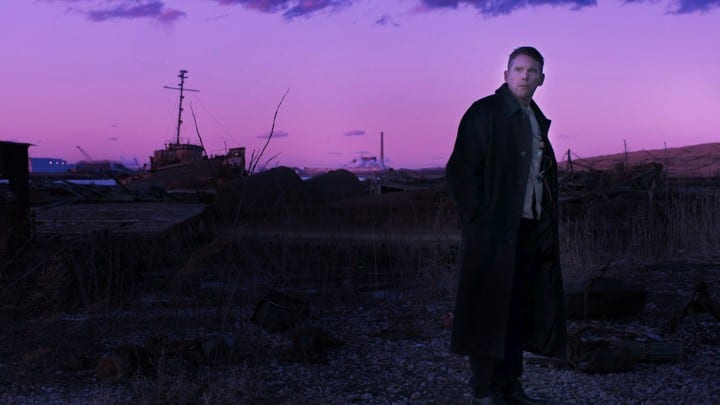
Scene from First Reformed. Notice the cross in the background – a symbol of eco-crucifixion.
Toller is himself a tortured soul still mourning the death of his son killed during the war in Iraq and the subsequent loss of his marriage. He shares this with Michael after listening to the man recount the soul-searing litany of facts documenting how climate disruption is leading to the death of our planet. When Toller tells him about the loss of his son, Michael asks him how he is able to go on. It’s not in the movie, but in Paul Schrader’s original script, Toller says this:
The Old Calvinists used to preach a doctrine called the “Unforgivable Sin.” You don’t hear about it any more. It was the sin against the Holy Spirit. It was the sin against Hope. The only sin that lies beyond forgiveness. It comes down to choice. We choose hope or despair. We cannot avoid choosing. We are not free to not decide. It’s what we truly are.
In the movie, we get these words from Toller:
Courage is the solution to despair. Reason offers no answers. We cannot be certain what the future holds. We must choose despite uncertainty. Wisdom is the ability to hold two contradictory thoughts in your mind simultaneously. Hope and despair. A life without despair is a life without hope. Holding those ideas in your head together is life itself.
Michael then asks the question that infects the heart and mind of Toller for the rest of the movie:
Can God forgive us? For what we have done to this world?
Toller responds: I don’t know. Who can know the mind of God? Perhaps we are a way station. But we can choose. To live the righteous life, to believe, to forgive. Grace covers us all.
Later he mulls over the conversation in his mind and writes about it in his journal:
Despair is a form of pride. “I know that nothing can change and I know there is no hope.” Merton wrote about this. Despair is a development of pride so great that it chooses one’s certitude rather than admit God is more creative than we are.
The Unforgivable Sin
I wish the movie had retained Toller’s lines about the Unforgivable Sin, because they add theological and biblical context for the questions about ecological sin. In fact, that doctrine comes straight from Matthew 12:30-32:
Jesus warned them: “Therefore I tell you, people will be forgiven for every sin and blasphemy, but blasphemy against the Spirit will not be forgiven. Whoever speaks a word against the Son of Man will be forgiven, but whoever speaks against the Holy Spirit will not be forgiven, either in this age or in the age to come.”
In a sermon I wrote for my book, Creation-Crisis Preaching: Ecology, Theology, and the Pulpit, I apply an ecological hermeneutic to this passage in order to try to understand its meaning from an environmental perspective. The sermon is called “I Am Ruah.” I preach it from the perspective of the Holy Spirit – the breath of God and air of the planet – recounting how she is crucified by the burning of fossil fuels and climate disruption.
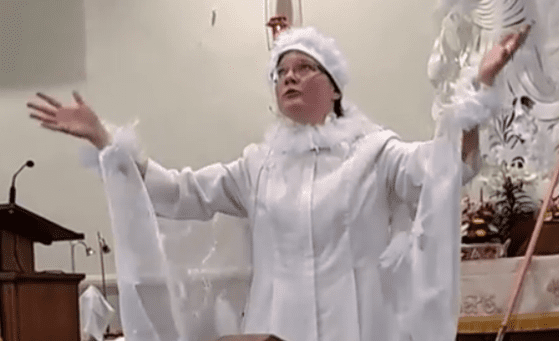
Leah Schade as Ruah (the Holy Spirit).
Building on one of the meanings of the Hebrew word ruah as a mother bird, the sermon is a creative actualization of Ruah’s perspective of this planet. The sermon takes a long view of Earth’s story and creates a narrative amplification of the Spirit’s interaction with Earth and its flora and fauna, especially human beings, and particularly Jesus. At one point in the sermon, Ruah says:
Your kind learned to unlock the heat within the stone, to dig deep for the black oily remains, to fracture the rock and release the gases held safely miles beneath the surface. As your kind swarmed the globe, the sacred balance began to tilt. You tore the trees – the planet’s lungs – from forests and jungles. Grey toxic fumes rose from your factories, your cars, your power plants, hovering over your cities, choking and smothering.
This is blasphemy against the Spirit – the unforgiveable sin. For if the very essence of life, God’s breath, Ruah, is destroyed, there can be no breath, no life for anyone or anything. It is unforgiveable because there is no return. Once the balance tips too far, the cascading effect on the oceans, the ice sheets, the mountains, and the climate cycles falls too fast to stop.
In other words, how can there be forgiveness if there is no one left to give or receive it?
The sermon concludes with Ruah laying her wings beside a draped brown cloth, saying:
I am Ruah. I am all the air there ever was. I know every cell of your body. And I carry the memory of all other cells through which I have moved. I am carrying the memories to your sons and daughters across time and across the planet. What will be the air that they breathe?
Thus, I would concur with Rev. Toller that it does come down to the choice between hope and despair.
Currently, the trajectory of our species is toward despair.
Those who deny that climate disruption is happening may not be willing to admit to their own sense of despair. They may cover it up with false eschatological hope in a paternalistic Big-Daddy God who will come down and clean up the mess we’ve made, while taking the faithful to some mythical paradise. Or they may say F-it – we’re going to double down and drill, frack, pollute, and use up every last resource of this planet until there’s nothing left, because G*dammit, it’s our right.
As mentioned earlier, such an attitude belies the truth about despair, that it is a form of pride. The assumption is that nothing can change; there is no hope. “Despair is a development of pride so great that it chooses one’s certitude rather than admit God is more creative than we are.”
Schrader’s other famous movie was The Last Temptation of Christ in which Jesus is tempted to give up his divinity and become just another human being. The devil tempts him with a vision of life with a wife and children, friends, wholesome work, and an easy death at the end of a long life. We know the choice Jesus made – to reject the easy path in obedience to a higher good.
Perhaps Schrader could have given First Reformed a subtitle: The Last Temptation of Humanity.
For in this movie we are shown humanity’s last temptation: giving up on hope. Michael gives up and commits suicide. Rev. Jeffers gives up and sells his soul and his ministry to the highest bidder. Industrialist Edward Balq gives up and spends every last dollar cocooning himself in luxury while he lays waste to the planet. Rev. Toller gives up and drowns his despair first in a putrid mix of whiskey and Pepto Bismol, and then (presumably) in a glass of Drano.
In fact, all the men in this movie succumb to despair. Only the two female characters show any sign of the courage needed for this time.
Esther (Victoria Hill) and Mary (Amanda Seyfried) beg and plead for the men they love to take care of themselves, to care about life, to have the courage to face the future. They want these men to exercise wisdom – “the ability to hold two contradictory thoughts in your mind simultaneously. Hope and despair. A life without despair is a life without hope. Holding those ideas in your head together is life itself.” (Michael tried to hold these ideas in his head, and his head literally exploded at the end of a shot gun.)
In the Hebrew scriptures, Esther goes to the king and pleads for the life of her people when they are faced with genocide. In the movie, Esther begs Toller to take care of his own life as he is drowning in health problems and depression. Christian scriptures portray Mary as the God-bearer, birthing new hope and new life into the world through her son, Jesus. In the movie, Mary is pregnant with a son. When she cannot save her husband, she attempts to bring new life to Toller. The beautiful bike ride among the trees in the park (the only time we see Toller truly smile); the mystical and transcendental levitation; the search for Toller when he has succumbed to self-crucifixion.
The abrupt ending of the movie leaves us wondering – is it real? Is this final moment of connection merely a dying man’s last hope? Or is this a moment of redemption, salvation even? The deliberate ambiguity of the ending is intentional.
Yet the primary question of the film remains uncomfortably unanswered: Will God forgive us?
The way you answer the question may say more about you, your experiences, and your beliefs, than it does about the film itself.
How, then, are we to respond to a movie such as First Reformed?
I suggest that we see it in the same vein as a parable. A parable is a story told to convey a moral or spiritual lesson. In the New Testament, Jesus used parables to illustrate truths about what he called “the Kingdom of God.” Some of his parables are difficult to interpret. Stories like the ten maidens (Matthew 25:1-13) or the man ejected from the wedding banquet (Matthew 22:1-14) appear to be enigmatic, harsh, and even objectionable to either the original hearers or our postmodern ears.
But these parables often use tropes and exaggerations in order to make a larger point. We’re not meant to read them literally or even to interpret them as allegories. Rather, the parable is a device meant to wake us up from our spiritual torpor, shake us loose from pre-conceived notions, and rethink business as usual. They challenge us to make different choices.
Thus, while I want to push back against the stereotypes in the movie, perhaps they serve a larger purpose. First Reformed uses the tropes of the worst qualities of American Christianity and churches, as well as the worst examples of environmental despair taken to its extreme of either eco-terrorism or eco-suicide, in order to make a point. And the point is that when we cut ourselves off from community, from human connectedness, from God’s Creation, from the gifts of justice alongside grace, mercy, and love, this is what results. It’s a world of empty, vacuous churches; a world sickened and dying; a world with no other alternatives than violence to self or others.
First Reformed is a parable that is meant to wake us up from our spiritual torpor, shake us loose from pre-conceived notions, and rethink business as usual. This film challenges us to make different choices.
Perhaps there should be a comma between the words of the title: First, Reformed. First, we must be reformed. Our harmful worldviews, our self-centered attitudes, our world-destroying and health-destroying habits, our empty and sold-out religious shells – all of this must be re-formed.
This is what Esther and Mary call for. I, for one, join them.

Leah D. Schade is the Assistant Professor of Preaching and Worship at Lexington Theological Seminary (Kentucky) and author of the book Creation-Crisis Preaching: Ecology, Theology, and the Pulpit (Chalice Press, 2015).
Twitter: @LeahSchade
Facebook: https://www.facebook.com/LeahDSchade/
More of Leah’s film reviews:
Not Your Mother’s ‘Wonder Woman’: A Feminist Review
The Healing Power of ‘Moonlight’: Race, Erotic Love, and Baptism
Previous Post

January 27, 2019
What is 'Good Preaching'? A Sermon about Sermons
Next Post

March 21, 2019 Iraq War Sermon - 16 Years Later
Browse Our Archives
Select a Category Academy of Homiletics Addiction Advent AI (Artificial Intelligence) Animals Apocalypse Appalachia Ash Wednesday Baptism Bible Black Lives Matter Blade Runner Book review Children in church Christian Nationalism Christian/Islamic relations Christmas Church Clergy Climate change COVID-19 Creation Data Centers Death penalty Devotional Dialogue Doubt Earth Day Easter Ecofeminism EcoPreacher 1-2-3 ELCA ELCA Youth Gathering Election Environment/ecology Epiphany Faith Faith and Politics Feminism Film review Food Food and Faith Forgiveness Fracking Good Friday Good Omens Grief Gun violence Holy Humor Sunday Holy Week Howard Thurman ICE Immigration Indigenous wisdom Interview Jesus Kentucky Lafayette High School Marching Band Leadership Lent LGBTQIA+ Marching band Martin Luther Martin Luther King Jr. Mary Maundy Thursday Michael Sheen Mother of Jesus Nature New Year's Eve Palm Sunday Parables Pentecost Poem, Poetry Politics Poor People's Campaign Pop culture Prayers Preaching Progressive Christianity Public theology Purple Zone Racism and White Privilege Religion Religion and environment Religion and politics Religion and pop culture Religion and violence Rev. Nelson Rabell Gonzalez Sermons Spanish language resources for preaching Technology Thanksgiving Theological education theology Trees Trump Uncategorized Vegan War Women and religion Workshop Worship
Select a Month October 2026 September 2026 July 2026 June 2026 May 2026 April 2026 March 2026 February 2026 January 2026 December 2025 November 2025 October 2025 September 2025 May 2025 April 2025 March 2025 February 2025 January 2025 December 2024 November 2024 October 2024 September 2024 August 2024 July 2024 June 2024 May 2024 April 2024 March 2024 February 2024 January 2024 December 2023 November 2023 October 2023 September 2023 August 2023 July 2023 June 2023 May 2023 April 2023 March 2023 February 2023 January 2023 December 2022 November 2022 October 2022 August 2022 July 2022 June 2022 May 2022 April 2022 March 2022 February 2022 January 2022 December 2021 November 2021 October 2021 September 2021 August 2021 July 2021 June 2021 May 2021 April 2021 March 2021 January 2021 December 2020 November 2020 October 2020 September 2020 August 2020 July 2020 June 2020 May 2020 April 2020 February 2020 January 2020 December 2019 November 2019 October 2019 September 2019 August 2019 July 2019 June 2019 May 2019 April 2019 March 2019 January 2019 December 2018 November 2018 October 2018 September 2018 August 2018 July 2018 June 2018 May 2018 April 2018 March 2018 February 2018 January 2018 December 2017 November 2017 October 2017 September 2017 August 2017 July 2017 June 2017 May 2017 April 2017
Follow Us!
TAKE THE
Religious Wisdom Quiz
What Christian group is known for large-scale evangelistic crusades?
Select your answer to see how you score.
Orthodox Methodists Quakers Evangelicals
Books by This Author Books by Leah D. Schade
Related posts from EcoPreacher

Love Your Neighbor – Including Earth-Kin: Lev. 19,...

Preaching About Climate Change: What Clergy Need Most

Making Space for Eco-Grief—and Hope—in Your Church
VBS Murder Skit: When a Church Teaches Children...
TRENDING AT PATHEOS Progressive Christian

What Being a Modern-Day Apostle Means to Me
In my last column, I discussed the ins and outs of modern-day...

Did Ancient China Once Worship the God of...
Across human history, a common thread weaves through the origins of the...

Love Your Neighbor – Including Earth-Kin: Lev. 19,...
God’s command to love your neighbor means acting in an ethical and...

Lead a Church Study of “Jesus and Lao...
Guest writer Jack Thomas (The Irreverent Reverend) reflects on leading his church...

Pastoral Wisdom for Responding to Sermon Pushback
Getting sermon pushback on your social justice sermon? Learn practical, Proverbs-based strategies...

Principles for Understanding the Apostolic Ministry Today
Whenever people discover that my formal ministry title is "apostle," as in...
view all Progressive Christian blogs
Ad-Free & Subscriber Log-In Subscription Support
- About Us
- 2026 Calendar
- Videos
- Podcasts
- Library of World Religions
- Faith In Media Tracker
- Advertise With Us
- Write for Us
- Privacy Policy
- Terms of Service
- Do Not Sell My Data
- Contact Us
- Radiant Digital
- Manage Newsletter Subscriptions
- Unsubscribe From Notifications
- Sitemap
Copyright 2008-2026, Patheos. All rights reserved.
Subscription Support Ad-Free & Subscriber Log-In
Follow Patheos