
BuddhistCatholicContemplativeEvangelicalGeneral ChristianHinduJewishLatter-day SaintMuslimNew VisionsProgressive Christian
Beliefs
- Buddhist
- Catholic
- Contemplative
- Evangelical
- General Christian
- Hindu
- Jewish
- Latter-day Saint
- More Voices
- Muslim
- New Visions
- Pagan
- Progressive Christian
Topics
- Religion News
- Food and Religion
- Sports and Religion
- Religious Art
- Religious Music and Entertainment
- Religious Events
- History and Religion
- Style and Religion
- Politics and Religion
- Women in Religion
- Recreation Outdoors and Religion
- Business Finance and Religion
- Careers Workplace and Religion
- Education and Religion
- Family Parenting and Religion
- Health Fitness and Religion
- Home and Religion
- Relationships and Religion
- Technology and Religion
- Travel and Religion
Columnists
- Buddhist Columnists
- Business Finance and Religion Columnists
- Careers Workplace and Religion Columnists
- Catholic Columnists
- Contemplative Columnists
- Education and Religion Columnists
- Evangelists Columnists
- Family Parenting and Religion Columnists
- General Christian Columnists
- Health Fitness and Religion Columnists
- Hindu Columnists
- History and Religion Columnists
- Home and Religion Columnists
- Jewish Columnists
- More Voices Columnists
- Latter Day Columnists
- Muslim Columnists
- New Visions Columnists
- Nonreligious Columnists
- Pagan Columnists
- Politics and Religion Columnists
- Progressive Columnists
- Recreation Outdoors and Religion Columnists
- Relationships and Religion Columnists
- Religion News Columnists
- Religious Art Columnists
- Religious Events Columnists
- Religious Music and Entertainment Columnists
- Sports and Religion Columnists
- Style and Religion Columnists
- Technology and Religion Columnists
- Travel and Religion Columnists
- Women in Religion Columnists
Resource Library
- 2026 Calendar
- Library of World Religions
- The 100 Most Holy Places on Earth
- Patheos Answers
- Podcasts
- Videos
- Faith Leaders Database
- Anglican Episcopalian
- Bahai
- Baptist
- Buddhism
- Christianity
- Confucianism
- Eastern Orthodoxy
- Hinduism
- Holiness and Pentecostal
- ISKCON
- Islam
- Judaism
- Lutheran
- Methodist
- The Church of Jesus Christ of Latter-day Saints
- New Age
- Paganism
- Presbytarian and Reformed
- Protestantism
- Religion Behind the Scenes
- Roman Catholic
- Scientology
- Shia Islam
- Sikhism
- Sufism
- Sunni Islam
- Taoism
- Zen
- See all religions
Research Tools
 Ad-Free & Subscriber Log-In Subscription Support
Ad-Free & Subscriber Log-In Subscription Support
Follow Patheos 

- Trending:
- Forgiveness
- |
- Marriage
- |
- Consciousness
- |
- Death Penalty
- |
- Election
- |
- Halloween

- Home
- Progressive Christian
- Iraq War Sermon – 16 Years Later
Iraq War Sermon – 16 Years Later
Last updated on: March 21, 2019 at 12:24 pm by Leah D. Schade
Iraq War Sermon – 16 Years Later 2019-03-21T12:24:19-04:00 Leah D. Schade
Patheos Explore the world's faith through different perspectives on religion and spirituality! Patheos has the views of the prevalent religions and spiritualities of the world.
It’s been 16 years since the start of the Iraq War. For the record – some Christian ministers preached against this war. We got strong push-back. But history bears the truth and necessity of our prophetic witness. This is the sermon I preached on March 23, 2003, just after the war began.
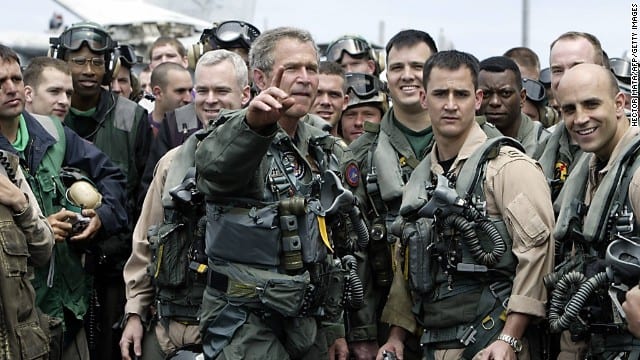
US President George W. Bush meets pilots and crew members of the aircraft carrier USS Abrahan Lincoln as they return to the US after being deployed in the Gulf region 01 May 2003. Photo credit: HECTOR MATA/AFP/Getty Images. Public Domain
I have struggled for months as to whether I would support preemptive military strikes on Iraq.
I have tried to stay informed by all points of view, both for and against military action. I have read and listened to voices on both sides. I have talked and argued with people whom I respect, and those whose opinions I strongly disagree with. And I have changed my mind countless times. I have been on the fence, not able to make a decision, and have watched others more sure of their beliefs than me take action accordingly.
Then as I watched the so-called “countdown” on Tuesday night, I realized that my personal struggles had no bearing on what would actually happen. Perhaps, like me, you have felt that no matter your views, values, or beliefs, we are all being swept along on a tidal wave over which we have no control. I have felt disempowered, irrelevant, cynical and, yes, angry and worried over the whole affair.
When I feel this way, I have a tendency to want to avoid what’s going on. I disengage.
In fact, as late as Thursday, it had not even occurred to me that I should preach on this war. I had my sermon already prepared, and it did not mention the Iraq War in any way. I had felt so oversaturated with the whole thing that I wanted to just act as if it did not exist. It happened without me, what does it matter whether I address it or not?
But then Thursday afternoon I had lunch with the female clergy group I belong to here in Media, Pa. And the question came up how each of us was handling the Iraq War situation in our congregations and from our pulpits. I shared that our church is starting a prayer list for family members called into service, and that our senior pastor addressed the matter very directly in his upcoming newsletter article. I also said that our sanctuary would be open to everyone during office hours Monday-Friday for prayer and meditation. I said nothing about my hesistancy to address the war in my sermon.
But one of the other clergy women said that she would state very clearly what her beliefs are as a Christian.
“I oppose all war,” she said.
One of the other women challenged her, “You mean you don’t even believe in the ‘just war’ theory?” She shook her head, “There is no such thing as a ‘just war.’”
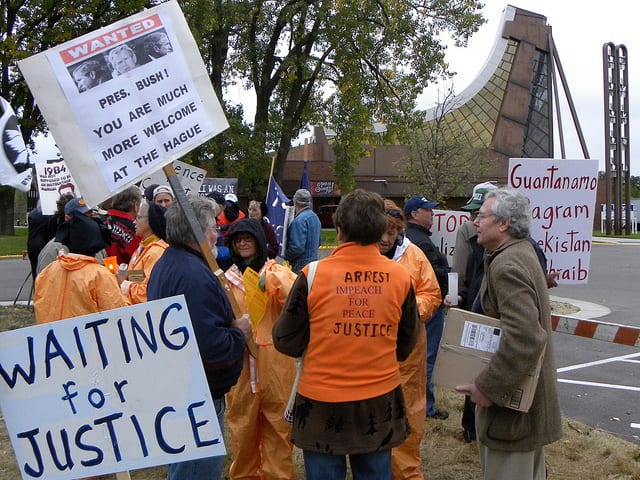
Protest against George W. Bush speaking at Beth El synagogue in St. Louis Park
St. Louis Park, Minnesota. September 21, 2011. Photo credit: Fibonacci Blue. Creative Commons Attribution License.
This gave me pause, because I had always believed that some military action was allowable in certain circumstances. My thinking had aligned with the ELCA’s social statement, For Peace in God’s World (adopted in 1995), which states that war is permissible if it meets the following criteria:
The war must have a just cause. It must be waged by a legitimate authority. It must be formally declared. It must be fought with peaceful intention. It must be a last resort. There must be reasonable hope of success. And the means used must be proportional to the ends sought.
Now, personally, I leaned towards not supporting this Iraq War because it did not meet all the criteria for a just war. In our country, war must be declared by Congress. No such thing has been done. And I do not believe that we have exhausted every alternative for a peaceful resolution to the conflict. So this war is not a last resort.
But what this colleague of mine was saying was that, in fact, under no circumstances is war ever just. Similarly, there’s no such thing as “just rape”, or “just child abuse.” This got my wheels turning.
I decided to do some research on this term, “just war.”
I learned that the idea was developed by St. Augustine around the year 400 CE, who essentially said that there is sometimes a moral obligation to use violence if necessary to defend the innocent against evil. He came up with some of the basic criteria for a just war – which the ELCA Social Statement references.
But for the first few centuries after Christ’s ascension, Christian approaches to war were largely pacifistic in nature. Jesus never made a distinction between “just war” and “unjust” war. Jesus’ message was consistently one of nonviolence. “Those who live by the sword will die by the sword” (Matt. 26:52). There was never any justification for violence in the realm of God which Jesus preached and taught.
However, as soon as Constantine legalized Christianity in 313 CE, a shift happened.
The Roman Empire made Christianity the state religion in order to help secure its power. So grateful were Christians and their leaders not to be persecuted anymore, it became very easy to accommodate themselves to the dominant power in the world. Ever since that time, the Christian commitment to nonviolence has been compromised. The teachings of Jesus have been watered down to suit the interests of powerful individuals and leaders. And the kingdom of God has been shaped around the whims of whatever earthly kingdoms are fighting for power.
We may like to say that war can be justified when defending the innocent. But with the possible exception for WWII, I can think of no war conducted in the last two millennia that has completely met the criteria of the just war theory. The problem is that it is too easy to manipulate the criteria for a just war. There are too many ways to justify one’s own stance when trying to say that initiating military aggression is just.
President Bush made some promises in his speech earlier this week.
He promised that “the dangers to our country and the world will be overcome. We will pass through this time of peril and carry on the work of peace. We will defend our freedom. We will bring freedom to others. And we will prevail.”
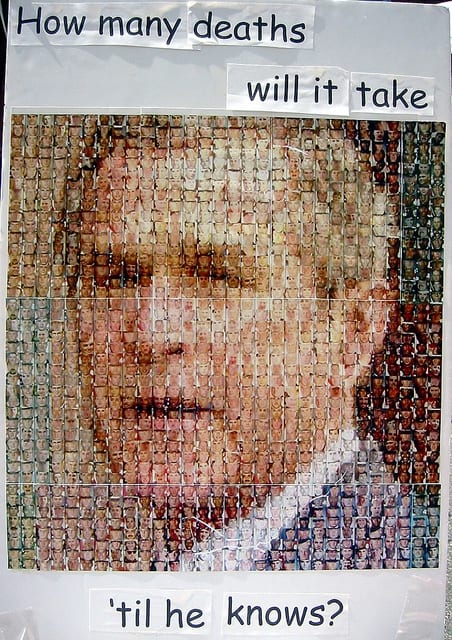
Anti-Bush protest poster. some rights reserved. Futureatlas.com.
However, what also needs to be said is that killing oppressive rulers, such as Saddam Hussein, still makes us killers. To quote the theologian, Walter Wink:
We want to believe in a final violence that will, this last time, eradicate evil and make future violence unnecessary. But the violence we use creates new evil, no matter how just the cause . . . Violence can never stop violence because its very success leads others to imitate it. Paradoxically, violence is most dangerous when it succeeds. (Engaging the Powers, Walter Wink, Augsburg Press, 1992, 216).
War is always failure.
War always promises more than it actually delivers. But choosing to act on a conviction of nonviolence is never a failure. Because even the smallest act of nonviolence is a way for God to work through it to bring peace into our world. Nonviolence never fails. Even when it is not successful, it still never fails. Because it offers a new way of resolving conflict that ensures life instead of threatening destruction.
Being a person of peace means that you refuse to resort to violence as a means to accomplish any objective. Actually, it challenges you to think more creatively, to find ingenious solutions to seemingly intractable problems.
What does this mean to me, personally, as a Christian?
It means that, for the first time, I am beginning to say with firm conviction that I am committed to nonviolence. I am no longer on the fence, trying to decide who’s right or who’s wrong in this particular military conflict. For me, it’s not about choosing sides anymore. It’s about choosing a third way. It’s about choosing the way of Jesus.
So, not only do I not endorse this war — I don’t endorse any war.
I realize that I take great risk in saying this, especially publicly, as a leader in a Christian church. And I know that my conviction will not magically resolve the overwhelming complexity of this world. I understand that sometimes we are forced to make difficult decisions about the violence done to us by others, and that nonviolent solutions are not always evident.
But my reason for sharing this with you – in the pulpit – is to let you know that as a pastor in the Christian church, I am engaging in this process of discernment.
Public domain.
I am not asking you to think the way I think. Instead, I am inviting you to do your own soul searching.
Engage this process not just as a citizen of the United States, but as a world citizen, and as a Christian. View this war, and all armed conflict, indeed all violence, not just from one side or the other. View it as a disciple of Christ.
For example, a friend of mine pointed out to me that when you hear the casualty reports come in, you will hear them numbered according to “them and us.” But how does God see those numbers? God will not care if they are soldiers or civilians, American or Iraqi. God will only see God’s sons and daughters dead in a war. God will only mourn at the total number of dead — no matter whose side they are on. When you see those numbers come in, don’t just look at American casualties. Add up both sides. And mourn that number. Because they are all sons and daughters of God.
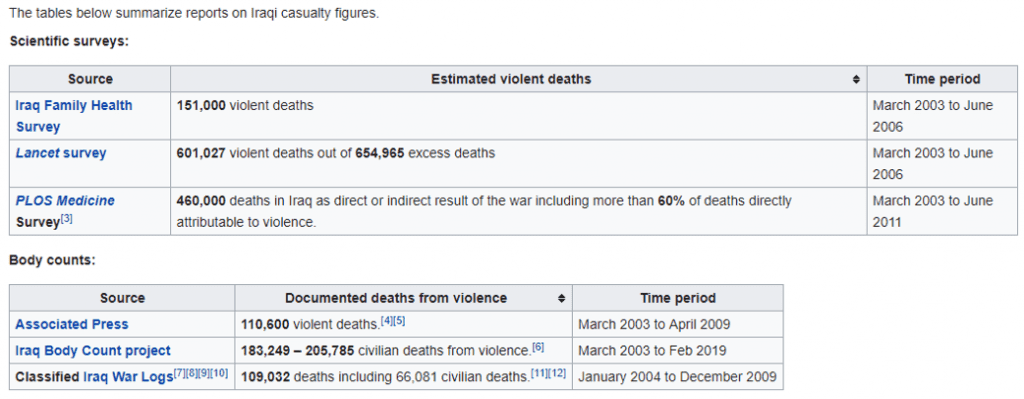
Iraq War death statistics vary. This summary of estimates from Wikipedia range from tens to hundreds of thousands.
So, what can I do as a Christian citizen of the world who chooses to live in a country that has initiated aggression against another?
And whose military defends my very right to say these things in public? Understand that my critique is not against the women and men who have pledged their lives in defense of our country. They deserve honor and respect for their willingness to sacrifice.
But while this is an ongoing process of discernment for me, I do know one thing. I can start very small. I can pledge to my unborn child that I oppose violence in all its forms. I don’t know exactly how this will manifest itself. But I know that at the very least it begins with vision, where we can begin to see conflict without violence as an option.
This is, of course, a very personal decision.
There are many other Christians, including people in this church, people in other churches, and soldiers on the front lines of this conflict, who have gone through their own process of discernment and come to a different conclusion than me.
I know that there are people who will disagree with my conviction. But I am intentionally opening myself up to that. Because I believe that the Christian community is a place that can hold these different views in creative tension, allowing the Holy Spirit to work in and through them.
I accept that there will be consequences for my stance of nonviolence. But God promises that this is the way that leads to true life, uncompromised integrity, and actualized hope. To again quote Walter Wink:
The crucifixion and resurrection of Jesus are the assurance that there is a force at work in the world to transform even the most crushing defeat into divine victory. We are thus freed from having to produce results; we have only have to believe in what we cannot yet see. We are freed from despair; we only have to trust the One in and through and for whom all things exist. We are freed from having to succeed; we only have to be faithful (Wink pp. 218-219).
Each of us will have to make our own decisions when faced with these dilemmas.
But as Christians, we must be engaged in the process of discernment.
We must challenge each other to think through our convictions and actions. We must also continue to respect one another and to care for one another, despite our disagreements.
And we must trust God in a world where we are tempted to trust violence as the way to secure peace. God has made a promise to us, to the entire world, that nonviolence is the way to life. And God’s promises never fail.
Amen.
 Leah D. Schade is the Assistant Professor of Preaching and Worship at Lexington Theological Seminary (Kentucky) and author of the book Creation-Crisis Preaching: Ecology, Theology, and the Pulpit (Chalice Press, 2015).
Twitter: @LeahSchade
Facebook: https://www.facebook.com/LeahDSchade/
Further reading:
How to Preach When You Are Afraid
Preaching Across Divides: Purple Zone Strategies for Pulpit and Public Square
How to be a Christian (and a Pastor) After the Midterm Elections
Previous Post
March 19, 2019
Will God Forgive Us? 'First Reformed' Film Review
Next Post

March 25, 2019 Rethinking the Parable of the Fruitless Tree in Luke 13:1-9
Browse Our Archives
Select a Category Academy of Homiletics Addiction Advent AI (Artificial Intelligence) Animals Apocalypse Appalachia Ash Wednesday Baptism Bible Black Lives Matter Blade Runner Book review Children in church Christian Nationalism Christian/Islamic relations Christmas Church Clergy Climate change COVID-19 Creation Data Centers Death penalty Devotional Dialogue Doubt Earth Day Easter Ecofeminism EcoPreacher 1-2-3 ELCA ELCA Youth Gathering Election Environment/ecology Epiphany Faith Faith and Politics Feminism Film review Food Food and Faith Forgiveness Fracking Good Friday Good Omens Grief Gun violence Holy Humor Sunday Holy Week Howard Thurman ICE Immigration Indigenous wisdom Interview Jesus Kentucky Lafayette High School Marching Band Leadership Lent LGBTQIA+ Marching band Martin Luther Martin Luther King Jr. Mary Maundy Thursday Michael Sheen Mother of Jesus Nature New Year's Eve Palm Sunday Parables Pentecost Poem, Poetry Politics Poor People's Campaign Pop culture Prayers Preaching Progressive Christianity Public theology Purple Zone Racism and White Privilege Religion Religion and environment Religion and politics Religion and pop culture Religion and violence Rev. Nelson Rabell Gonzalez Sermons Spanish language resources for preaching Technology Thanksgiving Theological education theology Trees Trump Uncategorized Vegan War Women and religion Workshop Worship
Select a Month October 2026 September 2026 July 2026 June 2026 May 2026 April 2026 March 2026 February 2026 January 2026 December 2025 November 2025 October 2025 September 2025 May 2025 April 2025 March 2025 February 2025 January 2025 December 2024 November 2024 October 2024 September 2024 August 2024 July 2024 June 2024 May 2024 April 2024 March 2024 February 2024 January 2024 December 2023 November 2023 October 2023 September 2023 August 2023 July 2023 June 2023 May 2023 April 2023 March 2023 February 2023 January 2023 December 2022 November 2022 October 2022 August 2022 July 2022 June 2022 May 2022 April 2022 March 2022 February 2022 January 2022 December 2021 November 2021 October 2021 September 2021 August 2021 July 2021 June 2021 May 2021 April 2021 March 2021 January 2021 December 2020 November 2020 October 2020 September 2020 August 2020 July 2020 June 2020 May 2020 April 2020 February 2020 January 2020 December 2019 November 2019 October 2019 September 2019 August 2019 July 2019 June 2019 May 2019 April 2019 March 2019 January 2019 December 2018 November 2018 October 2018 September 2018 August 2018 July 2018 June 2018 May 2018 April 2018 March 2018 February 2018 January 2018 December 2017 November 2017 October 2017 September 2017 August 2017 July 2017 June 2017 May 2017 April 2017
Follow Us!
TAKE THE
Religious Wisdom Quiz
What is the Jewish festival celebrating the giving of the Law at Sinai?
Select your answer to see how you score.
Shavuot (Pentecost) Yom Kippur Tabernacles Purim
Books by This Author Books by Leah D. Schade
Related posts from EcoPreacher

Pastoral Wisdom for Responding to Sermon Pushback

"Render Unto Caesar": Faith, Politics, and Elections

What Matt. 21:23-32 Teaches About Integrity In An...

Preaching About Climate Change: What Clergy Need Most
TRENDING AT PATHEOS Progressive Christian

What Being a Modern-Day Apostle Means to Me
In my last column, I discussed the ins and outs of modern-day...

Did Ancient China Once Worship the God of...
Across human history, a common thread weaves through the origins of the...

Love Your Neighbor – Including Earth-Kin: Lev. 19,...
God’s command to love your neighbor means acting in an ethical and...

Lead a Church Study of “Jesus and Lao...
Guest writer Jack Thomas (The Irreverent Reverend) reflects on leading his church...

Pastoral Wisdom for Responding to Sermon Pushback
Getting sermon pushback on your social justice sermon? Learn practical, Proverbs-based strategies...

Principles for Understanding the Apostolic Ministry Today
Whenever people discover that my formal ministry title is "apostle," as in...
view all Progressive Christian blogs
Ad-Free & Subscriber Log-In Subscription Support
- About Us
- 2026 Calendar
- Videos
- Podcasts
- Library of World Religions
- Faith In Media Tracker
- Advertise With Us
- Write for Us
- Privacy Policy
- Terms of Service
- Do Not Sell My Data
- Contact Us
- Radiant Digital
- Manage Newsletter Subscriptions
- Unsubscribe From Notifications
- Sitemap
Copyright 2008-2026, Patheos. All rights reserved.
Subscription Support Ad-Free & Subscriber Log-In
Follow Patheos