
BuddhistCatholicContemplativeEvangelicalGeneral ChristianHinduJewishLatter-day SaintMuslimNew VisionsProgressive Christian
Beliefs
- Buddhist
- Catholic
- Contemplative
- Evangelical
- General Christian
- Hindu
- Jewish
- Latter-day Saint
- More Voices
- Muslim
- New Visions
- Pagan
- Progressive Christian
Topics
- Religion News
- Food and Religion
- Sports and Religion
- Religious Art
- Religious Music and Entertainment
- Religious Events
- History and Religion
- Style and Religion
- Politics and Religion
- Women in Religion
- Recreation Outdoors and Religion
- Business Finance and Religion
- Careers Workplace and Religion
- Education and Religion
- Family Parenting and Religion
- Health Fitness and Religion
- Home and Religion
- Relationships and Religion
- Technology and Religion
- Travel and Religion
Columnists
- Buddhist Columnists
- Business Finance and Religion Columnists
- Careers Workplace and Religion Columnists
- Catholic Columnists
- Contemplative Columnists
- Education and Religion Columnists
- Evangelists Columnists
- Family Parenting and Religion Columnists
- General Christian Columnists
- Health Fitness and Religion Columnists
- Hindu Columnists
- History and Religion Columnists
- Home and Religion Columnists
- Jewish Columnists
- More Voices Columnists
- Latter Day Columnists
- Muslim Columnists
- New Visions Columnists
- Nonreligious Columnists
- Pagan Columnists
- Politics and Religion Columnists
- Progressive Columnists
- Recreation Outdoors and Religion Columnists
- Relationships and Religion Columnists
- Religion News Columnists
- Religious Art Columnists
- Religious Events Columnists
- Religious Music and Entertainment Columnists
- Sports and Religion Columnists
- Style and Religion Columnists
- Technology and Religion Columnists
- Travel and Religion Columnists
- Women in Religion Columnists
Resource Library
- 2026 Calendar
- Library of World Religions
- The 100 Most Holy Places on Earth
- Patheos Answers
- Podcasts
- Videos
- Faith Leaders Database
- Anglican Episcopalian
- Bahai
- Baptist
- Buddhism
- Christianity
- Confucianism
- Eastern Orthodoxy
- Hinduism
- Holiness and Pentecostal
- ISKCON
- Islam
- Judaism
- Lutheran
- Methodist
- The Church of Jesus Christ of Latter-day Saints
- New Age
- Paganism
- Presbytarian and Reformed
- Protestantism
- Religion Behind the Scenes
- Roman Catholic
- Scientology
- Shia Islam
- Sikhism
- Sufism
- Sunni Islam
- Taoism
- Zen
- See all religions
Research Tools
 Ad-Free & Subscriber Log-In Subscription Support
Ad-Free & Subscriber Log-In Subscription Support
Follow Patheos 

- Trending:
- Forgiveness
- |
- Marriage
- |
- Consciousness
- |
- Death Penalty
- |
- Election
- |
- Halloween

- Home
- Progressive Christian
- Hi, I’m Leah. I’m a Recovering Racist.
Hi, I’m Leah. I’m a Recovering Racist.
Last updated on: January 19, 2019 at 5:22 pm by Leah D. Schade
Hi, I’m Leah. I’m a Recovering Racist. 2019-01-19T17:22:31-04:00 Leah D. Schade
Patheos Explore the world's faith through different perspectives on religion and spirituality! Patheos has the views of the prevalent religions and spiritualities of the world.
I need to share what part I play in this country’s racism and white supremacy. It is not up to people of color to instruct us. It’s up to us as whitefolks to engage in this work and do it now. So I need to say it: I’m a recovering racist.

What do I mean by saying I’m a recovering racist?
I mean that I’m a white person who grew up in a family and a culture where the inherent assumption is that I am superior to people whose skin color is darker than my own. I unwittingly developed a set of discriminatory and derogatory attitudes based on assumptions and perceptions I learned about people of other races. While I was not aware of these assumptions growing up, they nevertheless undergirded all of my interactions with whites and people of color. It was the water I swam in but was not conscious of.
For example, even though I grew up in a racially mixed school and neighborhood that should have instilled in me a sense of community and camaraderie with children and adults who looked different than me, the reality was different. Some adults in my household used words like “porch monkey” and, yes, “nigger,” to refer to blacks in my community. This instilled in me an unconscious assumption that blacks were lazy, dirty, unintelligent, dangerous, and on the level of animals. I hate to admit that. But it’s the truth. And for the first decade of my life, I didn’t realize this was a problem, because it was just the way things were.
In fact, I never even knew the word “nigger” was a problem until third grade when I mispronounced the name of the country “Niger” when reading aloud in social studies class. All the kids reacted as if I had said a curse word. I had, but I didn’t know it. I was embarrassed and ashamed and didn’t know why. After class, the teacher pulled me aside to gently explain my mistake and why that word is verboten. I was nine years old.
Nearly forty years later, I see that conversation with my teacher as the first step in my decades-long (and still ongoing) recovery from racism. A racism training workshop I attended in seminary (the first of several) was another important milestone.
But it wasn’t until I was much older that I began to understand that racism is more than just a personal failing.
Racism has to do with the power that is ascribed to me based on my white skin. I didn’t ask for this power, and I may not always be conscious of it, but I have it nonetheless. It’s granted to me through social structures and conventions as well as my having access to resources that are closed to others based on their skin color. This means that my personal racism is a manifestation of a systemic problem. Our entire culture and society are in need of recovery from racism.
What do I mean by “recovery”? Is racism some kind of addiction?
I believe it is. Psychology Today defines addiction as “a condition in which a person engages in the use of a substance or in a behavior for which the rewarding effects provide a compelling incentive to repeatedly pursue the behavior despite detrimental consequences.”
In the case of racism, it’s not just a person but a system that is engaging in behaviors for which the rewarding effects (maintaining the status quo of whiteness as normative) provide a compelling incentive (the privileging of whiteness) to repeatedly pursue the behavior (the myriad forms of racism) despite detrimental consequences.
What are those consequences?
Our entire society is founded on and structured around an inherent belief in white supremacy. Everything from the schools we attend, to the places we shop, to the advertisements we see, to the courts and prisons that deal with our lawbreakers, to the way our votes are districted, to the banks that finance our mortgages all privilege whiteness in both subtle and blatant ways. This is called systemic racism and it affects all levels of society, even if individual members are trying their best to overcome their personal racism.
This means that for those of us who want to see change, we have to work on many levels at the same time. It means working to enact laws against gerrymandering, for example, while also calling out our family members who repeat racist jokes. It means advocating for protecting and restoring voting rights, while also educating ourselves about the history and current manifestations of racism in America. We have to be willing to talk about racism in our churches, while also cultivating friendships with people who are racially different than us.
So let me suggest that whitefolks like me need something akin to Alcoholics Anonymous. Perhaps we could call it Whitefolks Anonymous?
Whatever we call it, we need groups of whitefolks who meet on a regular basis to grapple with our addiction to white privilege, a racist system, and our own demons of white supremacy.
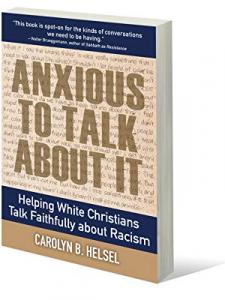
If you are a white Christian, I can recommend a book to help you start that conversation in your own congregation. Carolyn Helsel’s Anxious to Talk About It (Chalice Press, 2018) offers tools and practices to explore the anxious feelings that can come up when talking about racism. You’ll find that her book will enable your church to move through the anxiety and engage these difficult conversations. It’s not about judgment and fear. It’s about developing compassion, and gaining knowledge of self, others, and the important issues at stake.
And if you’re a preacher, I recommend Helsel’s follow-up book, Preaching About Racism. With straightforward and digestible chapters, this book offers both critical theory as well as strategies and insights for crafting biblical and theological sermons that address racism from different angles.
This is and will be a work in progress. But we have to start somewhere. I have to start somewhere.
So how does one recover from being a racist? Perhaps we need a 12-Step program…

Leah D. Schade is the Assistant Professor of Preaching and Worship at Lexington Theological Seminary (Kentucky) and author of the book Creation-Crisis Preaching: Ecology, Theology, and the Pulpit (Chalice Press, 2015).
Twitter: @LeahSchade
Facebook: https://www.facebook.com/LeahDSchade/
Read also:
To Understand Martin Luther King Jr., Read Howard Thurman
The Healing Power of ‘Moonlight’: Race, Erotic Love, and Baptism
James Cone: One White Woman’s Tribute
Previous Post
January 14, 2019
From Eco-Crucifixion to Eco-Resurrection
Next Post

January 20, 2019 Kentucky, We Need to Talk About Our White Supremacist Problem
Browse Our Archives
Select a Category Academy of Homiletics Addiction Advent AI (Artificial Intelligence) Animals Apocalypse Appalachia Ash Wednesday Baptism Bible Black Lives Matter Blade Runner Book review Children in church Christian Nationalism Christian/Islamic relations Christmas Church Clergy Climate change COVID-19 Creation Data Centers Death penalty Devotional Dialogue Doubt Earth Day Easter Ecofeminism EcoPreacher 1-2-3 ELCA ELCA Youth Gathering Election Environment/ecology Epiphany Faith Faith and Politics Feminism Film review Food Food and Faith Forgiveness Fracking Good Friday Good Omens Grief Gun violence Holy Humor Sunday Holy Week Howard Thurman ICE Immigration Indigenous wisdom Interview Jesus Kentucky Lafayette High School Marching Band Leadership Lent LGBTQIA+ Marching band Martin Luther Martin Luther King Jr. Mary Maundy Thursday Michael Sheen Mother of Jesus Nature New Year's Eve Palm Sunday Parables Pentecost Poem, Poetry Politics Poor People's Campaign Pop culture Prayers Preaching Progressive Christianity Public theology Purple Zone Racism and White Privilege Religion Religion and environment Religion and politics Religion and pop culture Religion and violence Rev. Nelson Rabell Gonzalez Sermons Spanish language resources for preaching Technology Thanksgiving Theological education theology Trees Trump Uncategorized Vegan War Women and religion Workshop Worship
Select a Month October 2026 September 2026 July 2026 June 2026 May 2026 April 2026 March 2026 February 2026 January 2026 December 2025 November 2025 October 2025 September 2025 May 2025 April 2025 March 2025 February 2025 January 2025 December 2024 November 2024 October 2024 September 2024 August 2024 July 2024 June 2024 May 2024 April 2024 March 2024 February 2024 January 2024 December 2023 November 2023 October 2023 September 2023 August 2023 July 2023 June 2023 May 2023 April 2023 March 2023 February 2023 January 2023 December 2022 November 2022 October 2022 August 2022 July 2022 June 2022 May 2022 April 2022 March 2022 February 2022 January 2022 December 2021 November 2021 October 2021 September 2021 August 2021 July 2021 June 2021 May 2021 April 2021 March 2021 January 2021 December 2020 November 2020 October 2020 September 2020 August 2020 July 2020 June 2020 May 2020 April 2020 February 2020 January 2020 December 2019 November 2019 October 2019 September 2019 August 2019 July 2019 June 2019 May 2019 April 2019 March 2019 January 2019 December 2018 November 2018 October 2018 September 2018 August 2018 July 2018 June 2018 May 2018 April 2018 March 2018 February 2018 January 2018 December 2017 November 2017 October 2017 September 2017 August 2017 July 2017 June 2017 May 2017 April 2017
Follow Us!
TAKE THE
Religious Wisdom Quiz
What happened when Peter tried to walk on water?
Select your answer to see how you score.
The Spirit descended upon him He led other disciples out He sank when he doubted He ran ahead of Jesus
Books by This Author Books by Leah D. Schade
Related posts from EcoPreacher

Making Space for Eco-Grief—and Hope—in Your Church
VBS Murder Skit: When a Church Teaches Children...

Cancer Alley Prophets: Jeremiah 20, Matthew 10
10 Books to Address Christian Nationalism in Your...
TRENDING AT PATHEOS Progressive Christian

What Being a Modern-Day Apostle Means to Me
In my last column, I discussed the ins and outs of modern-day...

Did Ancient China Once Worship the God of...
Across human history, a common thread weaves through the origins of the...

Love Your Neighbor – Including Earth-Kin: Lev. 19,...
God’s command to love your neighbor means acting in an ethical and...

Lead a Church Study of “Jesus and Lao...
Guest writer Jack Thomas (The Irreverent Reverend) reflects on leading his church...

Pastoral Wisdom for Responding to Sermon Pushback
Getting sermon pushback on your social justice sermon? Learn practical, Proverbs-based strategies...

Principles for Understanding the Apostolic Ministry Today
Whenever people discover that my formal ministry title is "apostle," as in...
view all Progressive Christian blogs
Ad-Free & Subscriber Log-In Subscription Support
- About Us
- 2026 Calendar
- Videos
- Podcasts
- Library of World Religions
- Faith In Media Tracker
- Advertise With Us
- Write for Us
- Privacy Policy
- Terms of Service
- Do Not Sell My Data
- Contact Us
- Radiant Digital
- Manage Newsletter Subscriptions
- Unsubscribe From Notifications
- Sitemap
Copyright 2008-2026, Patheos. All rights reserved.
Subscription Support Ad-Free & Subscriber Log-In
Follow Patheos