
BuddhistCatholicContemplativeEvangelicalGeneral ChristianHinduJewishLatter-day SaintMuslimNew VisionsProgressive Christian
Beliefs
- Buddhist
- Catholic
- Contemplative
- Evangelical
- General Christian
- Hindu
- Jewish
- Latter-day Saint
- More Voices
- Muslim
- New Visions
- Pagan
- Progressive Christian
Topics
- Religion News
- Food and Religion
- Sports and Religion
- Religious Art
- Religious Music and Entertainment
- Religious Events
- History and Religion
- Style and Religion
- Politics and Religion
- Women in Religion
- Recreation Outdoors and Religion
- Business Finance and Religion
- Careers Workplace and Religion
- Education and Religion
- Family Parenting and Religion
- Health Fitness and Religion
- Home and Religion
- Relationships and Religion
- Technology and Religion
- Travel and Religion
Columnists
- Buddhist Columnists
- Business Finance and Religion Columnists
- Careers Workplace and Religion Columnists
- Catholic Columnists
- Contemplative Columnists
- Education and Religion Columnists
- Evangelists Columnists
- Family Parenting and Religion Columnists
- General Christian Columnists
- Health Fitness and Religion Columnists
- Hindu Columnists
- History and Religion Columnists
- Home and Religion Columnists
- Jewish Columnists
- More Voices Columnists
- Latter Day Columnists
- Muslim Columnists
- New Visions Columnists
- Nonreligious Columnists
- Pagan Columnists
- Politics and Religion Columnists
- Progressive Columnists
- Recreation Outdoors and Religion Columnists
- Relationships and Religion Columnists
- Religion News Columnists
- Religious Art Columnists
- Religious Events Columnists
- Religious Music and Entertainment Columnists
- Sports and Religion Columnists
- Style and Religion Columnists
- Technology and Religion Columnists
- Travel and Religion Columnists
- Women in Religion Columnists
Resource Library
- 2026 Calendar
- Library of World Religions
- The 100 Most Holy Places on Earth
- Patheos Answers
- Podcasts
- Videos
- Faith Leaders Database
- Anglican Episcopalian
- Bahai
- Baptist
- Buddhism
- Christianity
- Confucianism
- Eastern Orthodoxy
- Hinduism
- Holiness and Pentecostal
- ISKCON
- Islam
- Judaism
- Lutheran
- Methodist
- The Church of Jesus Christ of Latter-day Saints
- New Age
- Paganism
- Presbytarian and Reformed
- Protestantism
- Religion Behind the Scenes
- Roman Catholic
- Scientology
- Shia Islam
- Sikhism
- Sufism
- Sunni Islam
- Taoism
- Zen
- See all religions
Research Tools
 Ad-Free & Subscriber Log-In Subscription Support
Ad-Free & Subscriber Log-In Subscription Support
Follow Patheos 

- Trending:
- Forgiveness
- |
- Marriage
- |
- Consciousness
- |
- Death Penalty
- |
- Election
- |
- Halloween

- Home
- Progressive Christian
- How to be a Christian (and a Pastor) After the Midterm Elections
How to be a Christian (and a Pastor) After the Midterm Elections
Last updated on: November 7, 2018 at 6:47 pm by Leah D. Schade
How to be a Christian (and a Pastor) After the Midterm Elections 2018-11-07T18:47:49-04:00 Leah D. Schade
Patheos Explore the world's faith through different perspectives on religion and spirituality! Patheos has the views of the prevalent religions and spiritualities of the world.
As expected, the 2018 midterm elections were a mixed bag for both political parties in the U.S. Depending on where you live and your party affiliation, you are likely either celebrating, or bitterly disappointed, or some combination of both. However, if you’re a Christian – and especially a minister – knowing Sunday morning’s service is just ahead may be creating an even higher level of angst. This is because churches are increasingly becoming flash points of political clashes among members or between members and clergy.

Photo credit: Pexels.com. Public domain.
As a seminary professor of preaching and worship, I’m hearing more and more stories of parishioners engaging in heated exchanges with each other or their pastor over any number of issues, including race, positions on the abortion debate, immigration, and gun violence, to name just a few. The tension clergy leaders and church members are feeling these days can make it difficult to hold together as the Body of Christ, whether it’s sharing a pew, partaking in communion, or doing the work of committees and councils.
“How are we supposed to be the church in a time like this?”
“How are we supposed to go into our churches on Sunday morning? What are we supposed to say and do? How can we face those who are going to gloat over this election victory? How are we going to endure the pain of those who are alarmed by the outcome? What does it look like to be church in the midst of all this?”
These are the kinds of questions ministers and parishioners may be asking.
As I’ve been working on my book Preaching in the Purple Zone: Ministry in the Red-Blue Divide (coming out in April 2019 from Rowman & Littlefield), I’ve been asking these questions, too. Over the past two years, I’ve researched how preachers approach controversial issues in their sermons, and worked with clergy on ways to navigate the Purple Zone while proclaiming the gospel with integrity and pastoral prudence. As you’re thinking about this coming Sunday – or any Sunday after a volatile political election – here are some things to keep in mind for being a Christian in the midst of a fractured and divided society.
1. Ensuring people’s safety is top priority.
Given the rhetoric of the person who occupies the White House, and given the fact that 14 pipe bombs were intended prominent politicians and members of the media, and several hate-crime-based mass murders occurred just prior to the election, a significant portion of this country is experiencing alarm and legitimate fear about their physical and emotional safety, or for their family members, friends, students, or co-workers. Women, people of color, Jews, Muslims, immigrants and their children, and people of differing sexual orientations, and children in schools, are among those who are worried about their safety during this volatile time.
So if you are a pastor or leader of a congregation, it must be clearly stated that no kind of hateful rhetoric will be tolerated in God’s house of worship. The church is called to be a place of refuge. If you are a Christian, you are part of the Body of Christ, which means that you are to refrain from that kind of talk – even outside of the church. You represent Christ in the world. Behave in a manner that reflects the One whom you worship.
2. If you are a Christian (including a pastor) who is celebrating the results of this election, do not gloat. Now is the time for restraint.
This is not like the Sunday after the World Series or the Superbowl where the victors can good-naturedly rib the losers. For those whose candidates were defeated, there is existential angst based on real or perceived threats to their safety, economic stability, health, and general well-being. The church must be a place to shore up the basic foundations of decency, respect, and the means by which to preserve the common good.
3. Be cautious about insisting that people need to “come together.” Avoid using words like “unify” and “move on.”
For those who are living with the effects of toxic rhetoric that authorizes homophobia, misogyny, anti-Semitism, xenophobia, gun violence, sexual violence, racism and white privilege, hearing an urge to “come together” with someone who has supported those positions is insensitive at best, terrifying at worst. Being a Christian during this time may require space-giving. Eventually we will need to talk about where we go from here. But understand that this is a time of grief and fear for many. Reach out and check in with people. But avoid urging them to engage with people or situations that may feel threatening or harmful to them.
4. It’s okay for parishioners to take a break.
Some people may not even feel comfortable going to church this Sunday if they cannot bring themselves to face what they fear will be the triumphant jeers of their fellow Christians. That is perfectly understandable. Take the time you need. Let the dust settle. When you’re ready to come back, do so in your own time.
5. But if you are a pastor, you don’t have the luxury of absence.
Remember that the day after the crucifixion, the women did something that we as clergy need to do. They showed up. The women were confused, angry, anguished, and in deep grief. But they went to the tomb because they were faithful. They went to perform the rituals – the sacred actions and words – that were part of their people’s faith for centuries. We, too, are called to show up. We are called to be faithful and perform the sacred rituals that give meaning and stability in uncertain times.
6. Times like these are exactly why we are called to be Christian, to preach, to minister.
While it’s understandable that you may be feeling trepidation heading into Sunday morning, remember that this is precisely the time when clergy are needed. “For such a time as this,” as Mordechai said to Esther when she faced an uncertain outcome in representing her people to the king. In other words, we are ideally situated as people of faith to step into this tension. After the resurrection, Jesus told the women to convey the message: “He has already gone ahead to Galilee to meet you,” (Mark 16:7). The Spirit is already at work in ways that may not yet be evident. So we are called to be a calming presence and to use all of our skills of reflective listening, empathy, and active attention.
7. Lean into the liturgy and worship.
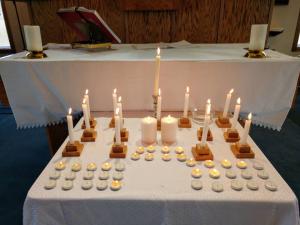
Photo credit: Leah D. Schade. Public domain.
The church has the advantage of ancient actions and words – rituals – that are designed to hold the vast range of feelings experienced by the congregation. Rely on that pattern of worship that is so ingrained in us: gathering, hearing God’s word, breaking bread and sharing wine, and sending out into the world. Let the liturgy minister to you and your congregation. Let it gather in all who will come. Offer prayers for healing. Set up a table with candles for people to light as symbols of their concerns or prayers. Reassure the congregation that the Spirit of God through the compassion of Jesus Christ is in our midst.
8. God is at still at work.
If you’re a Revised Common Lectionary preacher, you know that the texts this coming Sunday focus on the Widow of Zarephath (1 Kings 17:8-16) and the Widow bringing her small offering to the Temple in Jerusalem (Mark 12:38-44). In both stories, there are intense political divides between religious leaders, political leaders, and different tribes – just like there are today. But exacerbating all these divides in scripture as well as in our time is the disparity between those who control the community’s wealth and those who do not. Economic violence is the problem undergirding many of our political tensions.
In the midst of this, God puts the widows front and center.
The ones who are poor, who have no social safety net, who are cast aside by economic systems that prey on them – even as their leaders parade about in rich clothing. So no matter how these midterm elections turned out, God is still calling us to pay attention to the poor, the lost, the forgotten, the disenfranchised, the victims of economic violence.
9. Our work remains.
Regardless of the results of the midterm elections, the rich are still parading in their robes. The widows remain. They still have only a jar of flour and a jug of oil. They still have only two coins. And Jesus is still watching. When everyone else is distracted by the big goings-on among the power-brokers, it’s Jesus who points out the widow. It’s Jesus who draws attention to a system that leads to this level of destitution and desperation – even as she tries to be faithful. Let’s pull up a chair alongside Jesus and follow his gaze to see who he is paying attention to. And then let’s get to work to address those systems of economic violence.
Elections come and go. The work for the church remains.
[Looking for sermon ideas for Sunday? Check out this blog piece by Lisa Cressman at Backstory Preaching.]
Leah D. Schade is the Assistant Professor of Preaching and Worship at Lexington Theological Seminary (Kentucky) and author of the book Creation-Crisis Preaching: Ecology, Theology, and the Pulpit (Chalice Press, 2015). She is an ordained minister in the Lutheran Church (ELCA). The views expressed here are her own and do not represent the institutions she serves.
Twitter: @LeahSchade
Facebook: https://www.facebook.com/LeahDSchade/.
Read also:
It’s Time to Vote and THUNDER at the Polls: Rev. Dr. William Barber Visits Kentucky
Bringing Our Faith to the Ballot Box: All Saints Sunday Sermon
Previous Post
November 4, 2018
Bringing Our Faith to the Ballot Box: All Saints Sunday Sermon
Next Post

November 11, 2018 The Widow’s Mite? No, MIGHT! – Justice, Power, and the Widow
Browse Our Archives
Select a Category Academy of Homiletics Addiction Advent AI (Artificial Intelligence) Animals Apocalypse Appalachia Ash Wednesday Baptism Bible Black Lives Matter Blade Runner Book review Children in church Christian Nationalism Christian/Islamic relations Christmas Church Clergy Climate change COVID-19 Creation Data Centers Death penalty Devotional Dialogue Doubt Earth Day Easter Ecofeminism EcoPreacher 1-2-3 ELCA ELCA Youth Gathering Election Environment/ecology Epiphany Faith Faith and Politics Feminism Film review Food Food and Faith Forgiveness Fracking Good Friday Good Omens Grief Gun violence Holy Humor Sunday Holy Week Howard Thurman ICE Immigration Indigenous wisdom Interview Jesus Kentucky Lafayette High School Marching Band Leadership Lent LGBTQIA+ Marching band Martin Luther Martin Luther King Jr. Mary Maundy Thursday Michael Sheen Mother of Jesus Nature New Year's Eve Palm Sunday Parables Pentecost Poem, Poetry Politics Poor People's Campaign Pop culture Prayers Preaching Progressive Christianity Public theology Purple Zone Racism and White Privilege Religion Religion and environment Religion and politics Religion and pop culture Religion and violence Rev. Nelson Rabell Gonzalez Sermons Spanish language resources for preaching Technology Thanksgiving Theological education theology Trees Trump Uncategorized Vegan War Women and religion Workshop Worship
Select a Month October 2026 September 2026 July 2026 June 2026 May 2026 April 2026 March 2026 February 2026 January 2026 December 2025 November 2025 October 2025 September 2025 May 2025 April 2025 March 2025 February 2025 January 2025 December 2024 November 2024 October 2024 September 2024 August 2024 July 2024 June 2024 May 2024 April 2024 March 2024 February 2024 January 2024 December 2023 November 2023 October 2023 September 2023 August 2023 July 2023 June 2023 May 2023 April 2023 March 2023 February 2023 January 2023 December 2022 November 2022 October 2022 August 2022 July 2022 June 2022 May 2022 April 2022 March 2022 February 2022 January 2022 December 2021 November 2021 October 2021 September 2021 August 2021 July 2021 June 2021 May 2021 April 2021 March 2021 January 2021 December 2020 November 2020 October 2020 September 2020 August 2020 July 2020 June 2020 May 2020 April 2020 February 2020 January 2020 December 2019 November 2019 October 2019 September 2019 August 2019 July 2019 June 2019 May 2019 April 2019 March 2019 January 2019 December 2018 November 2018 October 2018 September 2018 August 2018 July 2018 June 2018 May 2018 April 2018 March 2018 February 2018 January 2018 December 2017 November 2017 October 2017 September 2017 August 2017 July 2017 June 2017 May 2017 April 2017
Follow Us!
TAKE THE
Religious Wisdom Quiz
Which prophet's visions include "Gog and Magog"?
Select your answer to see how you score.
Micah Ezekiel Daniel Amos
Books by This Author Books by Leah D. Schade
Related posts from EcoPreacher

Pastoral Wisdom for Responding to Sermon Pushback

What Matt. 21:23-32 Teaches About Integrity In An...

Preaching About Climate Change: What Clergy Need Most

When The Data Center Wolf Is At Your...
TRENDING AT PATHEOS Progressive Christian

What Being a Modern-Day Apostle Means to Me
In my last column, I discussed the ins and outs of modern-day...

Did Ancient China Once Worship the God of...
Across human history, a common thread weaves through the origins of the...

Love Your Neighbor – Including Earth-Kin: Lev. 19,...
God’s command to love your neighbor means acting in an ethical and...

Lead a Church Study of “Jesus and Lao...
Guest writer Jack Thomas (The Irreverent Reverend) reflects on leading his church...

Pastoral Wisdom for Responding to Sermon Pushback
Getting sermon pushback on your social justice sermon? Learn practical, Proverbs-based strategies...

Principles for Understanding the Apostolic Ministry Today
Whenever people discover that my formal ministry title is "apostle," as in...
view all Progressive Christian blogs
Ad-Free & Subscriber Log-In Subscription Support
- About Us
- 2026 Calendar
- Videos
- Podcasts
- Library of World Religions
- Faith In Media Tracker
- Advertise With Us
- Write for Us
- Privacy Policy
- Terms of Service
- Do Not Sell My Data
- Contact Us
- Radiant Digital
- Manage Newsletter Subscriptions
- Unsubscribe From Notifications
- Sitemap
Copyright 2008-2026, Patheos. All rights reserved.
Subscription Support Ad-Free & Subscriber Log-In
Follow Patheos