
BuddhistCatholicContemplativeEvangelicalGeneral ChristianHinduJewishLatter-day SaintMuslimNew VisionsProgressive Christian
Beliefs
- Buddhist
- Catholic
- Contemplative
- Evangelical
- General Christian
- Hindu
- Jewish
- Latter-day Saint
- More Voices
- Muslim
- New Visions
- Pagan
- Progressive Christian
Topics
- Religion News
- Food and Religion
- Sports and Religion
- Religious Art
- Religious Music and Entertainment
- Religious Events
- History and Religion
- Style and Religion
- Politics and Religion
- Women in Religion
- Recreation Outdoors and Religion
- Business Finance and Religion
- Careers Workplace and Religion
- Education and Religion
- Family Parenting and Religion
- Health Fitness and Religion
- Home and Religion
- Relationships and Religion
- Technology and Religion
- Travel and Religion
Columnists
- Buddhist Columnists
- Business Finance and Religion Columnists
- Careers Workplace and Religion Columnists
- Catholic Columnists
- Contemplative Columnists
- Education and Religion Columnists
- Evangelists Columnists
- Family Parenting and Religion Columnists
- General Christian Columnists
- Health Fitness and Religion Columnists
- Hindu Columnists
- History and Religion Columnists
- Home and Religion Columnists
- Jewish Columnists
- More Voices Columnists
- Latter Day Columnists
- Muslim Columnists
- New Visions Columnists
- Nonreligious Columnists
- Pagan Columnists
- Politics and Religion Columnists
- Progressive Columnists
- Recreation Outdoors and Religion Columnists
- Relationships and Religion Columnists
- Religion News Columnists
- Religious Art Columnists
- Religious Events Columnists
- Religious Music and Entertainment Columnists
- Sports and Religion Columnists
- Style and Religion Columnists
- Technology and Religion Columnists
- Travel and Religion Columnists
- Women in Religion Columnists
Resource Library
- 2026 Calendar
- Library of World Religions
- The 100 Most Holy Places on Earth
- Patheos Answers
- Podcasts
- Videos
- Faith Leaders Database
- Anglican Episcopalian
- Bahai
- Baptist
- Buddhism
- Christianity
- Confucianism
- Eastern Orthodoxy
- Hinduism
- Holiness and Pentecostal
- ISKCON
- Islam
- Judaism
- Lutheran
- Methodist
- The Church of Jesus Christ of Latter-day Saints
- New Age
- Paganism
- Presbytarian and Reformed
- Protestantism
- Religion Behind the Scenes
- Roman Catholic
- Scientology
- Shia Islam
- Sikhism
- Sufism
- Sunni Islam
- Taoism
- Zen
- See all religions
Research Tools
 Ad-Free & Subscriber Log-In Subscription Support
Ad-Free & Subscriber Log-In Subscription Support
Follow Patheos 

- Trending:
- Forgiveness
- |
- Marriage
- |
- Consciousness
- |
- Death Penalty
- |
- Election
- |
- Halloween

- Home
- Progressive Christian
- Skin Jobs and Snow Jobs: Blade Runner 2049 as Cli-Fi Noir and Race Erasure
Skin Jobs and Snow Jobs: Blade Runner 2049 as Cli-Fi Noir and Race Erasure
Last updated on: August 7, 2018 at 8:09 am by Leah D. Schade
Skin Jobs and Snow Jobs: Blade Runner 2049 as Cli-Fi Noir and Race Erasure 2018-08-07T08:09:48-04:00 Leah D. Schade
Patheos Explore the world's faith through different perspectives on religion and spirituality! Patheos has the views of the prevalent religions and spiritualities of the world.
I’ve written scads of academic papers, published articles, and even a book. But nothing to this point is as cool as having my essay about the movie Blade Runner 2049 as cli-fi and race erasure published in the book, Cyberpunk Nexus: Exploring the Blade Runner Universe.
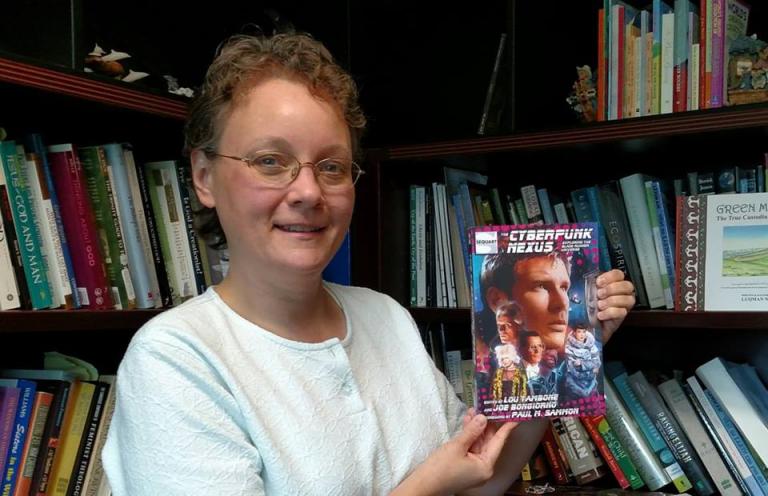
Blade Runner (1982) and Blade Runner 2049 are my favorite movies of all time.
I have nerded out on the first movie since I was a teen. As an adult, I’ve written blog posts about them*.* [See: Do You Like Our Owl? ‘Blade Runner’ (1982) and Climate Change and Blade Runner 2049: 5 Star Review.] So when I was invited to contributed a chapter to this anthology edited by Lou Tambone and Joe Bongiorno, published by Sequart Organization, I jumped at the opportunity.
With 416 pages of 27 essays, plus a forward by Paul M. Sammon (author of Future Noir: The Making of Blade Runner), the book examines the entire Blade Runner saga, from the original novel to its numerous movie versions. The essays take a critical look at all aspects of the Blade Runner franchise, including Philip K. Dick’s book upon which the movies are based (Do Androids Dream of Electric Sheep?), the music, comic book spin-offs, and film iterations.
This collection has intellectual and philosophical heft. Essayists explore themes such as the meaning of life, death and dying, science and technology, and love. My essay takes a critical look at the films through the overlapping lenses of race theory and the emerging sub-genre of cli-fi (climate fiction – sci fi that deals with climate disruption). Here’s a teaser with the essay’s introduction.
“Skin Jobs and Snow Jobs: Blade Runner 2049 as Cli-Fi Noir and Race Erasure”
What I first noticed about Blade Runner 2049 is that it feels like the original Blade Runner. Denis Villenueve’s cinematic masterpiece of “future noir” layers superb visual effects upon an absorbing storyline peopled with fascinating characters who wrestle with poignant religious and philosophical themes.[1] Visual and aural “quotes” from the original 1982 Blade Runner film are embedded into stunning, high-concept scenes to create grim, poetic beauty worthy of Ridley Scott’s original dystopian vision.
Flying cars swoop across vast desiccated landscapes. Glowing umbrellas and oversized neon ads illuminate garish urban city-scapes. The churning, vibrating soundtrack by Wallfisch and Zimmer pays homage to Vangelis’ aural masterpiece (complete with a key musical cameo from the original soundtrack) while adding its own mystique with soaring strata of synth-sound. The film even furthers the climate and environmental storyline presciently rendered in the 1982 film, thus securing both films’ place in the emerging subgenre of cli-fi (literature and art that addresses or is informed by climate change). With its brooding, pessimistic interplay of light and shadow against the backdrop of extreme climate breakdown, I suggest that BR2049 is part of a new genre-fusion we might call “cli-fi noir.”

Race erasure in Blade Runner
But BR2049 also continues a failing of its predecessor – the erasure of race, even as it appropriates the black experience of slavery, oppression, and the struggle for personhood and freedom. As I watched both films from the perspective of the Black Lives Matter movement, I realized that the feeling I savored from both movies was largely premised on the reality of my occupying a racial, socio-economic position as a middle-class Caucasian who benefits from the privilege of my white race. Because, as writer Nicholas Podany points out, neither film requires white people “to leave their comfort zones of white fragility to enjoy a compelling story about bigotry and persecution.”[2] In other words, while each film can be viewed as a metaphor for racial oppression, they give barely a nod to the reality of racism itself. Because despite a few token characters of color, the main roles in both movies are filled by white actors.
Whitewashing science fiction
Whitewashing in science fiction is, of course, nothing new.[3] But BR2049 had an opportunity to engage the reality of racism in a much more honest and straightforward way than its predecessor. The fact that that opportunity was squandered is more than just a disappointment. It actually reinforces a narrative and underlying artistic structure of white privilege precisely at a moment in our history when such narratives need to be interrogated, deconstructed, and placed within a larger context of eco-racism and the climate crisis that is having enormous impacts on communities of color.
This essay will critically explore BR2049 through the intersections of race, technology, climate change, and economic exploitation. I will make the case that if “cli-fi noir” is, indeed, to become a new subgenre, then directors, producers, and actors must forthrightly address the reality of raced bodies if there is to be any integrity to their art. . .
To read the rest of the essay, you can find The Cyberpunk Nexus: Exploring the Blade Runner Universe on Amazon in print and on Kindle.

Leah D. Schade is the Assistant Professor of Preaching and Worship at Lexington Theological Seminary (Kentucky) and author of the book Creation-Crisis Preaching: Ecology, Theology, and the Pulpit (Chalice Press, 2015). She is an ordained minister in the Lutheran Church (ELCA).
Twitter: @LeahSchade
Facebook: https://www.facebook.com/LeahDSchade/.
See also:
Watching ‘Blade Runner’ (1982) in the Age of Black Lives Matter
Blade Runner 2049: Cli-Fi at Its Best
[1] See: Sammon, Paul M. The Future Noir: The Making of Blade Runner (Revised and Updated). Dey Street Books, 2017.
[2] Podany, Nicholas. “BLADE RUNNER 2049: White Appropriation of Black Oppression.” Medium, 19 Oct. 2017, medium.com/@nicholaspodany/blade-runner-2049-white-appropriation-of-black-oppression-76a5e20ca324. Accessed 6 Feb. 2018.
[3] See: Rieder, John. Colonialism and the Emergence of Science Fiction. Middetown, Connecticut: Wesleyan University Press. 2008. See also: Berlatsky, Noah. “Why Sci-Fi Keeps Imagining the Subjugation of White People.” The Atlantic, Atlantic Media Company, 25 Apr. 2014, www.theatlantic.com/entertainment/archive/2014/04/why-sci-fi-keeps-imagining-the-enslavement-of-white-people/361173/. And: Berlatsky, Noah. “Star Wars and the 4 Ways Science Fiction Handles Race.” The Atlantic, Atlantic Media Company, 25 Mar. 2014, www.theatlantic.com/entertainment/archive/2014/03/-em-star-wars-em-and-the-4-ways-science-fiction-handles-race/359507/.
Previous Post

August 4, 2018
Manna: Bread and Laughter in the Wilderness
Next Post

August 10, 2018 The Pietà of a Mother Orca: Carrying the Grief of an Eco-Crucifixion
Browse Our Archives
Select a Category Academy of Homiletics Addiction Advent AI (Artificial Intelligence) Animals Apocalypse Appalachia Ash Wednesday Baptism Bible Black Lives Matter Blade Runner Book review Children in church Christian Nationalism Christian/Islamic relations Christmas Church Clergy Climate change COVID-19 Creation Data Centers Death penalty Devotional Dialogue Doubt Earth Day Easter Ecofeminism EcoPreacher 1-2-3 ELCA ELCA Youth Gathering Election Environment/ecology Epiphany Faith Faith and Politics Feminism Film review Food Food and Faith Forgiveness Fracking Good Friday Good Omens Grief Gun violence Holy Humor Sunday Holy Week Howard Thurman ICE Immigration Indigenous wisdom Interview Jesus Kentucky Lafayette High School Marching Band Leadership Lent LGBTQIA+ Marching band Martin Luther Martin Luther King Jr. Mary Maundy Thursday Michael Sheen Mother of Jesus Nature New Year's Eve Palm Sunday Parables Pentecost Poem, Poetry Politics Poor People's Campaign Pop culture Prayers Preaching Progressive Christianity Public theology Purple Zone Racism and White Privilege Religion Religion and environment Religion and politics Religion and pop culture Religion and violence Rev. Nelson Rabell Gonzalez Sermons Spanish language resources for preaching Technology Thanksgiving Theological education theology Trees Trump Uncategorized Vegan War Women and religion Workshop Worship
Select a Month October 2026 September 2026 July 2026 June 2026 May 2026 April 2026 March 2026 February 2026 January 2026 December 2025 November 2025 October 2025 September 2025 May 2025 April 2025 March 2025 February 2025 January 2025 December 2024 November 2024 October 2024 September 2024 August 2024 July 2024 June 2024 May 2024 April 2024 March 2024 February 2024 January 2024 December 2023 November 2023 October 2023 September 2023 August 2023 July 2023 June 2023 May 2023 April 2023 March 2023 February 2023 January 2023 December 2022 November 2022 October 2022 August 2022 July 2022 June 2022 May 2022 April 2022 March 2022 February 2022 January 2022 December 2021 November 2021 October 2021 September 2021 August 2021 July 2021 June 2021 May 2021 April 2021 March 2021 January 2021 December 2020 November 2020 October 2020 September 2020 August 2020 July 2020 June 2020 May 2020 April 2020 February 2020 January 2020 December 2019 November 2019 October 2019 September 2019 August 2019 July 2019 June 2019 May 2019 April 2019 March 2019 January 2019 December 2018 November 2018 October 2018 September 2018 August 2018 July 2018 June 2018 May 2018 April 2018 March 2018 February 2018 January 2018 December 2017 November 2017 October 2017 September 2017 August 2017 July 2017 June 2017 May 2017 April 2017
Follow Us!
TAKE THE
Religious Wisdom Quiz
I saw a river flowing from the temple threshold, getting deeper until it became a river no one could cross. What grew along its banks?
Select your answer to see how you score.
Flowers Grass Vines Trees
Books by This Author Books by Leah D. Schade
Related posts from EcoPreacher

Inside Out 2 Parallels Faith Journey, Theological Education

Nye: A Review by an American in Kentucky

Michael Sheen’s The Passion of Port Talbot is...
Clergy Report Preaching More about Climate Change: National...
TRENDING AT PATHEOS Progressive Christian

What Being a Modern-Day Apostle Means to Me
In my last column, I discussed the ins and outs of modern-day...

Did Ancient China Once Worship the God of...
Across human history, a common thread weaves through the origins of the...

Love Your Neighbor – Including Earth-Kin: Lev. 19,...
God’s command to love your neighbor means acting in an ethical and...

Lead a Church Study of “Jesus and Lao...
Guest writer Jack Thomas (The Irreverent Reverend) reflects on leading his church...

Pastoral Wisdom for Responding to Sermon Pushback
Getting sermon pushback on your social justice sermon? Learn practical, Proverbs-based strategies...

Principles for Understanding the Apostolic Ministry Today
Whenever people discover that my formal ministry title is "apostle," as in...
view all Progressive Christian blogs
Ad-Free & Subscriber Log-In Subscription Support
- About Us
- 2026 Calendar
- Videos
- Podcasts
- Library of World Religions
- Faith In Media Tracker
- Advertise With Us
- Write for Us
- Privacy Policy
- Terms of Service
- Do Not Sell My Data
- Contact Us
- Radiant Digital
- Manage Newsletter Subscriptions
- Unsubscribe From Notifications
- Sitemap
Copyright 2008-2026, Patheos. All rights reserved.
Subscription Support Ad-Free & Subscriber Log-In
Follow Patheos