
BuddhistCatholicContemplativeEvangelicalGeneral ChristianHinduJewishLatter-day SaintMuslimNew VisionsProgressive Christian
Beliefs
- Buddhist
- Catholic
- Contemplative
- Evangelical
- General Christian
- Hindu
- Jewish
- Latter-day Saint
- More Voices
- Muslim
- New Visions
- Pagan
- Progressive Christian
Topics
- Religion News
- Food and Religion
- Sports and Religion
- Religious Art
- Religious Music and Entertainment
- Religious Events
- History and Religion
- Style and Religion
- Politics and Religion
- Women in Religion
- Recreation Outdoors and Religion
- Business Finance and Religion
- Careers Workplace and Religion
- Education and Religion
- Family Parenting and Religion
- Health Fitness and Religion
- Home and Religion
- Relationships and Religion
- Technology and Religion
- Travel and Religion
Columnists
- Buddhist Columnists
- Business Finance and Religion Columnists
- Careers Workplace and Religion Columnists
- Catholic Columnists
- Contemplative Columnists
- Education and Religion Columnists
- Evangelists Columnists
- Family Parenting and Religion Columnists
- General Christian Columnists
- Health Fitness and Religion Columnists
- Hindu Columnists
- History and Religion Columnists
- Home and Religion Columnists
- Jewish Columnists
- More Voices Columnists
- Latter Day Columnists
- Muslim Columnists
- New Visions Columnists
- Nonreligious Columnists
- Pagan Columnists
- Politics and Religion Columnists
- Progressive Columnists
- Recreation Outdoors and Religion Columnists
- Relationships and Religion Columnists
- Religion News Columnists
- Religious Art Columnists
- Religious Events Columnists
- Religious Music and Entertainment Columnists
- Sports and Religion Columnists
- Style and Religion Columnists
- Technology and Religion Columnists
- Travel and Religion Columnists
- Women in Religion Columnists
Resource Library
- 2026 Calendar
- Library of World Religions
- The 100 Most Holy Places on Earth
- Patheos Answers
- Podcasts
- Videos
- Faith Leaders Database
- Anglican Episcopalian
- Bahai
- Baptist
- Buddhism
- Christianity
- Confucianism
- Eastern Orthodoxy
- Hinduism
- Holiness and Pentecostal
- ISKCON
- Islam
- Judaism
- Lutheran
- Methodist
- The Church of Jesus Christ of Latter-day Saints
- New Age
- Paganism
- Presbytarian and Reformed
- Protestantism
- Religion Behind the Scenes
- Roman Catholic
- Scientology
- Shia Islam
- Sikhism
- Sufism
- Sunni Islam
- Taoism
- Zen
- See all religions
Research Tools
 Ad-Free & Subscriber Log-In Subscription Support
Ad-Free & Subscriber Log-In Subscription Support
Follow Patheos 

- Trending:
- Forgiveness
- |
- Marriage
- |
- Consciousness
- |
- Death Penalty
- |
- Election
- |
- Halloween

- Home
- Progressive Christian
- What Do We Do With a Doubting Thomas?
What Do We Do With a Doubting Thomas?
Last updated on: April 9, 2018 at 8:24 am by Leah D. Schade
What Do We Do With a Doubting Thomas? 2018-04-09T08:24:28-04:00 Leah D. Schade
Patheos Explore the world's faith through different perspectives on religion and spirituality! Patheos has the views of the prevalent religions and spiritualities of the world.
The story of Doubting Thomas is sometimes used to shame those who struggle with their faith. Let’s rethink this approach to those who doubt. This story has even more grace than you might think. Text: John 20:24 – 29.

“Walking and thinking.” Photo by d26b73. Some rights reserved. https://www.flickr.com/photos/draganbrankovic/
I know that my redeemer lives.
I know that Jesus was crucified, died and was buried, and on the third day, rose again.
How do I know this? How do any of us know this?
We weren’t there. We didn’t see any of this happen.
All we know is what we’ve been told – by the gospel writers, by Paul,
by the early church fathers and mothers,
by our own fathers and mothers.
Some of us were told by pastors, and relatives, and friends.
And for some reason, we believed.
That’s one of the reasons we’re here now.
Because we experienced something that changed our lives.
And we want to share that with each other, to tell the story.

The foggy bridge. Photo by Guiseppe Milo. Some rights reserved. https://www.flickr.com/photos/giuseppemilo/
But what happens when we try to share this spirit with someone we love, someone we care about deeply, and they don’t believe?
Maybe a son or daughter, maybe a friend, maybe a grandson or granddaughter, maybe your own life-partner.
What happens if they do not believe?
Or if they once shared the faith with you, but, for whatever reason, have turned away?
What happens if they reject that what you share with them,
if they refuse to come with you to this place of worship,
to join you in this faith that is the foundation of your life?
What happens when we encounter the doubting Thomas?
I know what sometimes happens for me.
It’s like there’s this separation between us that I don’t know how get through.
I want so much for them to know what I know,
to feel what I feel, to experience what I experience.
Because it’s this incredible thing – this peace, this spirit, this grace.
And I want this faith to come to them.
But year after year, time after time — they just say no.
And then sometimes I get angry.
What’s wrong with them that they don’t get it?
What’s wrong with me that I can’t convince them?
And sometimes I just throw up my hands and I say, fine, be that way.
If you’re going to be that stubborn . . .
if you’re going to be that rational that you need some kind of proof . . .
if insist on refusing the free gift of grace . . .
if you don’t love me enough, and trust me enough to take me at my word.
Fine, whatever.
Then there is this cold, unmoving space between us.

San Bernardo AR#11. Photo by Nicolas Alejandro. Some rights reserved. https://www.flickr.com/photos/nalejandro/
I wonder if the disciples felt this way when they shared the good news with Thomas?
They shared with him that they had seen Jesus, that he was alive and had come to them.
“Peace be with you. As the Father has sent me, so I send you,”
and then he breathed his Holy Spirit on them.
I wonder if the disciples felt hurt, or angry, or maybe looked down on Thomas because he refused to believe?
But I must admit, there are times when I relate more to Thomas than to the disciples.
Because this cold, unmoving space isn’t always between me and another person.
Sometimes I have felt this within my own soul.
There have been times when I have felt like Thomas, struggling with doubts and unbelief.
Maybe you know the feeling, too.
You know that you should believe, that you’re supposed to have faith,
but you look around at everyone else singing the hymns
and saying the creed with confidence,
and all you feel is this cold, unmoving space within you.
You wonder, what’s wrong with me that I don’t get it?
Maybe you feel guilty knowing that in the midst of this faithful congregation,
you are really just a doubting Thomas.

“Desert.” Photo by Beshef. Some rights reserved. https://www.flickr.com/photos/sharif/
But let’s not be too quick to pass judgment on Thomas.
Let’s not forget the faithfulness that Thomas exhibited earlier this gospel.
In the story of the raising of Lazarus,
we saw Thomas boldly encourage his fellow disciples to accompany Jesus to Bethany,
even though there was the danger that the religious leaders would try to stone and arrest Jesus again.
Despite the worries of the other disciples, Thomas says,
“Let us also go that we may die with him.” (John 11:16)
Doesn’t sound like the words of a doubter to me.
Then, in chapter 14, when Jesus is saying his farewell to the disciples, it’s Thomas who says:
“Lord, we do not know where you are going. How can we know the way?”
It’s a good question,
and you have to admire Thomas for his courage to speak up and ask what the other disciples were probably all wondering in their minds.
Jesus said to him, “I am the way, and the truth, and the life. No one comes to the Father except through me. If you know me, you will know my Father also. From now on you do know him and have seen him.” (John 14:1-7)
There it is — Thomas has his answer.
From now on you do know him and have seen him.
In light of these words, maybe we shouldn’t be surprised at Thomas’s doubts when the disciples tell him that they have seen the Lord.
Thomas hasn’t seen it.
Sure, he saw Jesus alive during his ministry, healing and teaching,
ministering with miracles and amazing words.
But he also saw Jesus nailed to a cross. He saw a soldier pierce his side.
Thomas saw Jesus dead.
He has seen God crucified.
He has seen all his hope, all his faith, nailed up on a cross, dead as dead can be.
I think of this when I encounter my own doubting Thomases.
I remember what some of them have seen – all their hope, all their faith,
nailed into a hospital bed. Or the coffin of a loved one. A pile of divorce papers.
Or the bigotry and hatred and violence that has destroyed so many lives.
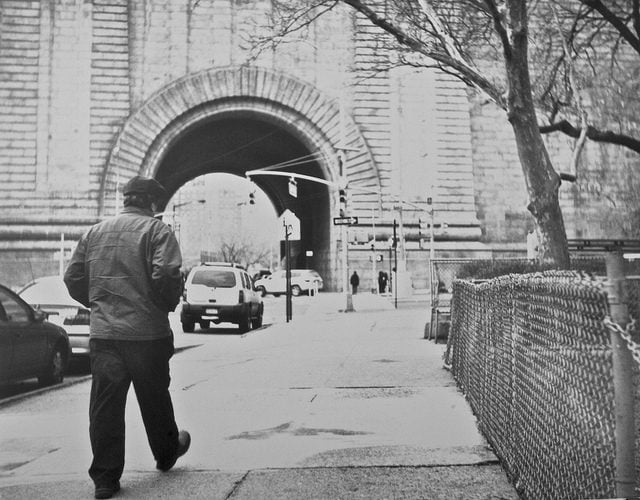
Man walking alone. Photo by Sagie. Some rights reserved. https://www.flickr.com/photos/n0thing/
I imagine they might be able to relate to Thomas wandering alone through the streets of Jerusalem.
He has left his friends hiding behind locked doors because he needs some time alone.
He’s trying to come to terms with what he has seen. Imagine Thomas thinking to himself:
“Is this the God I trusted? Is this what I put my hope in all this time?
Is this the God I believe in – a God who is dead?”
Eventually, he wanders back to the house where the disciples are still in hiding.
Thomas walks in, expecting to see a room full of darkness and depression, the heavy curtains drawn.
Perhaps he’s hoping to commiserate with his friends.
But instead, their faces are lit up and they are rejoicing
as if they have just heard the best news.
“Guess what? You just missed him! We have seen the Lord!”
Thomas looks around at these people who have been his friends and companions all this time – and he doesn’t recognize them.
Something has happened to them that he was not a part of.
And he doesn’t know what’s going on, but he doesn’t like it.
It’s as if they’re all strangers to him, and he’s scared.
Because they know something he doesn’t know, they feel something he doesn’t feel,
they’ve experienced something he has not experienced.
They have seen something he has not seen.
And he says: “No . . . no! Unless I see the mark of the nails in his hands,
and put my finger in the mark of the nails and my hand in his side, I will not believe.”
That could have been the end of the story. But it doesn’t stop there.
Time passes – a week goes by. Thomas is still with them in that room.
He hasn’t left. And they haven’t made him leave.
Whatever hurt and anger and indignation they might have felt,
apparently it wasn’t strong enough to drive him away.
Because in that cold, unmoving space, the warm breath of Jesus’ spirit was moving among them, drawing them together.

Kaleidescope. Photo by Shelia Sund. Some rights reserved. https://www.flickr.com/photos/sheila_sund/
And then . . . Jesus does appear. Notice – he does not chastise the unbeliever.
No one taunts Thomas with, “See, I told you so. Now don’t you feel dumb?”
Jesus simply says, “Peace be with you. Put your finger here and see my hands.
Reach out your hand and put it in my side. Do not doubt but believe.”
Thomas answers him, “My Lord and my God!”
It is true! You are real! You didn’t abandon me. You’re no longer dead!
Oh, my Lord, and my God! Now I know that my redeemer lives!
Now I know that not only were you crucified, died and were buried,
and on the third day rose again.
Oh my Lord, and my God!”
You see, Jesus did not give up on Thomas. He came back.
He created a new faith in Thomas,
lifting him up beyond his fears, his guilt, and his unbelief.
And in the same way, God will not give not up on our doubting Thomases.
Whether they are someone we know, or we ourselves.
God will keep coming back to us, again and again, until we know the truth about faith.
Until we feel the love of forgiveness,
Until we see the peace which passes all understanding.
We are not expected to force each other, to force ourselves, to feel something we don’t feel. But we are called to be like Thomas, who was honest about those feelings, and who expressed those questions and doubts openly and with courage.

Hand on the shoulder. Photo by Mike Renlund. Some rights reserved. https://www.flickr.com/photos/deltamike/
This story teaches us that if we know someone who was once with us as a fellow disciple,
but for some reason is not with us now,
we are not to reject them.
Or chastise them, or look down on them.
We are to stay in relationship with them, and wait with them.
Even if they don’t believe, and it appears they never will.
So what are we to do in the meantime, in this space in between, where we are again waiting?
We are to continue to share the Holy Spirit with each other,
to accompany each other while we are questioning, doubting,
struggling with our feelings of betrayal, pain, and grief.
We do this so that we do not lose hope,
so that we may be comforted that just as Jesus came to Thomas,
he will come to each of us – in his own time and in his own way – to create a new faith.
Because in the end, Jesus has promised that we will be even more blessed than Thomas.
We will be the ones who have not seen, and yet have come to believe. Amen.

Leah D. Schade is the Assistant Professor of Preaching and Worship at Lexington Theological Seminary (Kentucky) and author of the book Creation-Crisis Preaching: Ecology, Theology, and the Pulpit (Chalice Press, 2015). She is an ordained minister in the Lutheran Church (ELCA).
Twitter: @LeahSchade
Facebook: https://www.facebook.com/LeahDSchade/.
Previous Post

April 6, 2018
Top 10 EcoPreacher Posts – 1st Anniversary on Patheos
Next Post
April 14, 2018 A Dozen Bible Passages for Preaching a Creation-Care Sermon
Browse Our Archives
Select a Category Academy of Homiletics Addiction Advent AI (Artificial Intelligence) Animals Apocalypse Appalachia Ash Wednesday Baptism Bible Black Lives Matter Blade Runner Book review Children in church Christian Nationalism Christian/Islamic relations Christmas Church Clergy Climate change COVID-19 Creation Data Centers Death penalty Devotional Dialogue Doubt Earth Day Easter Ecofeminism EcoPreacher 1-2-3 ELCA ELCA Youth Gathering Election Environment/ecology Epiphany Faith Faith and Politics Feminism Film review Food Food and Faith Forgiveness Fracking Good Friday Good Omens Grief Gun violence Holy Humor Sunday Holy Week Howard Thurman ICE Immigration Indigenous wisdom Interview Jesus Kentucky Lafayette High School Marching Band Leadership Lent LGBTQIA+ Marching band Martin Luther Martin Luther King Jr. Mary Maundy Thursday Michael Sheen Mother of Jesus Nature New Year's Eve Palm Sunday Parables Pentecost Poem, Poetry Politics Poor People's Campaign Pop culture Prayers Preaching Progressive Christianity Public theology Purple Zone Racism and White Privilege Religion Religion and environment Religion and politics Religion and pop culture Religion and violence Rev. Nelson Rabell Gonzalez Sermons Spanish language resources for preaching Technology Thanksgiving Theological education theology Trees Trump Uncategorized Vegan War Women and religion Workshop Worship
Select a Month October 2026 September 2026 July 2026 June 2026 May 2026 April 2026 March 2026 February 2026 January 2026 December 2025 November 2025 October 2025 September 2025 May 2025 April 2025 March 2025 February 2025 January 2025 December 2024 November 2024 October 2024 September 2024 August 2024 July 2024 June 2024 May 2024 April 2024 March 2024 February 2024 January 2024 December 2023 November 2023 October 2023 September 2023 August 2023 July 2023 June 2023 May 2023 April 2023 March 2023 February 2023 January 2023 December 2022 November 2022 October 2022 August 2022 July 2022 June 2022 May 2022 April 2022 March 2022 February 2022 January 2022 December 2021 November 2021 October 2021 September 2021 August 2021 July 2021 June 2021 May 2021 April 2021 March 2021 January 2021 December 2020 November 2020 October 2020 September 2020 August 2020 July 2020 June 2020 May 2020 April 2020 February 2020 January 2020 December 2019 November 2019 October 2019 September 2019 August 2019 July 2019 June 2019 May 2019 April 2019 March 2019 January 2019 December 2018 November 2018 October 2018 September 2018 August 2018 July 2018 June 2018 May 2018 April 2018 March 2018 February 2018 January 2018 December 2017 November 2017 October 2017 September 2017 August 2017 July 2017 June 2017 May 2017 April 2017
Follow Us!
TAKE THE
Religious Wisdom Quiz
What does "Barnabas" mean?
Select your answer to see how you score.
Servant of the Lord The Chosen One God is my help Son of Encouragement
Books by This Author Books by Leah D. Schade
Related posts from EcoPreacher

What Matt. 21:23-32 Teaches About Integrity In An...
Reclaiming 1 Peter 2:19-25 From Abuse: Sermon for...

Thomas Touching Christ’s Wounds: Eco-Spiritual Lessons
Palm Sunday Counters the Violence of Christian Nationalism
TRENDING AT PATHEOS Progressive Christian

What Being a Modern-Day Apostle Means to Me
In my last column, I discussed the ins and outs of modern-day...

Did Ancient China Once Worship the God of...
Across human history, a common thread weaves through the origins of the...

Love Your Neighbor – Including Earth-Kin: Lev. 19,...
God’s command to love your neighbor means acting in an ethical and...

Lead a Church Study of “Jesus and Lao...
Guest writer Jack Thomas (The Irreverent Reverend) reflects on leading his church...

Pastoral Wisdom for Responding to Sermon Pushback
Getting sermon pushback on your social justice sermon? Learn practical, Proverbs-based strategies...

Principles for Understanding the Apostolic Ministry Today
Whenever people discover that my formal ministry title is "apostle," as in...
view all Progressive Christian blogs
Ad-Free & Subscriber Log-In Subscription Support
- About Us
- 2026 Calendar
- Videos
- Podcasts
- Library of World Religions
- Faith In Media Tracker
- Advertise With Us
- Write for Us
- Privacy Policy
- Terms of Service
- Do Not Sell My Data
- Contact Us
- Radiant Digital
- Manage Newsletter Subscriptions
- Unsubscribe From Notifications
- Sitemap
Copyright 2008-2026, Patheos. All rights reserved.
Subscription Support Ad-Free & Subscriber Log-In
Follow Patheos