
BuddhistCatholicContemplativeEvangelicalGeneral ChristianHinduJewishLatter-day SaintMuslimNew VisionsProgressive Christian
Beliefs
- Buddhist
- Catholic
- Contemplative
- Evangelical
- General Christian
- Hindu
- Jewish
- Latter-day Saint
- More Voices
- Muslim
- New Visions
- Pagan
- Progressive Christian
Topics
- Religion News
- Food and Religion
- Sports and Religion
- Religious Art
- Religious Music and Entertainment
- Religious Events
- History and Religion
- Style and Religion
- Politics and Religion
- Women in Religion
- Recreation Outdoors and Religion
- Business Finance and Religion
- Careers Workplace and Religion
- Education and Religion
- Family Parenting and Religion
- Health Fitness and Religion
- Home and Religion
- Relationships and Religion
- Technology and Religion
- Travel and Religion
Columnists
- Buddhist Columnists
- Business Finance and Religion Columnists
- Careers Workplace and Religion Columnists
- Catholic Columnists
- Contemplative Columnists
- Education and Religion Columnists
- Evangelists Columnists
- Family Parenting and Religion Columnists
- General Christian Columnists
- Health Fitness and Religion Columnists
- Hindu Columnists
- History and Religion Columnists
- Home and Religion Columnists
- Jewish Columnists
- More Voices Columnists
- Latter Day Columnists
- Muslim Columnists
- New Visions Columnists
- Nonreligious Columnists
- Pagan Columnists
- Politics and Religion Columnists
- Progressive Columnists
- Recreation Outdoors and Religion Columnists
- Relationships and Religion Columnists
- Religion News Columnists
- Religious Art Columnists
- Religious Events Columnists
- Religious Music and Entertainment Columnists
- Sports and Religion Columnists
- Style and Religion Columnists
- Technology and Religion Columnists
- Travel and Religion Columnists
- Women in Religion Columnists
Resource Library
- 2026 Calendar
- Library of World Religions
- The 100 Most Holy Places on Earth
- Patheos Answers
- Podcasts
- Videos
- Faith Leaders Database
- Anglican Episcopalian
- Bahai
- Baptist
- Buddhism
- Christianity
- Confucianism
- Eastern Orthodoxy
- Hinduism
- Holiness and Pentecostal
- ISKCON
- Islam
- Judaism
- Lutheran
- Methodist
- The Church of Jesus Christ of Latter-day Saints
- New Age
- Paganism
- Presbytarian and Reformed
- Protestantism
- Religion Behind the Scenes
- Roman Catholic
- Scientology
- Shia Islam
- Sikhism
- Sufism
- Sunni Islam
- Taoism
- Zen
- See all religions
Research Tools
 Ad-Free & Subscriber Log-In Subscription Support
Ad-Free & Subscriber Log-In Subscription Support
Follow Patheos 

- Trending:
- Forgiveness
- |
- Marriage
- |
- Consciousness
- |
- Death Penalty
- |
- Election
- |
- Halloween

- Home
- Progressive Christian
- James Cone – One White Woman’s Tribute
James Cone – One White Woman’s Tribute
Last updated on: April 30, 2018 at 8:57 pm by Leah D. Schade
James Cone – One White Woman’s Tribute 2018-04-30T20:57:42-04:00 Leah D. Schade
Patheos Explore the world's faith through different perspectives on religion and spirituality! Patheos has the views of the prevalent religions and spiritualities of the world.
The eminent black liberation theologian James Cone has died at the age of 79. It feels to me like a shining light in the moral universe has just gone out. His work has been critical for my development as a theologian and homiletician. Cone’s books were turning points for me as a person of whiteness who needed to understand just how that whiteness impinged upon my scholarship, preaching, teaching, pastoring, and place in society.
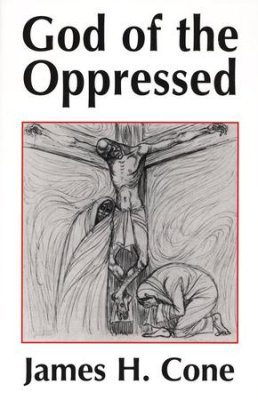
Cone’s book, God of the Oppressed, helped me understand that all white theologians must be read with a hermeneutic of suspicion.
This is because of our inability to comprehend what life is like for blacks in this country as the descendants of slaves dealing with the effects of internalized oppression. For Cone, all the theological lions from Barth to Tillich are suspect because they are unaware that their supposed knowledge of God is corrupt by being white and oppressive.
From Cone’s perspective, God’s revelation to blacks and other oppressed peoples is the only valid revelation. He provocatively proclaimed that “Jesus is black.” This was a shocking statement to make in 1975 and even now in 2018. But it makes sense, because Jesus so closely identified with the poor and oppressed Jews in his own time, he is also Black today because that is the population who has endured the most suffering in this country. (Although I would add that First Nation tribes have endured – and continue to suffer – at least equal shares of suffering at the hands of whites, albeit in different forms.)
Cone’s writing taught me that the ethical dimensions of our knowing (epistemology) have important implications for our discourse about our relationship with God and each other. Those questions regard the who, what and how of epistemology.
Who gets to determine what is “real” knowledge?
Up until the late twentieth century, the realm of knowledge was guarded by white European men with considerable wealth and control over who was excluded from theological discussions (women, colonized people, the poor, etc.). Thus a self-reinforcing circle of elitist knowers determined that anything which deviated from the purely intellectual, dispassionate, supposedly objective means of obtaining knowledge was suspect at best and necessarily disregarded at worst. The reason is because they have been insulated from the ways in which their epistemology justifies the othering, denigration, subjugation and even annihilation of women, people of color, the poor and the marginalized of this world.
Where is knowledge located?
The where of epistemology has two dimensions for black theologians. One is the internalized and highly personal knowledge of the self. The other is within the community of believers.
Cone began his book, God of the Oppressed, with an outright statement of the personal and sociopolitical factors that inform the epistemology of his theology – how he has come to know what he knows about God. According to Cone, it is the theologian’s personal history that serves as the most important factor in shaping the methodology and content of his or her theological perspective. Thus he urges theologians to be more up front about the nonintellectual factors that are so important for the opinions they advance.
Cone’s personal location in the black church of white-dominated America was a prime informant of his theology. He described the “mental grid” of his theology within the context of a people who have been enslaved, lynched and ghettoized. It also gave him the moral and ethical ground to criticize white theologians who are blind to the way their sociopolitical location upholds the very structures Jesus despised. For Cone, only those who speak from the very place where Jesus located himself – at the point of capture, torture, suffering and death – have epistemological access to the theological resources for knowing Christ and God.
Cone’s work helped me as an ecofeminist theologian to go a step further.
I came to the realization that theological knowing is also located in bodily knowledge for women in both suffering and humiliation, as well as visceral joy and the celebration of the incarnation. Feminists argue that the intensely localized knowledge of women through their experiences of sexuality, childbirth, rape, abuse, and intimate love, are important sources of theological reflection, especially in light of God’s decision to incarnate as a fully fleshed human being.
Ecological theologians insist that knowledge of God is also located in the suffering of the planet – it’s ecosystems, species driven to extinction, and waters that can no longer sustain life. Thus the intersection of ecology and feminism – ecofeminism – is a nexus of divine revelation precisely because of the ways in which females and the natural world share in mutual suffering.
The other dimension of the where of black theological epistemology is within the COMMUNITY of the oppressed.
What the slaves and their descendants came to know about God was mediated not just through their common experience of bondage and oppression, but also in the black church. Spirituals, the biblical hermeneutic of liberation, personal testimonies, spirited prayers and prophetic preaching proclaimed a gospel of hope, God’s love, and faith-survival skills to help sustain them for “one more day.”
This was in direct contrast with the epistemology of the white church which declared the stories, practices and beliefs of the black church to be suspect for supposed superstition and being heathen and “uncivilized.” In resistance to this oppressive narrative about told about them, the community of Black believers lifted each other up, and supported each other. They developed codes for communicating that went right over the heads of their white masters. They also held each other accountable in cases of “back-sliding” and sinfulness.
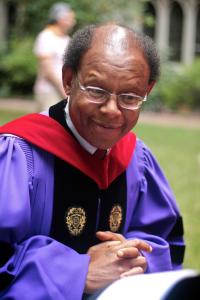
James Cone. Public domain.
How should whites continue our discourse about what we can know about God, given what Cone has taught us?
Cone is very clear that in order for whites to know anything about the God of liberation, they must adopt a position of uncharacteristic humility and learn from their black brothers and sisters who this God is. No longer can whites assume a position of superiority in the theological realm. They have lost the moral authority to claim any knowledge of God. Only by submitting to the teachings of the black church and converting to the struggle for black freedom and against white oppression, can whites hope to be invited – and provisionally accepted – into this struggle for freedom.
Chief among the how of black liberation theology is to interpret Scripture through the lens of liberation for oppressed people. This is why the story of Exodus is a prototype for understanding the black struggle for release from slavery and entrance into a promised land.
There is much more that should be said about James Cone.
This is just one testimony of one white woman whose heart was convicted and whose eyes were opened by the work of this theologian. My colleagues and I at Lexington Theological Seminary encourage our students to read Cone and wrestle with the implications of his black liberation theology for their own ministries in the church. Most recently I had students in my covenant group read a chapter from his last work, The Cross and the Lynching Tree. Cone’s writing generated much rich discussion among our racially-diverse group about how our knowledge of the ongoing suffering of the black community must fundamentally shape the conversation of the church for justice.
I am grateful to James Cone for giving me and so many others the theological and epistemological tools we need for confronting racialized evil, standing in solidarity with its victims, and allowing God to work with, in and through us to effect resurrections after the crucifixions.
Leah D. Schade is the Assistant Professor of Preaching and Worship at Lexington Theological Seminary (Kentucky) and author of the book Creation-Crisis Preaching: Ecology, Theology, and the Pulpit (Chalice Press, 2015). She is an ordained minister in the Lutheran Church (ELCA).
Twitter: @LeahSchade
Facebook: https://www.facebook.com/LeahDSchade/.
For more of Leah’s reflection on race and theology:
The Healing Power of ‘Moonlight’: Race, Erotic Love, and Baptism
Watch Night with Simeon and Anna: Recommit to Racial Justice in 2018
8 Ways to Preach About Charlottesville, White Supremacy, and Racial Justice
Next Post
May 5, 2018 An Iconic Moment - ELCA Synod Elects First Female African-American Bishop
Browse Our Archives
Select a Category Academy of Homiletics Addiction Advent AI (Artificial Intelligence) Animals Apocalypse Appalachia Ash Wednesday Baptism Bible Black Lives Matter Blade Runner Book review Children in church Christian Nationalism Christian/Islamic relations Christmas Church Clergy Climate change COVID-19 Creation Data Centers Death penalty Devotional Dialogue Doubt Earth Day Easter Ecofeminism EcoPreacher 1-2-3 ELCA ELCA Youth Gathering Election Environment/ecology Epiphany Faith Faith and Politics Feminism Film review Food Food and Faith Forgiveness Fracking Good Friday Good Omens Grief Gun violence Holy Humor Sunday Holy Week Howard Thurman ICE Immigration Indigenous wisdom Interview Jesus Kentucky Lafayette High School Marching Band Leadership Lent LGBTQIA+ Marching band Martin Luther Martin Luther King Jr. Mary Maundy Thursday Michael Sheen Mother of Jesus Nature New Year's Eve Palm Sunday Parables Pentecost Poem, Poetry Politics Poor People's Campaign Pop culture Prayers Preaching Progressive Christianity Public theology Purple Zone Racism and White Privilege Religion Religion and environment Religion and politics Religion and pop culture Religion and violence Rev. Nelson Rabell Gonzalez Sermons Spanish language resources for preaching Technology Thanksgiving Theological education theology Trees Trump Uncategorized Vegan War Women and religion Workshop Worship
Select a Month October 2026 September 2026 July 2026 June 2026 May 2026 April 2026 March 2026 February 2026 January 2026 December 2025 November 2025 October 2025 September 2025 May 2025 April 2025 March 2025 February 2025 January 2025 December 2024 November 2024 October 2024 September 2024 August 2024 July 2024 June 2024 May 2024 April 2024 March 2024 February 2024 January 2024 December 2023 November 2023 October 2023 September 2023 August 2023 July 2023 June 2023 May 2023 April 2023 March 2023 February 2023 January 2023 December 2022 November 2022 October 2022 August 2022 July 2022 June 2022 May 2022 April 2022 March 2022 February 2022 January 2022 December 2021 November 2021 October 2021 September 2021 August 2021 July 2021 June 2021 May 2021 April 2021 March 2021 January 2021 December 2020 November 2020 October 2020 September 2020 August 2020 July 2020 June 2020 May 2020 April 2020 February 2020 January 2020 December 2019 November 2019 October 2019 September 2019 August 2019 July 2019 June 2019 May 2019 April 2019 March 2019 January 2019 December 2018 November 2018 October 2018 September 2018 August 2018 July 2018 June 2018 May 2018 April 2018 March 2018 February 2018 January 2018 December 2017 November 2017 October 2017 September 2017 August 2017 July 2017 June 2017 May 2017 April 2017
Follow Us!
TAKE THE
Religious Wisdom Quiz
Which Gospel begins "In the beginning was the Word"?
Select your answer to see how you score.
John Mark Matthew Luke
Books by This Author Books by Leah D. Schade
Related posts from EcoPreacher

Making Space for Eco-Grief—and Hope—in Your Church
VBS Murder Skit: When a Church Teaches Children...

Cancer Alley Prophets: Jeremiah 20, Matthew 10
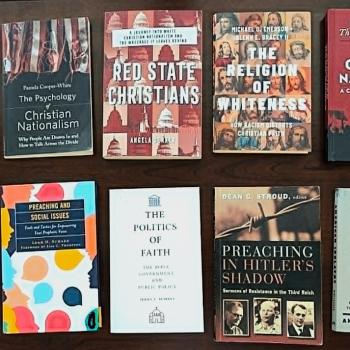
10 Books to Address Christian Nationalism in Your...
TRENDING AT PATHEOS Progressive Christian

What Being a Modern-Day Apostle Means to Me
In my last column, I discussed the ins and outs of modern-day...

Did Ancient China Once Worship the God of...
Across human history, a common thread weaves through the origins of the...

Love Your Neighbor – Including Earth-Kin: Lev. 19,...
God’s command to love your neighbor means acting in an ethical and...

Lead a Church Study of “Jesus and Lao...
Guest writer Jack Thomas (The Irreverent Reverend) reflects on leading his church...

Pastoral Wisdom for Responding to Sermon Pushback
Getting sermon pushback on your social justice sermon? Learn practical, Proverbs-based strategies...

Principles for Understanding the Apostolic Ministry Today
Whenever people discover that my formal ministry title is "apostle," as in...
view all Progressive Christian blogs
Ad-Free & Subscriber Log-In Subscription Support
- About Us
- 2026 Calendar
- Videos
- Podcasts
- Library of World Religions
- Faith In Media Tracker
- Advertise With Us
- Write for Us
- Privacy Policy
- Terms of Service
- Do Not Sell My Data
- Contact Us
- Radiant Digital
- Manage Newsletter Subscriptions
- Unsubscribe From Notifications
- Sitemap
Copyright 2008-2026, Patheos. All rights reserved.
Subscription Support Ad-Free & Subscriber Log-In
Follow Patheos