
BuddhistCatholicContemplativeEvangelicalGeneral ChristianHinduJewishLatter-day SaintMuslimNew VisionsProgressive Christian
Beliefs
- Buddhist
- Catholic
- Contemplative
- Evangelical
- General Christian
- Hindu
- Jewish
- Latter-day Saint
- More Voices
- Muslim
- New Visions
- Pagan
- Progressive Christian
Topics
- Religion News
- Food and Religion
- Sports and Religion
- Religious Art
- Religious Music and Entertainment
- Religious Events
- History and Religion
- Style and Religion
- Politics and Religion
- Women in Religion
- Recreation Outdoors and Religion
- Business Finance and Religion
- Careers Workplace and Religion
- Education and Religion
- Family Parenting and Religion
- Health Fitness and Religion
- Home and Religion
- Relationships and Religion
- Technology and Religion
- Travel and Religion
Columnists
- Buddhist Columnists
- Business Finance and Religion Columnists
- Careers Workplace and Religion Columnists
- Catholic Columnists
- Contemplative Columnists
- Education and Religion Columnists
- Evangelists Columnists
- Family Parenting and Religion Columnists
- General Christian Columnists
- Health Fitness and Religion Columnists
- Hindu Columnists
- History and Religion Columnists
- Home and Religion Columnists
- Jewish Columnists
- More Voices Columnists
- Latter Day Columnists
- Muslim Columnists
- New Visions Columnists
- Nonreligious Columnists
- Pagan Columnists
- Politics and Religion Columnists
- Progressive Columnists
- Recreation Outdoors and Religion Columnists
- Relationships and Religion Columnists
- Religion News Columnists
- Religious Art Columnists
- Religious Events Columnists
- Religious Music and Entertainment Columnists
- Sports and Religion Columnists
- Style and Religion Columnists
- Technology and Religion Columnists
- Travel and Religion Columnists
- Women in Religion Columnists
Resource Library
- 2026 Calendar
- Library of World Religions
- The 100 Most Holy Places on Earth
- Patheos Answers
- Podcasts
- Videos
- Faith Leaders Database
- Anglican Episcopalian
- Bahai
- Baptist
- Buddhism
- Christianity
- Confucianism
- Eastern Orthodoxy
- Hinduism
- Holiness and Pentecostal
- ISKCON
- Islam
- Judaism
- Lutheran
- Methodist
- The Church of Jesus Christ of Latter-day Saints
- New Age
- Paganism
- Presbytarian and Reformed
- Protestantism
- Religion Behind the Scenes
- Roman Catholic
- Scientology
- Shia Islam
- Sikhism
- Sufism
- Sunni Islam
- Taoism
- Zen
- See all religions
Research Tools
 Ad-Free & Subscriber Log-In Subscription Support
Ad-Free & Subscriber Log-In Subscription Support
Follow Patheos 

- Trending:
- Forgiveness
- |
- Marriage
- |
- Consciousness
- |
- Death Penalty
- |
- Election
- |
- Halloween

- Home
- Progressive Christian
- The Last Rhino, Good Friday, and the Preachers’ Silence
The Last Rhino, Good Friday, and the Preachers’ Silence
Last updated on: March 30, 2018 at 5:18 am by Leah D. Schade
The Last Rhino, Good Friday, and the Preachers’ Silence 2018-03-30T05:18:57-04:00 Leah D. Schade
Patheos Explore the world's faith through different perspectives on religion and spirituality! Patheos has the views of the prevalent religions and spiritualities of the world.
It was a Tuesday when “Sudan,” the last male northern white rhino on the planet, died in Kenya on March 20, 2018. But it might as well have been Good Friday. Because the extinction of this rhino species is part of an Earth-wide crucifixion.
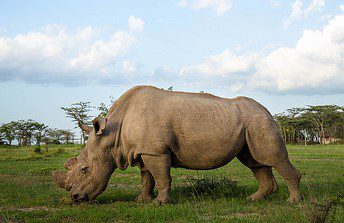
“Sudan,” the last remaining male white northern rhino. Photo taken in Kenya, 2015. Sudan died on March 20, 2018. Photo credit: public domain.
I use the term eco-crucifixion to describe the trauma and destruction that is happening to ecosystems, the climate, and vulnerable human communities. We are committing eco-cide, and the parallels to the crucifixion of Jesus are numerous.
Why use the term “eco-crucifixion”?
Some may take offense in my using the preeminent Christian symbol of the cross to describe what is happening to Earth. I recognize there is a risk that my use of this term may be interpreted as an attempt to Christianize the environmental crisis, a move that may be off-putting or deeply offensive to colleagues of other faiths, traditions and beliefs. My work among interfaith grassroots environmental groups has sensitized me to this issue. Christians, too, may resent such a co-opting of this symbolic event that is so deeply spiritual and carries so much personal and communal meaning.
Hence, I do not use the term “eco-crucifixion” flippantly or without caution.
Rather, my choice of this word arises out of my understanding of what constituted Jesus’ crucifixion. It was the torture and death of an innocent being for the purpose of strengthening and furthering the power of what theologian Walter Wink called the “domination system.” Jesus’ crucifixion was a political death with consequences at the spiritual and eternal levels, as well as for the world in the here and now.
Sudan’s death is also a political one.

It’s a consequence of the collision of the powers of human greed, colonialism, agri-business, the meat industry, cultural ignorance, anthropocentric arrogance, and environmental devastation. Not to mention cowardly actions of men who hunt “big game” animals with rifles for sport or profit. While it certainly does not have the soteriological significance of Jesus’ death, there are both spiritual and here-and-now consequences of Sudan’s demise.
I see a direct parallel between the crucifixion of Jesus and what is happening to Earth. Its ecosystems and species are disappearing at such an alarming rate, some scientists are calling it “ecological Armageddon.”
Since 1970, “vertebrate populations of wild animals have declined by nearly two-thirds, while in the same period, human numbers doubled and global GDP quadrupled,” writes John Gibbons in the Irish Times. “This vast increase in human prosperity was made possible by rapidly plundering the natural world for ‘resources’ for our consumption, while using it a dump for our wastes.”
As a result, we are seeing 10,000 species disappear from this planet every year.
Well, actually, most of us are not really seeing this disappearance at all. In an article for The Guardian, George Monbiot explains that humans have “selective bindness” when it comes to species extinction.
“[O]ur collective memory is wiped clean by ecological loss. One of the most important concepts defining our relationship to the natural world is shifting baseline syndrome, coined by the fisheries biologist Daniel Pauly. The people of each generation perceive the state of the ecosystems they encountered in their childhood as normal and natural. When wildlife is depleted, we might notice the loss, but we are unaware that the baseline by which we judge the decline is in fact a state of extreme depletion.”
Especially distressing for someone like me who has devoted her career to helping teach clergy how to incorporate Creation-care into their sermons, is the deafening silence on species extinction from the pulpit. For preachers, species extinction is among their lowest priorities when it comes to justice issues they choose to address.
How do I know this?
I recently conducted a survey of mainline Protestant clergy in the United States to assess how preachers are approaching their sermons during this divisive time in our nation’s history. Using the platform SurveyMonkey, I sent out a 60-question online survey entitled “Preaching about Controversial Issues” which ran for six weeks, from mid-January to the end of February 2017. I received responses from 1205 participants in 45 states (with an almost equal number of male and female respondents). The survey explores a range of topics, including controversial topics clergy are willing to preach about, the topics they intentionally avoid, and their reasons for doing so. [Read more about this project at my website, Preaching in the Purple Zone.]
Environmental issues rank lowest among priorities for preachers
One section of the questionnaire asked respondents to indicate topics they had mentioned in their sermons in the previous 12 months, choosing from a list of 38 issues. As you can see from the chart below showing the topics which ranked at the bottom, the results indicate that environmental issues were among the lowest priority for clergy to address (see the green arrows).
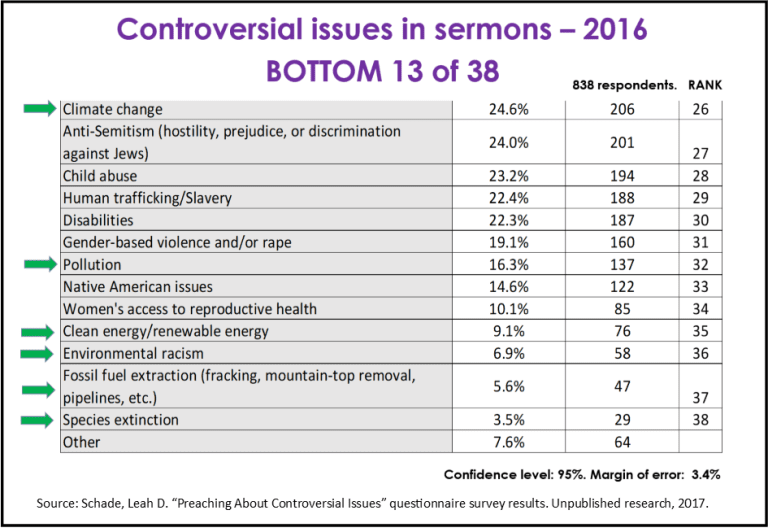
The six environmental topics all ranked in the bottom half of the list.
Species extinction ranked dead last.
Further, when given the option to choose two of the topics that they were most likely to avoid in their sermons, 319 out of 761 respondents chose one of the environmental issues. In other words, 42% of respondents on that question listed at least one environmental issue as a topic they would avoid in preaching.
Species extinction is a topic some clergy actively avoid in their preaching.
In the questionnaire, respondents were asked to indicate their reasons for avoiding preaching about each of the environmental topics. When it came to species extinction, some of the narrative responses were telling.
“[Species extinction] is not applicable to the gospel text.”
“[Species extinction is] not my most pressing issue. But, I recognize that the increase of our population has changed the national and international landscape and division of resources.”
“[I have] other bigger fish to fry (ironically enough!).”
In other words, endangered species are truly among “the least of these” (Matthew 25:40).
Monbiot offers another explanation for this selective blindness about species extinction that I believe affects preachers as well.
He posits that “the infrastructure of marketing and media helps us not to see, not to think, not to connect our spots of perception to create a moral world view upon which we can act.” Why do we succumb to this? Monbiot proffers that our selective blindness to species extinction protects us from both cognitive dissonance and grief.

“To be aware of the wonder and enchantment of the world, its astonishing creatures and complex interactions, and to be aware simultaneously of the remarkably rapid destruction of almost every living system, is to take on a burden of grief that is almost unbearable. This is what the great conservationist Aldo Leopold meant when he wrote: ‘One of the penalties of an ecological education is that one lives alone in a world of wounds.’”
I doubt many preachers will mention the death of Sudan, the last male northern white rhino, when they preach on Good Friday.
Or in any other sermons in the weeks to come, for that matter. But I wish they would. Good Friday is about unbearable grief. Jesus died an ignominious death with just a few witnesses. Today, hundreds of thousands of species are blinking out like stars swallowed in the black hole of gone-forever. And many of us don’t even know they ever even existed. Rachel Carson’s nightmare description of a world without insects and birds which scared me a decade ago when I first read Silent Spring (written in 1962) is becoming our reality. As Gibbons describes it: “an ominous, ever-expanding wave of stillness is spreading across the natural world like a slow tsunami.”
We need to hear sermons that articulate the grief we feel at this loss of the world that God created.
I long for words of lamentation spoken from the pulpit that recognize the sobbing pain I feel knowing my children will live in a world where over 300,000 species have disappeared in the time between when I was born and when they were born. It’s like the deep sadness of knowing that my children will never know the people in our family who died in the years before they were born – my husband’s and my own grandparents; my sister Ivy Jo; my best friend Jenny.
I will need to add Sudan the white rhino to that list.
Because, to my great sadness, they never even knew there was such a thing as a white rhino. In fact, I myself did not even know he had lived . . . until it was announced that he had died. All around the planet, species that I am not even aware of are disappearing. And they are taking the biological diversity, beauty, and resiliency of Earth with them.
I know that it’s important to preach the good news of Christ’s resurrection, even in the midst of the crucifixion. But at this moment, I need to sit in the shadow of the valley of death and mourn what has been lost.
I believe God grieves with me and takes all of that loss into God’s self.
So on this Good Friday, even though I likely won’t hear Sudan mentioned in any sermons, when I walk the Stations of the Cross, I’ll consider how God’s embodied Spirit within this planet walks the Via Dolorosa today. And when I contemplate one of Jesus’s last words on the cross, I will remember Sudan – and all the other species lost due to my own species’ ecological sin.
“It is finished.” And he bowed his head, and breathed his last. (John 19:30)
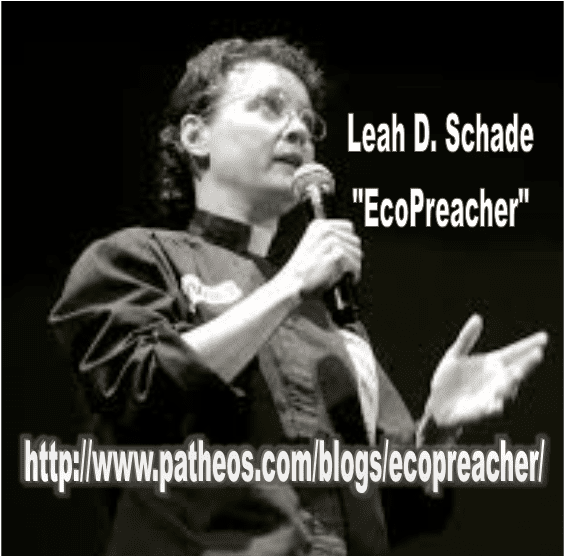
Leah D. Schade is the Assistant Professor of Preaching and Worship at Lexington Theological Seminary (Kentucky) and author of the book Creation-Crisis Preaching: Ecology, Theology, and the Pulpit (Chalice Press, 2015). She is an ordained minister in the Lutheran Church (ELCA).
Twitter: @LeahSchade
Facebook: https://www.facebook.com/LeahDSchade/.
See also:
More than Eco-Palms: Ecojustice and Palm Sunday
Feed the Right Wolf: Preaching Eco-Resurrection in the Midst of Eco-Crucifixion
17 Ways to be an EcoPreacher and Help Heal Our Planet
Resurrection Sermon for an Earth-kin Congregation

Next Post
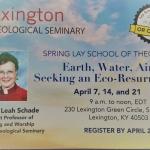
March 28, 2018 Three Workshops - Earth, Water, Air: Seeking an Eco-Resurrection
Browse Our Archives
Select a Category Academy of Homiletics Addiction Advent AI (Artificial Intelligence) Animals Apocalypse Appalachia Ash Wednesday Baptism Bible Black Lives Matter Blade Runner Book review Children in church Christian Nationalism Christian/Islamic relations Christmas Church Clergy Climate change COVID-19 Creation Data Centers Death penalty Devotional Dialogue Doubt Earth Day Easter Ecofeminism EcoPreacher 1-2-3 ELCA ELCA Youth Gathering Election Environment/ecology Epiphany Faith Faith and Politics Feminism Film review Food Food and Faith Forgiveness Fracking Good Friday Good Omens Grief Gun violence Holy Humor Sunday Holy Week Howard Thurman ICE Immigration Indigenous wisdom Interview Jesus Kentucky Lafayette High School Marching Band Leadership Lent LGBTQIA+ Marching band Martin Luther Martin Luther King Jr. Mary Maundy Thursday Michael Sheen Mother of Jesus Nature New Year's Eve Palm Sunday Parables Pentecost Poem, Poetry Politics Poor People's Campaign Pop culture Prayers Preaching Progressive Christianity Public theology Purple Zone Racism and White Privilege Religion Religion and environment Religion and politics Religion and pop culture Religion and violence Rev. Nelson Rabell Gonzalez Sermons Spanish language resources for preaching Technology Thanksgiving Theological education theology Trees Trump Uncategorized Vegan War Women and religion Workshop Worship
Select a Month October 2026 September 2026 July 2026 June 2026 May 2026 April 2026 March 2026 February 2026 January 2026 December 2025 November 2025 October 2025 September 2025 May 2025 April 2025 March 2025 February 2025 January 2025 December 2024 November 2024 October 2024 September 2024 August 2024 July 2024 June 2024 May 2024 April 2024 March 2024 February 2024 January 2024 December 2023 November 2023 October 2023 September 2023 August 2023 July 2023 June 2023 May 2023 April 2023 March 2023 February 2023 January 2023 December 2022 November 2022 October 2022 August 2022 July 2022 June 2022 May 2022 April 2022 March 2022 February 2022 January 2022 December 2021 November 2021 October 2021 September 2021 August 2021 July 2021 June 2021 May 2021 April 2021 March 2021 January 2021 December 2020 November 2020 October 2020 September 2020 August 2020 July 2020 June 2020 May 2020 April 2020 February 2020 January 2020 December 2019 November 2019 October 2019 September 2019 August 2019 July 2019 June 2019 May 2019 April 2019 March 2019 January 2019 December 2018 November 2018 October 2018 September 2018 August 2018 July 2018 June 2018 May 2018 April 2018 March 2018 February 2018 January 2018 December 2017 November 2017 October 2017 September 2017 August 2017 July 2017 June 2017 May 2017 April 2017
Follow Us!
TAKE THE
Religious Wisdom Quiz
What does "Pentateuch" mean?
Select your answer to see how you score.
Holy Writings Sacred Teachings God's Law Five Scrolls
Books by This Author Books by Leah D. Schade
Related posts from EcoPreacher

Pastoral Wisdom for Responding to Sermon Pushback

Love Your Neighbor – Including Earth-Kin: Lev. 19,...

What Matt. 21:23-32 Teaches About Integrity In An...

Preaching About Climate Change: What Clergy Need Most
TRENDING AT PATHEOS Progressive Christian

What Being a Modern-Day Apostle Means to Me
In my last column, I discussed the ins and outs of modern-day...

Did Ancient China Once Worship the God of...
Across human history, a common thread weaves through the origins of the...

Love Your Neighbor – Including Earth-Kin: Lev. 19,...
God’s command to love your neighbor means acting in an ethical and...

Lead a Church Study of “Jesus and Lao...
Guest writer Jack Thomas (The Irreverent Reverend) reflects on leading his church...

Pastoral Wisdom for Responding to Sermon Pushback
Getting sermon pushback on your social justice sermon? Learn practical, Proverbs-based strategies...

Principles for Understanding the Apostolic Ministry Today
Whenever people discover that my formal ministry title is "apostle," as in...
view all Progressive Christian blogs
Ad-Free & Subscriber Log-In Subscription Support
- About Us
- 2026 Calendar
- Videos
- Podcasts
- Library of World Religions
- Faith In Media Tracker
- Advertise With Us
- Write for Us
- Privacy Policy
- Terms of Service
- Do Not Sell My Data
- Contact Us
- Radiant Digital
- Manage Newsletter Subscriptions
- Unsubscribe From Notifications
- Sitemap
Copyright 2008-2026, Patheos. All rights reserved.
Subscription Support Ad-Free & Subscriber Log-In
Follow Patheos