
BuddhistCatholicContemplativeEvangelicalGeneral ChristianHinduJewishLatter-day SaintMuslimNew VisionsProgressive Christian
Beliefs
- Buddhist
- Catholic
- Contemplative
- Evangelical
- General Christian
- Hindu
- Jewish
- Latter-day Saint
- More Voices
- Muslim
- New Visions
- Pagan
- Progressive Christian
Topics
- Religion News
- Food and Religion
- Sports and Religion
- Religious Art
- Religious Music and Entertainment
- Religious Events
- History and Religion
- Style and Religion
- Politics and Religion
- Women in Religion
- Recreation Outdoors and Religion
- Business Finance and Religion
- Careers Workplace and Religion
- Education and Religion
- Family Parenting and Religion
- Health Fitness and Religion
- Home and Religion
- Relationships and Religion
- Technology and Religion
- Travel and Religion
Columnists
- Buddhist Columnists
- Business Finance and Religion Columnists
- Careers Workplace and Religion Columnists
- Catholic Columnists
- Contemplative Columnists
- Education and Religion Columnists
- Evangelists Columnists
- Family Parenting and Religion Columnists
- General Christian Columnists
- Health Fitness and Religion Columnists
- Hindu Columnists
- History and Religion Columnists
- Home and Religion Columnists
- Jewish Columnists
- More Voices Columnists
- Latter Day Columnists
- Muslim Columnists
- New Visions Columnists
- Nonreligious Columnists
- Pagan Columnists
- Politics and Religion Columnists
- Progressive Columnists
- Recreation Outdoors and Religion Columnists
- Relationships and Religion Columnists
- Religion News Columnists
- Religious Art Columnists
- Religious Events Columnists
- Religious Music and Entertainment Columnists
- Sports and Religion Columnists
- Style and Religion Columnists
- Technology and Religion Columnists
- Travel and Religion Columnists
- Women in Religion Columnists
Resource Library
- 2026 Calendar
- Library of World Religions
- The 100 Most Holy Places on Earth
- Patheos Answers
- Podcasts
- Videos
- Faith Leaders Database
- Anglican Episcopalian
- Bahai
- Baptist
- Buddhism
- Christianity
- Confucianism
- Eastern Orthodoxy
- Hinduism
- Holiness and Pentecostal
- ISKCON
- Islam
- Judaism
- Lutheran
- Methodist
- The Church of Jesus Christ of Latter-day Saints
- New Age
- Paganism
- Presbytarian and Reformed
- Protestantism
- Religion Behind the Scenes
- Roman Catholic
- Scientology
- Shia Islam
- Sikhism
- Sufism
- Sunni Islam
- Taoism
- Zen
- See all religions
Research Tools
 Ad-Free & Subscriber Log-In Subscription Support
Ad-Free & Subscriber Log-In Subscription Support
Follow Patheos 

- Trending:
- Forgiveness
- |
- Marriage
- |
- Consciousness
- |
- Death Penalty
- |
- Election
- |
- Halloween

- Home
- Progressive Christian
- More than Eco-Palms: Ecojustice and Palm Sunday
More than Eco-Palms: Ecojustice and Palm Sunday
Last updated on: March 22, 2018 at 6:39 pm by Leah D. Schade
More than Eco-Palms: Ecojustice and Palm Sunday 2018-03-22T18:39:37-04:00 Leah D. Schade
Patheos Explore the world's faith through different perspectives on religion and spirituality! Patheos has the views of the prevalent religions and spiritualities of the world.
On Palm Sunday, thousands of churches will use sustainably-harvested palms in their worship services marking the beginning of Holy Week. It is right and good that more congregations are recognizing the need to exercise environmental responsibility when it comes to liturgical practices. Organizations such as Eco-Palms protect important forests and sustainable livelihoods in the harvesting communities. But let’s not end there. The sermon, too, can incorporate ecojustice themes that highlight the connection between Jesus’ crucifixion and the eco-crucifixion happening today.
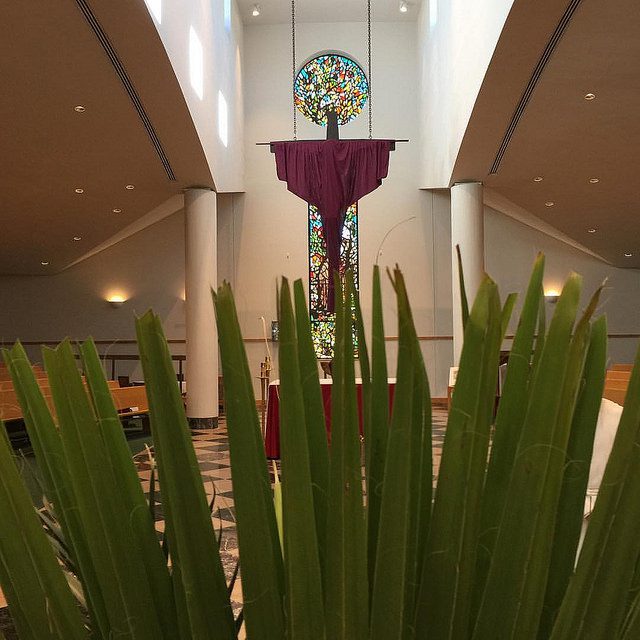
Palm Sunday. Photo by Tony Alter. Some rights reserved. www.flickr.com
We begin our Palm Sunday services with our palm fronds and branches lifted high, singing “All Glory, Laud and Honor.”
Our voices echo those of the crowds gathered outside of Jerusalem waving branches, spreading their cloaks on the road. They were cheering on the man they hoped would lead them to a glorious military victory over the Roman Empire.
Less than thirty minutes later, we’re all yelling, “Crucify him!” when the dramatic reading of the Passion story calls for us to call out these words.
What happened? Why the sudden 180-degree turn? As soon as the crowds in Jerusalem realized that Jesus is a leader of sacrificial peace instead of bloody war, they turn on him. One minute their chanting, “Hosanna to the Son of David!” Soon after that they’re screaming, “Crucify him!”
For some people this sudden move from Palms to Passion is jolting.
We feel uncomfortable calling for Jesus’ death. We don’t want to be identified with that crowd. Some Christians and certain churches even avoid the entire Holy Week journey altogether. They have Palm Sunday, alright. But they skip over all the dark, ugly, graphic parts of the story on Good Friday. They go right from palms to Easter lilies. None of that messy stuff in between.
Lutherans, drawing on Dietrich Bonhoeffer, call this “cheap grace.”
Because it requires no change, no response. It provides no means for a change of heart, for a transformed attitude, for a moment of self-awareness, repentance and a decision to lead a life of reconciliation.
But we choose not to ignore the suffering of Jesus. We believe it is vital that we tell all parts of the story, and that we recognize ourselves as part of both crowds – the ones who cheer, and the ones who call for crucifixion. Especially as our planet is undergoing an eco-crucifixion, it is imperative that we tell that part of the story as well. The crucifixion of Jesus happened once in history. But the crucifixion of Earth is carried out daily.
Crucified Earth

Mark I. Wallace, in his book Finding God in the Singing River: Christianity, Spirit, Nature (Philadelphia: Fortress, 2005), offers a novel image of Earth as the continually crucified Spirit of God. By seeing the Holy Spirit as the feminine aspect of God, which then becomes embodied in the natural world, he builds on Sallie McFague’s notion of Earth as God’s body. He then shifts the focus to the third person of the Trinity and incorporates the Divine Feminine. He makes the connection to Christ’s crucifixion in this way:
If God’s body – this small planet that is now under siege by continued global warming, deforestation, the spread of toxins, the chronic loss of habitat – continues to suffer and bleed, then does not God, in some sense real but still unknowable and mysterious to us, also suffer and bleed? . . .
If it is the case that when the earth, God’s body, suffers, then God’s Spirit suffers as well, then we can say that the Spirit of God is ‘Christ-like’ or ‘cruciform’ because the Spirit suffers the same violent fate as did Jesus – but now a suffering not confined to a onetime event of the cross, as in the case of Jesus, but a suffering that the Spirit experiences daily through the continual debasement of the earth and its inhabitants . . . [T]he Spirit bears the cross of a planet under siege as she lives under the burden of humankind’s ecological sin (Wallace, 23 – 24).
Wallace warns of a “permanent trauma to the divine life itself” (Wallace, 129).
This trauma happens through the crucifixion-like ecocide that humans continually inflict upon Earth and its inhabitants). His powerful equation of God’s suffering through Jesus on the cross with God’s suffering through the embodied Spirit in Earth is meant to spurn “a conversion of the heart to a vision of a green earth, where all persons live in harmony with their natural environments” that persuades us “to work toward a seamless social-environmental ethic of justice and love toward all of God’s creatures” (Wallace, 136).
So on Palm Sunday, we tell the story of the Passion to remember.
We tell this story to our children so that they remember. Lest we think ourselves so much more advanced than those who attacked Jesus, we must recognize that we are no different today. What was done to Jesus is still done to people and our planet.

“This world is not my home.” Collage created by Leah D. Schade
Native Americans continue to lose their sacred land sacrificed to the colonization of the oil and gas industry. Communities of color continue to be targeted for polluting industries and toxic landfills. Island nations such as Puerto Rico are raked by catastrophic storms super-charged by climate change and given little help in recovery. Coral reefs worldwide are bleaching and dying. Billions of populations of plants, fish, and animals have been lost in recent decades in what scientists are calling a “biological annihilation.”
We are in the midst of the sixth mass extinction event since life began on this planet.
So, yes, the crucifixion of our planet and people is real and ongoing.
There is a hymn sometimes sung during Holy Week entitled, “Ah, Holy Jesus” (Johann Heermann, 1630).
Ah, Holy Jesus . . .
Who was the guilty? Who brought this upon thee?
Alas, my treason, Jesus, hath undone thee.
Twas I, Lord Jesus, I it was denied thee.
I crucified thee.
On Palm Sunday and Holy Week, we consciously and intentionally remember that we are guilty and have committed eco-crucifixion against people and planet.
The pain of eco-crucifixion is real, and that the voices of those who suffer need to be heard. We must speak of this in our worship service so that we do not become numb to the pain and thus apathetic towards our sisters and brothers. Because if we cut ourselves off from their pain, the cycle of violence will only continue.
But there is another reason why we tell this story.
We do this to remember what God is doing in response to this crucifixion. Some might say, “Well, yes, God sent Jesus to die for our sins. God allowed Jesus to die in order to make payment for our sins. That’s what God is doing here, right?”
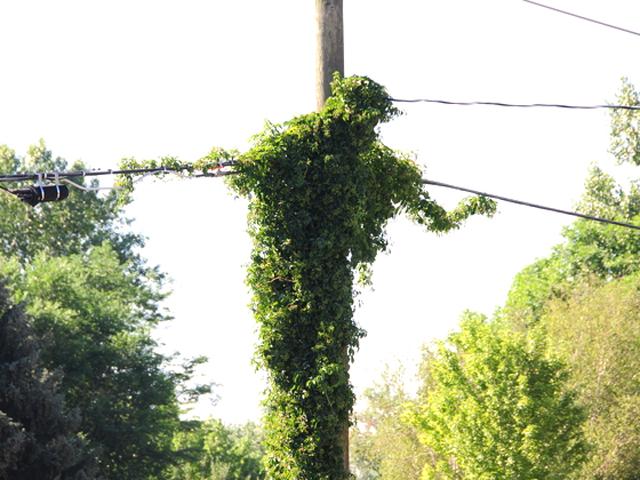
(Photo by Don Taylor of Littleton, Colorado; http://kisselpaso.com/photo-of-the-day-leafy-green-jesus-on-a-telephone-pole-in-colorado/)
However, I would again argue that this is also “cheap grace.” Because this theory of atonement requires no response from us. It provides for no change of heart, or a transformed attitude, or a moment of self-awareness, repentance and a decision to lead a life of reconciliation.
Does God really require the killing of Jesus in order to be satisfied for our sins? No. But humans do.
The domination systems had to kill Jesus because he was a threat to their power. And we continue to sacrifice lives for the sake of institutional domination, imperial arrogance, economic and territorial greed, and petty pride.
But God answers all of this in the crucifixion and resurrection of Jesus. The answer is: this must stop!
If God wanted sacrifice, then Jesus would have remained dead. That’s not what happened. Jesus was resurrected. Jesus lives. This means that God does not condone violence committed against God’s Creation. God submits to it, absorbs it, and lives right through it in order to be in solidarity with those who suffer through it. And then God resurrects the condemned one, the betrayed one, the crucified one in order to show that this act of violence is not the last word.
I have to believe that God, who has brought us through 14 billion years of time, will not abandon us now.
That somehow God is working through even this human-made catastrophe of global climate change, deforestation, massive extinction, and toxic poisoning to find a way for life to push through once again. So I make the choice to believe – and act on my firm belief – that on the other side of the Good Friday of the eco-crucifixion, there is an eco-resurrection. [I discuss eco-crucifixion and eco-resurrection Creation-Crisis Preaching: Ecology, Theology, and the Pulpit in my book (Chalice Press, 2015).]
Stay with the journey to the cross.
Don’t turn away from it. It will not be easy. But this is part of God’s plan to transform the worst of humanity into the very best that God intends for God’s people, for our planet, and for our future.
This reflection is also available at the Lutherans Restoring Creation website, which has ecotheological reflections for every Sunday of the three-year lectionary cycle. Check out the LRC sermon reflection archive here.
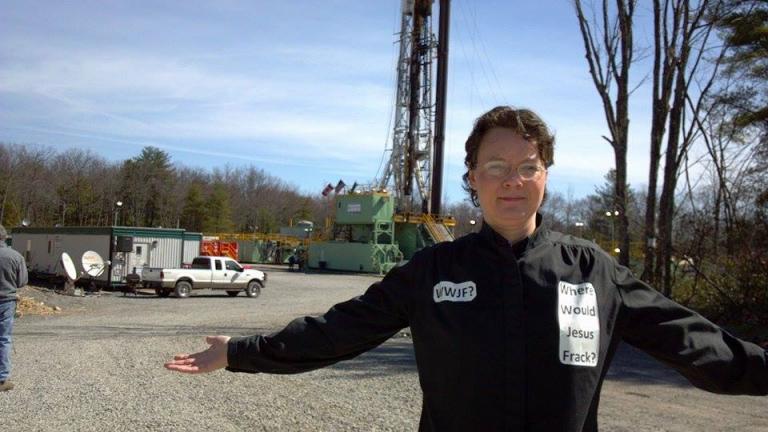
Leah D. Schade is the Assistant Professor of Preaching and Worship at Lexington Theological Seminary (Kentucky) and author of the book Creation-Crisis Preaching: Ecology, Theology, and the Pulpit (Chalice Press, 2015). She is an ordained minister in the Lutheran Church (ELCA).
Twitter: @LeahSchade
Facebook: https://www.facebook.com/LeahDSchade/.
Read also:
Is Earth Worth Dying For? A Reflection on the Earth Martyrs
Six Children’s Sermon Ideas for Earth Day
No, Mr. Pruitt, Fossil Fuels Are Not God’s ‘Blessing’ for Humanity
The Reformation is Over: Long Live the Eco-Reformation!
Previous Post

March 14, 2018
What Surprised Me About the #NationalWalkoutDay at My Daughter’s School
Next Post

March 24, 2018 Resurrection Sermon for an Earth-kin Congregation
Browse Our Archives
Select a Category Academy of Homiletics Addiction Advent AI (Artificial Intelligence) Animals Apocalypse Appalachia Ash Wednesday Baptism Bible Black Lives Matter Blade Runner Book review Children in church Christian Nationalism Christian/Islamic relations Christmas Church Clergy Climate change COVID-19 Creation Data Centers Death penalty Devotional Dialogue Doubt Earth Day Easter Ecofeminism EcoPreacher 1-2-3 ELCA ELCA Youth Gathering Election Environment/ecology Epiphany Faith Faith and Politics Feminism Film review Food Food and Faith Forgiveness Fracking Good Friday Good Omens Grief Gun violence Holy Humor Sunday Holy Week Howard Thurman ICE Immigration Indigenous wisdom Interview Jesus Kentucky Lafayette High School Marching Band Leadership Lent LGBTQIA+ Marching band Martin Luther Martin Luther King Jr. Mary Maundy Thursday Michael Sheen Mother of Jesus Nature New Year's Eve Palm Sunday Parables Pentecost Poem, Poetry Politics Poor People's Campaign Pop culture Prayers Preaching Progressive Christianity Public theology Purple Zone Racism and White Privilege Religion Religion and environment Religion and politics Religion and pop culture Religion and violence Rev. Nelson Rabell Gonzalez Sermons Spanish language resources for preaching Technology Thanksgiving Theological education theology Trees Trump Uncategorized Vegan War Women and religion Workshop Worship
Select a Month October 2026 September 2026 July 2026 June 2026 May 2026 April 2026 March 2026 February 2026 January 2026 December 2025 November 2025 October 2025 September 2025 May 2025 April 2025 March 2025 February 2025 January 2025 December 2024 November 2024 October 2024 September 2024 August 2024 July 2024 June 2024 May 2024 April 2024 March 2024 February 2024 January 2024 December 2023 November 2023 October 2023 September 2023 August 2023 July 2023 June 2023 May 2023 April 2023 March 2023 February 2023 January 2023 December 2022 November 2022 October 2022 August 2022 July 2022 June 2022 May 2022 April 2022 March 2022 February 2022 January 2022 December 2021 November 2021 October 2021 September 2021 August 2021 July 2021 June 2021 May 2021 April 2021 March 2021 January 2021 December 2020 November 2020 October 2020 September 2020 August 2020 July 2020 June 2020 May 2020 April 2020 February 2020 January 2020 December 2019 November 2019 October 2019 September 2019 August 2019 July 2019 June 2019 May 2019 April 2019 March 2019 January 2019 December 2018 November 2018 October 2018 September 2018 August 2018 July 2018 June 2018 May 2018 April 2018 March 2018 February 2018 January 2018 December 2017 November 2017 October 2017 September 2017 August 2017 July 2017 June 2017 May 2017 April 2017
Follow Us!
TAKE THE
Religious Wisdom Quiz
What does "Pentateuch" mean?
Select your answer to see how you score.
Holy Writings Sacred Teachings God's Law Five Scrolls
Books by This Author Books by Leah D. Schade
Related posts from EcoPreacher

Pastoral Wisdom for Responding to Sermon Pushback

Love Your Neighbor – Including Earth-Kin: Lev. 19,...

What Matt. 21:23-32 Teaches About Integrity In An...

Preaching About Climate Change: What Clergy Need Most
TRENDING AT PATHEOS Progressive Christian

What Being a Modern-Day Apostle Means to Me
In my last column, I discussed the ins and outs of modern-day...

Did Ancient China Once Worship the God of...
Across human history, a common thread weaves through the origins of the...

Love Your Neighbor – Including Earth-Kin: Lev. 19,...
God’s command to love your neighbor means acting in an ethical and...

Lead a Church Study of “Jesus and Lao...
Guest writer Jack Thomas (The Irreverent Reverend) reflects on leading his church...

Pastoral Wisdom for Responding to Sermon Pushback
Getting sermon pushback on your social justice sermon? Learn practical, Proverbs-based strategies...

Principles for Understanding the Apostolic Ministry Today
Whenever people discover that my formal ministry title is "apostle," as in...
view all Progressive Christian blogs
Ad-Free & Subscriber Log-In Subscription Support
- About Us
- 2026 Calendar
- Videos
- Podcasts
- Library of World Religions
- Faith In Media Tracker
- Advertise With Us
- Write for Us
- Privacy Policy
- Terms of Service
- Do Not Sell My Data
- Contact Us
- Radiant Digital
- Manage Newsletter Subscriptions
- Unsubscribe From Notifications
- Sitemap
Copyright 2008-2026, Patheos. All rights reserved.
Subscription Support Ad-Free & Subscriber Log-In
Follow Patheos