
BuddhistCatholicContemplativeEvangelicalGeneral ChristianHinduJewishLatter-day SaintMuslimNew VisionsProgressive Christian
Beliefs
- Buddhist
- Catholic
- Contemplative
- Evangelical
- General Christian
- Hindu
- Jewish
- Latter-day Saint
- More Voices
- Muslim
- New Visions
- Pagan
- Progressive Christian
Topics
- Religion News
- Food and Religion
- Sports and Religion
- Religious Art
- Religious Music and Entertainment
- Religious Events
- History and Religion
- Style and Religion
- Politics and Religion
- Women in Religion
- Recreation Outdoors and Religion
- Business Finance and Religion
- Careers Workplace and Religion
- Education and Religion
- Family Parenting and Religion
- Health Fitness and Religion
- Home and Religion
- Relationships and Religion
- Technology and Religion
- Travel and Religion
Columnists
- Buddhist Columnists
- Business Finance and Religion Columnists
- Careers Workplace and Religion Columnists
- Catholic Columnists
- Contemplative Columnists
- Education and Religion Columnists
- Evangelists Columnists
- Family Parenting and Religion Columnists
- General Christian Columnists
- Health Fitness and Religion Columnists
- Hindu Columnists
- History and Religion Columnists
- Home and Religion Columnists
- Jewish Columnists
- More Voices Columnists
- Latter Day Columnists
- Muslim Columnists
- New Visions Columnists
- Nonreligious Columnists
- Pagan Columnists
- Politics and Religion Columnists
- Progressive Columnists
- Recreation Outdoors and Religion Columnists
- Relationships and Religion Columnists
- Religion News Columnists
- Religious Art Columnists
- Religious Events Columnists
- Religious Music and Entertainment Columnists
- Sports and Religion Columnists
- Style and Religion Columnists
- Technology and Religion Columnists
- Travel and Religion Columnists
- Women in Religion Columnists
Resource Library
- 2026 Calendar
- Library of World Religions
- The 100 Most Holy Places on Earth
- Patheos Answers
- Podcasts
- Videos
- Faith Leaders Database
- Anglican Episcopalian
- Bahai
- Baptist
- Buddhism
- Christianity
- Confucianism
- Eastern Orthodoxy
- Hinduism
- Holiness and Pentecostal
- ISKCON
- Islam
- Judaism
- Lutheran
- Methodist
- The Church of Jesus Christ of Latter-day Saints
- New Age
- Paganism
- Presbytarian and Reformed
- Protestantism
- Religion Behind the Scenes
- Roman Catholic
- Scientology
- Shia Islam
- Sikhism
- Sufism
- Sunni Islam
- Taoism
- Zen
- See all religions
Research Tools
 Ad-Free & Subscriber Log-In Subscription Support
Ad-Free & Subscriber Log-In Subscription Support
Follow Patheos 

- Trending:
- Forgiveness
- |
- Marriage
- |
- Consciousness
- |
- Death Penalty
- |
- Election
- |
- Halloween

- Home
- Progressive Christian
- To Understand Martin Luther King Jr., Read Howard Thurman
To Understand Martin Luther King Jr., Read Howard Thurman
Last updated on: April 3, 2018 at 7:43 am by Leah D. Schade
To Understand Martin Luther King Jr., Read Howard Thurman 2018-04-03T07:43:45-04:00 Leah D. Schade
Patheos Explore the world's faith through different perspectives on religion and spirituality! Patheos has the views of the prevalent religions and spiritualities of the world.
The sermons, essays, and speeches of The Rev. Dr. Martin Luther King, Jr. are a wonder to behold for their rhetorical prowess. Richard Lischer, in his book, The Preacher King (Oxford University Press, 1997), explains how King drew together many strands to weave his compelling rhetoric.
Raised in Ebenezer Baptist Church, King experienced the power of black preaching.
His seminary training in Protestant liberalism gave him the tools of critical thinking. He also had a keen understanding of the power of American civil religion. King fused all of this into his unique homiletical style. This enabled his rhetoric to comfort and inspire the black congregations to whom he spoke. At the same time, he was able to draw in sympathetic whites to the cause of liberation. He did this by appealing to their ideals of liberty, justice, and American patriotism.
For example, Martin Luther King’s Christmas Sermon demonstrates the interconnectedness of all peoples in a compelling way. The famous I Have a Dream speech helped listeners to see the God of history drawing the cause of desegregation into the great arc of history that “bends toward justice.” And his sermon on the Drum Major Instinct is a perfect example of using a common image – a drum major – to brilliantly illustrate egoism and its destructive consequences for individuals and societies. With incredible skill, King used metaphors, images, concepts and ideals to preach on oppression and liberation that had the ability to reach both oppressed and oppressor.
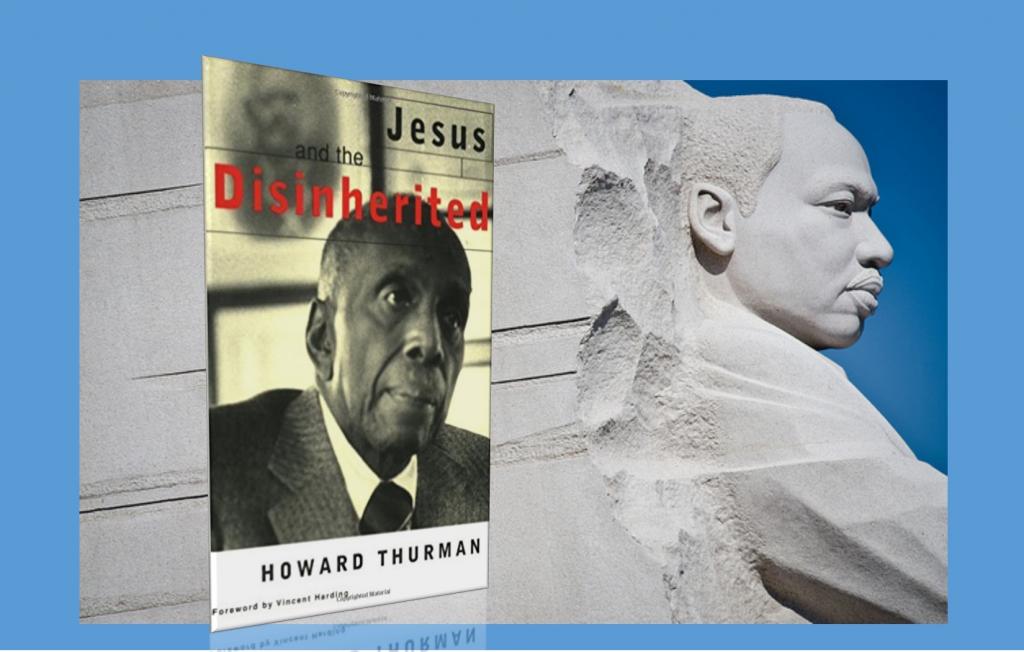
One of the major sources of inspiration for Martin Luther King was the theologian Howard Thurman (1900 – 1981).
King was said to have carried Thurman’s 1949 book, Jesus and the Disinherited, with him to his dying day. Examining this book will help us see how Thurman’s biblical exegesis and black theology influenced King.
In other words, to understand Martin Luther King, you need to read Howard Thurman.
The idea for Thurman’s book came from a conversation he had with a man in Ceylon, India. The man questioned how Thurman could still be a Christian knowing that Christianity was used to justify the institution of slavery that had kept his ancestors in bondage for generations. That same religion continued to keep American blacks oppressed through segregation and Jim Crow laws.
Thurman chose answer the man’s challenge to justify his faith by using a method of disputation similar to that of Thomas Aquinas’ dialectical reasoning. He states the question, and names all the reasons for a negative answer. But then he affirms a positive answer by showing how a correct understanding of doctrine (in this case, the “religion of Jesus,” as Thurman calls it) provides the means for arriving at an answer that affirms faith.
Thurman describes the “disinherited” as those with their “backs against the wall” whose survival is daily in doubt.
Always the same question persists for the oppressed. Under what terms is survival possible? What Jesus endeavored to demonstrate is how to find a way out of internalized oppression. This teaching, Thurman insists, is absolutely applicable to Blacks today. Because if one’s attitude toward one’s oppressor, one’s fellow oppressees, and oneself is not aligned with the will of God, the risk of self-destruction from within grows exponentially.
This leads Thurman to confront the three “hounds of hell” that pursue the disinherited — fear, deception and hate.
Each of these maladies are gross distortions of self-protection. These survival mechanisms adopted by the disinherited can, ironically, become the sources of their own undoing. For example, fear is useful to protect against danger. And hatred is the means by which the oppressed preserve their core of identity and prevent moral disintegration. But when persistent, systemic and overpowering fear and hatred are part of everyday life, something happens. The habits built for self-preservation turn out to be the stepping stones on the road to destruction. Violence and addictions, for example, are symptoms of this internalized oppression.
Thurman argues that Jesus was one of the disinherited.
This meant that Jesus’ teachings are not just a resource for survival. They actually bring about the means of flourishing, even in the midst of oppression. Applying the lens of black theology to scriptural exegesis, Thurman provides a solid argument to embrace the religion of Jesus. Thurman insists that the religion of Jesus transforms the demons of internalized oppression into the means for grace, hope, and empowerment for change.
One can imagine Martin Luther King reading Howard Thurman again and again. He needed to remind himself how to bring together Scripture and a hermeneutic of liberation.
Thurman’s theology provided the framework for King to pastorally address the crowds of his oppressed brothers and sisters. They longed for a Word that would help them through “one more day.” Inspired by Thurman, King was able to give them that life-sustaining Word.
Of course, there came a point in King’s ministry and civic engagement when his rhetoric became much more caustic, definitive, and prophetic.
Martin Luther King came to realize that the powers of racism and oppression were much more entrenched and virulent than he had anticipated. We can detect this shift in his rhetoric especially during the last three years of his life. In his work with the Poor People’s Campaign**, and in his critique of American militarism, his soaring and hopeful prose took on a sharper, jeremiadic tone. As he learned from Thurman, sometimes a good sermon is simply not enough.
“Obviously, then, merely preaching love of one’s enemies or exhortations – however high and holy – cannot, in the last analysis, accomplish this result. At the center of the attitude is a core of painstaking discipline, made possible only by personal triumph. The ethical demand upon the more privileged and the underprivileged is the same.” (106)
In many ways, King’s life mirrored that of the Savior to whom he committed his life. Jesus began his ministry with an openness to engaging and (sometimes playfully) conversing with all manner of peoples, even those in oppressive positions. King did the same.
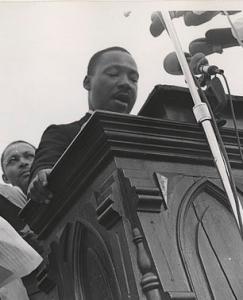
But just as Jesus the disinherited moved toward Jerusalem and his crucifixion, King the disinherited moved toward Memphis and his assassination.
Jesus’ engagement with the Powers was more and more direct the closer he came to the center of the beast. He overturned the moneychangers’ tables. He engaged in heated exchanges with religious leaders. And he spoke directly with Pilate himself. Jesus minced no words and spared no prophetic action. Similarly, Martin Luther King’s tone in his writing and speaking became much more prophetic, directly criticizing those who exercised authority and power in oppressive ways.
And, sadly, like Jesus, King’s life was cut short. His murder happened just he was in the thick of naming and unmasking the Powers for what they really were. They are the evil of the Domination System (in the words of Walter Wink). And it appeared they had defeated the man of God.
But death to the man does not mean death to the cause of justice.
Our task today is to take up that cause with just as much fervor as Martin Luther King. We face yet another rising tide of white supremacy and normalized racism. Not to mention a president who disparages non-whites at every turn. So our challenge is pressing. We must confront police brutality toward black and brown bodies. The criminalization of skin color. And the dehumanization of entire countries deemed “holes for excrement.” Such rhetoric and policies require an equal and opposing force for prophetic justice. Today there is just as much need for the dismantling of the power structures that keep both oppressed and oppressor in thrall.
Thurman explains how the religion of Jesus can show the disinherited (and their allies) how to break the patterns of self-destruction and self-hate.
Instead, we can embrace the redemptive and life-giving religion of Jesus. This religion converts the heart of the believer from the inside out, no matter what oppressive circumstances press in from the outside. Through profound biblical exegesis, Thurman shows Jesus’ self-understanding as a beloved and precious Child of God. Jesus then enables others to experience this belovedness for themselves through his teachings, miracles, healings, and the resurrection itself.
As a result, the disinherited can indeed cling to the religion of Jesus without hesitation. We can draw upon its transformative love to withstand the onslaught of oppression and take up the cause of liberation.
May we, like Martin Luther King, draw on these words of Howard Thurman.
“The disinherited will know for themselves that there is a Spirit at work in life and in the hearts of [all people] which is committed to overcoming the world.” – Howard Thurman
**The Poor People’s Campaign has been revived by The Rev. William Barber. To join the national call for a moral revival click here: https://poorpeoplescampaign.org/

Leah D. Schade is the Assistant Professor of Preaching and Worship at Lexington Theological Seminary (Kentucky) and author of the book Creation-Crisis Preaching: Ecology, Theology, and the Pulpit (Chalice Press, 2015). She is an ordained minister in the Lutheran Church (ELCA).
Twitter: @LeahSchade
Facebook: https://www.facebook.com/LeahDSchade/.
For more of Leah’s reflections on Dr. Martin Luther King Jr., racism, white privilege, and justice:
Preaching King’s ‘Drum Major Instinct’ in the Trump Era
The Harp Sermon: a Response to Charlottesville and Racial Hatred
Preaching Hagar and Ishmael when Philando is on Screen
Watching ‘Blade Runner’ (1982) in the Age of Black Lives Matter
Previous Post

January 7, 2018
'In God We Trump' - Film Review
Next Post

February 3, 2018 'You've got some dirt on your forehead': Ash Wednesday reflection
Browse Our Archives
Select a Category Academy of Homiletics Addiction Advent AI (Artificial Intelligence) Animals Apocalypse Appalachia Ash Wednesday Baptism Bible Black Lives Matter Blade Runner Book review Children in church Christian Nationalism Christian/Islamic relations Christmas Church Clergy Climate change COVID-19 Creation Data Centers Death penalty Devotional Dialogue Doubt Earth Day Easter Ecofeminism EcoPreacher 1-2-3 ELCA ELCA Youth Gathering Election Environment/ecology Epiphany Faith Faith and Politics Feminism Film review Food Food and Faith Forgiveness Fracking Good Friday Good Omens Grief Gun violence Holy Humor Sunday Holy Week Howard Thurman ICE Immigration Indigenous wisdom Interview Jesus Kentucky Lafayette High School Marching Band Leadership Lent LGBTQIA+ Marching band Martin Luther Martin Luther King Jr. Mary Maundy Thursday Michael Sheen Mother of Jesus Nature New Year's Eve Palm Sunday Parables Pentecost Poem, Poetry Politics Poor People's Campaign Pop culture Prayers Preaching Progressive Christianity Public theology Purple Zone Racism and White Privilege Religion Religion and environment Religion and politics Religion and pop culture Religion and violence Rev. Nelson Rabell Gonzalez Sermons Spanish language resources for preaching Technology Thanksgiving Theological education theology Trees Trump Uncategorized Vegan War Women and religion Workshop Worship
Select a Month October 2026 September 2026 July 2026 June 2026 May 2026 April 2026 March 2026 February 2026 January 2026 December 2025 November 2025 October 2025 September 2025 May 2025 April 2025 March 2025 February 2025 January 2025 December 2024 November 2024 October 2024 September 2024 August 2024 July 2024 June 2024 May 2024 April 2024 March 2024 February 2024 January 2024 December 2023 November 2023 October 2023 September 2023 August 2023 July 2023 June 2023 May 2023 April 2023 March 2023 February 2023 January 2023 December 2022 November 2022 October 2022 August 2022 July 2022 June 2022 May 2022 April 2022 March 2022 February 2022 January 2022 December 2021 November 2021 October 2021 September 2021 August 2021 July 2021 June 2021 May 2021 April 2021 March 2021 January 2021 December 2020 November 2020 October 2020 September 2020 August 2020 July 2020 June 2020 May 2020 April 2020 February 2020 January 2020 December 2019 November 2019 October 2019 September 2019 August 2019 July 2019 June 2019 May 2019 April 2019 March 2019 January 2019 December 2018 November 2018 October 2018 September 2018 August 2018 July 2018 June 2018 May 2018 April 2018 March 2018 February 2018 January 2018 December 2017 November 2017 October 2017 September 2017 August 2017 July 2017 June 2017 May 2017 April 2017
Follow Us!
TAKE THE
Religious Wisdom Quiz
What king of Israel was famous for his chariot and for fighting Ahab?
Select your answer to see how you score.
Joash Omri Jehu Jeroboam
Books by This Author Books by Leah D. Schade
Related posts from EcoPreacher

10 Books to Address Christian Nationalism in Your...

Palm Sunday Counters the Violence of Christian Nationalism

Ezekiel 37 Counters White Christian Nationalism

Jesus & the Woman at the Well Counter...
TRENDING AT PATHEOS Progressive Christian

What Being a Modern-Day Apostle Means to Me
In my last column, I discussed the ins and outs of modern-day...

Did Ancient China Once Worship the God of...
Across human history, a common thread weaves through the origins of the...

Love Your Neighbor – Including Earth-Kin: Lev. 19,...
God’s command to love your neighbor means acting in an ethical and...

Lead a Church Study of “Jesus and Lao...
Guest writer Jack Thomas (The Irreverent Reverend) reflects on leading his church...

Pastoral Wisdom for Responding to Sermon Pushback
Getting sermon pushback on your social justice sermon? Learn practical, Proverbs-based strategies...

Principles for Understanding the Apostolic Ministry Today
Whenever people discover that my formal ministry title is "apostle," as in...
view all Progressive Christian blogs
Ad-Free & Subscriber Log-In Subscription Support
- About Us
- 2026 Calendar
- Videos
- Podcasts
- Library of World Religions
- Faith In Media Tracker
- Advertise With Us
- Write for Us
- Privacy Policy
- Terms of Service
- Do Not Sell My Data
- Contact Us
- Radiant Digital
- Manage Newsletter Subscriptions
- Unsubscribe From Notifications
- Sitemap
Copyright 2008-2026, Patheos. All rights reserved.
Subscription Support Ad-Free & Subscriber Log-In
Follow Patheos