
BuddhistCatholicContemplativeEvangelicalGeneral ChristianHinduJewishLatter-day SaintMuslimNew VisionsProgressive Christian
Beliefs
- Buddhist
- Catholic
- Contemplative
- Evangelical
- General Christian
- Hindu
- Jewish
- Latter-day Saint
- More Voices
- Muslim
- New Visions
- Pagan
- Progressive Christian
Topics
- Religion News
- Food and Religion
- Sports and Religion
- Religious Art
- Religious Music and Entertainment
- Religious Events
- History and Religion
- Style and Religion
- Politics and Religion
- Women in Religion
- Recreation Outdoors and Religion
- Business Finance and Religion
- Careers Workplace and Religion
- Education and Religion
- Family Parenting and Religion
- Health Fitness and Religion
- Home and Religion
- Relationships and Religion
- Technology and Religion
- Travel and Religion
Columnists
- Buddhist Columnists
- Business Finance and Religion Columnists
- Careers Workplace and Religion Columnists
- Catholic Columnists
- Contemplative Columnists
- Education and Religion Columnists
- Evangelists Columnists
- Family Parenting and Religion Columnists
- General Christian Columnists
- Health Fitness and Religion Columnists
- Hindu Columnists
- History and Religion Columnists
- Home and Religion Columnists
- Jewish Columnists
- More Voices Columnists
- Latter Day Columnists
- Muslim Columnists
- New Visions Columnists
- Nonreligious Columnists
- Pagan Columnists
- Politics and Religion Columnists
- Progressive Columnists
- Recreation Outdoors and Religion Columnists
- Relationships and Religion Columnists
- Religion News Columnists
- Religious Art Columnists
- Religious Events Columnists
- Religious Music and Entertainment Columnists
- Sports and Religion Columnists
- Style and Religion Columnists
- Technology and Religion Columnists
- Travel and Religion Columnists
- Women in Religion Columnists
Resource Library
- 2026 Calendar
- Library of World Religions
- The 100 Most Holy Places on Earth
- Patheos Answers
- Podcasts
- Videos
- Faith Leaders Database
- Anglican Episcopalian
- Bahai
- Baptist
- Buddhism
- Christianity
- Confucianism
- Eastern Orthodoxy
- Hinduism
- Holiness and Pentecostal
- ISKCON
- Islam
- Judaism
- Lutheran
- Methodist
- The Church of Jesus Christ of Latter-day Saints
- New Age
- Paganism
- Presbytarian and Reformed
- Protestantism
- Religion Behind the Scenes
- Roman Catholic
- Scientology
- Shia Islam
- Sikhism
- Sufism
- Sunni Islam
- Taoism
- Zen
- See all religions
Research Tools
 Ad-Free & Subscriber Log-In Subscription Support
Ad-Free & Subscriber Log-In Subscription Support
Follow Patheos 

- Trending:
- Forgiveness
- |
- Marriage
- |
- Consciousness
- |
- Death Penalty
- |
- Election
- |
- Halloween

- Home
- Progressive Christian
- The Healing Power of ‘Moonlight’: Race, Erotic Love, and Baptism
The Healing Power of ‘Moonlight’: Race, Erotic Love, and Baptism
Last updated on: January 4, 2018 at 11:05 am by Leah D. Schade
The Healing Power of ‘Moonlight’: Race, Erotic Love, and Baptism 2018-01-04T11:05:21-04:00 Leah D. Schade
Patheos Explore the world's faith through different perspectives on religion and spirituality! Patheos has the views of the prevalent religions and spiritualities of the world.
The Healing Power of Moonlight: Race, Erotic Love, and Baptism
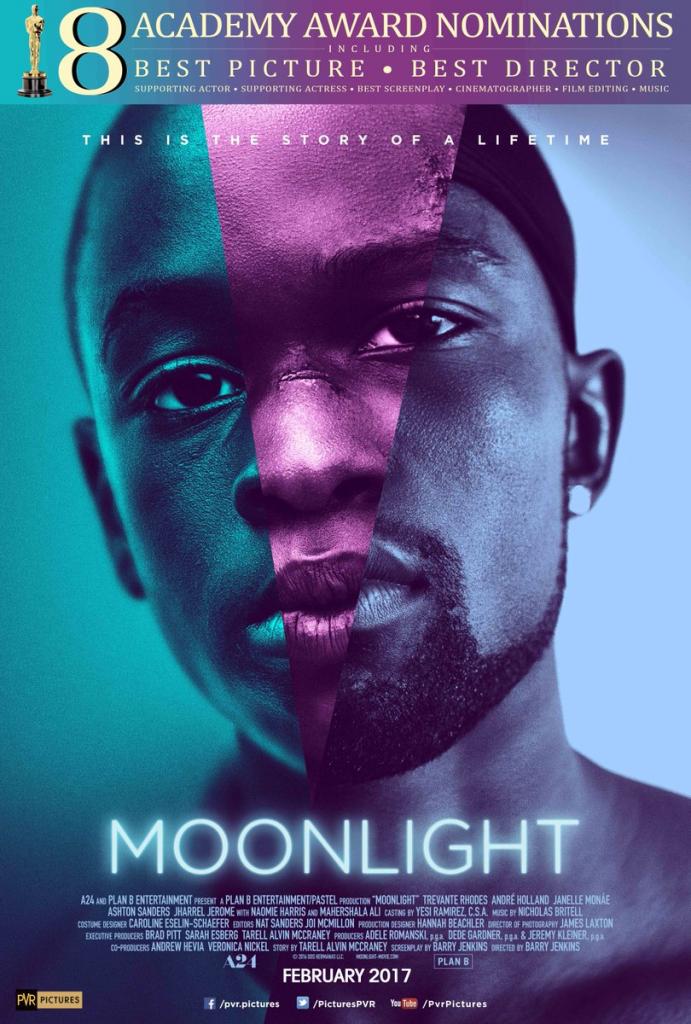
Read: Genesis 1:1 – 5; Mark 1:4 – 11 (Revised Common Lectionary, Year B: First Sunday after the Epiphany, The Baptism of Jesus)
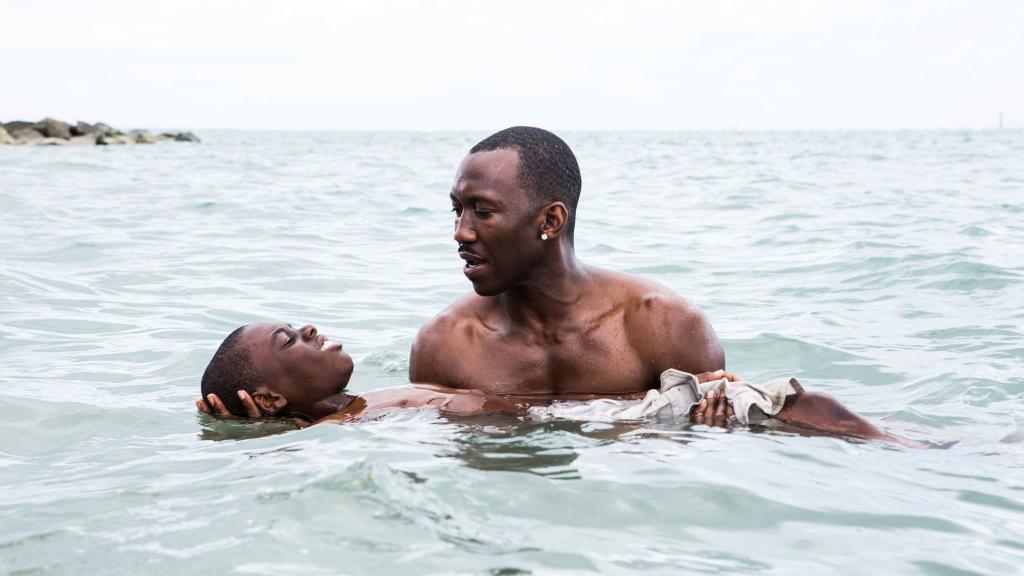
Juan wades in the water and beckons young Chiron to join him.
The camera seems to bob on the surface, waves lapping across our vision as we watch the boy palming the water, tasting its saltiness, delighting in its cool wetness. He has obviously never been in the ocean before, even though he lives in Florida. This is his first time in the sea.
Juan’s voice is soothing and reassuring as he bouys the boy in the water. “Let your head relax in my hand. I got you, I promise. I’m not gonna let you go.” The man is teaching Chiron how to float.
As I watch this scene of the movie Moonlight*, a realization washes over me.*
I’m witnessing a baptism!
Chiron is a skinny young kid whose mother is lost to drugs, whose father is simply lost, and whose world on land is pummeled by bullying and violence. He is so small that the other boys nickname him “Little.” But here in the water, held by the strong, gentle man who has become his father-figure, the sun glistening on their dark skin, Chiron is transformed.
In the beginning when God created the heavens and the earth, 2the earth was a formless void and darkness covered the face of the deep, while a wind from God swept over the face of the waters. 3Then God said, ‘Let there be light’; and there was light. (Genesis 1:1 – 3)
“Feel that right there?” Juan asks him. “You in the middle of the world, man.”
Juan teaches the boy to swim. Chiron mirrors the man in the breast stroke, their bodies synchronized in the water. He is learning how to survive in the water from the man who, ironically, is the one who supplies his mother with drugs. A man who relies on guns and intimidation as tools of the trade. But also a man who was moved to rescue Chiron with tenderness, wisdom, and strength. Juan laughs in sheer delight as he watches Chiron swim in the waves, floating, drifting, held by the waters.
In those days Jesus came from Nazareth of Galilee and was baptized by John in the Jordan. 10And just as he was coming up out of the water, he saw the heavens torn apart and the Spirit descending like a dove on him.11And a voice came from heaven, ‘You are my Son, the Beloved; with you I am well pleased.’ (Mark 1:9 – 11)
Juan sits next to Chiron on the beach as their bodies dry in the sun.
“Let me tell you something, man. There are black people everywhere. Remember that, okay? No place you can go in the world there ain’t no black people. We’s the first on this planet.”
Juan shares a memory from his time growing up in Cuba. “Runnin’ around with no shoes on when the moon was out. This one time I run by this old lady. She stopped me. She said, ‘Running around, catching up all that light. In moonlight, black boys look blue. You blue.”
Then he gives young Chiron the words of wisdom that will follow him, troubling his waters, for the rest of his life.
“At some time, you gonna have to decide for yourself who you gonna be. Can’t let nobody make that decision for you.”
We wonder, the boy wonders – who am I? Who is Chiron going to be?
Earlier in the movie we see Little taunted and chased by the bigger boys, set upon with fierce fists and feet. But one boy, Kevin, leaves the gang and follows Little walking alone across the grassy field.
“All you gotta do is show these niggas you ain’t soft,” he says to his friend.
“But I ain’t soft,” Little replies softly.
“I know, I know. But it don’t mean nothing if they don’t know. Come on. You want these fools to pick on you every day?”
The boys tumble to the ground, wrestling like wolf cubs. Just two boys, friends, engaging in friendly horseplay. Their energy spent, they lie on the ground, the grass a bed beneath them, their breathing heavy. I thought I saw a look pass between them. Little did I know at that point – this was Chiron’s first sexual encounter. He did not know it either.
“See, Little, I knew you wasn’t soft.”
In his groundbreaking work Gay and Gaia: Ethics, Ecology, and the Erotic (1996), Daniel T. Spencer shared two vignettes. In the first he is wandering in the Colorado prairie, immersing himself in the beauty of nature while leaving behind the words “faggot” and “homo” flung at him at school. In the second, he is a man, nestled in the strong arms of his beloved as they take in the North Cascade Mountains, “embraced by erotic love and all of nature” (3).
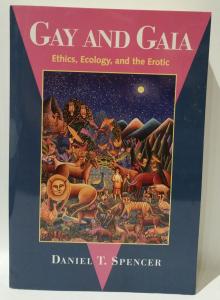
Spencer explains that “the erotic energy that most deeply connects us with others also can point to a deeper ecological connection with all of creation” (4). He stresses the necessity of story to help us understand our place within Creation, and our place with each other. “(P)art of what I believe is necessary to ensure the survival and thriving of all our stories and of our planet is to learn to listen to the stories of others so that we can learn to see the world and our place in the world differently, more fully, in richer shades of color and involving more intricate webs of relationship” (6.)
Moonlight is one of those films that helped me see the world and my place in the world differently, more fully, in richer shades of color, and involving more intricate webs of relationship.
It challenged me to think in a more expansive way about the Christian ritual of baptism and its connection with the primal waters of the Earth. It challenged the stereotypes of black men and heteronormative sexuality that I received unquestioningly as a straight, white woman.
And it challenged my white privilege in a very simple way.
It showed me a world where there are no white characters. I did not see one person in the film reflecting my race back to me. The film decentered my whiteness. And that’s a good thing.
In Alice Walker’s book, The Color Purple [New York: Harcourt Brace Jovanovich, 1982], the character Shug tells her beloved, Celie: “You have to git man off your eyeball, before you can see anything a’tall.”
Man corrupt everything, say Shug. He on your box of grits, in your head, and all over the radio. He try to make you think he everywhere. Soon as you think he everywhere, you think he God. But he ain’t. Whenever you trying to pray, and man plop himself on the other end of it, tell him to git lost, say Shug. Conjure up flowers, wind, water, a big rock. But this hard work, let me tell you. He been there so long, he don’t want to budge. He threaten lightening, floods, and earthquakes. Us fight. I hardly pray at all. Every time I conjure up a rock, I throw it. (166-68)
As a white person, I’ve learned the same applies when it comes to the oppressive dominance of my race in our culture.
“You have to git white off your eyeball, before you can see anything a’tall.”
As Spencer reminds me, “Dominant portrayals of reality and the world do not tell the whole story, and the story they do tell is distorted, often at our expense” (327).
I need movies like Moonlight and books like The Color Purple to tell me different stories and help me understand the world outside my race and sexuality bubble.
In the second part of the movie, Chiron and Kevin are teenagers. The two young men have a chance encounter on the beach. We see what Chiron sees – the ocean water dark, it’s foam illuminated by moonlight. We remember the last time he was with a man on this beach. The absence of Juan is palpable.
“He who lives by the gun, dies by the gun.” The violence that secured Juan’s business and his wealth (and Chiron’s safety) is the violence that finally took his life.
But not before Chiron shyly, but bravely, spoke with his father-figure about his struggle with his budding sexual identity. In a scene in Juan’s home, the man sits with Chiron at the kitchen table. Juan’s girlfriend, Teresa (who has become Chiron’s surrogate mother), looks on.
“What’s a faggot?” the thin boy asks the handsome, muscular man.
Juan squirms and gropes for an answer. “A faggot is a word used to make gay people feel bad.”
“Am I a faggot?”
“No. You can be gay, but you gotta let nobody call you no faggot.”
Teresa gives Juan a look.
Juan says to Chiron, “You got plenty of time to figure that out.”
“How do I know?”
“You just do.”
Teresa’s words are at once enigmatic and reassuring. “You’ll know when you know.”
Juan concludes: “You ain’t gotta know right now, alright? Not yet.”
Eight years later, Chiron and Kevin sit together on the sand, facing the water that had held Little with such tender power.
Kevin speaks. “You like the water? Well I can introduce you to some fire.” He pulls out a joint, and the two light up.
Kevin comments on how good the ocean breeze feels. For me, a Christian, his words seem to invoke the breath of the Holy Spirit.
“Sometimes round the way where we live, you can catch that same breeze. It just come through the hood and it’s like everything stop for a second . . . ‘cause everyone just wanna feel it. Everything just gets quiet, you know?”
Oh, yes, he’s definitely talking about the Spirit of God.
Chiron resonates with this. “And it’s like all you can hear is your own heartbeat.”
“Feels so good, man.”
“So good.”
“Hell, shit make you wanna cry, feel so good.”
“You cry?” Chiron asks, astonished.
“Nah. Makes we want to. What you cry about?”
Tall, lanky, but still shy and vulnerable, Chiron admits to his friend, “Shit, I cry so much, sometimes I feel like I’m a-just turn into drops.”
“You just roll out into the water, right?”
And then Chiron, his soul laid bare in that Holy Spirit moment, baptized by water and fire, says the words that are both confession and invitation. “I wanna do a lot of things that don’t make sense.”
The two young men connect in an intense moment of erotic touch, the sand, waves, and darkness sheltering their brief minutes of love.
“But one day when I was sitting quiet and feeling like a motherless child, which I was, it come to me: that feeling of being a part of everything, not separate at all.”

Those were Shug’s words to Celie, two black female bodies whose souls also struggled to find love and safety amidst a harsh world of patriarchy, racial and domestic violence, and the heteronormative culture of the 1930’s South.
Shug assures Celie, “God love all them feelings. That’s some of the best stuff God did. And when you know God loves ‘em you enjoys ‘em a lot more. You can just relax, go with everything that’s going, and praise God by liking what you like.”
Chiron and Kevin find those feelings, that sensation of being a part of everything, being a part of each other, not separate at all.
Spencer explains it this way: “The erotic is that part of sacred power that moves us toward connection, with ourselves, with each other, with all of nature, and with the divine” (322). He urges us to reclaim, revision, and reintegrate the connections between the erotic and the ecological, seeing “the erotic as ecological and ecology as erotic” (322).
But for Chiron and Kevin, the moment of connection is short-lived.
The hands that arouse and caress Chiron are also the hands that will turn to fists and spill his blood.
The wolf cubs, now grown, are caught in a vicious pack of hyenas that seek dominance through physical displays of violence. Kevin, trapped between his love for Chiron and the acceptance and approval of the pack (not to mention his own conflicted feelings of sexuality), accepts a dare to punch his best friend. Chiron does not fight back. Only his eyes show the pain of betrayal, the excruciating realization that his beloved has turned on him and given him over to the pack. They descend on him, kicking and punching his face and body without mercy.
When Chiron eventually returns to school, he is once again transformed.
Gone is the softness. Hard steel resolve pushes him through the school to the classroom where the leader of the pack sits at a desk. This is the one who had tortured him all during his boyhood. This is the hyena who goaded Kevin into hitting his best friend, and then led the pack in the attack on Chiron.
“All you gotta do is show these niggas you ain’t soft.”
Chiron picks up a wooden chair and brings is crashing down upon the unsuspecting pack leader. His body slumps to the ground, twitching, unconscious.
Kevin’s eyes lock with Chiron’s as he watches his friend whisked away in a police car.
Helpless, the two are separated by the homophobia and violence that structures their world.
Spencer notes that “Homophobia prevents heterosexuals from accepting the benefits and gifts offered by sexual minorities: theoretical insights, social and spiritual visions and options, contributions to the arts and culture, to religion, to family life, to all facets of society” (Summarizing a point in the book Homophobia: How We All Pay the Price (Warren J. Blumenfeld, ed. [Boston: Beacon Press, 1992]).
The same can be said for Afriphobia.
While the entire movie is devoid of white characters, the structures of white power undergird every scene of the movie. The ghettos. The drugs. The prison system. The poverty. The so-called “black-on-black crime.” Moonlight gives us a glimpse into the world heterosexual white supremacy has created for blacks. We watch a beautiful, sensitive boy – who happens to be a sexual minority – crushed in a system that cares nothing for the benefits or gifts he could have to offer.
Might Chiron have had theoretical insights? Social and spiritual visions and options? Could he have made contributions to the arts and culture? To religion? Family life? Any facet of society?
It seems we will never know. Because Chiron will languish in jail, his gifts discarded, and his body another pawn of the criminal justice system.
In the final act of the movie, the scene opens upon a muscular black man intimidating a young drug pusher over the money he has collected. Is this Juan reincarnated?
No longer called Chiron or Little, the man now goes by “Black,” the nickname Kevin had given him two decades earlier. He has assumed the mantle of his mentor, Juan. The expensive car, the well-furbished house, the gun at the ready should the drug deal go bad.
We can hardly believe this is the same little boy. Is there anything left of the gentle soul he had once been?
A surprise phone message from Kevin gives us the answer.
Just hearing his voice sends Chiron into erotic dreams, awakening a yearning he had kept buried for at least a decade.
He makes the drive back to his old neighborhood, and finds Kevin working a legit job as a cook in a restaurant. He shows Chiron a picture of his child. Though he is no longer with the child’s mother, the birth of his first-born has changed him. He is committed to a life on the up-and-up, to make a better future for his son than he had for himself.
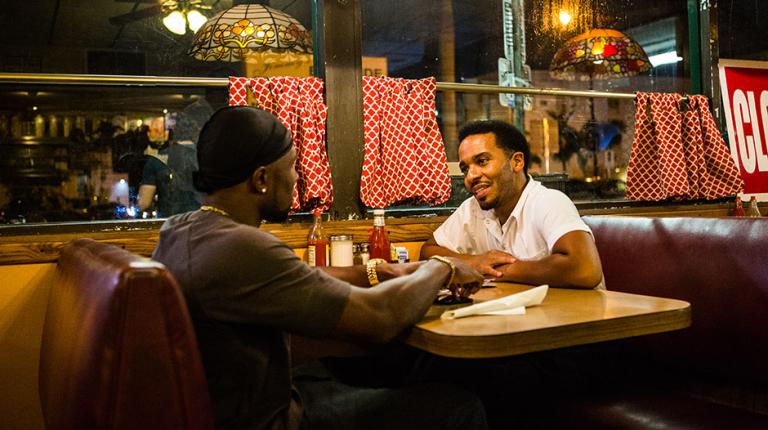
As Chiron sits in the booth of the nearly-empty restaurant, he watches Kevin cooking in the kitchen. The sexual tension between them is electric as Chiron tastes the food Kevin has made for him. It is a sacramental meal – a meal of forgiveness and reconciliation.
From baptism to communion – Moonlight takes us to both poles of the Christian liturgy.
After closing up the restaurant, Kevin accepts a ride from Chiron back to his modest apartment.
They pull into a complex right on the edge of the ocean. We see what Chiron sees – the ocean breeze blowing the palm trees. The white waves, cresting blue in the moonlight.
Wind, water, sand, and his beloved – Chiron has come home.
Carter Heyward once wrote: “We need to help each other realize that our desire for intimacy, connection, and touch – whether explicitly sexual touching or a more diffuse sensual yearning – is erotic. It is good. And it is sacred.”
She goes on to insist that, “Our primary moral agency – our capacity to do what is more or less right in any given situation – is to help create the yearning and conditions for non-violent, non-abusive life together.” (“Embodying the Connections: What Lesbians Can Learn from Gay Men about Sex and What Gay Men Must Learn from Lesbians about Justice,” in Spirituality and Community: Diversity in Lesbian and Gay Experience, ed. J. Michael Clark and Michael L. Stemmeler [Las Colinas, Texas: Monument Press, 1994], 138, 140.).
Kevin then asks the question that has haunted Chiron all his life. It is the question first posed to him by Juan after his “baptism.” It is the question of identity.
“Who is you?” Kevin asks. “The car, the fronts. Who is you?”
Chiron insists, “I’m me, man, I ain’t trying to be nothing else.”
“Oh, okay. So you hard now?”
“When we got to Atlanta, we started over,” Chiron explains. “I built myself from the ground up. Built myself hard.”
Kevin takes this in. Then he confesses: “I wasn’t never really myself.”
Spencer notes J. Michael Clark’s argument that “common to lesbian and gay male experiences and the ecological crisis is not only being devalued, valued instrumentally in relation to our worth to a society defined by white hetero-male capitalist norms, but also being totally disvalued, judged as valueless or having negative value in a society of compulsory heterosexuality.” (Beyond Our Ghettos: Gay Theology in Ecological Perspective. Cleveland: Pilgrim Press, 1993. 237. Quoted in Spencer, 327.)
Kevin and Chiron have both been devalued and disvalued. Their race and sexuality are judged not just as valueless, but as having a negative value. They are demonized both for their skin color and the way in which they have been born to love.
And yet, the baptismal water, the wind of the Spirit, the fire of their erotic love, the healing power of moonlight, the meal of their reconciliation – all of this has incredible power. Divine power.
They are, once again, together. And this is no small thing.
“Theology and religion give me ways to ground my ethics, to ground questions of human and ecological well-being in questions of ultimate concern – what different religious traditions have referred to as God or the sacred, or the Great Spirit,” says Spencer. “Where we find the sacred within, among, and between us tells us much about the shape of our ethics – who we are and how we act in light of who we claim to be and want to act” (5).
For me, Moonlight is a film that fuses ecological theology, sacramentology, and the ethics of race and sexuality into an unforgettable experience of grace.
“How we image God, that place/person/spirit where our deepest commitments lie – that is, how we do theology – will tell us a lot about who we are and how we live – that is, our ethics,” Spencer reminds us (7). Moonlight shows us an image of God that does not transcend race or sexuality or Earth. Rather, God incarnates in those very places where we least expect – where heteronormative white male religion – has told us God could never be. In the bodies of black men, in the body of Earth itself – those are places where God chooses to be.
Chiron stands with Kevin in his kitchen. Summoning great courage, he reveals the vulnerable child he once was. He reveals the erotic young man he had been for a few brief moments on a beach beneath the moonlight.
He offers his heart.
“You the only man that’s ever touched me. You’re the only one. I haven’t really touched anyone since.”
The movie closes with the sound of waves lapping as Kevin cradles Chiron’s head, their bodies sheltered in darkness. It is a moment of redemption.
In the beginning when God created the heavens and the earth, 2the earth was a formless void and darkness covered the face of the deep, while a wind from God swept over the face of the waters. (Genesis 1:1-2).
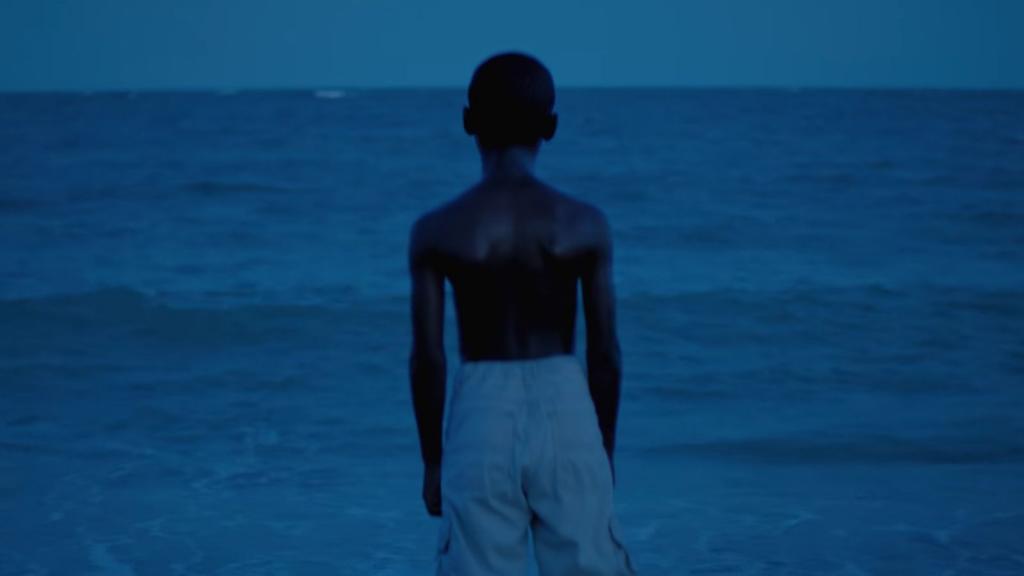
I think back to Juan’s words.
“Let your head relax in my hand. I got you, I promise. I’m not gonna let you go.”
Once again Chiron is learning how to float. How to be vulnerable. How to be held. How to be loved.
Leah D. Schade is the Assistant Professor of Preaching and Worship at Lexington Theological Seminary (Kentucky) and author of the book Creation-Crisis Preaching: Ecology, Theology, and the Pulpit (Chalice Press, 2015). She is an ordained minister in the Lutheran Church (ELCA).
Twitter: @LeahSchade
Facebook: https://www.facebook.com/LeahDSchade/.
More of Leah’s film reviews:
Watching ‘Blade Runner’ (1982) in the Age of Black Lives Matter
Blade Runner 2049: 5 Star Review
Not Your Mother’s “Wonder Woman”: A Feminist Review
Previous Post

December 31, 2017
5 Steps for a Healthy Pastor, Congregation, and Planet
Next Post

January 7, 2018 'In God We Trump' - Film Review
Browse Our Archives
Select a Category Academy of Homiletics Addiction Advent AI (Artificial Intelligence) Animals Apocalypse Appalachia Ash Wednesday Baptism Bible Black Lives Matter Blade Runner Book review Children in church Christian Nationalism Christian/Islamic relations Christmas Church Clergy Climate change COVID-19 Creation Data Centers Death penalty Devotional Dialogue Doubt Earth Day Easter Ecofeminism EcoPreacher 1-2-3 ELCA ELCA Youth Gathering Election Environment/ecology Epiphany Faith Faith and Politics Feminism Film review Food Food and Faith Forgiveness Fracking Good Friday Good Omens Grief Gun violence Holy Humor Sunday Holy Week Howard Thurman ICE Immigration Indigenous wisdom Interview Jesus Kentucky Lafayette High School Marching Band Leadership Lent LGBTQIA+ Marching band Martin Luther Martin Luther King Jr. Mary Maundy Thursday Michael Sheen Mother of Jesus Nature New Year's Eve Palm Sunday Parables Pentecost Poem, Poetry Politics Poor People's Campaign Pop culture Prayers Preaching Progressive Christianity Public theology Purple Zone Racism and White Privilege Religion Religion and environment Religion and politics Religion and pop culture Religion and violence Rev. Nelson Rabell Gonzalez Sermons Spanish language resources for preaching Technology Thanksgiving Theological education theology Trees Trump Uncategorized Vegan War Women and religion Workshop Worship
Select a Month October 2026 September 2026 July 2026 June 2026 May 2026 April 2026 March 2026 February 2026 January 2026 December 2025 November 2025 October 2025 September 2025 May 2025 April 2025 March 2025 February 2025 January 2025 December 2024 November 2024 October 2024 September 2024 August 2024 July 2024 June 2024 May 2024 April 2024 March 2024 February 2024 January 2024 December 2023 November 2023 October 2023 September 2023 August 2023 July 2023 June 2023 May 2023 April 2023 March 2023 February 2023 January 2023 December 2022 November 2022 October 2022 August 2022 July 2022 June 2022 May 2022 April 2022 March 2022 February 2022 January 2022 December 2021 November 2021 October 2021 September 2021 August 2021 July 2021 June 2021 May 2021 April 2021 March 2021 January 2021 December 2020 November 2020 October 2020 September 2020 August 2020 July 2020 June 2020 May 2020 April 2020 February 2020 January 2020 December 2019 November 2019 October 2019 September 2019 August 2019 July 2019 June 2019 May 2019 April 2019 March 2019 January 2019 December 2018 November 2018 October 2018 September 2018 August 2018 July 2018 June 2018 May 2018 April 2018 March 2018 February 2018 January 2018 December 2017 November 2017 October 2017 September 2017 August 2017 July 2017 June 2017 May 2017 April 2017
Follow Us!
TAKE THE
Religious Wisdom Quiz
How many New Testament books were written by John?
Select your answer to see how you score.
3 5 6 4
Books by This Author Books by Leah D. Schade
Related posts from EcoPreacher

Love Your Neighbor – Including Earth-Kin: Lev. 19,...

Preaching About Climate Change: What Clergy Need Most
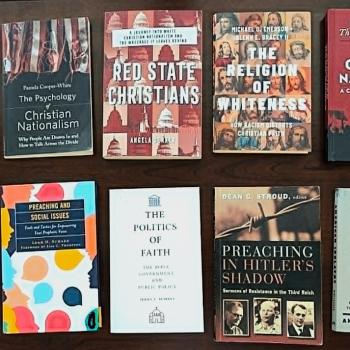
10 Books to Address Christian Nationalism in Your...

Eco-Wedding Liturgy: Creation-Centered Ideas for Weddings
TRENDING AT PATHEOS Progressive Christian

What Being a Modern-Day Apostle Means to Me
In my last column, I discussed the ins and outs of modern-day...

Did Ancient China Once Worship the God of...
Across human history, a common thread weaves through the origins of the...

Love Your Neighbor – Including Earth-Kin: Lev. 19,...
God’s command to love your neighbor means acting in an ethical and...

Lead a Church Study of “Jesus and Lao...
Guest writer Jack Thomas (The Irreverent Reverend) reflects on leading his church...

Pastoral Wisdom for Responding to Sermon Pushback
Getting sermon pushback on your social justice sermon? Learn practical, Proverbs-based strategies...

Principles for Understanding the Apostolic Ministry Today
Whenever people discover that my formal ministry title is "apostle," as in...
view all Progressive Christian blogs
Ad-Free & Subscriber Log-In Subscription Support
- About Us
- 2026 Calendar
- Videos
- Podcasts
- Library of World Religions
- Faith In Media Tracker
- Advertise With Us
- Write for Us
- Privacy Policy
- Terms of Service
- Do Not Sell My Data
- Contact Us
- Radiant Digital
- Manage Newsletter Subscriptions
- Unsubscribe From Notifications
- Sitemap
Copyright 2008-2026, Patheos. All rights reserved.
Subscription Support Ad-Free & Subscriber Log-In
Follow Patheos