
BuddhistCatholicContemplativeEvangelicalGeneral ChristianHinduJewishLatter-day SaintMuslimNew VisionsProgressive Christian
Beliefs
- Buddhist
- Catholic
- Contemplative
- Evangelical
- General Christian
- Hindu
- Jewish
- Latter-day Saint
- More Voices
- Muslim
- New Visions
- Pagan
- Progressive Christian
Topics
- Religion News
- Food and Religion
- Sports and Religion
- Religious Art
- Religious Music and Entertainment
- Religious Events
- History and Religion
- Style and Religion
- Politics and Religion
- Women in Religion
- Recreation Outdoors and Religion
- Business Finance and Religion
- Careers Workplace and Religion
- Education and Religion
- Family Parenting and Religion
- Health Fitness and Religion
- Home and Religion
- Relationships and Religion
- Technology and Religion
- Travel and Religion
Columnists
- Buddhist Columnists
- Business Finance and Religion Columnists
- Careers Workplace and Religion Columnists
- Catholic Columnists
- Contemplative Columnists
- Education and Religion Columnists
- Evangelists Columnists
- Family Parenting and Religion Columnists
- General Christian Columnists
- Health Fitness and Religion Columnists
- Hindu Columnists
- History and Religion Columnists
- Home and Religion Columnists
- Jewish Columnists
- More Voices Columnists
- Latter Day Columnists
- Muslim Columnists
- New Visions Columnists
- Nonreligious Columnists
- Pagan Columnists
- Politics and Religion Columnists
- Progressive Columnists
- Recreation Outdoors and Religion Columnists
- Relationships and Religion Columnists
- Religion News Columnists
- Religious Art Columnists
- Religious Events Columnists
- Religious Music and Entertainment Columnists
- Sports and Religion Columnists
- Style and Religion Columnists
- Technology and Religion Columnists
- Travel and Religion Columnists
- Women in Religion Columnists
Resource Library
- 2026 Calendar
- Library of World Religions
- The 100 Most Holy Places on Earth
- Patheos Answers
- Podcasts
- Videos
- Faith Leaders Database
- Anglican Episcopalian
- Bahai
- Baptist
- Buddhism
- Christianity
- Confucianism
- Eastern Orthodoxy
- Hinduism
- Holiness and Pentecostal
- ISKCON
- Islam
- Judaism
- Lutheran
- Methodist
- The Church of Jesus Christ of Latter-day Saints
- New Age
- Paganism
- Presbytarian and Reformed
- Protestantism
- Religion Behind the Scenes
- Roman Catholic
- Scientology
- Shia Islam
- Sikhism
- Sufism
- Sunni Islam
- Taoism
- Zen
- See all religions
Research Tools
 Ad-Free & Subscriber Log-In Subscription Support
Ad-Free & Subscriber Log-In Subscription Support
Follow Patheos 

- Trending:
- Forgiveness
- |
- Marriage
- |
- Consciousness
- |
- Death Penalty
- |
- Election
- |
- Halloween

- Home
- Progressive Christian
- Mary, Pondering and God-bearing: Part One
Mary, Pondering and God-bearing: Part One
Last updated on: December 22, 2017 at 4:27 am by Leah D. Schade
Mary, Pondering and God-bearing: Part One 2017-12-22T04:27:37-04:00 Leah D. Schade
Patheos Explore the world's faith through different perspectives on religion and spirituality! Patheos has the views of the prevalent religions and spiritualities of the world.
Mary, Pondering and God-bearing: Part One
Read: Luke 1:26 – 38; 44b – 55
Mary ponders.
Did you catch that? In Luke 1:29 after hearing the startling announcement that she, a teenage girl engaged to be married, has found favor with God, Mary stops to think about that. We’re told that she is perplexed and “ponders” what’s going on here. The Greek word means that she is turning things over in her mind. She’s thinking. She’s not a vacant field in which God will plant the seed of the Messiah. She’s not a servant to be ordered around.
I’ve always loved this particular painting of the Anunciation by Henry Ossawana Tanner (1898). The look on Mary’s face reminds me of my own 14-year-old daughter. A mixture of skepticism, curiosity, and growing wonder.
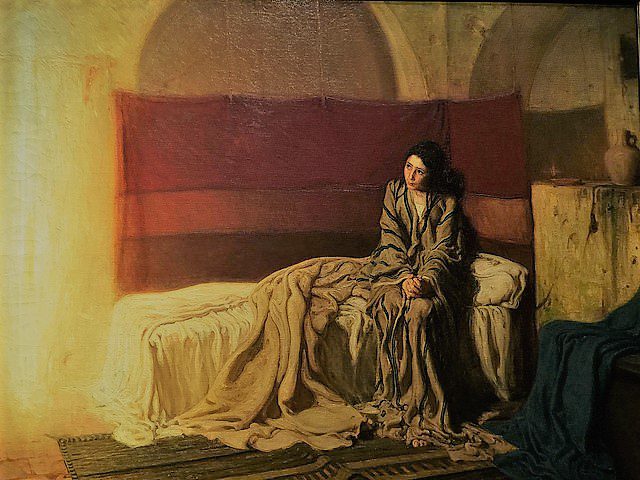
The Anunciation by Henry Ossawana Tanner, 1989. Photo by Laura Blanchard at the Phila. Museum of Art. Some rights reserved. www.flikr.com
She’s a thinking, feeling, turning-things-over-in-her-mind kind of gal.
I like those qualities in Mary. Apparently, God likes that about her, too. Because that is the kind of person Mary is, and that’s who God chooses to be the Theotokos, the Godbearer. [See also, Mary Ponders: Part Two, A Christmas Reflection.]
Kenda Dean and Ron Foster wrote a book called The Godbearing Life (Upper Room Books, Nashville, TN, 1998). In Chapter Two, they talk about Mary the Mother of Jesus as being a “God-bearer.” Why did God choose Mary? “She is uncompromised: as whole and unbroken as the day she was born, uncompromised by the outside world. In short, she has integrity,” (44). And so she is the one chosen to bring the Christ Child into the world. The Eastern Orthodox call her Theotokos – Theo meaning God, tokos meaning carrying.
Of course, the menfolk in her day may not have noticed, nor much cared much about Mary’s capacity for pondering. All most of them wanted from a woman was for her to be that vacant field or a servant for their bidding. No man, or women for that matter, would likely have expected God to choose a young female of limited means and with no social stature to be the one chosen to help God save the world. But not only has God chosen her, God gives Mary the space and the time to choose as well. While God has bestowed the identity as Favored One on her as a gift, Mary is the one who claims it for herself and declares her own agency.
“Here am I, the servant of the Lord; let it be with me according to your word.” (Luke 1:38)
It’s important to note, especially in the #MeToo age, when uninvited sexual aggression and/or misconduct is finally being exposed for the sin that it is, that this is not a story about divine force against a vulnerable female. As Dean and Foster note, “God does not seize Mary and take her by force. God does not enter this girl, or any of us, without our consent. After all, we don’t know how many stops Gabriel made before he got to Mary’s house. What sets Mary apart from the rest of us is quite simple: She says yes,” (48).
Choosing and claiming your identity and vocation
Suddenly Mary has gone from girlhood to womanhood to engagement to motherhood in the space of a few verses. Like this young God-bearer, a woman can have many different identities over time, and even at any one time in their lives. But she is often expected or pressured to take on the roles that best suit those who rely on her for what they need. We need women to be mothers, because they are the only ones who can bear children. But that biological need brings with it an incredible array of other roles that may or may not suit each woman: house-cleaner, cook, scheduling supervisor, chauffeur, nurse, and yes, even servant.
In Mary’s day women were not given a choice as to whether they would take on these roles. But when the angel Gabriel comes with God’s message, it is not an order by fiat. After Gabriel’s grand invitation in verse 37, the next verse records Mary’s response.
I would imagine there was a pregnant pause in the space in between Gabriel’s message and Mary’s answer.
The fact that the Bible records her as even having an answer indicates that Mary has a choice in the matter, a say as to whether or not she will enter into this covenant with God. We don’t know how long it took for her to ponder, to turn all this around in her mind. Maybe a few seconds. Maybe a few hours. Maybe even a few days.
But when she gives her answer she gives her body, her life, her womb of her own free will. God gives her that choice, respects her body, respects her womb, respects her as a woman and as a human being. I like that about God. Apparently Mary likes that, too. Because what comes next is one of the most beautiful songs in all of the Bible.
“My soul doth magnify the Lord!”
That’s one of the most astounding lines I’ve ever heard in Scripture. What does a magnifying glass do? It makes things look bigger than they are.

Photo by Kate Ter Haar. Some rights reserved. www.flikr.com
How odd that a young pregnant unwed teenager has the capacity for magnifying God—making God appear even bigger than God already is! A magnifier allows us to see something up close and in more exact detail. So what details about God does Mary enable us to see?
First, God’s presence brings joy.
But it’s not just your run-of-the-mill happiness. This is the kind of joy that comes from someone who has lived all her life under the thumb of others, and is suddenly liberated and able to breath deep enough to sing aloud her newfound song. It is joy that comes from seeing others experience the same kind of liberation. Others who, like Mary’s people, have labored as second-class citizens, been treated with less respect than they deserve, now lifted by the mighty arm of God to a high place with plenty to eat, when before they fed only on the crumbs that fell from the tables of the rich.
It is the kind of joy that comes from waiting faithfully and hopefully for a promise to be fulfilled, and suddenly realizing that the fulfillment is happening through you, inside of you. That’s what was happening for Mary.
Second, God’s presence brings change and transformation.
Mary’s body was being transformed by the pregnancy, but the world was being transformed even more. And just as a child grows slowly and secretly in a dark, protected place, so, too, does God’s promise grow slowly and secretly just out of sight.
How many women even now are filled with joy because they are serving as God-bearers in the world?
Not just women physically pregnant with new life, but also:
Women who incubate cells and treatments for diseases that will help heal the world.
Women who conspire together to make peace amongst themselves, even while the world is waging war all around them.
Transgender women, being God-bearers by bravely following their gender-vocation in the world.
Women who meet in government offices to plan a strategy for moving a country forward toward helping its people, even while other doors are slammed shut around them.
Women who join together in marriage with their spouse – whatever their gender – to be God-bearers through relationship and intimacy.
Women who claim their role as leaders in churches, businesses, board rooms, classrooms . . . wherever they discern a call to be God-bearers through their gifts and skills.
Women of different faiths who meet together over coffee to plan interfaith service events to inspire hope in their communities, even while other voices shout angry threatening words around them.
Third, God’s presence invites you to magnify God in the world.
Mary magnifies God and shows us that God is at work, knitting together new ideas, conceiving new friendships. Mary and God are co-conspirators, weaving threads of community, lifting up the lowly, feeding the hungry, saving the world. Each woman, and indeed, each man and child, has this same capacity for magnifying the Lord.
How does your life magnify God?
How do the actions you take, the decisions you make, the way you treat others, the way you spend your money, the career you choose for yourself, the way you interact with children, magnify God? How do your actions and decisions serve as a magnifying glass for others to see what God is up to, what God is doing in out-of-the-way places, how God is shaking things up in the highest places, who God is lifting up from the lowly places?
Your soul doth magnify the Lord.
You, like Mary, are the magnifying glass for others to see God in greater detail, to help others see God in an even bigger way. And God is filling you with joy that causes you to stand and sing aloud your newfound song.
All women have the capacity to be “God-bearers.” In fact, all people—women and men, children and elders alike—each of us is Theotokos, bearing Christ into the world.
God’s Holy Spirit enters into us, incarnates in us, and brings Christ’s life- and world-changing grace into the world.
God gives you that choice, respects your body, engages your mind, opens your heart, and loves you as the fragile, courageous, creative, sinful, and redeemed human being that you are. I like that about God. I’ll bet you like that about God, too.
Mary Ponders: Part Two, A Christmas Reflection
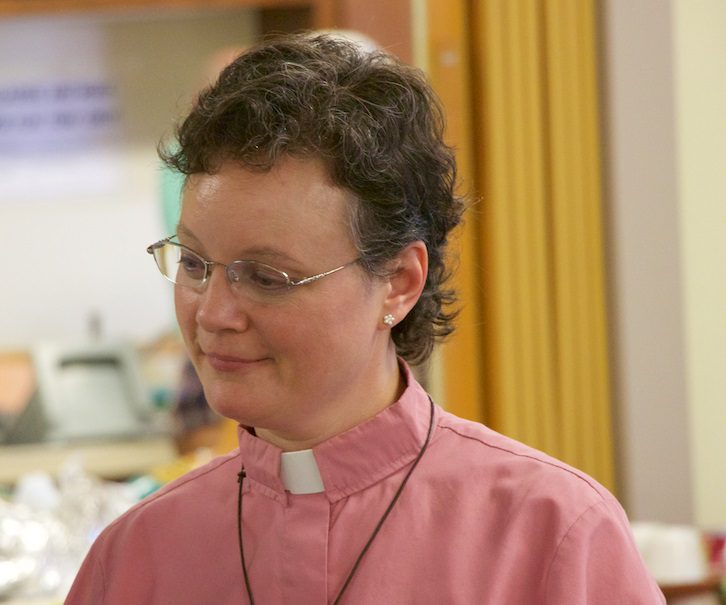
Leah D. Schade is the Assistant Professor of Preaching and Worship at Lexington Theological Seminary (Kentucky) and author of the book Creation-Crisis Preaching: Ecology, Theology, and the Pulpit (Chalice Press, 2015). She is an ordained minister in the Lutheran Church (ELCA).
Twitter: @LeahSchade
Facebook: https://www.facebook.com/LeahDSchade/.
Read more reflections about women, faith, and God:
Jesus, Mother Hen: This is the God I Want to Worship
Book Review: Preaching the Women of the Old Testament
#MeToo, #ChurchToo: The Church is Facing the Truth About Its Sexism
Previous Post

December 10, 2017
Conspiracy of the Christian Kind: Advent 3
Next Post
December 22, 2017 Mary Ponders: Part Two, A Christmas Reflection
Browse Our Archives
Select a Category Academy of Homiletics Addiction Advent AI (Artificial Intelligence) Animals Apocalypse Appalachia Ash Wednesday Baptism Bible Black Lives Matter Blade Runner Book review Children in church Christian Nationalism Christian/Islamic relations Christmas Church Clergy Climate change COVID-19 Creation Data Centers Death penalty Devotional Dialogue Doubt Earth Day Easter Ecofeminism EcoPreacher 1-2-3 ELCA ELCA Youth Gathering Election Environment/ecology Epiphany Faith Faith and Politics Feminism Film review Food Food and Faith Forgiveness Fracking Good Friday Good Omens Grief Gun violence Holy Humor Sunday Holy Week Howard Thurman ICE Immigration Indigenous wisdom Interview Jesus Kentucky Lafayette High School Marching Band Leadership Lent LGBTQIA+ Marching band Martin Luther Martin Luther King Jr. Mary Maundy Thursday Michael Sheen Mother of Jesus Nature New Year's Eve Palm Sunday Parables Pentecost Poem, Poetry Politics Poor People's Campaign Pop culture Prayers Preaching Progressive Christianity Public theology Purple Zone Racism and White Privilege Religion Religion and environment Religion and politics Religion and pop culture Religion and violence Rev. Nelson Rabell Gonzalez Sermons Spanish language resources for preaching Technology Thanksgiving Theological education theology Trees Trump Uncategorized Vegan War Women and religion Workshop Worship
Select a Month October 2026 September 2026 July 2026 June 2026 May 2026 April 2026 March 2026 February 2026 January 2026 December 2025 November 2025 October 2025 September 2025 May 2025 April 2025 March 2025 February 2025 January 2025 December 2024 November 2024 October 2024 September 2024 August 2024 July 2024 June 2024 May 2024 April 2024 March 2024 February 2024 January 2024 December 2023 November 2023 October 2023 September 2023 August 2023 July 2023 June 2023 May 2023 April 2023 March 2023 February 2023 January 2023 December 2022 November 2022 October 2022 August 2022 July 2022 June 2022 May 2022 April 2022 March 2022 February 2022 January 2022 December 2021 November 2021 October 2021 September 2021 August 2021 July 2021 June 2021 May 2021 April 2021 March 2021 January 2021 December 2020 November 2020 October 2020 September 2020 August 2020 July 2020 June 2020 May 2020 April 2020 February 2020 January 2020 December 2019 November 2019 October 2019 September 2019 August 2019 July 2019 June 2019 May 2019 April 2019 March 2019 January 2019 December 2018 November 2018 October 2018 September 2018 August 2018 July 2018 June 2018 May 2018 April 2018 March 2018 February 2018 January 2018 December 2017 November 2017 October 2017 September 2017 August 2017 July 2017 June 2017 May 2017 April 2017
Follow Us!
TAKE THE
Religious Wisdom Quiz
Which Christian group traces its roots to John Calvin’s teachings?
Select your answer to see how you score.
Methodists Lutherans Baptists Presbyterians
Books by This Author Books by Leah D. Schade
Related posts from EcoPreacher

Love Your Neighbor – Including Earth-Kin: Lev. 19,...

Preaching About Climate Change: What Clergy Need Most

Thieves and Bandits, Shepherds and Gates - John...
Reclaiming 1 Peter 2:19-25 From Abuse: Sermon for...
TRENDING AT PATHEOS Progressive Christian

What Being a Modern-Day Apostle Means to Me
In my last column, I discussed the ins and outs of modern-day...

Did Ancient China Once Worship the God of...
Across human history, a common thread weaves through the origins of the...

Love Your Neighbor – Including Earth-Kin: Lev. 19,...
God’s command to love your neighbor means acting in an ethical and...

Lead a Church Study of “Jesus and Lao...
Guest writer Jack Thomas (The Irreverent Reverend) reflects on leading his church...

Pastoral Wisdom for Responding to Sermon Pushback
Getting sermon pushback on your social justice sermon? Learn practical, Proverbs-based strategies...

Principles for Understanding the Apostolic Ministry Today
Whenever people discover that my formal ministry title is "apostle," as in...
view all Progressive Christian blogs
Ad-Free & Subscriber Log-In Subscription Support
- About Us
- 2026 Calendar
- Videos
- Podcasts
- Library of World Religions
- Faith In Media Tracker
- Advertise With Us
- Write for Us
- Privacy Policy
- Terms of Service
- Do Not Sell My Data
- Contact Us
- Radiant Digital
- Manage Newsletter Subscriptions
- Unsubscribe From Notifications
- Sitemap
Copyright 2008-2026, Patheos. All rights reserved.
Subscription Support Ad-Free & Subscriber Log-In
Follow Patheos