
BuddhistCatholicContemplativeEvangelicalGeneral ChristianHinduJewishLatter-day SaintMuslimNew VisionsProgressive Christian
Beliefs
- Buddhist
- Catholic
- Contemplative
- Evangelical
- General Christian
- Hindu
- Jewish
- Latter-day Saint
- More Voices
- Muslim
- New Visions
- Pagan
- Progressive Christian
Topics
- Religion News
- Food and Religion
- Sports and Religion
- Religious Art
- Religious Music and Entertainment
- Religious Events
- History and Religion
- Style and Religion
- Politics and Religion
- Women in Religion
- Recreation Outdoors and Religion
- Business Finance and Religion
- Careers Workplace and Religion
- Education and Religion
- Family Parenting and Religion
- Health Fitness and Religion
- Home and Religion
- Relationships and Religion
- Technology and Religion
- Travel and Religion
Columnists
- Buddhist Columnists
- Business Finance and Religion Columnists
- Careers Workplace and Religion Columnists
- Catholic Columnists
- Contemplative Columnists
- Education and Religion Columnists
- Evangelists Columnists
- Family Parenting and Religion Columnists
- General Christian Columnists
- Health Fitness and Religion Columnists
- Hindu Columnists
- History and Religion Columnists
- Home and Religion Columnists
- Jewish Columnists
- More Voices Columnists
- Latter Day Columnists
- Muslim Columnists
- New Visions Columnists
- Nonreligious Columnists
- Pagan Columnists
- Politics and Religion Columnists
- Progressive Columnists
- Recreation Outdoors and Religion Columnists
- Relationships and Religion Columnists
- Religion News Columnists
- Religious Art Columnists
- Religious Events Columnists
- Religious Music and Entertainment Columnists
- Sports and Religion Columnists
- Style and Religion Columnists
- Technology and Religion Columnists
- Travel and Religion Columnists
- Women in Religion Columnists
Resource Library
- 2026 Calendar
- Library of World Religions
- The 100 Most Holy Places on Earth
- Patheos Answers
- Podcasts
- Videos
- Faith Leaders Database
- Anglican Episcopalian
- Bahai
- Baptist
- Buddhism
- Christianity
- Confucianism
- Eastern Orthodoxy
- Hinduism
- Holiness and Pentecostal
- ISKCON
- Islam
- Judaism
- Lutheran
- Methodist
- The Church of Jesus Christ of Latter-day Saints
- New Age
- Paganism
- Presbytarian and Reformed
- Protestantism
- Religion Behind the Scenes
- Roman Catholic
- Scientology
- Shia Islam
- Sikhism
- Sufism
- Sunni Islam
- Taoism
- Zen
- See all religions
Research Tools
 Ad-Free & Subscriber Log-In Subscription Support
Ad-Free & Subscriber Log-In Subscription Support
Follow Patheos 

- Trending:
- Forgiveness
- |
- Marriage
- |
- Consciousness
- |
- Death Penalty
- |
- Election
- |
- Halloween

- Home
- Progressive Christian
- Healthy Trees, Healthy People: Why Citizen Scientists are Needed as Climate Changes
Healthy Trees, Healthy People: Why Citizen Scientists are Needed as Climate Changes
Last updated on: October 24, 2017 at 8:44 am by Leah D. Schade
Healthy Trees, Healthy People: Why Citizen Scientists are Needed as Climate Changes 2017-10-24T08:44:51-04:00 Leah D. Schade
Patheos Explore the world's faith through different perspectives on religion and spirituality! Patheos has the views of the prevalent religions and spiritualities of the world.
Healthy Trees, Healthy People
My father has an encyclopedic knowledge of trees. As a landscape designer and nursery/garden center owner, he would walk with me through Pennsylvania forests where he could name nearly every tree, including its genus and species. To be on a first-name basis with the trees, as Adam was in the original garden, is to have an intimate and stewarding relationship with Creation.
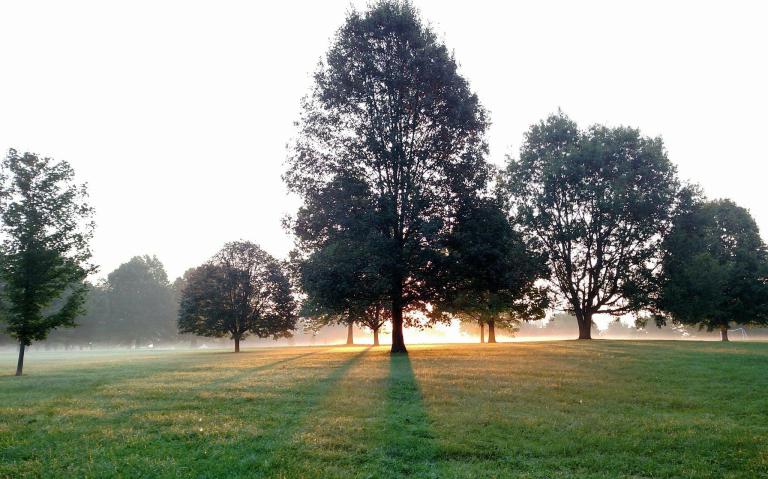
Trees at Kirklevington Park, Lexington, KY. Photo credit: Leah D. Schade. All rights reserved.
500 trees for 500th Anniversary of the Reformation
While I did not inherit that gift for remembering botanical names, I did develop a deep reverence for things green and growing. First as a Lutheran minister, and now a seminary professor in Lexington, Kentucky, cultivating an ethic of care for the Earth community is an orienting principle of my life and work. It seemed only fitting, then, when I heard about a University of Kentucky research study called “Healthy Trees, Healthy People,” that I should participate.
Especially as my fellow eco-Lutherans are celebrating 500 years of the Reformation by planting 500 trees across the U.S., I saw this study as an opportunity to learn more about these woody plants that sustain life on this planet. After all, as Martin Luther once said, “God writes the gospel not in the Bible alone, but on trees and flowers and clouds and stars.”
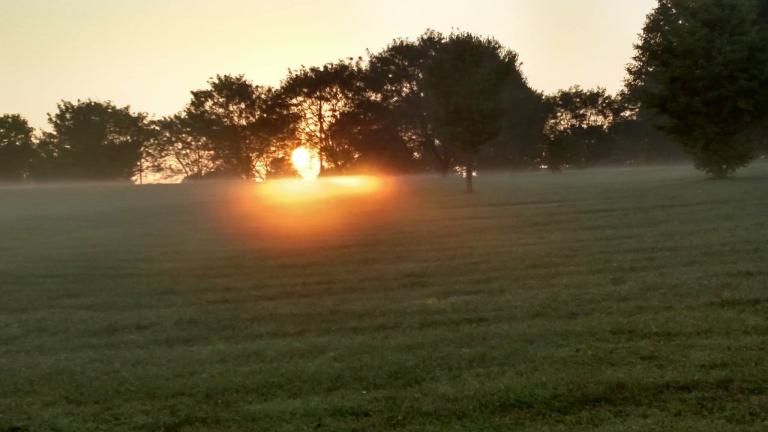
Dawn at Kirklevington Park, Lexington, KY. Photo credit: Leah D. Schade. All rights reserved.
Assessing tree and human health
How do we spot healthy trees? At the orientation, we were trained to assess the health of specific trees at two Lexington parks – Kirklevington and Harrods Hill. For six weeks we were to walk the pathways around the parks every few days and seek out the trees on our list. We learned how to observe the health of the roots, stem, and canopy of the trees, and to record them in our logs. At the same time, these walks would engage us in physical activity that would contribute to our own health. The researchers recorded our weight and blood pressure and administered a questionnaire to assess our level of stress. At the end of the six weeks, the same measures and questionnaire were repeated when we came to report our findings.
The study was designed to test whether people’s health improve when they engage in nature by becoming “citizen scientists” and observing the health of trees. By learning about the important role trees play in our urban environment, and about the pests that can threaten them, we become “eyes on the ground” for the researchers. Just as important, we improve our own physical, mental, and spiritual wellbeing.
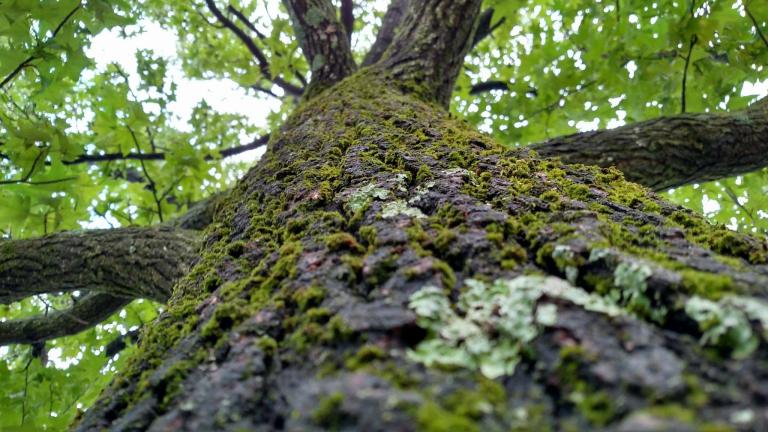
Tree at Harrods Hill Park, Lexington, KY. Photo credit: Leah D. Schade. All rights reserved.
Seeing trees in a different way
At the final session, I sat down with the lead researchers, Lynne Rieske-Kinney, PhD (Dept. of Entomology), and Heather Norman-Burgdolf, PhD (Dept. of Dietetics and Human Nutrition) to ask what they had learned from their findings so far. Initial indications are that people did report feeling happier and less stressed by the end of the study. In addition, participants shared their appreciation for being able to connect to nature with “a different set of eyes.”
“Most people are ‘tree-blind,’” explained Dr. Rieske-Kinney. “Once they learn how to spot signs of health and disease, it gives them a whole new perspective when out walking, or even looking at the trees in their own yard.”
This happened for me.
Not only can I now identify eight different species of trees, I know things like why “mulch volcanoes” are bad for trees (they cause fungus and disease to grow on the bark). And why the leaves of tulip poplars sometimes look scorched (the yellow poplar weevil feeds on the leaves and creates small holes).
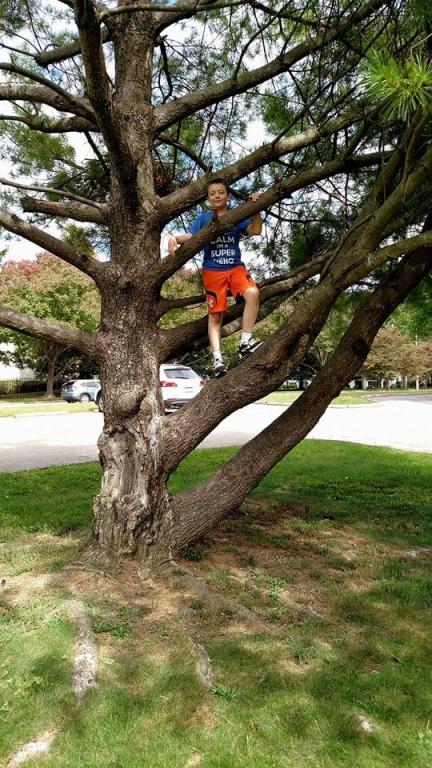
Tree climbing at Kirklevington Park, Lexington, KY. Photo credit: Leah D. Schade. All rights reserved.
And as I walked through the parks with my 10-year-old son, I felt the connection to my father and our walks in the woods of Pennsylvania. Not only did I teach Benjamin the names of the trees, he urged me to try the meat of the black walnuts he cracked. And we discovered that when you brew the leaves of the sweet gum tree with hot water and a little sugar, it creates a tea that captures the essence of green and the taste of summer.
How does climate change affect tree health?
I also asked Dr. Rieske-Kinney about the ways in which climate change impacts tree health. “We don’t know,” she admitted. “On the one hand, trees do better with increased carbon dioxide. But then, so do the pests that attack the trees, as well as insects that attack people. Just look at the spread of mosquitoes and the diseases they bring with them.”
She did note one thing for certain.
“What we do know is that things are changing. Insects are appearing in areas where they hadn’t been previously, pushing north as temperatures warm. Those that kill trees are doing so in new areas and at faster rates, contributing to the wildfires we’re seeing.”
Invasive pests in Lexington?
So, did anyone participating in the survey find evidence of the invasive insects we were trained to spot? Fortunately, no. None of the 50 participants reported any sightings of Asian Longhorned Beetles, Gypsy Moths, or Walnut twig beetles that cause Thousand Cankers Disease. Healthy trees abound in Lexington!
More citizen scientists are needed
But as the climate of Kentucky continues to warm and bring more pests, we will need even more citizen scientists to help with studies like this one. With the success of this study, the researchers are hoping to replicate it in other locations in Kentucky. I encouraged them to reach out to faith communities to enlist volunteers. What better place to seek out people interested in health and wholeness than in houses of worship where our values are shaped by faith in a God who loves this planet and wants us to care for it?
[Want to contact Dr. Rieske-Kinney to learn more about how you or your group can participate in or conduct this kind of research? Contact her at: [email protected]. Check out her faculty profile here.]
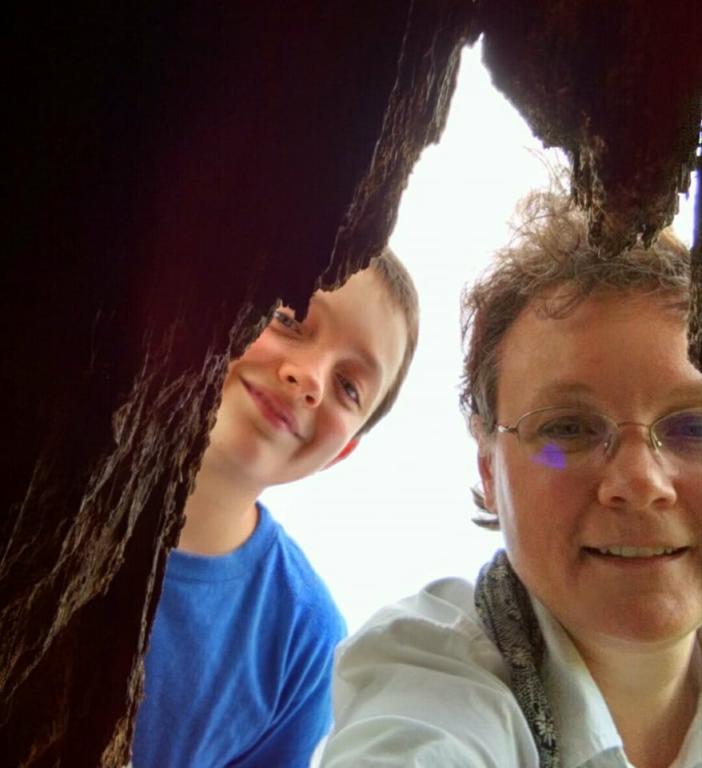
Photo credit: Leah D. Schade. All rights reserved.
Time to plant a tree!
As Reformation Sunday approaches, I’ll be planting my own tree with my husband and children. I’m sure Martin Luther would approve. And my father will be proud.
Leah D. Schade is the Assistant Professor of Preaching and Worship at Lexington Theological Seminary (Kentucky) and author of the book Creation-Crisis Preaching: Ecology, Theology, and the Pulpit (Chalice Press, 2015).
Twitter: @LeahSchade
Facebook: https://www.facebook.com/LeahDSchade/.
For more ideas about nurturing children within the natural world:
Welcoming Children into God’s Creation: 4 Things You Can Do Now
Six Children’s Sermon Ideas for Earth Day

Browse Our Archives
Select a Category Academy of Homiletics Addiction Advent AI (Artificial Intelligence) Animals Apocalypse Appalachia Ash Wednesday Baptism Bible Black Lives Matter Blade Runner Book review Children in church Christian Nationalism Christian/Islamic relations Christmas Church Clergy Climate change COVID-19 Creation Data Centers Death penalty Devotional Dialogue Doubt Earth Day Easter Ecofeminism EcoPreacher 1-2-3 ELCA ELCA Youth Gathering Election Environment/ecology Epiphany Faith Faith and Politics Feminism Film review Food Food and Faith Forgiveness Fracking Good Friday Good Omens Grief Gun violence Holy Humor Sunday Holy Week Howard Thurman ICE Immigration Indigenous wisdom Interview Jesus Kentucky Lafayette High School Marching Band Leadership Lent LGBTQIA+ Marching band Martin Luther Martin Luther King Jr. Mary Maundy Thursday Michael Sheen Mother of Jesus Nature New Year's Eve Palm Sunday Parables Pentecost Poem, Poetry Politics Poor People's Campaign Pop culture Prayers Preaching Progressive Christianity Public theology Purple Zone Racism and White Privilege Religion Religion and environment Religion and politics Religion and pop culture Religion and violence Rev. Nelson Rabell Gonzalez Sermons Spanish language resources for preaching Technology Thanksgiving Theological education theology Trees Trump Uncategorized Vegan War Women and religion Workshop Worship
Select a Month October 2026 September 2026 July 2026 June 2026 May 2026 April 2026 March 2026 February 2026 January 2026 December 2025 November 2025 October 2025 September 2025 May 2025 April 2025 March 2025 February 2025 January 2025 December 2024 November 2024 October 2024 September 2024 August 2024 July 2024 June 2024 May 2024 April 2024 March 2024 February 2024 January 2024 December 2023 November 2023 October 2023 September 2023 August 2023 July 2023 June 2023 May 2023 April 2023 March 2023 February 2023 January 2023 December 2022 November 2022 October 2022 August 2022 July 2022 June 2022 May 2022 April 2022 March 2022 February 2022 January 2022 December 2021 November 2021 October 2021 September 2021 August 2021 July 2021 June 2021 May 2021 April 2021 March 2021 January 2021 December 2020 November 2020 October 2020 September 2020 August 2020 July 2020 June 2020 May 2020 April 2020 February 2020 January 2020 December 2019 November 2019 October 2019 September 2019 August 2019 July 2019 June 2019 May 2019 April 2019 March 2019 January 2019 December 2018 November 2018 October 2018 September 2018 August 2018 July 2018 June 2018 May 2018 April 2018 March 2018 February 2018 January 2018 December 2017 November 2017 October 2017 September 2017 August 2017 July 2017 June 2017 May 2017 April 2017
Follow Us!
TAKE THE
Religious Wisdom Quiz
What kind of animal did Jesus ride into Jerusalem?
Select your answer to see how you score.
Camel Horse Ox Donkey
Books by This Author Books by Leah D. Schade
Related posts from EcoPreacher

Love Your Neighbor – Including Earth-Kin: Lev. 19,...

Preaching About Climate Change: What Clergy Need Most

When The Data Center Wolf Is At Your...

VBS Murder Skit: When a Church Teaches Children...
TRENDING AT PATHEOS Progressive Christian

What Being a Modern-Day Apostle Means to Me
In my last column, I discussed the ins and outs of modern-day...

Did Ancient China Once Worship the God of...
Across human history, a common thread weaves through the origins of the...

Love Your Neighbor – Including Earth-Kin: Lev. 19,...
God’s command to love your neighbor means acting in an ethical and...

Lead a Church Study of “Jesus and Lao...
Guest writer Jack Thomas (The Irreverent Reverend) reflects on leading his church...

Pastoral Wisdom for Responding to Sermon Pushback
Getting sermon pushback on your social justice sermon? Learn practical, Proverbs-based strategies...

Principles for Understanding the Apostolic Ministry Today
Whenever people discover that my formal ministry title is "apostle," as in...
view all Progressive Christian blogs
Ad-Free & Subscriber Log-In Subscription Support
- About Us
- 2026 Calendar
- Videos
- Podcasts
- Library of World Religions
- Faith In Media Tracker
- Advertise With Us
- Write for Us
- Privacy Policy
- Terms of Service
- Do Not Sell My Data
- Contact Us
- Radiant Digital
- Manage Newsletter Subscriptions
- Unsubscribe From Notifications
- Sitemap
Copyright 2008-2026, Patheos. All rights reserved.
Subscription Support Ad-Free & Subscriber Log-In
Follow Patheos