
BuddhistCatholicContemplativeEvangelicalGeneral ChristianHinduJewishLatter-day SaintMuslimNew VisionsProgressive Christian
Beliefs
- Buddhist
- Catholic
- Contemplative
- Evangelical
- General Christian
- Hindu
- Jewish
- Latter-day Saint
- More Voices
- Muslim
- New Visions
- Pagan
- Progressive Christian
Topics
- Religion News
- Food and Religion
- Sports and Religion
- Religious Art
- Religious Music and Entertainment
- Religious Events
- History and Religion
- Style and Religion
- Politics and Religion
- Women in Religion
- Recreation Outdoors and Religion
- Business Finance and Religion
- Careers Workplace and Religion
- Education and Religion
- Family Parenting and Religion
- Health Fitness and Religion
- Home and Religion
- Relationships and Religion
- Technology and Religion
- Travel and Religion
Columnists
- Buddhist Columnists
- Business Finance and Religion Columnists
- Careers Workplace and Religion Columnists
- Catholic Columnists
- Contemplative Columnists
- Education and Religion Columnists
- Evangelists Columnists
- Family Parenting and Religion Columnists
- General Christian Columnists
- Health Fitness and Religion Columnists
- Hindu Columnists
- History and Religion Columnists
- Home and Religion Columnists
- Jewish Columnists
- More Voices Columnists
- Latter Day Columnists
- Muslim Columnists
- New Visions Columnists
- Nonreligious Columnists
- Pagan Columnists
- Politics and Religion Columnists
- Progressive Columnists
- Recreation Outdoors and Religion Columnists
- Relationships and Religion Columnists
- Religion News Columnists
- Religious Art Columnists
- Religious Events Columnists
- Religious Music and Entertainment Columnists
- Sports and Religion Columnists
- Style and Religion Columnists
- Technology and Religion Columnists
- Travel and Religion Columnists
- Women in Religion Columnists
Resource Library
- 2026 Calendar
- Library of World Religions
- The 100 Most Holy Places on Earth
- Patheos Answers
- Podcasts
- Videos
- Faith Leaders Database
- Anglican Episcopalian
- Bahai
- Baptist
- Buddhism
- Christianity
- Confucianism
- Eastern Orthodoxy
- Hinduism
- Holiness and Pentecostal
- ISKCON
- Islam
- Judaism
- Lutheran
- Methodist
- The Church of Jesus Christ of Latter-day Saints
- New Age
- Paganism
- Presbytarian and Reformed
- Protestantism
- Religion Behind the Scenes
- Roman Catholic
- Scientology
- Shia Islam
- Sikhism
- Sufism
- Sunni Islam
- Taoism
- Zen
- See all religions
Research Tools
 Ad-Free & Subscriber Log-In Subscription Support
Ad-Free & Subscriber Log-In Subscription Support
Follow Patheos 

- Trending:
- Forgiveness
- |
- Marriage
- |
- Consciousness
- |
- Death Penalty
- |
- Election
- |
- Halloween

- Home
- Progressive Christian
- The Execution of God: Encountering the Death Penalty – A Preacher’s Review
The Execution of God: Encountering the Death Penalty – A Preacher’s Review
Last updated on: November 3, 2017 at 10:59 pm by Leah D. Schade
The Execution of God: Encountering the Death Penalty – A Preacher’s Review 2017-11-03T22:59:26-04:00 Leah D. Schade
Patheos Explore the world's faith through different perspectives on religion and spirituality! Patheos has the views of the prevalent religions and spiritualities of the world.
The Execution of God: Encountering the Death Penalty by Jeff Hood (Chalice Press, 2017)
A Preacher’s Review
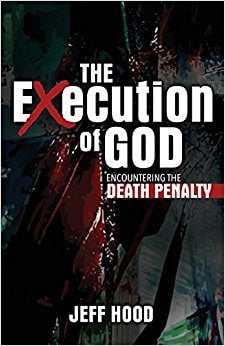
For a religion whose central figure suffered death by state execution, it is striking how silent Christian preachers are when it comes to the death penalty. If you are a preacher, when was the last time you addressed the death penalty in a sermon? If you sit in the pew on Sunday morning, can you think of one time when your pastor talked about capital punishment from the pulpit?
Not me.
I’m embarrassed to admit that in my 17 years as an ordained minister – 16 years serving churches – I never once preached a sermon addressing the death penalty. I led adult forums about it. I facilitated conversation with Confirmation students about it when teaching about the commandment, “You shall not murder.” But capital punishment was never a focus for even one of my sermons.
Why is that?
Looking back, I can see that I feared the death penalty was too “hot” for me to handle in a sermon. Talk about a polarizing issue. Either you support the execution of convicted murderers – for any number of reasons – or, you do not – also for any number of reasons. There is no middle ground on capital punishment.
This is, literally, a life and death issue.
The passions that arise on either side of this topic can lead to heated debates that can, in turn, reveal deep theological, moral, and ethical fault lines within a congregation. Little wonder, then, that the death penalty is homiletical ground where angels fear to tread.
But after reading Jeff Hood’s book, The Execution of God: Encountering the Death Penalty (Chalice Press, 2017), I wish I had had this book earlier in my ministry. Because I realize with regret that I missed countless opportunities to speak to this topic in my sermons. Worse, I abdicated my prophetic authority as a minister of the Word to bring attention to a subject that requires much more consideration than preachers give it.
An unconventional book
The Execution of God is an unconventional book for a far too conventional practice. The death penalty is put on trial in Hood’s book, and the reader must decide the sentence. Part memoir, part prophetic tirade, part biblical reflection, Hood’s writing is provocative in the truest sense of the word. Because his aim is to provoke – to unsettle, to aggravate us who live in a country where we are shockingly comfortable with the compounding of killing upon killing. Whatever your stance is on the death penalty, I dare you to read Hood’s book and maintain the rationale for your silence – and thus complicity – with the system of death we allow in this nation.
Not a “safe” read
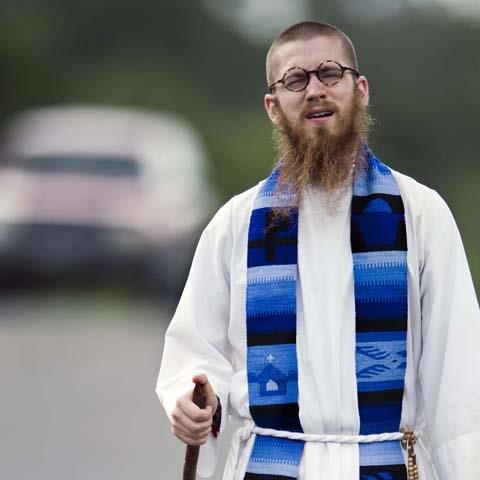
The Rev. Dr. Jeff Hood
As a Baptist pastor, theologian, and activist working to abolish the death penalty, Hood cries out from the belly of the beast – in Texas, which is one of 31 states that currently utilize capital punishment. For Hood, the only way to transform the discourse about the death penalty is to disrupt it by way of open-ended challenge, disturbance, and displacement. To that end, he occasionally employs profanity and some vulgar vernacular, so readers easily offended may gasp. In other words, when using this book for studies with youth or sensitive readers, the judicious pastor will want to share key excerpts rather than the whole volume.
Equipping us for the labyrinth
But as you read about Hood’s encounters with actual death row inmates, and journey with him through the maze of biblical references that mark his quest, you realize something. Hood is taking us into the theological labyrinth that houses the Minotaur – the death penalty – at its center. Because he has traversed these dangerous routes many times, he is able to equip us with the biblical and philosophical tools we need to defend against the beast.
For example, when responding to those who would make the case that the Bible supports the death penalty, Hood has plenty of great lines to counter such arguments (Like: “The death penalty is a moral cancer on our society primarily because it refuses to acknowledge the possibility of redemption,” [104].)
Thus, Hood is like the mythical Theseus leading the charge to finally put the Minotaur of capital punishment out of its misery. His quest is nothing less than to save the thousands who wait in cells to be sent by Minos – our criminal justice system – as a sacrifice to the devouring monster. Along the way, he proclaims an incarnational divine love that puts its body between the condemned and the executioners.
Love your neighbor by executing your neighbor?
Hood’s primary concern driving this book is that most Christians fail to recognize the stunning hypocrisy of their hermeneutical and ethical fallacies that enable the death penalty to exist. The result of this moral vacuum is not only that hundreds of people have been murdered (including those later proven innocent), but that the very God we worship is murdered by our blood-lust.
What makes Hood’s case so compelling is his theological argument that capital punishment flies in the face of the Christian message about love. Taking his cue from Matthew 25 where Jesus identifies himself with the ones in prison, Hood sees the Imago Dei in every death row inmate. Such a notion is jarring, for certain. How can the monster on the gurney be synonymous with the person of Christ on the cross? But biblically, it is irrefutable, and Hood utilizes key stories and images from scripture to make his case. From God’s mercy toward Cain, to Jesus’ laying down his body between the Pharisees and the woman accused of adultery, the evidence for God desiring less killing, not more, is overwhelming. As Hood reminds us, “We will either love God or kill God. The death penalty offers us no other options.” 13
It’s the theology, stupid
Hood pulls no punches when it comes to excoriating the two institutions enmeshed in the practice of capital punishment – the church and the state. From seeing governors as Herods, to Sunday School teachers as bloodthirsty vicarious murderers, Hood utilizes the lens of execution to expose our sacrilege and build his case against the powers that thrill to see the sacrifice of death row inmates.
The Execution of God urges clergy, especially in their role as preachers, to reveal the theological doctrines that support capital punishment for what they are: heresy. The structure of Christian atonement theory is especially to blame: “I don’t think it’s a coincidence that Christians often support the death penalty. Deadly theology leads to deadly practice. . . We are carrying out an ancient ritual of atonement every time the state kills for us,” (110).
Business as usual
But we as individuals and as a society must also share the responsibility for the continued existence of the death penalty. Hood is scathing in his observation of the business-as-usual comportment of Christians in the face of the horrors of this system:
“There will be much forgetting after tonight. People will go on about their lives as if nothing ever happened, and many will go to church. Pastors will offer communion in the coming days. The problem is that the communion our churches offer will not be real. For, it is impossible to have real communion when no one knows if they will be the next one killed. The God that is celebrated will be a fraud. For, how can anyone claim to believe in a God that kills because of anger and vengeance? For people who claim to follow Jesus here, we are the great pretenders. . . How can anyone feel good about being made a serial killer by their government?” (75, 82).
Harsh words? Yes. True? Also, yes.
The prophet must needs call us to account if the mercy of God is to find its way into our hearts, our culture, our churches, and our government.

Death row cell. Photo by “Christopher” on flickr.com. Some rights reserved.
Waking up to the nightmare in order to dream
Surprisingly, Hood remains relentlessly hopeful that his growing abolition movement will eventually overcome the evil of the death penalty. As he describes his lonesome pilgrimages to execution centers in protest of capital punishment, we rejoice to see more feet join him in the walk, and even a few minds given over to questioning their certainty that the death penalty is perfectly rational and morally permissible.
Consider, for example, Hood’s exchange with one person he encountered while walking his first execution-center-pilgrimage:
“Do you need a ride?”
“No, I am on a pilgrimage to abolish the death penalty.”
“I am for the death penalty. Why are you against it?”
“Because I am a Christian.”
“I am a Christian too, and I am still for the death penalty. Why do you think being a Christian has anything to do with opposing the death penalty?”
“Because I don’t believe you can love your neighbor as your self and execute them.”
“Damn, that makes sense. I’m going to have to think about that some more.” (85.)
Think about that some more
If The Execution of God does nothing else for readers, it will make them think about the death penalty some more. And if it works as intended, we will realize, along with Hood, that, “Something is happening. People are dreaming of a world beyond death,” (12).
Preach about that some more
Hood’s book helps preachers to enter into that dream by showing us the nightmare of our current reality with the death penalty. Now it’s up to us in our sermons to help actualize that dream and, at the very least, have the courage to address the subject of the death penalty in our congregations – especially in the pulpit.
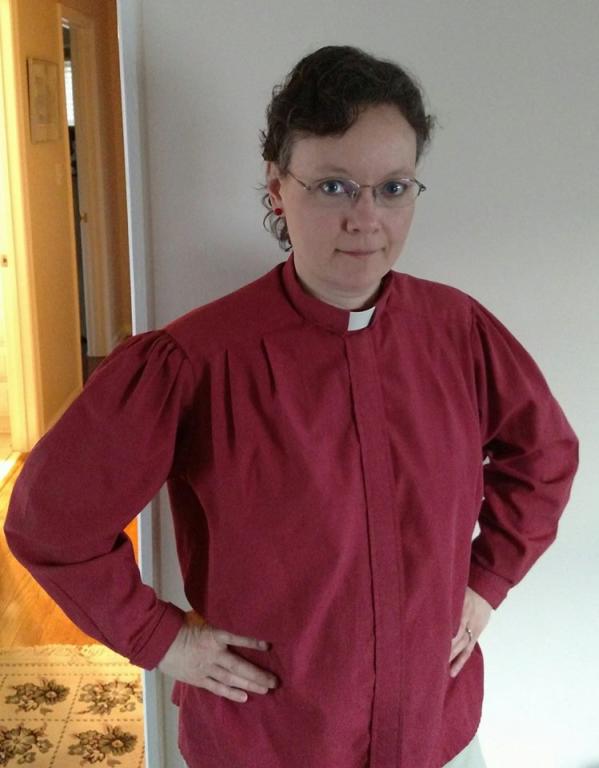
Leah D. Schade is the Assistant Professor of Preaching and Worship at Lexington Theological Seminary (Kentucky) and author of the book Creation-Crisis Preaching: Ecology, Theology, and the Pulpit (Chalice Press, 2015).
Twitter: @LeahSchade
Facebook: https://www.facebook.com/LeahDSchade/.
More book reviews by Leah Schade:
Eco-Reformation- Grace and Hope for a Planet in Peril
Preaching the Women of the Old Testament
Dar Tellum: 1970s Children’s Book about Climate Change
Harnessing “The Butterfly Effect”: A Join Book Review

Next Post
November 2, 2017 Webinar: Preaching Controversial Issues
Browse Our Archives
Select a Category Academy of Homiletics Addiction Advent AI (Artificial Intelligence) Animals Apocalypse Appalachia Ash Wednesday Baptism Bible Black Lives Matter Blade Runner Book review Children in church Christian Nationalism Christian/Islamic relations Christmas Church Clergy Climate change COVID-19 Creation Data Centers Death penalty Devotional Dialogue Doubt Earth Day Easter Ecofeminism EcoPreacher 1-2-3 ELCA ELCA Youth Gathering Election Environment/ecology Epiphany Faith Faith and Politics Feminism Film review Food Food and Faith Forgiveness Fracking Good Friday Good Omens Grief Gun violence Holy Humor Sunday Holy Week Howard Thurman ICE Immigration Indigenous wisdom Interview Jesus Kentucky Lafayette High School Marching Band Leadership Lent LGBTQIA+ Marching band Martin Luther Martin Luther King Jr. Mary Maundy Thursday Michael Sheen Mother of Jesus Nature New Year's Eve Palm Sunday Parables Pentecost Poem, Poetry Politics Poor People's Campaign Pop culture Prayers Preaching Progressive Christianity Public theology Purple Zone Racism and White Privilege Religion Religion and environment Religion and politics Religion and pop culture Religion and violence Rev. Nelson Rabell Gonzalez Sermons Spanish language resources for preaching Technology Thanksgiving Theological education theology Trees Trump Uncategorized Vegan War Women and religion Workshop Worship
Select a Month October 2026 September 2026 July 2026 June 2026 May 2026 April 2026 March 2026 February 2026 January 2026 December 2025 November 2025 October 2025 September 2025 May 2025 April 2025 March 2025 February 2025 January 2025 December 2024 November 2024 October 2024 September 2024 August 2024 July 2024 June 2024 May 2024 April 2024 March 2024 February 2024 January 2024 December 2023 November 2023 October 2023 September 2023 August 2023 July 2023 June 2023 May 2023 April 2023 March 2023 February 2023 January 2023 December 2022 November 2022 October 2022 August 2022 July 2022 June 2022 May 2022 April 2022 March 2022 February 2022 January 2022 December 2021 November 2021 October 2021 September 2021 August 2021 July 2021 June 2021 May 2021 April 2021 March 2021 January 2021 December 2020 November 2020 October 2020 September 2020 August 2020 July 2020 June 2020 May 2020 April 2020 February 2020 January 2020 December 2019 November 2019 October 2019 September 2019 August 2019 July 2019 June 2019 May 2019 April 2019 March 2019 January 2019 December 2018 November 2018 October 2018 September 2018 August 2018 July 2018 June 2018 May 2018 April 2018 March 2018 February 2018 January 2018 December 2017 November 2017 October 2017 September 2017 August 2017 July 2017 June 2017 May 2017 April 2017
Follow Us!
TAKE THE
Religious Wisdom Quiz
True or False: Paul wrote to the Philippians while he was imprisoned.
Select your answer to see how you score.
FALSE TRUE
Books by This Author Books by Leah D. Schade
Related posts from EcoPreacher

10 Principios para la Predicación Ecológica

Preaching Alongside COP30 - Frameworks for Climate Justice

How to Handle Sermon Pushback on Social Justice...

8 Lessons for Preachers from Cory Booker, Historic...
TRENDING AT PATHEOS Progressive Christian

What Being a Modern-Day Apostle Means to Me
In my last column, I discussed the ins and outs of modern-day...

Did Ancient China Once Worship the God of...
Across human history, a common thread weaves through the origins of the...

Love Your Neighbor – Including Earth-Kin: Lev. 19,...
God’s command to love your neighbor means acting in an ethical and...

Lead a Church Study of “Jesus and Lao...
Guest writer Jack Thomas (The Irreverent Reverend) reflects on leading his church...

Pastoral Wisdom for Responding to Sermon Pushback
Getting sermon pushback on your social justice sermon? Learn practical, Proverbs-based strategies...

Principles for Understanding the Apostolic Ministry Today
Whenever people discover that my formal ministry title is "apostle," as in...
view all Progressive Christian blogs
Ad-Free & Subscriber Log-In Subscription Support
- About Us
- 2026 Calendar
- Videos
- Podcasts
- Library of World Religions
- Faith In Media Tracker
- Advertise With Us
- Write for Us
- Privacy Policy
- Terms of Service
- Do Not Sell My Data
- Contact Us
- Radiant Digital
- Manage Newsletter Subscriptions
- Unsubscribe From Notifications
- Sitemap
Copyright 2008-2026, Patheos. All rights reserved.
Subscription Support Ad-Free & Subscriber Log-In
Follow Patheos