
BuddhistCatholicContemplativeEvangelicalGeneral ChristianHinduJewishLatter-day SaintMuslimNew VisionsProgressive Christian
Beliefs
- Buddhist
- Catholic
- Contemplative
- Evangelical
- General Christian
- Hindu
- Jewish
- Latter-day Saint
- More Voices
- Muslim
- New Visions
- Pagan
- Progressive Christian
Topics
- Religion News
- Food and Religion
- Sports and Religion
- Religious Art
- Religious Music and Entertainment
- Religious Events
- History and Religion
- Style and Religion
- Politics and Religion
- Women in Religion
- Recreation Outdoors and Religion
- Business Finance and Religion
- Careers Workplace and Religion
- Education and Religion
- Family Parenting and Religion
- Health Fitness and Religion
- Home and Religion
- Relationships and Religion
- Technology and Religion
- Travel and Religion
Columnists
- Buddhist Columnists
- Business Finance and Religion Columnists
- Careers Workplace and Religion Columnists
- Catholic Columnists
- Contemplative Columnists
- Education and Religion Columnists
- Evangelists Columnists
- Family Parenting and Religion Columnists
- General Christian Columnists
- Health Fitness and Religion Columnists
- Hindu Columnists
- History and Religion Columnists
- Home and Religion Columnists
- Jewish Columnists
- More Voices Columnists
- Latter Day Columnists
- Muslim Columnists
- New Visions Columnists
- Nonreligious Columnists
- Pagan Columnists
- Politics and Religion Columnists
- Progressive Columnists
- Recreation Outdoors and Religion Columnists
- Relationships and Religion Columnists
- Religion News Columnists
- Religious Art Columnists
- Religious Events Columnists
- Religious Music and Entertainment Columnists
- Sports and Religion Columnists
- Style and Religion Columnists
- Technology and Religion Columnists
- Travel and Religion Columnists
- Women in Religion Columnists
Resource Library
- 2026 Calendar
- Library of World Religions
- The 100 Most Holy Places on Earth
- Patheos Answers
- Podcasts
- Videos
- Faith Leaders Database
- Anglican Episcopalian
- Bahai
- Baptist
- Buddhism
- Christianity
- Confucianism
- Eastern Orthodoxy
- Hinduism
- Holiness and Pentecostal
- ISKCON
- Islam
- Judaism
- Lutheran
- Methodist
- The Church of Jesus Christ of Latter-day Saints
- New Age
- Paganism
- Presbytarian and Reformed
- Protestantism
- Religion Behind the Scenes
- Roman Catholic
- Scientology
- Shia Islam
- Sikhism
- Sufism
- Sunni Islam
- Taoism
- Zen
- See all religions
Research Tools
 Ad-Free & Subscriber Log-In Subscription Support
Ad-Free & Subscriber Log-In Subscription Support
Follow Patheos 

- Trending:
- Forgiveness
- |
- Marriage
- |
- Consciousness
- |
- Death Penalty
- |
- Election
- |
- Halloween

- Home
- Progressive Christian
- Shoes in the Vineyard: Immigration and Jesus’ Parable
Shoes in the Vineyard: Immigration and Jesus’ Parable
Last updated on: September 26, 2017 at 8:50 am by Leah D. Schade
Shoes in the Vineyard: Immigration and Jesus’ Parable 2017-09-26T08:50:50-04:00 Leah D. Schade
Patheos Explore the world's faith through different perspectives on religion and spirituality! Patheos has the views of the prevalent religions and spiritualities of the world.
Sermon: “Shoes in the Vineyard.” How Jesus’ parable about the workers in the vineyard has shaped my perspective about immigration, refugees, undocumented workers, and Dreamers.
Texts: Jonah 3:10-4:11, Matthew 20:1-16 (The Parable of the Workers in the Vineyard)
It’s not fair!
Those are usually the first words I hear when reading this story about the workers in the vineyard in a Bible study with people. And I’m usually the first person to say it. I do not like it when things are unfair. I’m the first born of 4 children. I hated seeing my siblings receive the same privileges as me – but at a younger age – after I had had to wait so long.
Fairness is at the heart of many contemporary issues of public debate. Name just about any topic, and you’ll hear someone voicing a grievance that something is not fair. Whether it’s health care, climate change, gun regulations, or tax rates – everyone has a perspective and opinion on what is fair.
Immigration, undocumented workers, refugees, “Dreamers”
Take, for example, people who were not born in this country, but who came here seeking either freedom from oppression, or to escape from extreme violence, or to flee the ravages of war and poverty. Some say it’s not fair that undocumented workers enjoy the benefits of this country without waiting to become citizens. While others say it’s not fair that desperate people are denied asylum, or are arrested and sent back to the violence they had tried to escape.
So, what does fairness mean? By what standards do we decide what is fair?
Our readings in Jonah and the Gospel of Matthew ask these same questions. And we learn that what is fair is a matter of perspective.
They say you should not judge a person until you walk a mile in their shoes. Well, we’ve got three sets of shoes in this parable, three different perspectives: the shoes of the early workers, the late workers, and the shoes of God.
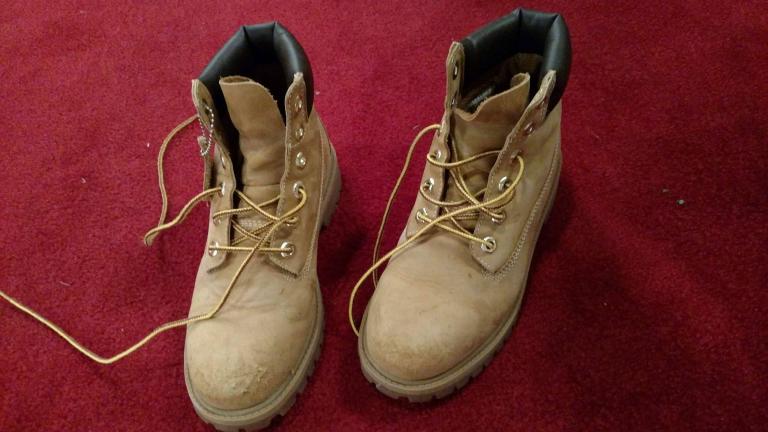
“Jonah boots” Photo credit: Leah D. Schade. All rights reserved.
“Jonah boots”
Let’s start by putting on the shoes of the first workers. Heavy shoes. Heavy work. We’re going to call these “Jonah boots.” Because Jonah was like these early workers. If you’ll recall the story of Jonah, he was an Israelite, one of the chosen people. He was a prophet, and by golly he had both seniority and tenure. In his mind, only those who were wearing these boots had earned the full measure of God’s grace. Look how long he had labored. And look at his work record – it was stellar.
Well, except for that time when he played hooky from an assignment he’d been given by God to go and preach to the Ninevites. He took a boat going in the opposite direction. So he was a little late to work that time. He got delayed by that storm, and being thrown overboard, and there was that little episode with the whale.
So I guess Jonah was not so stellar after all. He was, in fact, disobedient. He didn’t deserve mercy. And yet God gave him mercy anyway. It’s not fair, is it?
Then Jonah finally goes to Nineveh – those heathens, those foreigners.
It’s no wonder he wanted to refuse this assignment from God. Nineveh is in Syria – the enemy nation, the ones who had oppressed his people. So reluctantly, he preaches the shortest sermon ever — 8 words: “Forty days more and Nineveh shall be overthrown.”
I teach homiletics. I would not have been able to give that sermon a passing grade. And yet, the people of Nineveh responded to that sermon and repented! Everyone from the king down to the animals put on sackcloth and ashes and repented of their sins and changed their wicked ways. God had mercy on them and decided not to rain fire and brimstone on their city.
“Ninevite Sandals”
They were like the latecomers to the vineyard. Let’s try on those shoes.
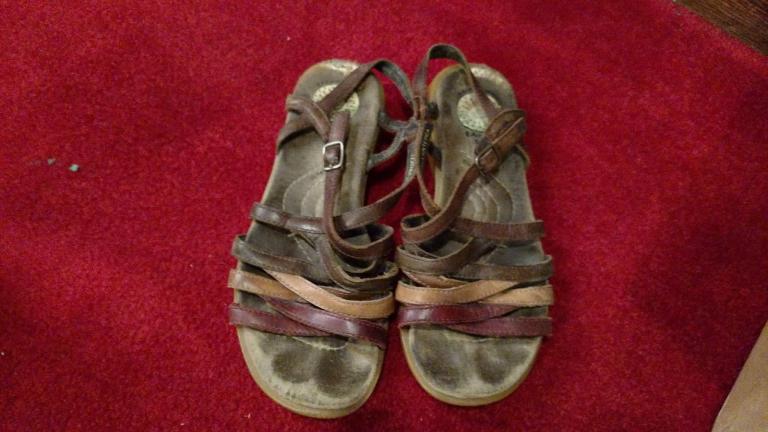
“Ninevite sandals” Photo credit: Leah D. Schade. All rights reserved.
Oh, much better — lighter. Easier. We’ll call these “Ninevite Sandals.” Those late workers are probably saying to themselves, “Can you believe we got the same pay as the people who worked a full day? It’s not really fair, is it?”
We don’t know why these workers came late. Maybe they had cared for a sick family member and were just now getting to the market to seek work. Maybe all the jobs had been claimed by other workers. Maybe they overslept. Maybe they were older and had been passed over by other employers. The parable doesn’t tell us any of that.
But we do know this: all the workers in the vineyard were in need of the same thing – the means to support themselves. So you can imagine how it felt to be in the Ninevite sandals of those latecomers. They must have felt both relief and gratitude that the landowner would be generous enough to give them a full day’s pay.
But the ones wearing Jonah boots are angry.
“This is no way to run a business! Who does this vineyard owner think he is? We deserve more than those latecomers. In fact those latecomers shouldn’t even get one tenth of what we got. It’s just not fair!”
How quickly Jonah forgets! Jonah was himself a latecomer!
He never showed up for work that day when he hopped aboard that ship. And God showed him mercy — twice! First by saving him from drowning, then by saving him from the digestive track of a whale!
See, Jonah resented divine generosity toward others, but when the shoe’s on the other foot, or, rather, when the foot’s in the other shoe . . . . he was glad to receive it himself, wasn’t he?
Which shoes are you wearing?
I would be willing to wager that each one of us has worn the Jonah boots at some point in our lives. We get jealous when we see others get something we think they don’t deserve, especially without doing half the work we put into it. But you see, jealousy is a dangerous emotion, because it blinds us to God’s generosity towards us in our own life.
See, I’ve learned some important things since the time I was in my parents’ house feeling jealous toward my siblings. I’ve learned that it doesn’t matter how difficult my life has been, or how much I think I deserve. Because there will always be people who have it easier, and people who have it harder than I do. And the people who’ve had a more difficult life than me will NOT see me as having on Jonah boots. They’ll see me as wearing Ninevite sandals.
So depending on which shoes you’re wearing, it will change your perspective about the story.
Those wearing the Ninevite sandals are going to feel gratitude and relief towards God. But those wearing the Jonah boots are going to feel jealousy towards their fellow workers. And they’re going to feel something else, something even more pernicious. It’s called ENVY.
In Matthew 20:15, the vineyard owner asks the disgruntled workers: “Are you envious because I am generous?”
There is a difference between jealousy and envy.
Jealousy is what you feel toward your peers when you want what they have. Envy is what you feel toward the person whose power you want. Sometimes what we feel is envy towards God because we wish we had that kind of power. And frankly, we’re envious because we can’t be that generous in our own hearts.
Which brings us to the third set of shoes.
God’s shoes are big shoes to fill!
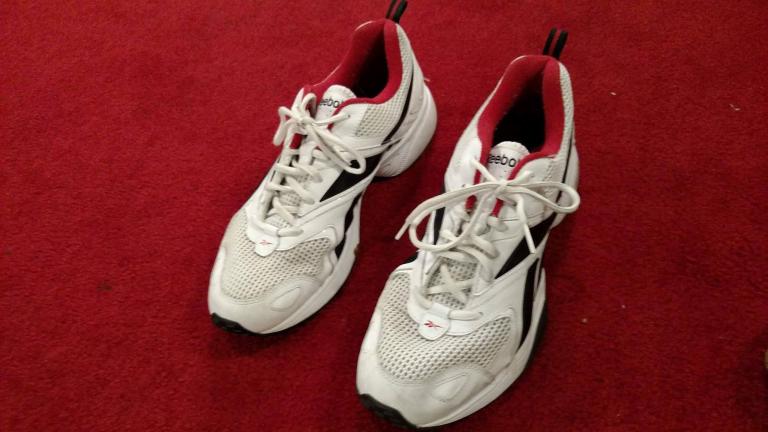
“Sneakers of the vineyard owner” Photo credit: Leah D. Schade. All rights reserved.
I’m not even going to try to put on these shoes. They are way too big for me.
These are running shoes. Because the vineyard owner is running back and forth between the vineyard and the town, trying to round up as many workers as possible. God never stops running to find us. The sneakers of the vineyard owner leave tracks all over town, seeking out every person he can find.
You see, these texts are not just about the early workers or the late workers. These texts are meant to tell us about God — who God is and what God does.
What do we learn about God through the character of the vineyard owner?
We learn three things.
First, it is God who owns the vineyard.
Without the vineyard owner, no one would have any work or any pay! Neither the late nor the early workers would have anything without the vineyard owner giving them work to do in the first place. So we need to remember our place, and be humble and respectful of the one who has sovereignty over the vineyard and all the workers.
Second, God needs as many workers as She can get because the harvest is coming in now, and God doesn’t want to lose one precious fruit.
I worked with a pastor who used to go to California every year during this month of September to help his friend who owned a vineyard. When those grapes are ripe, you can’t waste time. They have to be picked immediately. If they aren’t harvested right away, they can either succumb to mold from rain, or rot from too much sun. There is a sense of urgency here. Whatever God has to do to get those grapes picked, God will do it. God will scour the town looking for people to work in the vineyard to ensure that the harvest is complete.
Third, God is generous beyond human comprehension.
Whether you’re wearing Jonah Boots or Ninevite Sandals, we all get the same pay as Jonah received after he had sinned. He received God’s mercy. The Ninevites received God’s mercy.
You’re right. It’s not fair. And thanks be to God, it’s not fair.
So this gives me a different perspective on the people in this country who do not have official papers of citizenship, but are still willing to work in the vineyard, so to speak. Here I am wearing my Ninevite sandals, and I know that just about every strawberry I pop into my mouth, every green bean I sautee in my pan, is because of a worker who I will never see, who may or may not have official papers, but who was willing to do the work.
The truth is, I have enjoyed every benefit and blessing of this country through no effort of my own.
Because I was born here. I did not earn my citizenship. I was privileged to have parents who already lived here. Because their parents already lived here. And their parents lived here. And their parents who . . . oh, wait. That generation came from Germany and Ireland to escape war and famine and poverty.
My ancestors came to this country seeking mercy. And I am here today because they were shown mercy.
I have never had to know war, hunger, poverty, oppression, gang violence, drought, hurricanes, or other climate disasters. And you know what? That’s not fair.
It’s not fair that I have been so fortunate.
So who am I to be jealous of people who want the basics I enjoy? Who am I to be envious of a God who is generous enough to make sure all receive mercy? That’s the kind of nation I want to be a part of – one that extends the generosity and mercy of God.
Official citizens or not, they are working right alongside the rest of us bringing in the harvest. They get the same promise that you and I do. God promises that they are God’s children, God will never abandon them, and God will love them forever. God gave that promise to you and me. God gives that promise to them. If I can be a part of making that promise a reality, then I want to be a part of that.
God’s promise is the same across all generations, from my ancestors who came from Europe, to immigrants and refugees who come from other countries today. God’s promise is the same, both for the Jonahs and the Ninevites of this world.
So is this fair? In God’s vineyard, you bet it is!
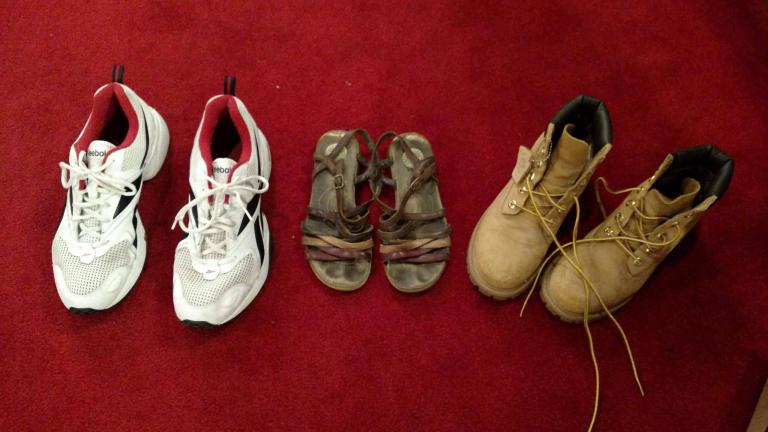
“Shoes in the vineyard” Photo credit: Leah D. Schade. All rights reserved.
So go ahead and put on your shoes — whether they’re Jonah boots or Ninevite sandals. There are so many grapes on the vine, we don’t have another day to lose. There are people who need help, there are disasters to clean up, there are injustices to address, there are children who need protection, and there is bread to be shared and wine to be poured.
And you can be assured that God’s grace is going to be there at the end of the day giving out the same mercy to the entire vineyard, and to every worker . . . no matter what shoes you’re wearing. Amen.
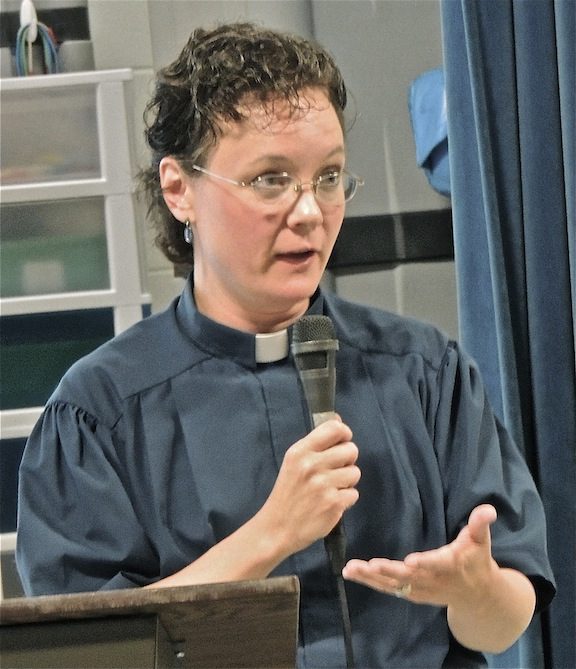
Leah D. Schade is the Assistant Professor of Preaching and Worship at Lexington Theological Seminary (Kentucky) and author of the book Creation-Crisis Preaching: Ecology, Theology, and the Pulpit (Chalice Press, 2015).
Twitter: @LeahSchade
Facebook: https://www.facebook.com/LeahDSchade/.
Read more of Leah’s sermons:
The Harp Sermon: A Response to Charlottesville and Racial Hatred
Sermon: Finding the Mustard Seed in the Arboretum of Faith
Receiving the Right Yoke: A Sermon on Burdens and Stress
Write a Different Ending: Phineas and the ‘Butter Battle’
Psalm 137: The Beautifully Dangerous Psalm
Previous Post

September 21, 2017
Interview with Jim Minick, author of 'Fire is Your Water'
Next Post

September 29, 2017 Feast of St. Francis: Resurrection Sermon for an Earth-Kin Congregation
Browse Our Archives
Select a Category Academy of Homiletics Addiction Advent AI (Artificial Intelligence) Animals Apocalypse Appalachia Ash Wednesday Baptism Bible Black Lives Matter Blade Runner Book review Children in church Christian Nationalism Christian/Islamic relations Christmas Church Clergy Climate change COVID-19 Creation Data Centers Death penalty Devotional Dialogue Doubt Earth Day Easter Ecofeminism EcoPreacher 1-2-3 ELCA ELCA Youth Gathering Election Environment/ecology Epiphany Faith Faith and Politics Feminism Film review Food Food and Faith Forgiveness Fracking Good Friday Good Omens Grief Gun violence Holy Humor Sunday Holy Week Howard Thurman ICE Immigration Indigenous wisdom Interview Jesus Kentucky Lafayette High School Marching Band Leadership Lent LGBTQIA+ Marching band Martin Luther Martin Luther King Jr. Mary Maundy Thursday Michael Sheen Mother of Jesus Nature New Year's Eve Palm Sunday Parables Pentecost Poem, Poetry Politics Poor People's Campaign Pop culture Prayers Preaching Progressive Christianity Public theology Purple Zone Racism and White Privilege Religion Religion and environment Religion and politics Religion and pop culture Religion and violence Rev. Nelson Rabell Gonzalez Sermons Spanish language resources for preaching Technology Thanksgiving Theological education theology Trees Trump Uncategorized Vegan War Women and religion Workshop Worship
Select a Month October 2026 September 2026 July 2026 June 2026 May 2026 April 2026 March 2026 February 2026 January 2026 December 2025 November 2025 October 2025 September 2025 May 2025 April 2025 March 2025 February 2025 January 2025 December 2024 November 2024 October 2024 September 2024 August 2024 July 2024 June 2024 May 2024 April 2024 March 2024 February 2024 January 2024 December 2023 November 2023 October 2023 September 2023 August 2023 July 2023 June 2023 May 2023 April 2023 March 2023 February 2023 January 2023 December 2022 November 2022 October 2022 August 2022 July 2022 June 2022 May 2022 April 2022 March 2022 February 2022 January 2022 December 2021 November 2021 October 2021 September 2021 August 2021 July 2021 June 2021 May 2021 April 2021 March 2021 January 2021 December 2020 November 2020 October 2020 September 2020 August 2020 July 2020 June 2020 May 2020 April 2020 February 2020 January 2020 December 2019 November 2019 October 2019 September 2019 August 2019 July 2019 June 2019 May 2019 April 2019 March 2019 January 2019 December 2018 November 2018 October 2018 September 2018 August 2018 July 2018 June 2018 May 2018 April 2018 March 2018 February 2018 January 2018 December 2017 November 2017 October 2017 September 2017 August 2017 July 2017 June 2017 May 2017 April 2017
Follow Us!
TAKE THE
Religious Wisdom Quiz
What does Paul say he does not do the good he wants to do, but instead does?
Select your answer to see how you score.
What leads to death The evil he does not want to do What displeases God What is sinful
Books by This Author Books by Leah D. Schade
Related posts from EcoPreacher

Workers in the Vineyard: Sermon Ideas for Matt....
Thieves and Bandits, Shepherds and Gates - John...
Reclaiming 1 Peter 2:19-25 From Abuse: Sermon for...

Resist Ethnocentrism & Christian Nationalism in Lent: Gen...
TRENDING AT PATHEOS Progressive Christian

What Being a Modern-Day Apostle Means to Me
In my last column, I discussed the ins and outs of modern-day...

Did Ancient China Once Worship the God of...
Across human history, a common thread weaves through the origins of the...

Love Your Neighbor – Including Earth-Kin: Lev. 19,...
God’s command to love your neighbor means acting in an ethical and...

Lead a Church Study of “Jesus and Lao...
Guest writer Jack Thomas (The Irreverent Reverend) reflects on leading his church...

Pastoral Wisdom for Responding to Sermon Pushback
Getting sermon pushback on your social justice sermon? Learn practical, Proverbs-based strategies...

Principles for Understanding the Apostolic Ministry Today
Whenever people discover that my formal ministry title is "apostle," as in...
view all Progressive Christian blogs
Ad-Free & Subscriber Log-In Subscription Support
- About Us
- 2026 Calendar
- Videos
- Podcasts
- Library of World Religions
- Faith In Media Tracker
- Advertise With Us
- Write for Us
- Privacy Policy
- Terms of Service
- Do Not Sell My Data
- Contact Us
- Radiant Digital
- Manage Newsletter Subscriptions
- Unsubscribe From Notifications
- Sitemap
Copyright 2008-2026, Patheos. All rights reserved.
Subscription Support Ad-Free & Subscriber Log-In
Follow Patheos