
BuddhistCatholicContemplativeEvangelicalGeneral ChristianHinduJewishLatter-day SaintMuslimNew VisionsProgressive Christian
Beliefs
- Buddhist
- Catholic
- Contemplative
- Evangelical
- General Christian
- Hindu
- Jewish
- Latter-day Saint
- More Voices
- Muslim
- New Visions
- Pagan
- Progressive Christian
Topics
- Religion News
- Food and Religion
- Sports and Religion
- Religious Art
- Religious Music and Entertainment
- Religious Events
- History and Religion
- Style and Religion
- Politics and Religion
- Women in Religion
- Recreation Outdoors and Religion
- Business Finance and Religion
- Careers Workplace and Religion
- Education and Religion
- Family Parenting and Religion
- Health Fitness and Religion
- Home and Religion
- Relationships and Religion
- Technology and Religion
- Travel and Religion
Columnists
- Buddhist Columnists
- Business Finance and Religion Columnists
- Careers Workplace and Religion Columnists
- Catholic Columnists
- Contemplative Columnists
- Education and Religion Columnists
- Evangelists Columnists
- Family Parenting and Religion Columnists
- General Christian Columnists
- Health Fitness and Religion Columnists
- Hindu Columnists
- History and Religion Columnists
- Home and Religion Columnists
- Jewish Columnists
- More Voices Columnists
- Latter Day Columnists
- Muslim Columnists
- New Visions Columnists
- Nonreligious Columnists
- Pagan Columnists
- Politics and Religion Columnists
- Progressive Columnists
- Recreation Outdoors and Religion Columnists
- Relationships and Religion Columnists
- Religion News Columnists
- Religious Art Columnists
- Religious Events Columnists
- Religious Music and Entertainment Columnists
- Sports and Religion Columnists
- Style and Religion Columnists
- Technology and Religion Columnists
- Travel and Religion Columnists
- Women in Religion Columnists
Resource Library
- 2026 Calendar
- Library of World Religions
- The 100 Most Holy Places on Earth
- Patheos Answers
- Podcasts
- Videos
- Faith Leaders Database
- Anglican Episcopalian
- Bahai
- Baptist
- Buddhism
- Christianity
- Confucianism
- Eastern Orthodoxy
- Hinduism
- Holiness and Pentecostal
- ISKCON
- Islam
- Judaism
- Lutheran
- Methodist
- The Church of Jesus Christ of Latter-day Saints
- New Age
- Paganism
- Presbytarian and Reformed
- Protestantism
- Religion Behind the Scenes
- Roman Catholic
- Scientology
- Shia Islam
- Sikhism
- Sufism
- Sunni Islam
- Taoism
- Zen
- See all religions
Research Tools
 Ad-Free & Subscriber Log-In Subscription Support
Ad-Free & Subscriber Log-In Subscription Support
Follow Patheos 

- Trending:
- Forgiveness
- |
- Marriage
- |
- Consciousness
- |
- Death Penalty
- |
- Election
- |
- Halloween

- Home
- Progressive Christian
- The Harp Sermon: A Response to Charlottesville and Racial Hatred
The Harp Sermon: A Response to Charlottesville and Racial Hatred
Last updated on: August 22, 2017 at 7:04 pm by Leah D. Schade
The Harp Sermon: A Response to Charlottesville and Racial Hatred 2017-08-22T19:04:34-04:00 Leah D. Schade
Patheos Explore the world's faith through different perspectives on religion and spirituality! Patheos has the views of the prevalent religions and spiritualities of the world.
In addition to being a preaching professor, I am also a harpist. I was guest preaching at my home congregation, Gethsemane Lutheran in Lexington, Kentucky, on the Sunday after the deadly Nazi/KKK rally in Charlottesville, Virginia. In this ‘Harp Sermon,’ I draw on St. Paul’s analogy of the body and compare it to the instrument of the harp to talk about the sin of white supremacy. This is the time for all clergy to firmly proclaim God’s intention for diversity and to denounce racial hatred. [And if you’re looking for a pep talk for preaching about Charlottesville and white supremacy, read: 9 Reasons Why You Need to Preach about Charlottesville. Also, How to Preach When You Are Afraid.]
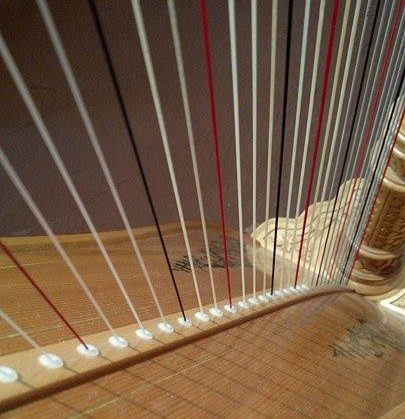
Harp strings. Photo by Leah D. Schade. All rights reserved.
The Harp and the Community of Christ
Text: 1 Cor. 12:14-27
[You can watch the video of this sermon here: (14 minutes)] The Harp Sermon
There is a book by Kahlil Gibran called The Prophet, in which he writes a poem about marriage has always stayed with me because he compares relationships with the strings of an instrument. Listen to his words:
Sing and dance together and be joyous,
but let each of you be alone,
Even as the strings of a [harp] are alone
though they quiver with the same music.
What a wonderful image of two people being together and yet having space in order to make beautiful music. I expand this metaphor to apply not just to two people, but to a whole community of faith, such as ours. And as a harpist, I have been mulling over what it means to be one of the strings in God’s instrument of the church.
Many strings – all necessary
Look at what Paul says about being a community of Christ. Verse 14 – “The body does not consist of one member but of many.” How many strings do you see on this harp? 47. But the sound of the harp is more than just these 47 strings. Look down here to the bottom of the harp – how many pedals do you see? 7 – one for each pitch of the scale. And each pedal has three positions – flat, natural and sharp. These pedals allow for a total of 141 different pitches. So that’s the first thing we learn about being in God’s instrument. It’s not just about one person, but about all of us gathered into this body of Christ.
Paul then says, “If the foot were to say, ‘Because I am not a hand, I do not belong to the body’, that would not make it any less a part of the body. And if the ear were to say, ‘Because I am not an eye, I do not belong to the body’, that would not make it any less a part of the body.”
He’s addressing the topic of inclusion in these verses. Because the church of Corinth was preoccupied with who was really included in their fellowship. Some in their assembly regarded certain individuals, and certain groups of people, as not worthy of inclusion because they were different from the others in the group. But Paul demonstrates just how ridiculous this is. It’s as if one of these pedals were to say, “Because I am not a string, I do not belong to the harp.” But that would not make it any less a part of the harp.
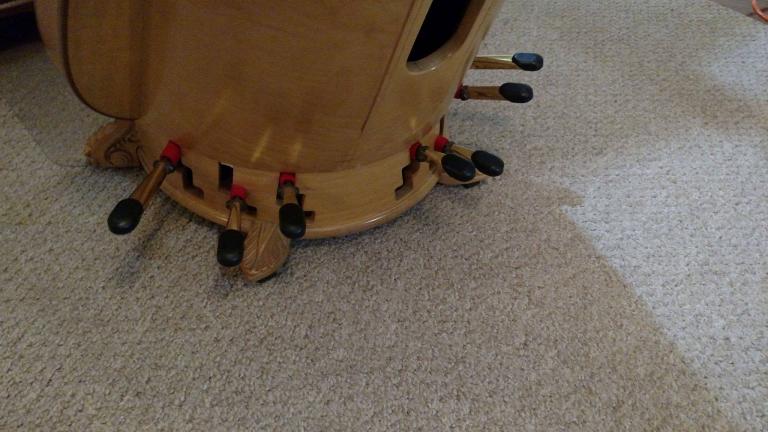
Harp pedals. Photo by Leah D. Schade. All rights reserved.
Without these pedals, I can’t play pretty glissandos. And without all these strings, I can’t play all the pitches that a piece requires. Every string is important. All the pedals are necessary.
All colors are necessary
But the people in the Corinth church wanted to know – are there some people in our fellowship who are more important than others? They were obsessed with status, rank, and position. They wanted to know who had the most value.
Which of these strings do you think is most important? As you saw when I asked the question in the Children’s Sermon, some of them said the white strings, some of them said the strings with different colors. But, in fact, all the strings are important – I need every one of them in order to play the notes of the music.
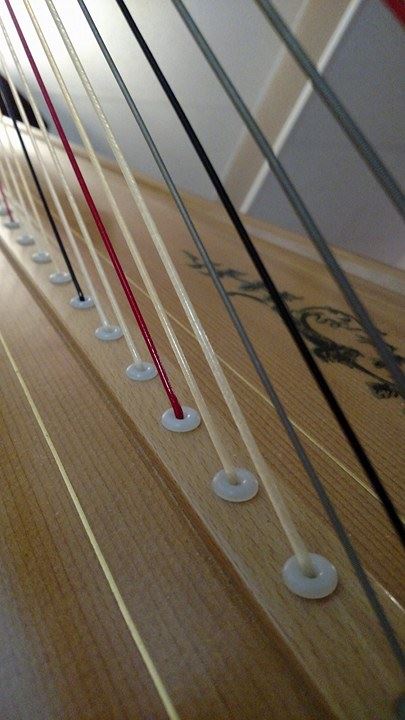
Harp strings. Leah D. Schade. All rights reserved.
In the same way, human beings have different skin colors. But there is nothing fundamentally superior about the quality of people with white skin. And this is important to remember in light of the events in Charlottesville, Virginia. God made all people to be the finest quality, just like the harp strings are all the finest quality.
We can’t be “color-blind”
Some people will say, “Well, I don’t see color. I’m color blind.” But as a harpist, I can tell you – I see color! I need to see color. Without these colors, I don’t know where I am on the harp. All the C’s are red. All the F’s are black or blue. They help to orient me as I play.
There are, of course, different kinds of strings, and that is a good thing! Wire strings are on the bottom, gut in the middle, nylon on the top. There are different diameters – some are thicker, some are thinner. The strings have different lengths – some are shorter, some are longer. And each one is tuned to a different pitch. Every string is necessary, just like every person is necessary. The differences are what make the music possible.
God wants variety
But in Corinth, they thought that certain people in church were more valuable than others. They were holding certain members in higher regard than others, treating certain people as being more important than the rest. They were trying to make the church of Jesus Christ into a hierarchy. But what Paul is trying to illustrate to them with this image of the body is that every member is important. It’s not a top-down pyramid ranking each person from highest to lowest.
As Paul says, “If the whole body were an eye, where would the hearing be? If the whole body were hearing, where would the sense of smell be?” If these were all the same type of string you wouldn’t have a harp anymore. You’d have nothing more than some rubber bands stretched across a box. How boring would that be? No – God created each one of us with differences. And God did this for a reason, for a purpose. God wants variety. God values inclusion.
The sin of exclusion
But for the members of the Corinthian church, the differences were not something to be celebrated. Difference was seen as an excuse to rank people in order of importance and value. They even went so far as to say that those ranked less important were not even needed or wanted by the church. They wanted to shut out those members altogether. But Paul told them that this is ridiculously sinful. It’s like the eye saying to the hand, ‘I have no need of you’, or the head saying to the feet, ‘I have no need of you.’
“On the contrary,” says Paul, “the members of the body that seem to be weaker are indispensable, and those members of the body that we think less honorable we clothe with greater honor, and our less respectable members are treated with greater respect.”
St. Paul urges us to respect the “less respectable”
What does Paul mean by that? How do we treat the less respectable members with greater respect? Let me return you again to the harp. This instrument is not just strings and pedals. They need the structure of the base, sound board, column and neck to hold them all together. All those pieces are important. Not only that, but there are parts of this harp that you cannot even see that are critical in the make up of a pedal harp. There are rods going up through the column that are not visible to the eye – they’re hidden inside the column. And those rods connect to a mechanism of 2000 moving parts here in the neck.
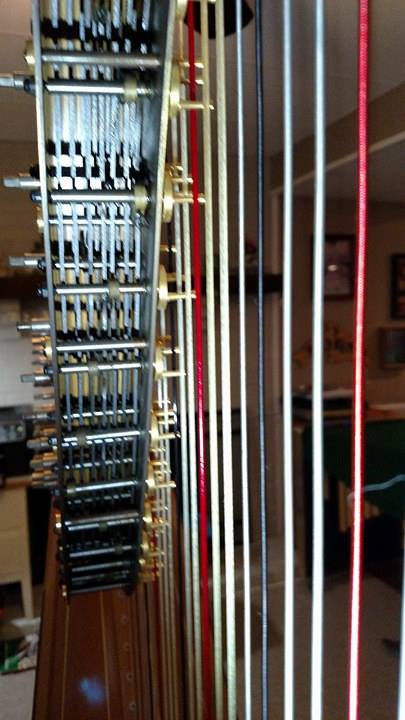
Harp gears. Photo by Leah D. Schade. All rights reserved.
I may want to just ignore this little pin here, or that little gear there, and think that it’s not important. But if just one of these behind-the-scenes parts gets out of alignment or breaks, do you know what will happen to the sound of this harp? [Make buzzing sound on the harp]. A terrible buzzing sound is what you’ll hear.
All of these parts need to be working together in order for the harp to create the best sound possible. They are all a part of the harp, and they are all necessary. In fact, I have to take extra steps to ensure that the inner workings of the harp stay aligned and in place. I have to get a harp regulator to regulate all the gears and pins and action of the harp on a regular basis. I need to make sure that all the parts are working in harmony with each other. And we need to make sure our human community is in harmony.
“If one member suffers, all suffer together with it.”
Paul then says, “If one member suffers, all suffer together with it.” How can this be? How can the events in Charlottesville, Virginia, affect us here in Lexington, Kentucky? Well, when you have a group of white supremacists saying that whole groups of people need to be made subservient or even eliminated based on their skin color, religion, ethnicity, or culture, you know what happens?
[Here I actual use a clipper to cut string. Loud sound of string breaking. You can see this on the video at minute 10:43.]
That’s what happens – the string is cut, gone. And do you know what happens to all the other strings around this empty space? They all get out of tune. You see, each string exerts a certain amount of pressure on this soundboard. If a string is broken or missing, the pressure of the whole soundboard gets out of whack. [I start putting a new string on harp.] So we need to do everything we can to restore the string. Because if I just let that spot open, the tuning of the whole harp is affected. “If one member suffers, all suffer together with it.”
Who is missing?
Look around you – who haven’t you seen sitting here in the seat nearby you in a while? Have you called them? Or sent them a card? Have you told them you miss seeing them here? Sure this string can exist out here on its own. It’s no less a string than when it was on this harp. But it cannot make the same music in this world without being connected to the body. “Now you are the body of Christ and individually members of it,” Paul says.
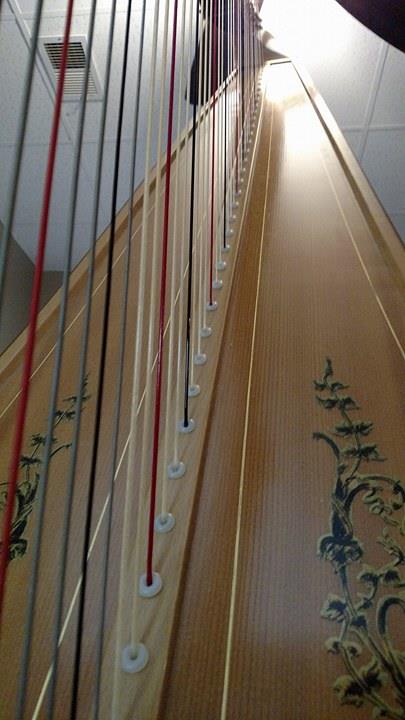
Harp strings, looking up. Photo by Leah D. Schade. All rights reserved.
Each one of you is important!
From the little baby cooing and gurgling in her father’s arms, to the Altar Guild members preparing the table, to the Confirmation students and teens texting each other on their cell phones, to members of the Finance Committee, to the greeter who handed you a bulletin this morning. All colors, all genders, all shapes, all sizes, all religions, all sexualities, all ages – they are all loved by God, and they are all needed on God’s instrument.
[Glissando from top to bottom and back up again] From the sopranos, to the altos, to the tenors, to the basses, and everyone in between. You are right where God wants you to be, and you serve a very important purpose in this instrument of the church. Never doubt that God created you, and created you to make a vital contribution to this world, even if it seems insignificant to you or to others around you. Never doubt that God wants you in this church, as a vital part of the Body of Christ.
Stand up, Body of Christ, Instrument of God, and let your strings vibrate with the love of God, so that the world may hear God’s beautiful, sweet music. Amen!
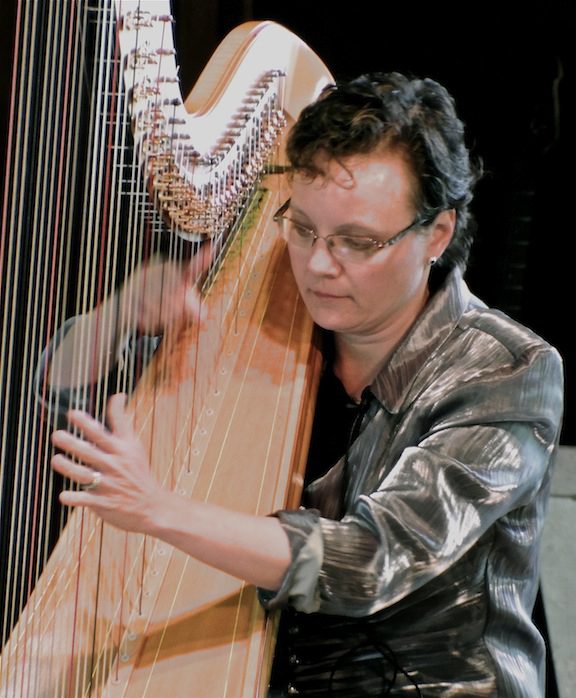 Leah D. Schade is the Assistant Professor of Preaching and Worship at Lexington Theological Seminary (Kentucky) and author of the book Creation-Crisis Preaching: Ecology, Theology, and the Pulpit (Chalice Press, 2015).
You can follow Leah on Twitter at @LeahSchade, and on Facebook at https://www.facebook.com/LeahDSchade/. Videos of Leah playing the harp can be found at https://www.facebook.com/leahschadeharpist/.
For more about preaching about Charlottesville, white supremacy, and racism:
9 Reasons Why You Need to Preach about Charlottesville
How to Preach When You Are Afraid
8 Ways to Preach about Charlottesville, White Supremacy, and Racial Justice
Psalm 137: The Beautifully Dangerous Psalm
Previous Post
August 2, 2017
7 Ways Your Church Can Support Your Female Pastor
Next Post
August 15, 2017 9 Reasons You Need to Preach about Charlottesville and White Supremacy
Browse Our Archives
Select a Category Academy of Homiletics Addiction Advent AI (Artificial Intelligence) Animals Apocalypse Appalachia Ash Wednesday Baptism Bible Black Lives Matter Blade Runner Book review Children in church Christian Nationalism Christian/Islamic relations Christmas Church Clergy Climate change COVID-19 Creation Data Centers Death penalty Devotional Dialogue Doubt Earth Day Easter Ecofeminism EcoPreacher 1-2-3 ELCA ELCA Youth Gathering Election Environment/ecology Epiphany Faith Faith and Politics Feminism Film review Food Food and Faith Forgiveness Fracking Good Friday Good Omens Grief Gun violence Holy Humor Sunday Holy Week Howard Thurman ICE Immigration Indigenous wisdom Interview Jesus Kentucky Lafayette High School Marching Band Leadership Lent LGBTQIA+ Marching band Martin Luther Martin Luther King Jr. Mary Maundy Thursday Michael Sheen Mother of Jesus Nature New Year's Eve Palm Sunday Parables Pentecost Poem, Poetry Politics Poor People's Campaign Pop culture Prayers Preaching Progressive Christianity Public theology Purple Zone Racism and White Privilege Religion Religion and environment Religion and politics Religion and pop culture Religion and violence Rev. Nelson Rabell Gonzalez Sermons Spanish language resources for preaching Technology Thanksgiving Theological education theology Trees Trump Uncategorized Vegan War Women and religion Workshop Worship
Select a Month October 2026 September 2026 July 2026 June 2026 May 2026 April 2026 March 2026 February 2026 January 2026 December 2025 November 2025 October 2025 September 2025 May 2025 April 2025 March 2025 February 2025 January 2025 December 2024 November 2024 October 2024 September 2024 August 2024 July 2024 June 2024 May 2024 April 2024 March 2024 February 2024 January 2024 December 2023 November 2023 October 2023 September 2023 August 2023 July 2023 June 2023 May 2023 April 2023 March 2023 February 2023 January 2023 December 2022 November 2022 October 2022 August 2022 July 2022 June 2022 May 2022 April 2022 March 2022 February 2022 January 2022 December 2021 November 2021 October 2021 September 2021 August 2021 July 2021 June 2021 May 2021 April 2021 March 2021 January 2021 December 2020 November 2020 October 2020 September 2020 August 2020 July 2020 June 2020 May 2020 April 2020 February 2020 January 2020 December 2019 November 2019 October 2019 September 2019 August 2019 July 2019 June 2019 May 2019 April 2019 March 2019 January 2019 December 2018 November 2018 October 2018 September 2018 August 2018 July 2018 June 2018 May 2018 April 2018 March 2018 February 2018 January 2018 December 2017 November 2017 October 2017 September 2017 August 2017 July 2017 June 2017 May 2017 April 2017
Follow Us!
TAKE THE
Religious Wisdom Quiz
What Christian denomination is known for circuit riders and revival meetings in America?
Select your answer to see how you score.
Methodist Catholic Presbyterian Episcopalian
Books by This Author Books by Leah D. Schade
Related posts from EcoPreacher

Making Space for Eco-Grief—and Hope—in Your Church
VBS Murder Skit: When a Church Teaches Children...

Cancer Alley Prophets: Jeremiah 20, Matthew 10
10 Books to Address Christian Nationalism in Your...
TRENDING AT PATHEOS Progressive Christian

What Being a Modern-Day Apostle Means to Me
In my last column, I discussed the ins and outs of modern-day...

Did Ancient China Once Worship the God of...
Across human history, a common thread weaves through the origins of the...

Love Your Neighbor – Including Earth-Kin: Lev. 19,...
God’s command to love your neighbor means acting in an ethical and...

Lead a Church Study of “Jesus and Lao...
Guest writer Jack Thomas (The Irreverent Reverend) reflects on leading his church...

Pastoral Wisdom for Responding to Sermon Pushback
Getting sermon pushback on your social justice sermon? Learn practical, Proverbs-based strategies...

Principles for Understanding the Apostolic Ministry Today
Whenever people discover that my formal ministry title is "apostle," as in...
view all Progressive Christian blogs
Ad-Free & Subscriber Log-In Subscription Support
- About Us
- 2026 Calendar
- Videos
- Podcasts
- Library of World Religions
- Faith In Media Tracker
- Advertise With Us
- Write for Us
- Privacy Policy
- Terms of Service
- Do Not Sell My Data
- Contact Us
- Radiant Digital
- Manage Newsletter Subscriptions
- Unsubscribe From Notifications
- Sitemap
Copyright 2008-2026, Patheos. All rights reserved.
Subscription Support Ad-Free & Subscriber Log-In
Follow Patheos