
BuddhistCatholicContemplativeEvangelicalGeneral ChristianHinduJewishLatter-day SaintMuslimNew VisionsProgressive Christian
Beliefs
- Buddhist
- Catholic
- Contemplative
- Evangelical
- General Christian
- Hindu
- Jewish
- Latter-day Saint
- More Voices
- Muslim
- New Visions
- Pagan
- Progressive Christian
Topics
- Religion News
- Food and Religion
- Sports and Religion
- Religious Art
- Religious Music and Entertainment
- Religious Events
- History and Religion
- Style and Religion
- Politics and Religion
- Women in Religion
- Recreation Outdoors and Religion
- Business Finance and Religion
- Careers Workplace and Religion
- Education and Religion
- Family Parenting and Religion
- Health Fitness and Religion
- Home and Religion
- Relationships and Religion
- Technology and Religion
- Travel and Religion
Columnists
- Buddhist Columnists
- Business Finance and Religion Columnists
- Careers Workplace and Religion Columnists
- Catholic Columnists
- Contemplative Columnists
- Education and Religion Columnists
- Evangelists Columnists
- Family Parenting and Religion Columnists
- General Christian Columnists
- Health Fitness and Religion Columnists
- Hindu Columnists
- History and Religion Columnists
- Home and Religion Columnists
- Jewish Columnists
- More Voices Columnists
- Latter Day Columnists
- Muslim Columnists
- New Visions Columnists
- Nonreligious Columnists
- Pagan Columnists
- Politics and Religion Columnists
- Progressive Columnists
- Recreation Outdoors and Religion Columnists
- Relationships and Religion Columnists
- Religion News Columnists
- Religious Art Columnists
- Religious Events Columnists
- Religious Music and Entertainment Columnists
- Sports and Religion Columnists
- Style and Religion Columnists
- Technology and Religion Columnists
- Travel and Religion Columnists
- Women in Religion Columnists
Resource Library
- 2026 Calendar
- Library of World Religions
- The 100 Most Holy Places on Earth
- Patheos Answers
- Podcasts
- Videos
- Faith Leaders Database
- Anglican Episcopalian
- Bahai
- Baptist
- Buddhism
- Christianity
- Confucianism
- Eastern Orthodoxy
- Hinduism
- Holiness and Pentecostal
- ISKCON
- Islam
- Judaism
- Lutheran
- Methodist
- The Church of Jesus Christ of Latter-day Saints
- New Age
- Paganism
- Presbytarian and Reformed
- Protestantism
- Religion Behind the Scenes
- Roman Catholic
- Scientology
- Shia Islam
- Sikhism
- Sufism
- Sunni Islam
- Taoism
- Zen
- See all religions
Research Tools
 Ad-Free & Subscriber Log-In Subscription Support
Ad-Free & Subscriber Log-In Subscription Support
Follow Patheos 

- Trending:
- Forgiveness
- |
- Marriage
- |
- Consciousness
- |
- Death Penalty
- |
- Election
- |
- Halloween

- Home
- Progressive Christian
- Noah’s Ark and Climate Change: What Kind of Church Will We Be?
Noah’s Ark and Climate Change: What Kind of Church Will We Be?
Last updated on: July 17, 2017 at 7:47 am by Leah D. Schade
Noah’s Ark and Climate Change: What Kind of Church Will We Be? 2017-07-17T07:47:45-04:00 Leah D. Schade
Patheos Explore the world's faith through different perspectives on religion and spirituality! Patheos has the views of the prevalent religions and spiritualities of the world.
The archetypal story of Noah and the Ark has become a beloved children’s motif. But it takes on heavier significance when read in light of our climate crisis and the floods of global warming. How should the Church respond to the threats of climate change?
[Biblical text: Genesis Chapters 6 – 9]
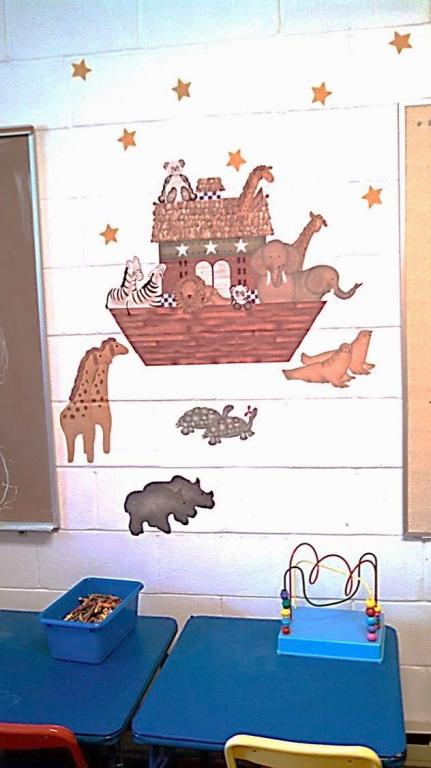
The wall of the children’s nursery in my previous church had a painting of Noah’s Ark.
Kids love the image of all the animals floating together in a big sea-going zoo. I remember shopping for baby items for my children and seeing cute renditions of the ark with adorable giraffes, hippos, and horsies poking their heads out of the windows and smiling from the deck.
But the story is really quite a tragedy, as the movie Noah starring Russell Crowe, has portrayed. If you really think about it, the cataclysmic destruction of life on Earth is overwhelming. And despite our efforts to soften the story, children can still grasp the enormity of the loss. I remember talking about Noah’s Ark in a children’s sermon once, and one child asked, “What happened to all the other animals who weren’t on the ark? And the people?” Er, uh . . .
We rush to the iconic dove and rainbow — God’s promise to never again destroy the Earth. But the truth is, the planet suffered immense loss in that primordial flood.
Here’s the truth, child. When human beings fill the earth with violence, everyone suffers. Even the animals. When human hearts are corrupt and filled with evil, the consequences for the innocent are unbearable (Genesis 6:5 – 13). Yes, the animals died. Yes, the people died. And it’s okay to be sad about that. Because it’s not fair, and it’s not right.
Ancient myths of the flood
Interestingly, the biblical references to a great flood and giant ark have remarkable parallels in many other archetypal myths found around the world. The Noah story as told in the Old Testament is actually a reworking of an earlier Babylonian myth recorded in the Gilgamesh Epic. The stories are nearly identical, save for the names of the characters. And in Greek mythology, there is a story of a eerily similar cataclysmic event in which a hero like Noah builds a boat to survive a great flood. In fact, more than 500 deluge legends are known around the world on nearly every continent.
Why are there so many flood stories? With so much similarity, historians have concluded that there must have been some global cataclysmic event very early in human history, maybe as early as 9500 BCE.
There are different theories as to what caused this global catastrophe. Some geologists think there may have been a huge shift in the earth’s tectonic plates, causing devastating flooding. Others posit that a meteor impacted the earth resulting in earthquakes, volcanic activity and abrupt climate change. But whatever the reason, there is little doubt that the Earth was covered by a deluge that wiped out civilizations around the world, leaving only a remnant of humanity behind to survive, rebuild, and repopulate.
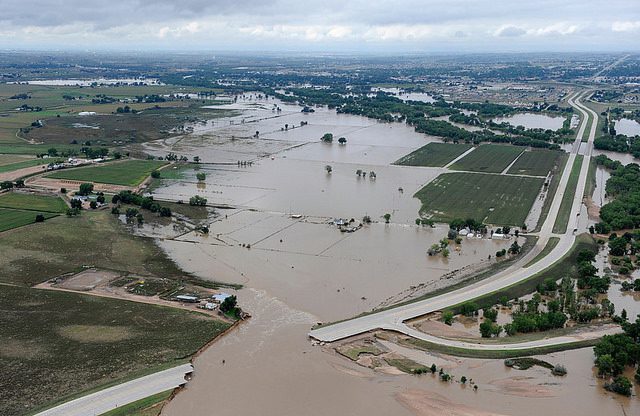
Flood in Greeley, Colorado, September 2013. US-EPA, US government work, no copyright restrictions.
I sometimes wonder if we are living in what will become a future generation’s mythic saga of our planetary catastrophe.
Nearly all my life I have been aware of (and contributing to) the slow-motion rise of a flood that began at the onset of the Industrial Age. From the time I was a child in the 70’s, I had heard warnings about what carbon dioxide from fossil fuels was doing to the atmosphere, warming the planet, melting glaciers, and wreaking environmental havoc across the Earth. Ever since I became a pastor, I’ve advocated for Creation-care, hoping and praying that hearts and minds would open and change. Now here I am with my own children, and The Washington Post reports that a group of scientists, policymakers and corporate leaders have determined that we have a mere three years to set greenhouse gas emissions on a downward path. Otherwise it will become “impossible to contain climate change within safe limits.”
Children are aware of this dystopian future.
At Thanksgiving dinner a few years ago, we were talking about world events and politics when my then 11-year-old daughter piped up, “I don’t know why you’re talking about all this. None of it is going to matter. The apocalypse is already happening. The end of the world is coming.”
Forks clattered. Mouths stood agape with half-swallowed mashed potatoes. All eyes turned to me, the ecofeminist-climate-activist mom. I shrunk in my chair. I never actually used the word “apocalypse” when explaining climate change to her. How did she come up with that?
“Why are you looking at her?” my daughter asked. “Don’t you read the news? It’s not her fault. She’s just trying to warn us.”
Did God try to warn others before getting to Noah?
Had others been given the divine warning about the impending global disaster and refused to heed the call to prepare? We know Noah’s urgent pleas to his neighbors were laughed off as the crazy doomsday scare tactics of a lunatic. In the same way, the warnings of climate scientists today are often dismissed, ridiculed, mocked and silenced. But they are not giving up. “The whole purpose of this comment … is to wake up the intentionality and the ingenuity that we must bring to this effort, because of the urgency,” said Christiana Figueres, who oversaw the United Nations negotiations that produced the Paris climate agreement, and helped author the statement about the three-year window.
But with an all-out assault on the climate and environmental protections by the most powerful nation on Earth, the window of opportunity seems to be narrowing even further.
It’s no wonder that real-life replicas of Noah’s Ark are being constructed around the world (including one near where I live in Kentucky). The ones who build such tourist attractions most likely would deny climate change (or insist that God would never let such a global catastrophe destroy the earth).
But it makes me wonder if the ark-archetype is gaining traction at some level of human consciousness. Because whether we admit it or not, we know the waters are on the rise.
Of course the logistics of getting all those species on a single seafaring vessel is quite absurd and impossible. Just think about how many living creatures Noah would have had to collect and fit on that ark. Here’s a list:
7000 species of worms
50,000 species of arachnids
900,000 species of insects
2500 species of amphibians
6000 species of reptiles
8600 species of birds
and 3500 species of mammals
plus food for one and all. (Walker, Symbols, 85).
How big would that boat have to be?
Here’s the thing: “The only vessel truly capable of holding all these is Spaceship Earth,” (Walker, Symbols, 85).
But this fragile planetary vessel floating in a sea of darkness and stars has once again been filled with with violence. We are finding ourselves with Noah in a Genesis 6 moment. Too many human hearts are corrupt and filled with evil, and the consequences for the innocent are unbearable.
Because it’s not just the climate crisis that plagues this earth. It is a convergence of global crises swirling into a perfect storm on the horizon. The cost of our primary source of energy – fossil fuels – is poisoning water, land, sky and bodies. The explosion of the human population is about to reach unsustainable levels. Financial crises have swept across our human society. And, yes, ecological issues regarding water supplies, global warming, garbage and pollution are threatening the health of the planet itself.
Add to this the accompanying threats of terrorism and war as a result of these conflicts over land and resources (and exacerbated by climate change) and we are, once again, facing a flood of catastrophic proportions. A flood of people, a flood of poverty, a flood of violence, and yes, the actual flooding of the coastlands and river around the world.
But this time the flood is not coming from God. It’s coming from humankind.
It’s hard not to see Noah’s story as a future-present allegory for our own time. In Genesis, God promised to never again destroy the Earth (Genesis 9:8-17). But human beings apparently are not willing to make that same promise. When we put country over planet, when we value our current comfort over our children’s survival, it appears some fatal genetic flaw was passed to us from Adam and Eve through Noah. He and his family were, after all, descendants of the first humans who took what they wanted, despite divine warnings of dire consequences.
What does this mean for us? And what are the implications for the Church in the decades ahead?
In her excellent book Living Beyond the End of the World, Margaret Swedish minces no words: “Nothing will make this wrenching transition go away; we can neither avoid it nor escape it. We have nowhere to go. We will either find a way to live through it, with dignity, with integrity, with hope (not optimism), or we will go through it with mounting human suffering. . . We are coming to the end of the world, or at least to the end of a world. How it ends will be very much up to us. We have many choices in front of us, but not this one – that the world we know is ending,” (156, 158).
There will be drastic changes in how we live, and what we do to survive. And for many people, it will be a matter of survival. In fact, for a large portion of the world’s people, it already is a question of basic survival.
The Church, then, must serve as a kind of “ark,” not just for humanity, but for all Creation. Comparisons of the Church to Noah’s Ark have been made since 1 Peter 3:13-22 (and for an excellent treatment of this text, see this Journey with Jesus essay). But it’s past time for Christians to advocate for all species of plants and animals, as well as the most vulnerable human communities, to find refuge on this ark of planet Earth.
Thankfully, more and more followers of Jesus and other faith communities are making Creation-care a priority.
An increasing number of religious communities are “going green,” as they come to view ecological issues as a matter of justice for the poor, and for the voiceless among God’s creatures (visit GreenFaith for more info). Nine different denominations have moved to divest from fossil fuels. And my ecotheology colleague, Jim Antal, authored a resolution recently approved by the United Church of Christ to denounce President Trump’s withdrawing the US from the Paris climate accords. [For a list of what different faiths have done to advocate for environmental issues, visit Yale’s Forum for Religion and Ecology.]
Disaster response
In terms of more immediate danger, there is also the urgency among religious communities to be prepared for climate-related disasters when they happen. My own Lutheran denomination (ELCA) has an entire division devoted to this effort called Lutheran Disaster Response. What’s great about LDR is that not only do they arrive on the scene when disasters hit, but they stay with communities long after the media spotlight has moved on. They remain committed to the people and neighborhoods in need of help until they have restored their lives and communities. As we’re seeing increasing numbers of climate-exacerbated weather catastrophes, LDR and other church emergency agencies will be needed more and more.
When there are weather-related events, the ark of the Church must be there to assist people, restore some sense of sanity, provide aid and relief, and help to rebuild. We’ve seen that happen over and over again, whether they are tsunami victims in southeast Asia, drought vicitms in Africa, flood victims in New Orleans and along the Mississipi, or victims of the steady onslaught of hurricanes each year. The ark of the Church is there for them, sending forth the dove of peace, and pointing to the rainbow overhead promising God’s ever-present care.
The hardest thing we have ever done
But people of faith must also add their voices and votes to the calls for immediate changes in our energy policies, meat consumption, and carbon-burning lifestyles and industries that are causing the flood of injustice and poverty to rise at unprecedented rates. Faith leaders in wealthy countries need to model a “downwardly mobile” lifestyle that constrains consumption and restores balance with the ecological systems that support human life. Margaret Swedish describes the challenge this way:
What is required now, and this must be the content of the call, is that this nation and other rich countries – and our religious and pastoral leaders as well – be summoned to turn toward a new way of life, one that puts our consumption and waste back into balance with nature, into a relationship with the earth that allows the earth to heal, restore, regenerate what is needed to continue the story of life, while at the same time making it possible for poor people to no longer be poor. . . This will be the hardest thing we have ever done (171).
We can. We must.
We’re in the hot, crowded ark. The flood waters are rising. We must ask ourselves: What kind of Church will we be? What kind of person am I being called to be?
As I remind my children every time we see a rainbow: God has promised to be with us, no matter what we face, and even if it is by our own hand. That promise is refracted by millions upon millions of tiny prism droplets in the sky, forming the colors of the rainbow that fill us with hope.
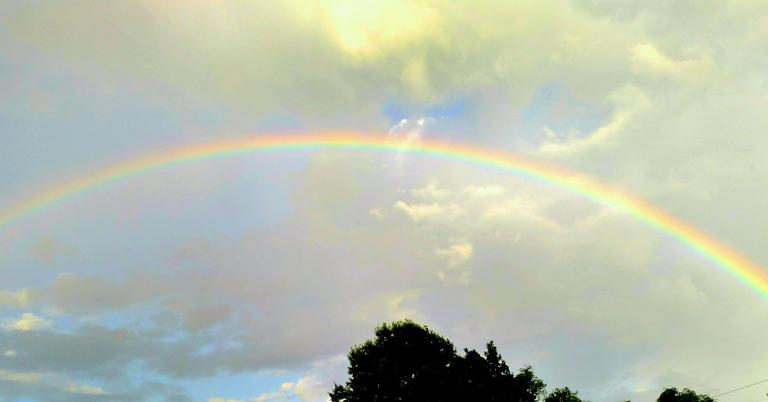
Rainbow. Photo by Leah D. Schade. Pubic Domain.
Leah D. Schade is the Assistant Professor of Preaching and Worship at Lexington Theological Seminary (Kentucky) and author of the book Creation-Crisis Preaching: Ecology, Theology, and the Pulpit (Chalice Press, 2015).
Leah will be presenting at the Wild Goose Festival in Hot Spring, NC, July 14 and 15! Her session info is available here: http://wildgoosefestival.org/sessions17-24/. Enter the special code BEMYGUEST for a 25% discount on tickets!
You can follow Leah on Twitter at @LeahSchade, and on Facebook at https://www.facebook.com/LeahDSchade/.
Check out Leah’s other posts on climate change:
What Can a Person of Faith Do About Climate Change?
Exit Paris? Enter Pentecost! A Christian Response to Reneging on the Climate Promise
Climate Change Impacts Health, Families, and Wallets
Why Changing Light Bulbs May be Hurting the Climate Movement
Sources:
Mooney, Chris, “These experts say we have three years to get climate change under control. And they’re the optimists,” The Washington Post, June 29, 2017. https://www.washingtonpost.com/news/energy-environment/wp/2017/06/29/these-experts-say-we-have-until-2020-to-get-climate-change-under-control-and-theyre-the-optimists/?utm_term=.4fe8d254e29b.
Swedish, Margaret, Living Beyond the End of the World: A Spirituality of Hope. Orbis, 2008.
Walker, Barbara G., The Woman’s Dictionary of Symbols and Sacred Objects, HarperSanFrancisco, 1988.
Previous Post

July 7, 2017
"God Camped Out With Us" - Sermon for a Church Camping Retreat

Browse Our Archives
Select a Category Academy of Homiletics Addiction Advent AI (Artificial Intelligence) Animals Apocalypse Appalachia Ash Wednesday Baptism Bible Black Lives Matter Blade Runner Book review Children in church Christian Nationalism Christian/Islamic relations Christmas Church Clergy Climate change COVID-19 Creation Data Centers Death penalty Devotional Dialogue Doubt Earth Day Easter Ecofeminism EcoPreacher 1-2-3 ELCA ELCA Youth Gathering Election Environment/ecology Epiphany Faith Faith and Politics Feminism Film review Food Food and Faith Forgiveness Fracking Good Friday Good Omens Grief Gun violence Holy Humor Sunday Holy Week Howard Thurman ICE Immigration Indigenous wisdom Interview Jesus Kentucky Lafayette High School Marching Band Leadership Lent LGBTQIA+ Marching band Martin Luther Martin Luther King Jr. Mary Maundy Thursday Michael Sheen Mother of Jesus Nature New Year's Eve Palm Sunday Parables Pentecost Poem, Poetry Politics Poor People's Campaign Pop culture Prayers Preaching Progressive Christianity Public theology Purple Zone Racism and White Privilege Religion Religion and environment Religion and politics Religion and pop culture Religion and violence Rev. Nelson Rabell Gonzalez Sermons Spanish language resources for preaching Technology Thanksgiving Theological education theology Trees Trump Uncategorized Vegan War Women and religion Workshop Worship
Select a Month October 2026 September 2026 July 2026 June 2026 May 2026 April 2026 March 2026 February 2026 January 2026 December 2025 November 2025 October 2025 September 2025 May 2025 April 2025 March 2025 February 2025 January 2025 December 2024 November 2024 October 2024 September 2024 August 2024 July 2024 June 2024 May 2024 April 2024 March 2024 February 2024 January 2024 December 2023 November 2023 October 2023 September 2023 August 2023 July 2023 June 2023 May 2023 April 2023 March 2023 February 2023 January 2023 December 2022 November 2022 October 2022 August 2022 July 2022 June 2022 May 2022 April 2022 March 2022 February 2022 January 2022 December 2021 November 2021 October 2021 September 2021 August 2021 July 2021 June 2021 May 2021 April 2021 March 2021 January 2021 December 2020 November 2020 October 2020 September 2020 August 2020 July 2020 June 2020 May 2020 April 2020 February 2020 January 2020 December 2019 November 2019 October 2019 September 2019 August 2019 July 2019 June 2019 May 2019 April 2019 March 2019 January 2019 December 2018 November 2018 October 2018 September 2018 August 2018 July 2018 June 2018 May 2018 April 2018 March 2018 February 2018 January 2018 December 2017 November 2017 October 2017 September 2017 August 2017 July 2017 June 2017 May 2017 April 2017
Follow Us!
TAKE THE
Religious Wisdom Quiz
Though you sit among the coals lamenting, you must remember that_________. What does Lamentations say will not cease?
Select your answer to see how you score.
His covenant His compassions His love His presence
Books by This Author Books by Leah D. Schade
Related posts from EcoPreacher

Love Your Neighbor – Including Earth-Kin: Lev. 19,...

Preaching About Climate Change: What Clergy Need Most

Making Space for Eco-Grief—and Hope—in Your Church
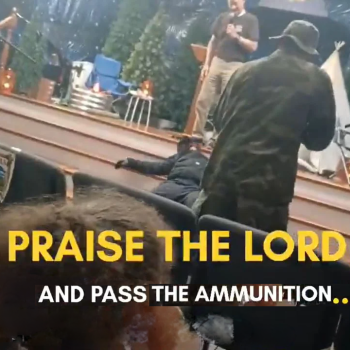
VBS Murder Skit: When a Church Teaches Children...
TRENDING AT PATHEOS Progressive Christian

What Being a Modern-Day Apostle Means to Me
In my last column, I discussed the ins and outs of modern-day...

Did Ancient China Once Worship the God of...
Across human history, a common thread weaves through the origins of the...

Love Your Neighbor – Including Earth-Kin: Lev. 19,...
God’s command to love your neighbor means acting in an ethical and...

Lead a Church Study of “Jesus and Lao...
Guest writer Jack Thomas (The Irreverent Reverend) reflects on leading his church...

Pastoral Wisdom for Responding to Sermon Pushback
Getting sermon pushback on your social justice sermon? Learn practical, Proverbs-based strategies...

Principles for Understanding the Apostolic Ministry Today
Whenever people discover that my formal ministry title is "apostle," as in...
view all Progressive Christian blogs
Ad-Free & Subscriber Log-In Subscription Support
- About Us
- 2026 Calendar
- Videos
- Podcasts
- Library of World Religions
- Faith In Media Tracker
- Advertise With Us
- Write for Us
- Privacy Policy
- Terms of Service
- Do Not Sell My Data
- Contact Us
- Radiant Digital
- Manage Newsletter Subscriptions
- Unsubscribe From Notifications
- Sitemap
Copyright 2008-2026, Patheos. All rights reserved.
Subscription Support Ad-Free & Subscriber Log-In
Follow Patheos