
BuddhistCatholicContemplativeEvangelicalGeneral ChristianHinduJewishLatter-day SaintMuslimNew VisionsProgressive Christian
Beliefs
- Buddhist
- Catholic
- Contemplative
- Evangelical
- General Christian
- Hindu
- Jewish
- Latter-day Saint
- More Voices
- Muslim
- New Visions
- Pagan
- Progressive Christian
Topics
- Religion News
- Food and Religion
- Sports and Religion
- Religious Art
- Religious Music and Entertainment
- Religious Events
- History and Religion
- Style and Religion
- Politics and Religion
- Women in Religion
- Recreation Outdoors and Religion
- Business Finance and Religion
- Careers Workplace and Religion
- Education and Religion
- Family Parenting and Religion
- Health Fitness and Religion
- Home and Religion
- Relationships and Religion
- Technology and Religion
- Travel and Religion
Columnists
- Buddhist Columnists
- Business Finance and Religion Columnists
- Careers Workplace and Religion Columnists
- Catholic Columnists
- Contemplative Columnists
- Education and Religion Columnists
- Evangelists Columnists
- Family Parenting and Religion Columnists
- General Christian Columnists
- Health Fitness and Religion Columnists
- Hindu Columnists
- History and Religion Columnists
- Home and Religion Columnists
- Jewish Columnists
- More Voices Columnists
- Latter Day Columnists
- Muslim Columnists
- New Visions Columnists
- Nonreligious Columnists
- Pagan Columnists
- Politics and Religion Columnists
- Progressive Columnists
- Recreation Outdoors and Religion Columnists
- Relationships and Religion Columnists
- Religion News Columnists
- Religious Art Columnists
- Religious Events Columnists
- Religious Music and Entertainment Columnists
- Sports and Religion Columnists
- Style and Religion Columnists
- Technology and Religion Columnists
- Travel and Religion Columnists
- Women in Religion Columnists
Resource Library
- 2026 Calendar
- Library of World Religions
- The 100 Most Holy Places on Earth
- Patheos Answers
- Podcasts
- Videos
- Faith Leaders Database
- Anglican Episcopalian
- Bahai
- Baptist
- Buddhism
- Christianity
- Confucianism
- Eastern Orthodoxy
- Hinduism
- Holiness and Pentecostal
- ISKCON
- Islam
- Judaism
- Lutheran
- Methodist
- The Church of Jesus Christ of Latter-day Saints
- New Age
- Paganism
- Presbytarian and Reformed
- Protestantism
- Religion Behind the Scenes
- Roman Catholic
- Scientology
- Shia Islam
- Sikhism
- Sufism
- Sunni Islam
- Taoism
- Zen
- See all religions
Research Tools
 Ad-Free & Subscriber Log-In Subscription Support
Ad-Free & Subscriber Log-In Subscription Support
Follow Patheos 

- Trending:
- Forgiveness
- |
- Marriage
- |
- Consciousness
- |
- Death Penalty
- |
- Election
- |
- Halloween

- Home
- Progressive Christian
- Do You Like Our Owl? ‘Blade Runner’ (1982) and Climate Change
Do You Like Our Owl? ‘Blade Runner’ (1982) and Climate Change
Last updated on: October 14, 2017 at 6:27 pm by Leah D. Schade
Do You Like Our Owl? ‘Blade Runner’ (1982) and Climate Change 2017-10-14T18:27:25-04:00 Leah D. Schade
Patheos Explore the world's faith through different perspectives on religion and spirituality! Patheos has the views of the prevalent religions and spiritualities of the world.
Like other Blade Runner geeks, I am eagerly awaiting the sequel to the dystopian sci-fi movie slated for this coming October. But when I recently re-watched the original film, I suddenly realized that climate change was written all over it.

I was 11 when Blade Runner was released in 1982. Over the years I have studied all aspects of the movie, from the lush synthetic music by Vangelis, to the tightly-written script, to the behind-the-scenes documentary. The film, loosely based on Philip K. Dick’s novel, Do Androids Dream of Electric Sheep, was ahead of its time in terms of the way it envisioned the rise of artificial intelligence and the use of technology such as video-phones and computers for forensic investigations. (I remember being blown away watching the main character Deckard [Harrison Ford], zoom in on a photograph to find hidden details – something we do with a mere finger-swipe today.)
Blade Runner = Cli-Fi
But when I recently watched the movie with friends in preparation for Blade Runner 2049’s release, I realized that the film was even more prescient than I thought. Especially in light of my work as an ecotheologian and climate/environmental activist, watching the movie takes on an even more ominous tone for me. I realize that Blade Runner was, in fact, a prototype of #cli-fi, climate fiction, and its futuristic vision has become future-present reality.
Climate change = humanity’s future
Set in 2019 Los Angeles, director Ridley Scott’s film-scape is eerily prophetic of the kinds of issues we are dealing with now in 2017 when the climate crisis is approaching irreversible levels. The movie begins with the camera panning in on a city enshrouded by smog-stained clouds that muddy the sun and dump perpetual rain on the decrepit city. (As we know from climate science – the warmer the atmosphere, the more moisture it absorbs, which results in deluges of rain.)
As the rains fall, towers of flaming gas erupt into the sky, reminding me of the flare stacks I’ve seen at fracking fields and gas refineries. According to the movie’s dismal vision, humanity never makes the transition to clean energy technologies, their fossil fuels continuing to fill the atmosphere with heat-trapping methane and carbon dioxide.

Today, even while the cost of clean energy continues to drop and we’re seeing more solar panels and wind turbines, fossil fuels continue to fill 80% of US energy demands. And the current Republican administration pushes relentlessly and criminally for increased drilling, fracking, and mining. So Blade Runner’s Los Angeles – a polluted and dripping city, awash in neon lights and the detritus of humanity – stands as a cautionary vision of what lies ahead if the transition to clean energy does not happen, or happen fast enough to avoid the worst effects of climate change.
“A new life awaits you in the Off-World colonies.”
According to the movie’s narrative, many humans have already escaped the dying planet to populate Off-World colonies. In reality, while we have not yet approached interstellar migration, it is interesting to note that Stephen Hawking recommends this strategy as one of the only hopes left for humanity’s survival. In the movie, this emigration is made possible because of the Replicants (androids) created to do the hard labor required in the hostile environments of the Off-World.
The premise of the movie is that a group of NEXUS-6 Replicants develop self-consciousness and escape their imprisonment. After murdering their captors, they steal a ship and return to Earth to infiltrate the Tyrell Corporation, the company that created them. Their goal is to find a way to extend their lives beyond their pre-programmed four-year limit. Deckard, a member of the Blade Runner unit in the LA police department, is dispatched to kill the “illegal” Replicants before their presence is discovered by the general population.

“Do you like our owl?”
When he pays a visit to the Tyrell Corporation to test one of the Replicants, Deckard has an exchange with a woman named Rachael which reveals even more bleak details about this futuristic world. Standing in the great hall of Eldon Tyrell, the company’s founder and genius brain-engineer, Deckard watches an owl take flight across the room.
“Do you like our owl?” asks Rachael (Tyrell’s niece) as she enters the room.
“It’s artificial?” Deckard asks.
“Of course.”
“Must be expensive.”
“Very.”
Apparently, the 6th great extinction has already occurred in Blade Runner’s world.
The skies, lands, and seas have become so toxic, and humanity has wiped out so many species, that Earth has been rendered uninhabitable for any creatures save for humans, rats, and bugs. (Watch for the rats scrounging for food on J.F. Sebastian’s table later in the movie, and Deckard pulling a bug out of his mouth from his drink at the bar.) This is a planet that is absent any greenery and devoid of anything but manufactured life.
Cells with serial numbers?
Later, in the apartment of one of the Replicants, Deckard finds a tiny translucent scale from some kind of creature, perhaps a fish or reptile. He takes it to a shop where artificial animals line the windows in cages. The shop owner peers through her electron microscope to determine what kind of creature the scale belongs to. On the screen she sees a serial number inscribed on one of the cells. “Finest quality. Superior workmanship,” she murmurs, and announces that it comes from a snake.
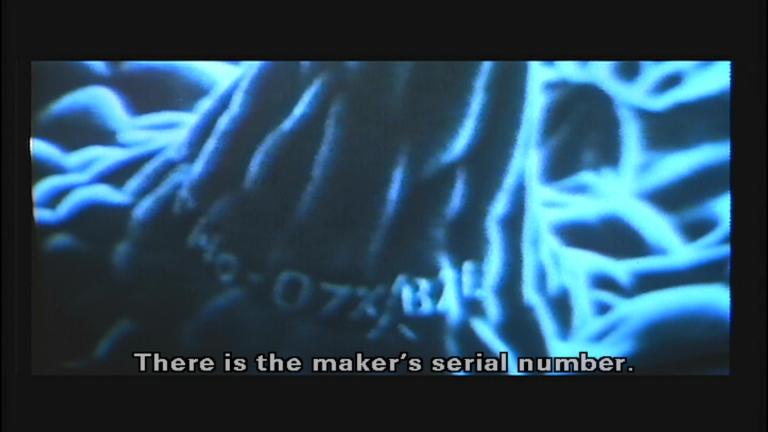
“Superior workmanship”
I thought of recent advances in CRISPR genetic design, nanotechnology, and the cloning of Dolly the Sheep, and the ethical issues such genetic engineering entails. I thought of corporate agri-giant Monsanto and their genetically-modified (GMO) seeds. Acres upon acres of fields are filled with their super-seeds, and when neighboring non-GMO farmer’s crops inadvertently cross-pollinate with Monsanto seeds, the farmers are sued for patent infringement. This forces the farmers either into subservience or financial ruin.
While I am in awe of humanity’s ability to plumb the depths of genetic engineering and the potential good that may result, I must admit: there is something terrifying to me about the ability and audacity to patent genetic code and use it for commercial purposes. Such god-like power over the very essence of life is so very dangerous. There are unintended consequences that are almost certain to backfire on our desire for control over the fundamentals of life itself.
“More human than human”
In Blade Runner, those consequences become real in the form of the NEXUS-6 Replicants. “More human than human,” is the Tyrell Corporation’s motto for the humanoid androids they create. But the desire to manufacture life is not driven by the divine creativity of tov (goodness) found in the biblical creation story of Genesis.
No, rather: “Commerce is our goal here,” Eldon Tyrell explains to Deckard. And when the Replicants rebel against those who profit from their enslavement, chaos and murder ensue.
“The fires of Orc”
“Fiery the angels fell. Deep thunder rolled around their shores, burning with the fires of Orc,” intones Roy Batty, the lead Replicant, when he first confronts a man who genetically designed his eyes. It is a slightly misquoted line from William Blake’s 1793 mythological narrative poem, America A Prophecy. The epic poem, originally meant to describe the rebellion of the American Colonies against England, contains chilling imagery that is eerily prescient of our present age of fiery fossil fuels and tumultuous climate change.
Laotian American writer and science fiction expert, Bryan Thao Worra, describes the mythological figure of Orc in Blake’s narrative, relating it to the Replicants in Blade Runner:
Orc’s activities are driven by emotion, and gradually degenerate into unpredictable chaos, terrorizing those around him. So, too, the degeneration of the replicants even as they seek vindication or redemption for their excesses. It’s a matter of some interest to consider what it means for the angels to fall, according to Roy Batty. With whom, then, does he feel the replicants should identify, even as they’re shackled with such limited time remaining to them? (http://thaoworra.blogspot.com/2009/11/nam-william-blake-orc-and-blade-runner.html)
“Time enough“?
We might ask the same question of ourselves as the clock is ticking on the time remaining for humanity to curb its excesses and transition to a saner, cleaner, more just economy. My teen daughter’s generation is realizing the shackles that have been locked onto them by their elders. For decades, we knew, #Exxonknew, scientists knew the deleterious effects of burning fossil fuels and spewing carbon emissions into the atmosphere. But through sleight-of-hand marketing and rapacious practices, America was tricked into believing the hubristic lie that we have the right to commodify everything from coal, oil and gas, to seeds, sheep, and people. The resulting consequences are worth another line from Blake’s poem:
I see thee in thick clouds and darkness on America’s shore.
Writhing in pangs of abhorred birth; red flames the crest rebellious
And eyes of death . . .

Alternate endings
As I watched the trailer for the new movie, I got the sense that the writers and director decided to follow the bleaker arc intended in the “director’s cut” of the original movie. At the end of the director’s cut, Deckard and Rachael (who, we learn, is also a Replicant) are shown leaving his apartment, the elevator door closing on them as they escape from other Blade Runners that will be seeking her out for “retirement” (a euphemism for execution). But such an ending was deemed “too bleak” by the producers and marketers.
So a cheesy, “Hollywood” ending was tacked on instead. In the version first shown in theatres, Deckard and Rachael fly through blue skies over a lush, green, wooded mountain landscape. The ending is incongruous at best, disingenuous at worst. There is no way such a landscape could exist when we’ve already seen that such healthy ecosystems are no longer possible on this planet. Yet the producers apparently decided that audiences could not handle the original stark ending.
What kind of ending are we heading for?
I am eager to see how Blade Runner 2049 envisions the planet’s future 30 years hence. Yet the idea of seeing our possible fate played out on a screen right before my eyes makes me slightly queasy. While we may not yet have hover-cars, Blade Runner got so many things right when it came to foreseeing America’s climate-blighted future. I worry about what the next movie will show us.
I think of Roy Batty’s final words which filled me with deep pathos as a teen, and sadden me even more now:
“All these moments will be lost in time. . . like tears . . . in rain. Time to die.”
We have already lost so much. It is incumbent on each of us – individually and collectively – to take all necessary steps to ensure that the worst effects of climate change remain in the realm of science fiction.
This post is part of a two-part series. Part Two examines Blade Runner from the perspective of Black Lives Matter.

Leah D. Schade is the Assistant Professor of Preaching and Worship at Lexington Theological Seminary (Kentucky) and author of the book Creation-Crisis Preaching: Ecology, Theology, and the Pulpit (Chalice Press, 2015).
You can follow Leah on Twitter at @LeahSchade, and on Facebook at https://www.facebook.com/LeahDSchade/.

Next Post

July 27, 2017 Watching 'Blade Runner' (1982) in the Age of Black Lives Matter
Browse Our Archives
Select a Category Academy of Homiletics Addiction Advent AI (Artificial Intelligence) Animals Apocalypse Appalachia Ash Wednesday Baptism Bible Black Lives Matter Blade Runner Book review Children in church Christian Nationalism Christian/Islamic relations Christmas Church Clergy Climate change COVID-19 Creation Data Centers Death penalty Devotional Dialogue Doubt Earth Day Easter Ecofeminism EcoPreacher 1-2-3 ELCA ELCA Youth Gathering Election Environment/ecology Epiphany Faith Faith and Politics Feminism Film review Food Food and Faith Forgiveness Fracking Good Friday Good Omens Grief Gun violence Holy Humor Sunday Holy Week Howard Thurman ICE Immigration Indigenous wisdom Interview Jesus Kentucky Lafayette High School Marching Band Leadership Lent LGBTQIA+ Marching band Martin Luther Martin Luther King Jr. Mary Maundy Thursday Michael Sheen Mother of Jesus Nature New Year's Eve Palm Sunday Parables Pentecost Poem, Poetry Politics Poor People's Campaign Pop culture Prayers Preaching Progressive Christianity Public theology Purple Zone Racism and White Privilege Religion Religion and environment Religion and politics Religion and pop culture Religion and violence Rev. Nelson Rabell Gonzalez Sermons Spanish language resources for preaching Technology Thanksgiving Theological education theology Trees Trump Uncategorized Vegan War Women and religion Workshop Worship
Select a Month October 2026 September 2026 July 2026 June 2026 May 2026 April 2026 March 2026 February 2026 January 2026 December 2025 November 2025 October 2025 September 2025 May 2025 April 2025 March 2025 February 2025 January 2025 December 2024 November 2024 October 2024 September 2024 August 2024 July 2024 June 2024 May 2024 April 2024 March 2024 February 2024 January 2024 December 2023 November 2023 October 2023 September 2023 August 2023 July 2023 June 2023 May 2023 April 2023 March 2023 February 2023 January 2023 December 2022 November 2022 October 2022 August 2022 July 2022 June 2022 May 2022 April 2022 March 2022 February 2022 January 2022 December 2021 November 2021 October 2021 September 2021 August 2021 July 2021 June 2021 May 2021 April 2021 March 2021 January 2021 December 2020 November 2020 October 2020 September 2020 August 2020 July 2020 June 2020 May 2020 April 2020 February 2020 January 2020 December 2019 November 2019 October 2019 September 2019 August 2019 July 2019 June 2019 May 2019 April 2019 March 2019 January 2019 December 2018 November 2018 October 2018 September 2018 August 2018 July 2018 June 2018 May 2018 April 2018 March 2018 February 2018 January 2018 December 2017 November 2017 October 2017 September 2017 August 2017 July 2017 June 2017 May 2017 April 2017
Follow Us!
TAKE THE
Religious Wisdom Quiz
Who said, "The just shall live by faith"?
Select your answer to see how you score.
Paul Peter John Jesus
Books by This Author Books by Leah D. Schade
Related posts from EcoPreacher

Love Your Neighbor – Including Earth-Kin: Lev. 19,...

Preaching About Climate Change: What Clergy Need Most

Making Space for Eco-Grief—and Hope—in Your Church

Eco-Wedding Liturgy: Creation-Centered Ideas for Weddings
TRENDING AT PATHEOS Progressive Christian

Why Christians Have a Sacred Duty to Vote:...
The Bible offers strong support for the sacred duty to vote. Here...

What Being a Modern-Day Apostle Means to Me
In my last column, I discussed the ins and outs of modern-day...

Did Ancient China Once Worship the God of...
Across human history, a common thread weaves through the origins of the...

Love Your Neighbor – Including Earth-Kin: Lev. 19,...
God’s command to love your neighbor means acting in an ethical and...

Lead a Church Study of “Jesus and Lao...
Guest writer Jack Thomas (The Irreverent Reverend) reflects on leading his church...

Principles for Understanding the Apostolic Ministry Today
Whenever people discover that my formal ministry title is "apostle," as in...
view all Progressive Christian blogs
Ad-Free & Subscriber Log-In Subscription Support
- About Us
- 2026 Calendar
- Videos
- Podcasts
- Library of World Religions
- Faith In Media Tracker
- Advertise With Us
- Write for Us
- Privacy Policy
- Terms of Service
- Do Not Sell My Data
- Contact Us
- Radiant Digital
- Manage Newsletter Subscriptions
- Unsubscribe From Notifications
- Sitemap
Copyright 2008-2026, Patheos. All rights reserved.
Subscription Support Ad-Free & Subscriber Log-In
Follow Patheos