
BuddhistCatholicContemplativeEvangelicalGeneral ChristianHinduJewishLatter-day SaintMuslimNew VisionsProgressive Christian
Beliefs
- Buddhist
- Catholic
- Contemplative
- Evangelical
- General Christian
- Hindu
- Jewish
- Latter-day Saint
- More Voices
- Muslim
- New Visions
- Pagan
- Progressive Christian
Topics
- Religion News
- Food and Religion
- Sports and Religion
- Religious Art
- Religious Music and Entertainment
- Religious Events
- History and Religion
- Style and Religion
- Politics and Religion
- Women in Religion
- Recreation Outdoors and Religion
- Business Finance and Religion
- Careers Workplace and Religion
- Education and Religion
- Family Parenting and Religion
- Health Fitness and Religion
- Home and Religion
- Relationships and Religion
- Technology and Religion
- Travel and Religion
Columnists
- Buddhist Columnists
- Business Finance and Religion Columnists
- Careers Workplace and Religion Columnists
- Catholic Columnists
- Contemplative Columnists
- Education and Religion Columnists
- Evangelists Columnists
- Family Parenting and Religion Columnists
- General Christian Columnists
- Health Fitness and Religion Columnists
- Hindu Columnists
- History and Religion Columnists
- Home and Religion Columnists
- Jewish Columnists
- More Voices Columnists
- Latter Day Columnists
- Muslim Columnists
- New Visions Columnists
- Nonreligious Columnists
- Pagan Columnists
- Politics and Religion Columnists
- Progressive Columnists
- Recreation Outdoors and Religion Columnists
- Relationships and Religion Columnists
- Religion News Columnists
- Religious Art Columnists
- Religious Events Columnists
- Religious Music and Entertainment Columnists
- Sports and Religion Columnists
- Style and Religion Columnists
- Technology and Religion Columnists
- Travel and Religion Columnists
- Women in Religion Columnists
Resource Library
- 2026 Calendar
- Library of World Religions
- The 100 Most Holy Places on Earth
- Patheos Answers
- Podcasts
- Videos
- Faith Leaders Database
- Anglican Episcopalian
- Bahai
- Baptist
- Buddhism
- Christianity
- Confucianism
- Eastern Orthodoxy
- Hinduism
- Holiness and Pentecostal
- ISKCON
- Islam
- Judaism
- Lutheran
- Methodist
- The Church of Jesus Christ of Latter-day Saints
- New Age
- Paganism
- Presbytarian and Reformed
- Protestantism
- Religion Behind the Scenes
- Roman Catholic
- Scientology
- Shia Islam
- Sikhism
- Sufism
- Sunni Islam
- Taoism
- Zen
- See all religions
Research Tools
 Ad-Free & Subscriber Log-In Subscription Support
Follow Patheos 

- Trending:
- Advent
- |
- Forgiveness
- |
- Thanksgiving
- |
- Election
- |
- Seasonal Holidays
- |
- Marriage

- Home
- Progressive Christian
- La Lengua de Dios: Pentecost and the Language of God
La Lengua de Dios: Pentecost and the Language of God
Last updated on: June 1, 2017 at 2:10 pm by Leah D. Schade
La Lengua de Dios: Pentecost and the Language of God 2017-06-01T14:10:55-04:00 Leah D. Schade
Patheos Explore the world's faith through different perspectives on religion and spirituality! Patheos has the views of the prevalent religions and spiritualities of the world.
Pentecost Sunday is a symphony of different languages. When is the last time you tried to talk with someone who spoke a different language than you?
I had a memorable encounter last year working the concession stand at my son’s baseball game with two other parents. One was Nick who was working the grill. He was white and English-speaking. The other was Maria, who served the food. She is Hispanic. I worked the cash register. Like Nick, I am white.
The two of them had worked together before and had a teasing rapport between them. He would pronounce her name with an exaggerated Hispanic accent, rolling his r’s, or sing her name with the notes of West Side Story’s “Maria.” And she would laugh and tease him right back. At one point she called him loco, which means “crazy.” He said, “I’m just a little crazy. How do you say that in Spanish?”
I offered: “Locito?” Maria turned to me with wide eyes. “Hablas Espanol?” Do you speak Spanish? I said, “Un poco, un poco.” Just a little. I had taken Spanish in high school and college and remembered just a a few words from those days.
The rest of the evening we tossed around different words, Spanish and English. Nick asked, “How do you say French Fries in Spanish?” I offered,“ Fritas?” Maria corrected me: papas fritas. Fried potatoes.
I learned that Maria was from the Dominican Republic, and she shared how she came to be in the U.S. with her three boys. Even though my son and hers were on different teams, we cheered for them. Whether they hit the ball, struck out, caught the pop fly or missed the ball, they heard us cheering for them in English and Spanish.
Hearing your own language in a foreign land
I can just imagine how it must have felt for the pilgrims gathered in Jerusalem for the Jewish festival of Shavuot. The high holy day commemorates the giving of the Law on Sinai to the people of Israel. The “official” language in Jerusalem would have been Latin, as the city was occupied by the Romans. The “official” language of the temple would have been Hebrew or Aramaic. But with all the foreigners pouring into the city, each of them speaking their own foreign language, it must have been confusing.
Maybe that’s the way it was for Maria and her family when they first came to America. Coming through the airport hearing not just English, but so many other languages, not knowing where to go or what to do. But then they found someone who spoke un poco, just a little Spanish to help them find their way.
Have you ever been in a foreign country?
Have you ever walked into a setting where people were talking, but you could not understand their language? The feeling of vulnerability is very disconcerting. I remember feeling that way when I visited Japan many years ago. Stepping into the airport and feeling so disoriented, not being able to read the signs or understand what people were saying.
But then clear as a bell I suddenly heard my own language! It was a like a beacon in a fog and I homed in on that signal. It was our guide who had come to meet us, and I clung to his every word!
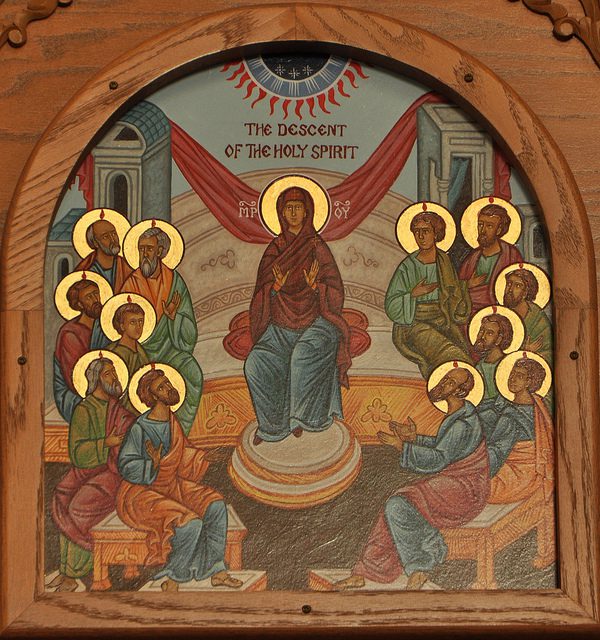
“Descent of the Holy Spirit” St. George Orthodox Cathedral, Toledo. Christine Uveges Loya. Some rights reserved. https://www.flickr.com/photos/frted/
Perhaps this was what it was like for those pilgrims in Jerusalem on that Pentecost Sunday. They passed a strange group of people babbling to each other, surrounded by a rushing wind. Out of the cacaphony of languages, they suddenly heard their own! Homing in on the one who spoke their native tongue, they noticed the strange light hovering over the stranger’s head. It appeared as a little flame, beckoning like a finger to come closer. They clung to his every word, as unto a guide in a new country. And this country was all about Jesus, Yeshua*, Jesu Criste.* In that moment they heard la lingua de Deos — the language of God.
What language shall we require?
I once discussed with a friend the ongoing debate in this country on whether immigrants wanting citizenship should be required to learn the English language. There are good arguments on both sides. Some say we should respect the culture of the immigrant and let them speak their own language. Others say that because English is the official language, they should be required to demonstrate a basic level of proficiency before being granted citizenship. The argument is that they have to be able to function as citizens in this country.
I don’t claim to have proficiency in that area of government policy, nor do I have an answer to that ongoing debate. But here is what I do know: in God’s country there is no language requirement. The miracle of Pentecost is not that the Holy Spirit enabled everyone to speak one official language. The miracle is that the disciples were given the ability to speak in a language other than their own. They were able to make a connection with someone with whom they would never have met otherwise.
Languages are a gift from God
We have so many different languages in our world today. There are approximately 6900 languages—nearly 7000 ways to proclaim God’s love in this world! These are all ways that we can be proclaiming God’s love for people in a language other than our own.
And apparently God thinks this is a good thing.
Remember the story of the Tower of Babel in Genesis Chapter 11? Humanity had become so proud and arrogant that they tried to build a tower up to the heavens. They were dominating the earth, and they all spoke one language.
Apparently there is something about having one language that leads a nation to feel superior. They lost their sense of humility before God, so much so that God confused the language of that civilization and scattered them across the face of the earth.
The lesson: different languages are a way to keep humanity from complete domination.
Have you ever tried to learn another language?
It is quite a humbling experience as you begin to learn a foreign language. You feel awkward and silly when you try to say these words that feel so different on your tongue. It takes a certain level of humbleness to put your security in your own language aside.
And when you try to talk to a native speaker in their own tongue, it takes a certain level of humility. When we take the time to learn another’s language, it says: I want to try to talk to you and listen to you on your terms. I want to learn how you say things, how you put your thoughts together. I want to understand how you experience the world, and how you express those experiences.
When you learn how another person speaks, you open your mind to another way of viewing the world. It takes a lot of effort. But when you humble yourself and try to learn un poco, just a little of another language, it tells the other person: I honor who you are. I honor who you are as a Child of God. And I honor God by trying to learn un poco, just a little of your language.
Are we ready for the fulfillment of the vision?
When Peter talked to that crowd of 3000 gathered on the day of Pentecost, he quoted the prophet Joel in saying, “Your young people will see visions and your elders will dream dreams.” Such dreams and visions are an indication that the Holy Spirit has come upon the people.
When I was still a pastor, I posed a question on Facebook, asking if anyone had any dreams or visions for our church.
One woman shared an actual dream. She was in our church on a Sunday morning, and the sanctuary was packed with people. The pews were so full that people had to stand in the aisles. It wasn’t a special occasion like a funeral, or a wedding, or a holiday. It was just a normal Sunday morning. But in her dream she looked around with amazement that so many people were at church.
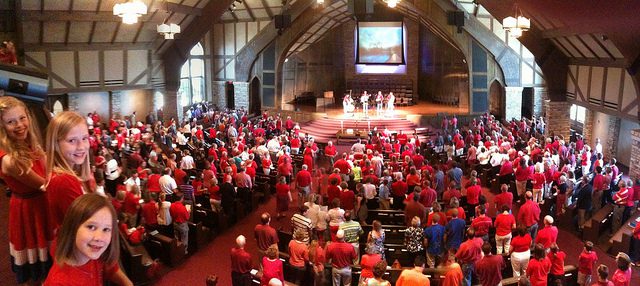
Photo credit: Wesley Fryer. Some rights reserved. https://www.flickr.com/photos/wfryer/
As a pastor, I first got excited that maybe the day is coming when this dream becomes reality.
But as I was reading this text from Acts, it reminded me that if God were to bless our church with that kind of Pentecost moment, it would mean that there would be people in the sanctuary who look different than us. They would have a different skin color, and speak a different language. If the Pentecost moment came to our church, it would mean I would have to converse with someone who comes from a different culture than I do, or a different country than I do.
I began to ask myself: are we as a church ready for that vision to become a reality in this congregation?
What is the language you need to learn?
Are we ready for the Holy Spirit to come into our church? Are we ready to be a Pentecost church, welcoming in a new way?
I’ve often thought that if churches really want to grow, they should determine what is the language—other than English—most commonly spoken in the community. Then offer classes for their members to learn that language. That way they can, like the disciples at Pentecost, be able to speak in la lengua de Dios, the language of God.
La lengua de Dios
There is something about la lengua de Dios that translates into all other languages. Don’t be surprised if, in the coming weeks and months, you start to encounter people who come to you, perhaps completely by surprise, and ask, in essence, Hables la lengua de Dios? Can you humble yourself and reach out to me? Will you help me? Are you willing to form a new friendship with me?
Do you speak the language of God?
And if that happens, maybe you’ll be able to say: un poco, just a little.
That’s all it takes – a little flame, a little courage, a little spark of welcomeness, a little bit of humility. Just a little breath of the Holy Spirit. It takes opening our eyes just a little to see a vision of God’s neighborhood filling our churches.
It takes opening our ears, our mouths, our hands, and our hearts just a little to speak la lengua de Dios.
Leah D. Schade is the Assistant Professor of Preaching and Worship at Lexington Theological Seminary (Kentucky) and author of the book Creation-Crisis Preaching: Ecology, Theology, and the Pulpit (Chalice Press, 2015).
You can follow Leah on Twitter at @LeahSchade, and on Facebook at https://www.facebook.com/LeahDSchade/.
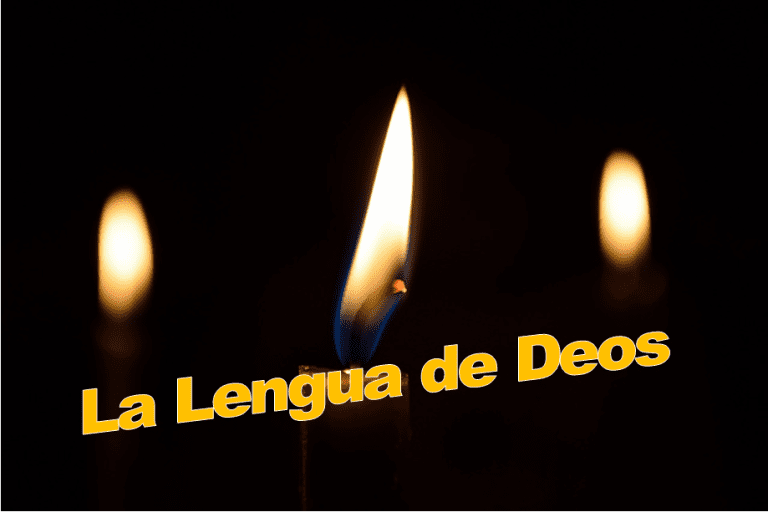
Opening image credit: Created by Leah D. Schade using photo in the public domain from flickr.com.
Previous Post
May 29, 2017
Flag Placement in Church: How to Have the Conversation

Browse Our Archives
Select a Category Academy of Homiletics Addiction Advent AI (Artificial Intelligence) Animals Apocalypse Appalachia Ash Wednesday Baptism Bible Black Lives Matter Blade Runner Book review Children in church Christ the King Sunday Christian Nationalism Christian/Islamic relations Christmas Church Clergy Climate change COVID-19 Creation Data Centers Death penalty Devotional Dialogue Doubt Earth Day Easter Ecofeminism EcoPreacher 1-2-3 ELCA ELCA Youth Gathering Election Environment/ecology Epiphany Faith Faith and Politics Feminism Film review Food Food and Faith Forgiveness Fracking Good Friday Good Omens Grief Gun violence Holy Humor Sunday Holy Week Howard Thurman ICE Immigration Indigenous wisdom Interview Jesus Kentucky Lafayette High School Marching Band Leadership Lent LGBTQIA+ Marching band Martin Luther Martin Luther King Jr. Mary Maundy Thursday Michael Sheen Mother of Jesus Nature New Year's Eve Palm Sunday Parables Pentecost Poem, Poetry Politics Poor People's Campaign Pop culture Prayers Preaching Progressive Christianity Public theology Purple Zone Racism and White Privilege Religion Religion and environment Religion and politics Religion and pop culture Religion and violence Rev. Nelson Rabell Gonzalez Sermons Spanish language resources for preaching Technology Thanksgiving Theological education theology Trees Trump Uncategorized Vegan War Women and religion Workshop Worship
Select a Month November 2026 October 2026 September 2026 July 2026 June 2026 May 2026 April 2026 March 2026 February 2026 January 2026 December 2025 November 2025 October 2025 September 2025 May 2025 April 2025 March 2025 February 2025 January 2025 December 2024 November 2024 October 2024 September 2024 August 2024 July 2024 June 2024 May 2024 April 2024 March 2024 February 2024 January 2024 December 2023 November 2023 October 2023 September 2023 August 2023 July 2023 June 2023 May 2023 April 2023 March 2023 February 2023 January 2023 December 2022 November 2022 October 2022 August 2022 July 2022 June 2022 May 2022 April 2022 March 2022 February 2022 January 2022 December 2021 November 2021 October 2021 September 2021 August 2021 July 2021 June 2021 May 2021 April 2021 March 2021 January 2021 December 2020 November 2020 October 2020 September 2020 August 2020 July 2020 June 2020 May 2020 April 2020 February 2020 January 2020 December 2019 November 2019 October 2019 September 2019 August 2019 July 2019 June 2019 May 2019 April 2019 March 2019 January 2019 December 2018 November 2018 October 2018 September 2018 August 2018 July 2018 June 2018 May 2018 April 2018 March 2018 February 2018 January 2018 December 2017 November 2017 October 2017 September 2017 August 2017 July 2017 June 2017 May 2017 April 2017
Follow Us!
TAKE THE
Religious Wisdom Quiz
Who dreamed of a ladder reaching to heaven?
Select your answer to see how you score.
Simeon Joseph Isaac Jacob
Books by This Author Books by Leah D. Schade
Related posts from EcoPreacher
Making Space for Eco-Grief—and Hope—in Your Church
VBS Murder Skit: When a Church Teaches Children...

Cancer Alley Prophets: Jeremiah 20, Matthew 10
10 Books to Address Christian Nationalism in Your...
TRENDING AT PATHEOS Progressive Christian

The Secret behind A Charlie Brown Thanksgiving
Do you know the secret behind A Charlie Brown Thanksgiving? Sparky was...

Bridging the Gap Between God and Man
From Far Off to the Ultimate Embrace “God is a Spirit: and...

Let Matthew 25 Guide You to a Greater...
With the crisp feel of fall in the air, our minds quickly...

Can a Chatbot Touch Your Soul?
Can a chatbot offer genuine spiritual counsel? One conversation brought me to...

Religion and Politics: How Should We Then Live?
Two cultural axioms get repeated in polite company. Don't mix religion and...

7 Things We Get Wrong About Giving Thanks
It's a time of year when many of us turn to the...
view all Progressive Christian blogs
Ad-Free & Subscriber Log-In Subscription Support
- About Us
- 2026 Calendar
- Videos
- Podcasts
- Library of World Religions
- Faith In Media Tracker
- Advertise With Us
- Write for Us
- Privacy Policy
- Terms of Service
- Do Not Sell My Data
- Contact Us
- Radiant Digital
- Manage Newsletter Subscriptions
- Unsubscribe From Notifications
- Sitemap
Copyright 2008-2026, Patheos, part of the Radiant Digital network of media brands. All rights reserved.
Subscription Support Ad-Free & Subscriber Log-In
Follow Patheos