
BuddhistCatholicContemplativeEvangelicalGeneral ChristianHinduJewishLatter-day SaintMuslimNew VisionsProgressive Christian
Beliefs
- Buddhist
- Catholic
- Contemplative
- Evangelical
- General Christian
- Hindu
- Jewish
- Latter-day Saint
- More Voices
- Muslim
- New Visions
- Pagan
- Progressive Christian
Topics
- Religion News
- Food and Religion
- Sports and Religion
- Religious Art
- Religious Music and Entertainment
- Religious Events
- History and Religion
- Style and Religion
- Politics and Religion
- Women in Religion
- Recreation Outdoors and Religion
- Business Finance and Religion
- Careers Workplace and Religion
- Education and Religion
- Family Parenting and Religion
- Health Fitness and Religion
- Home and Religion
- Relationships and Religion
- Technology and Religion
- Travel and Religion
Columnists
- Buddhist Columnists
- Business Finance and Religion Columnists
- Careers Workplace and Religion Columnists
- Catholic Columnists
- Contemplative Columnists
- Education and Religion Columnists
- Evangelists Columnists
- Family Parenting and Religion Columnists
- General Christian Columnists
- Health Fitness and Religion Columnists
- Hindu Columnists
- History and Religion Columnists
- Home and Religion Columnists
- Jewish Columnists
- More Voices Columnists
- Latter Day Columnists
- Muslim Columnists
- New Visions Columnists
- Nonreligious Columnists
- Pagan Columnists
- Politics and Religion Columnists
- Progressive Columnists
- Recreation Outdoors and Religion Columnists
- Relationships and Religion Columnists
- Religion News Columnists
- Religious Art Columnists
- Religious Events Columnists
- Religious Music and Entertainment Columnists
- Sports and Religion Columnists
- Style and Religion Columnists
- Technology and Religion Columnists
- Travel and Religion Columnists
- Women in Religion Columnists
Resource Library
- 2026 Calendar
- Library of World Religions
- The 100 Most Holy Places on Earth
- Patheos Answers
- Podcasts
- Videos
- Faith Leaders Database
- Anglican Episcopalian
- Bahai
- Baptist
- Buddhism
- Christianity
- Confucianism
- Eastern Orthodoxy
- Hinduism
- Holiness and Pentecostal
- ISKCON
- Islam
- Judaism
- Lutheran
- Methodist
- The Church of Jesus Christ of Latter-day Saints
- New Age
- Paganism
- Presbytarian and Reformed
- Protestantism
- Religion Behind the Scenes
- Roman Catholic
- Scientology
- Shia Islam
- Sikhism
- Sufism
- Sunni Islam
- Taoism
- Zen
- See all religions
Research Tools
 Ad-Free & Subscriber Log-In Subscription Support
Ad-Free & Subscriber Log-In Subscription Support
Follow Patheos 

- Trending:
- Forgiveness
- |
- Marriage
- |
- Consciousness
- |
- Death Penalty
- |
- Election
- |
- Halloween

- Home
- Progressive Christian
- Dar Tellum: 1970s Children’s Book about Climate Change Teaches my Son about Hope
Dar Tellum: 1970s Children’s Book about Climate Change Teaches my Son about Hope
Last updated on: June 13, 2017 at 10:30 am by Leah D. Schade
Dar Tellum: 1970s Children’s Book about Climate Change Teaches my Son about Hope 2017-06-13T10:30:59-04:00 Leah D. Schade
Patheos Explore the world's faith through different perspectives on religion and spirituality! Patheos has the views of the prevalent religions and spiritualities of the world.
Sorting through a box of elementary school mementos, I lifted a book out from under a class picture from 4th grade. My hand brushed over the cover with an odd title and intriguing illustration of a boy’s eyes and forehead merging with a mysterious swirling orb with a tiny face at the center: Dar Tellum – Stranger from a Distant Planet by James R. Berry*.*
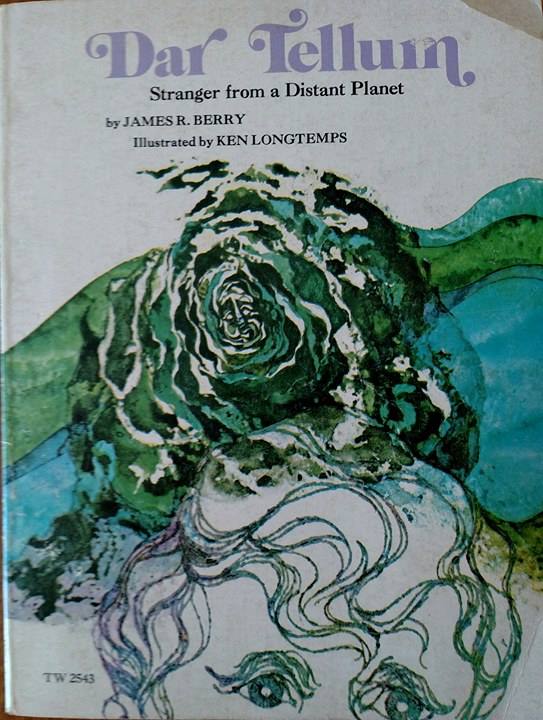
I smiled with recognition, remembering the first time I saw this book.
It was the early 1980s, and our 4th grade class stood in line outside the library door waiting to file in and find our very own book on the R.I.F. tables. R.I.F. stands for “Reading is Fundamental” – a nonprofit children’s literacy organization that brought books to schools twice a year for children to choose and take home. R.I.F. days were one of the highlights of elementary school for me. I couldn’t believe that they were actually giving books away for free! I picked up the thin paperback and opened to the first page:
“They’ve called me a dreamer ever since I can remember. Maybe it’s because I daydream a lot that I met Dar Tellum. I can’t tell grown-ups about him. I tried, but all I got was funny looks. Once my mother felt my forehead. So I know they wouldn’t believe the whole story. That’s why I’m writing this down for other kids to read. If I tell everything just the way it happened, you’ll believe me, even if it does sound pretty strange. And if the same thing ever happens to you, you’ll know it’s true even if no one else – especially grown-ups – believes you.”
“Yes! I’ll believe you!” my 10-year-old mind shouted. It felt like I was being let in on an important secret, one only a kid like me could or would understand. Because I was a dreamer, too. I spent hours in the woods spinning out adventures, seeking hidden messages in the rings of fallen trees, gasping when I found the shimmering rock glinting with magic that would open the secret passageway. So I knew this boy and I were kindred spirits. And I knew I had found my book!
Nearly four decades later, and here was the book once again in my hands.
Though the pages were yellowed, it was in surprisingly good condition. I sat down and read the story again, feeling a wave of nostalgia.
The boy’s name in the story was Ralph, and he describes the experience of being contacted by a mysterious being from a distant planet. Ralph and Dar Tellum communicate in their minds through telepathy and form a friendship. I remembered how the book fascinated me as I watched the two learning about each other’s worlds, and Dar Tellum teaching Ralph how to move objects with his mind through telekinesis.
But then I got to the second chapter, “Crisis on Earth,” and chills of eerie recognition shot up my spine.
Ralph happens upon his parents talking in the kitchen with hushed and worried voices:
“First, I found out what my Dad really does. I always knew he was some sort of an engineer. But he never spoke much about his work at home. It turned out that he was working on a secret government project. . . It seems that the planet Earth was right in the middle of a big crisis. Dozens of cities were in danger of becoming flooded. Already one city in some eastern country was almost covered with water. And the reason for this flooding was that the oceans were getting higher.
From what I understood the smoke from cars and factories called carbon dioxide gets into the atmosphere of Earth. It lets the sun’s heat in, but it won’t let much heat out. This carbon dioxide makes a kind of one-way lid on Earth. Heat in, but not much out. And this extra heat was warming up the north and south poles. So the ice was melting and the oceans were getting higher.”
Climate change! Ralph was talking about global warming!
I flipped back to the copyright page. The book was written in 1973! Just three years earlier, the U.S. National Oceanic and Atmospheric Administration (NOAA) had been established to fund research about climate change. Scientists were just beginning to understand the effects of carbon dioxide on the atmosphere. Apparently this children’s sci-fi author from 40 years ago knew enough about the issue of climate change to create a story out of it.
I’ve only been an environmental and climate activist for about ten years. But I had forgotten about this book, which I had cherished so long ago. Had seeds of my activism been planted without my recognizing it?
To my young mind at the time, the scenario of cities underwater seemed so fantastical, so out of the realm of possibility, that it never occurred to me it could ever happen in real life. But now here I am – a 46-year-old mom with a daughter entering high school, and a son who is now Ralph’s age. The polar ice caps are indeed melting. Coastland cities and island nations are indeed drowning. And the president of my country has just pulled out the Paris Climate Accord that gives guidelines for nations to curb greenhouse gas emissions and avoid the worst effects of climate change. What should I even do with this?
I decided to share Dar Tellum with my son to see what he might think of this book I had loved at his age.
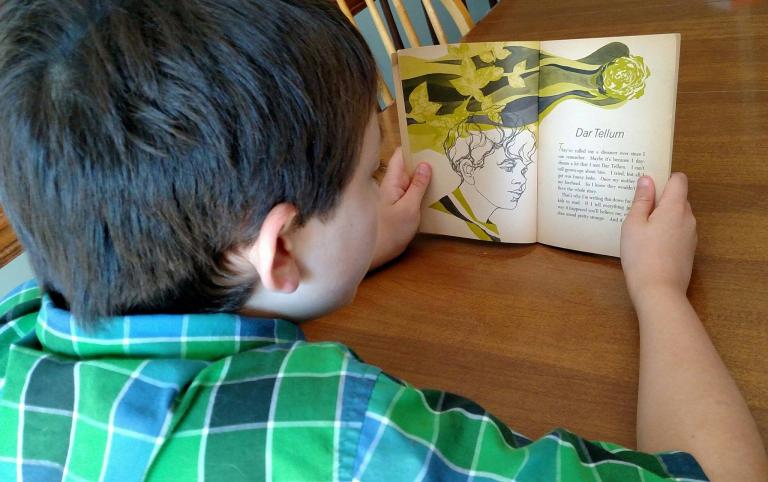
My son reading Dar Tellum. Photo credit: Leah D. Schade
He sat down with his banana and cereal and finished the book in about 90 minutes. Then I asked him some questions.
Me: What do you think the book is about?
Ben: I loved the book. Because it reminds me that there is always good in the future. It’s about saving the world.
Me: Saving the world from what?
Ben: Global warming. That’s what this book is talking about – climate change. The book is warning us about what’s happening right now. It’s trying to warn us about what’s going to happen. And here we are, and there is global warming going on.
I told him to look at the copyright page and find the year when the book was written.
Ben: 1973! Mom, you were only two years old when they knew about this stuff!
I look ruefully at this book once held by my 10-year-old hands, and now held by my 10-year-old son. I realized he’s holding a message in a bottle. But it’s a message that has gone unheeded by the ones who had the power to make changes when there was still time to act.
In the book, Dar Tellum suggests an idea to Ralph for saving Earth.
Ralph then shares the suggestion with his father (explaining the idea came to him in a dream):
“What Dar Tellum said was to put some tiny plants called algae into the atmosphere. Algae are plants so small you need a microscope to see each one. He explained that some kinds of algae can live high up where it’s cold. He said these plants would take carbon dioxide and turn it into oxygen. And, with carbon dioxide turned into oxygen, the Earth’s heat could get out of the atmosphere and the ice caps would stop melting.”
Of course my adult self knows algae living in the atmosphere is based on a scientific and biological impossibility. So I was disappointed that the plot-line of the story was based on such an illogical idea. But at least the author made an attempt to work science into the story, however flawed. Ralph’s father works with scientists to test the theory, and eventually the algae is shot into the atmosphere in a rocket. Earth is saved! [Note that even if it can’t live in thin air, the health of algae IS important for the climate: http://www.trinfinity8.com/studies-link-monsantos-glyphosate-to-ocean-death/.]
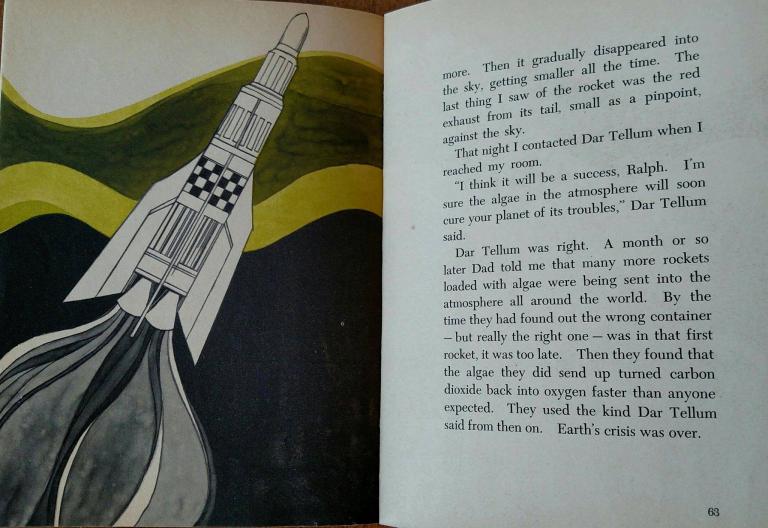
Dar Tellum, final pages
The importance of working with scientists was not lost on my son.
Ben: Scientists need to look for new stuff in the world, like putting algae into the sky. Scientists need to keep learning things about how to solve our problems because that can make a difference. The book shows us a better future, and that it can happen.
But I have to admit my worry that my son might be lulled into the same kind of wishful thinking I am tempted to cling to when problems are so overwhelming. I think both of us feel a little like Ralph in the story – dreamers wishing for help from somewhere or someone that could make the kind of rapid changes needed to reverse the effects of global warming. But the climate feedback loop is accelerating so rapidly, there is currently no technology available to suck up all that CO2 the way it happens in the book.
My son knows this, too. As he’s entering 5th grade, his naivety is falling away. He knows how dire things are, because we talk about it.
Ben: The author knew things were going to get worse. We should have listened to this book and did what it said.
Me: Why didn’t we listen?
Ben: Some people these days are not very good people. The politicians don’t listen. They’re on a whole different story, when they should be reading this one about global warming.
I nodded and thought of Psalm 8:
Out of the mouths of babes and infants
you have founded a bulwark because of your foes,
to silence the enemy and the avenger. (Psalm 8:2)
I asked him one final question: Who do you think should read this book?
Ben: The dreamers – the people who want to make a difference. Because no one else believes us. We can only trust each other. And that’s how we can make a better future.
It was then I realized something. Dar Tellum is, in some ways, our future selves – our best selves – trying to communicate with those who have eyes to see and ears to hear.
My hope and prayer is that there are many more 10-year-olds – and dreamers of all ages – ready to see and listen.
Leah D. Schade is the Assistant Professor of Preaching and Worship at Lexington Theological Seminary (Kentucky) and author of the book Creation-Crisis Preaching: Ecology, Theology, and the Pulpit (Chalice Press, 2015).
Leah will be presenting at the Wild Goose Festival in Hot Spring, NC, July 14 and 15! Her session info is available here: http://wildgoosefestival.org/sessions17-24/. Enter the special code BEMYGUEST for a 25% discount on tickets!
You can follow Leah on Twitter at @LeahSchade, and on Facebook at https://www.facebook.com/LeahDSchade/.
Dar Tellum, Stranger from a Distant Planet was written by James R. Berry and illustrated by Ken Longtemps. (Scholastic Book Services, 1973). The book is available through second-hand sellers on Amazon.com. I would have loved to interview the author for this blog post. Unfortunately, he died in 2003.

Next Post

June 18, 2017 Not Your Mother's "Wonder Woman": A Feminist Review
Browse Our Archives
Select a Category Academy of Homiletics Addiction Advent AI (Artificial Intelligence) Animals Apocalypse Appalachia Ash Wednesday Baptism Bible Black Lives Matter Blade Runner Book review Children in church Christian Nationalism Christian/Islamic relations Christmas Church Clergy Climate change COVID-19 Creation Data Centers Death penalty Devotional Dialogue Doubt Earth Day Easter Ecofeminism EcoPreacher 1-2-3 ELCA ELCA Youth Gathering Election Environment/ecology Epiphany Faith Faith and Politics Feminism Film review Food Food and Faith Forgiveness Fracking Good Friday Good Omens Grief Gun violence Holy Humor Sunday Holy Week Howard Thurman ICE Immigration Indigenous wisdom Interview Jesus Kentucky Lafayette High School Marching Band Leadership Lent LGBTQIA+ Marching band Martin Luther Martin Luther King Jr. Mary Maundy Thursday Michael Sheen Mother of Jesus Nature New Year's Eve Palm Sunday Parables Pentecost Poem, Poetry Politics Poor People's Campaign Pop culture Prayers Preaching Progressive Christianity Public theology Purple Zone Racism and White Privilege Religion Religion and environment Religion and politics Religion and pop culture Religion and violence Rev. Nelson Rabell Gonzalez Sermons Spanish language resources for preaching Technology Thanksgiving Theological education theology Trees Trump Uncategorized Vegan War Women and religion Workshop Worship
Select a Month October 2026 September 2026 July 2026 June 2026 May 2026 April 2026 March 2026 February 2026 January 2026 December 2025 November 2025 October 2025 September 2025 May 2025 April 2025 March 2025 February 2025 January 2025 December 2024 November 2024 October 2024 September 2024 August 2024 July 2024 June 2024 May 2024 April 2024 March 2024 February 2024 January 2024 December 2023 November 2023 October 2023 September 2023 August 2023 July 2023 June 2023 May 2023 April 2023 March 2023 February 2023 January 2023 December 2022 November 2022 October 2022 August 2022 July 2022 June 2022 May 2022 April 2022 March 2022 February 2022 January 2022 December 2021 November 2021 October 2021 September 2021 August 2021 July 2021 June 2021 May 2021 April 2021 March 2021 January 2021 December 2020 November 2020 October 2020 September 2020 August 2020 July 2020 June 2020 May 2020 April 2020 February 2020 January 2020 December 2019 November 2019 October 2019 September 2019 August 2019 July 2019 June 2019 May 2019 April 2019 March 2019 January 2019 December 2018 November 2018 October 2018 September 2018 August 2018 July 2018 June 2018 May 2018 April 2018 March 2018 February 2018 January 2018 December 2017 November 2017 October 2017 September 2017 August 2017 July 2017 June 2017 May 2017 April 2017
Follow Us!
TAKE THE
Religious Wisdom Quiz
What does the name "Moses" mean?
Select your answer to see how you score.
Delivered Drawn out (of water) Judge Saved
Books by This Author Books by Leah D. Schade
Related posts from EcoPreacher

Preaching About Climate Change: What Clergy Need Most

Making Space for Eco-Grief—and Hope—in Your Church
Can Preachers Talk About Climate Change?

Preaching Alongside COP30 - Frameworks for Climate Justice
TRENDING AT PATHEOS Progressive Christian

Why Christians Have a Sacred Duty to Vote:...
The Bible offers strong support for the sacred duty to vote. Here...

What Being a Modern-Day Apostle Means to Me
In my last column, I discussed the ins and outs of modern-day...

Did Ancient China Once Worship the God of...
Across human history, a common thread weaves through the origins of the...

Love Your Neighbor – Including Earth-Kin: Lev. 19,...
God’s command to love your neighbor means acting in an ethical and...

Lead a Church Study of “Jesus and Lao...
Guest writer Jack Thomas (The Irreverent Reverend) reflects on leading his church...

Principles for Understanding the Apostolic Ministry Today
Whenever people discover that my formal ministry title is "apostle," as in...
view all Progressive Christian blogs
Ad-Free & Subscriber Log-In Subscription Support
- About Us
- 2026 Calendar
- Videos
- Podcasts
- Library of World Religions
- Faith In Media Tracker
- Advertise With Us
- Write for Us
- Privacy Policy
- Terms of Service
- Do Not Sell My Data
- Contact Us
- Radiant Digital
- Manage Newsletter Subscriptions
- Unsubscribe From Notifications
- Sitemap
Copyright 2008-2026, Patheos. All rights reserved.
Subscription Support Ad-Free & Subscriber Log-In
Follow Patheos