
BuddhistCatholicContemplativeEvangelicalGeneral ChristianHinduJewishLatter-day SaintMuslimNew VisionsProgressive Christian
Beliefs
- Buddhist
- Catholic
- Contemplative
- Evangelical
- General Christian
- Hindu
- Jewish
- Latter-day Saint
- More Voices
- Muslim
- New Visions
- Pagan
- Progressive Christian
Topics
- Religion News
- Food and Religion
- Sports and Religion
- Religious Art
- Religious Music and Entertainment
- Religious Events
- History and Religion
- Style and Religion
- Politics and Religion
- Women in Religion
- Recreation Outdoors and Religion
- Business Finance and Religion
- Careers Workplace and Religion
- Education and Religion
- Family Parenting and Religion
- Health Fitness and Religion
- Home and Religion
- Relationships and Religion
- Technology and Religion
- Travel and Religion
Columnists
- Buddhist Columnists
- Business Finance and Religion Columnists
- Careers Workplace and Religion Columnists
- Catholic Columnists
- Contemplative Columnists
- Education and Religion Columnists
- Evangelists Columnists
- Family Parenting and Religion Columnists
- General Christian Columnists
- Health Fitness and Religion Columnists
- Hindu Columnists
- History and Religion Columnists
- Home and Religion Columnists
- Jewish Columnists
- More Voices Columnists
- Latter Day Columnists
- Muslim Columnists
- New Visions Columnists
- Nonreligious Columnists
- Pagan Columnists
- Politics and Religion Columnists
- Progressive Columnists
- Recreation Outdoors and Religion Columnists
- Relationships and Religion Columnists
- Religion News Columnists
- Religious Art Columnists
- Religious Events Columnists
- Religious Music and Entertainment Columnists
- Sports and Religion Columnists
- Style and Religion Columnists
- Technology and Religion Columnists
- Travel and Religion Columnists
- Women in Religion Columnists
Resource Library
- 2026 Calendar
- Library of World Religions
- The 100 Most Holy Places on Earth
- Patheos Answers
- Podcasts
- Videos
- Faith Leaders Database
- Anglican Episcopalian
- Bahai
- Baptist
- Buddhism
- Christianity
- Confucianism
- Eastern Orthodoxy
- Hinduism
- Holiness and Pentecostal
- ISKCON
- Islam
- Judaism
- Lutheran
- Methodist
- The Church of Jesus Christ of Latter-day Saints
- New Age
- Paganism
- Presbytarian and Reformed
- Protestantism
- Religion Behind the Scenes
- Roman Catholic
- Scientology
- Shia Islam
- Sikhism
- Sufism
- Sunni Islam
- Taoism
- Zen
- See all religions
Research Tools
 Ad-Free & Subscriber Log-In Subscription Support
Follow Patheos 

- Trending:
- Advent
- |
- Forgiveness
- |
- Thanksgiving
- |
- Election
- |
- Seasonal Holidays
- |
- Marriage

- Home
- Progressive Christian
- Abraham and Isaac, Guns and God
Abraham and Isaac, Guns and God
Last updated on: July 3, 2017 at 12:09 pm by Leah D. Schade
Abraham and Isaac, Guns and God 2017-07-03T12:09:04-04:00 Leah D. Schade
Patheos Explore the world's faith through different perspectives on religion and spirituality! Patheos has the views of the prevalent religions and spiritualities of the world.
The story of Abraham’s near-sacrifice of Isaac has all the drama of a Hollywood movie. [Read: Genesis 22:1-4.]
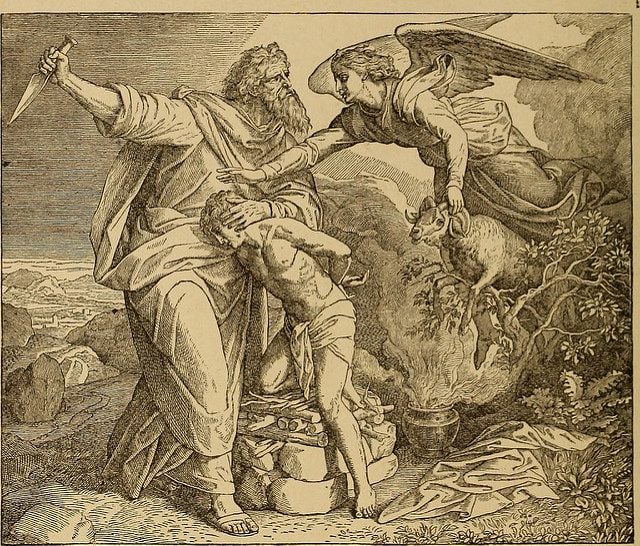
Image from page 127 of “Delightful stories; or, Home talks out of the Wonderful book.” (1888). Public domain.
There is no greater cliff-hanger than the image of Abraham’s knife poised above Isaac, just as an angel flies down to stay his hand. But it is also one of the more disturbing stories in Genesis for one simple reason.
Why would God want to test Abraham by telling him to sacrifice his own son?
What kind of a God is this? Why would God do such a thing? Not only that, but why would Abraham so willingly follow this command to kill his own son without question?
In order to answer these questions, we need to see that there are several layers to this story. And in order to understand what this story means for us today, we need to peel away the layers to find the core that lies at the heart of the story.
Let’s begin with Abraham’s response to this strange and cruel command.
He follows God’s dictate without protest. This may seem odd, but remember the pattern of Abraham’s previous responses to God’s commands. The first command God gave to Abraham was for the 100-yr-old man to leave his home, the land of Ur, with his elderly wife, and make a perilous journey across the desert to the Promised Land. He believed God’s promise of land, prosperity and children, so perhaps he trusted God beyond the need to question.
But in this story, God’s demand seems downright sadistic. Abraham himself must sacrifice his own son. Why? Why would God issue such a violent and abhorrent edict? Well, in that day and age, child sacrifice was not unheard of. It was not unusual for the peoples and cultures of that time to sacrifice their own children in order to appease an angry god, or to stay on the good side of capricious deities. So while it must have broken Abraham’s heart to hear his God make such a demand, he knew from the cultures and religions around him that sometimes this is the price that must be paid in order to secure the favor of one’s god.
So Abraham and Isaac travel three days into the wilderness.
Upon seeing the mountain where he is to perform the deed, Abraham tells his young attendants, “Stay here with the donkey; the boy and I will go over there; we will worship and then we will come back to you.” This is a classic moment of irony and ambiguity. Does Abraham really believe that he and Isaac will return? Or does he only say this to keep them and his son from knowing the truth? We’ll never know. But we can be sure that there must have been a questioning look that passed between the attendants and Isaac. What’s really going on here? It feels like something ominous lies ahead.
Abraham and Isaac begin their final walk to the site of sacrifice. Isaac’s mind must have been racing, the weight from the wood on his shoulders nothing compared to the weight in the pit of his stomach. Finally he asks, “Father, I was just wondering. We’ve got the fire; we’ve got the wood . . .
“Where is the lamb?”
It’s a question that must have gone through Abraham’s heart like the dagger he carried in his hand. It’s one of the most dramatic moments of irony in the Genesis story. Abraham’s answer seems evasive, but it also reveals his faith: “God himself will provide the lamb for a burnt offering, my son.”
These words, “God will provide,” (in Hebrew, YHWH yir-eh) are a statement of faith based on Abraham’s previous experiences with God. When Abraham set out on that journey to the Promised Land, God provided him the strength and endurance to survive the trip. God provided land upon which to settle. And God provided not just one son, but two – Isaac and Ishmael. But the deliberate ambiguity in Abraham’s answer to his son is significant. Will Isaac be the lamb?
“YHWH yir’eh, God will provide.”
I would imagine that those were the words Abraham kept repeating to himself over and over as he piled up the stones for the altar, as he lay down the wood for the sacrifice. “YHWH yir’eh, God will provide.” Perhaps even Isaac began repeating the words like a mantra as his father bound his hands, and he allowed himself to be laid upon the altar, the wood that was on his shoulders now laying under his back. “YHWH yir’eh, God will provide.”
With tears in his eyes, Abraham grabs the dagger. He stands over his son, his tears dripping onto Isaac’s face, mingling with the tears of his beloved son. And he raises his dagger. One last time, “YHWH yir’eh, God will provide.”
“Abraham — STOP!”
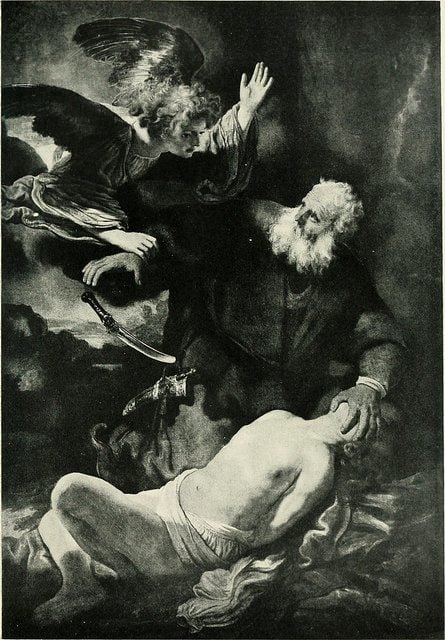
Image from page 234 of “Rembrandt : his life, his work, and his time” (1903). Public domain.
“Do not hurt the boy,” comes the voice from Abraham’s God. I know that you trust me. I know that you would do whatever your God asks of you — even if it meant killing your own son. But let this be a sign unto you — I do not require child sacrifice. God does not demand the blood of children.
And in that instant, Abraham’s eyes are opened, and he sees the ram caught in the thicket. He unties his son and they embrace. Now their tears of fear and sorrow are turned to tears of joy and laughter, “YHWH yir’eh, God will provide.” See? I told you! We’ll even call this place “YHWH yir’eh, God will provide.”
Sometimes we have to be taken right to the edge of death to realize the truth about God. In this story, we are taken right to the edge of the knife so that the lesson of this story will be indelibly etched in our minds. And the message is:
Do not sacrifice your children.
Do not engage in deadly violence against your offspring. Not now, not for all time. This is not a God who demands us to put our children on the altars of idols and sacrifice them. And as the later books of Exodus and Deuteronomy reinforce through their explicit laws against child sacrifice, this is a God who seeks the preservation of our offspring.
Today’s hearers of this text may not at first grasp the import of this story. “Of course we’re not going to kill our own children,” they may respond. But in reality, this story needs to be retold again and again. Because it raises important questions for our modern society:
In what ways are we threatening the health and well-being of our children on the altars of sacrifice?
Might we, in some ways, be like Abraham, blindly assuming that certain sacrifices are necessary, without questioning the culture around us that has conditioned our behaviors?
Because, in fact, child-sacrifice occurs daily on the altars of the gods of war, violence, commerce, lust and greed.
- Child-sacrifices have occurred in the Holy Lands where teens have been kidnapped by both Israelis and Palestinians and brutally murdered.
- Children are suffering by the thousands at the US southern border, caught between countries where their lives are threatened, and a country where so many refuse to welcome them into safety.
- Children are sacrificed in Syria as war rages around them and their small bodies are gassed and bombed.
- Children are sacrificed on the altar of anger in abusive households.
- In many areas of the world, children are valued no higher than chattel. They are recruited for armies, sold into child slavery and brothels, and brainwashed to become the eventual terrorists that carry bombs. Over and over, children are used for immoral purposes and are treated as property and ammunition.
And in America, many children’s lives are sacrificed at the altar of gun violence.
According to the data from the Center for Disease Control and Prevention, gun violence is one of the top five causes of death among children. 2,647 children and teens die from gunfire in America every year. That’s 7 every day. What’s more 17,012 children and teens suffered non-fatal gun injuries and the emotional aftermath that follows. (For more statistics, visit: http://www.bradycampaign.org/key-gun-violence-statistics.)
A year after the mass shooting at Sandy Hook Elementary School in 2012, a report was done on the deaths of 194 children ages 12 and under who died at the end of a gun barrel. From inner cities to tiny rural towns, 127 of the children died from gunshots in their own homes, while dozens more died in the homes of friends, neighbors, and relatives.
- 72 of the young victims either pulled the trigger themselves or were shot dead by another child.
- At least 52 deaths involved a child handling a gun left unsecured.
- 60 children died at the hands of their own parents, 50 of them in homicides.
- The average age of the victims was 6 years old.
(http://www.usatoday.com/story/news/nation/2013/05/11/children-protection-gun-violence/2079177/)
I have held a gun.
I have fired it. As a former hunter, I have used a gun to kill, to take the life of a living animal. There is something about the gun that imbues the holder with a sense of power over another – the power of death and life. If I do not pull the trigger, I have spared your life. If I pull it, I can take your life instantly. This is god-like power. It may be argued that any weapon can give that sense of power. But let’s face it – the only purpose of a gun is to kill or injure. That is why it was invented, and that is its sole purpose. Guns end lives.
And I say this as a former hunter who used to go into the woods every fall and spring to kill animals with a shotgun or rifle. I do not begrudge hunters this right (though I no longer participate in this activity). But as a parent, and as a citizen who has watched so many sacrifices of our children at the altar of the gun, I have to ask:
Are we worshiping the god of the gun?
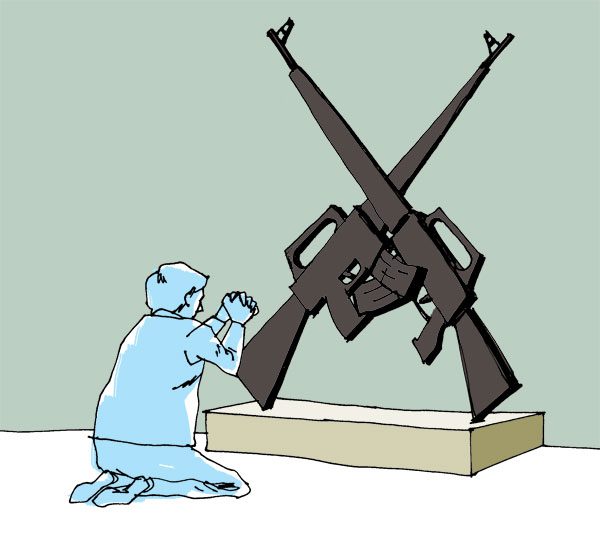
Have we allowed ourselves to become convinced that the sacrifice of children is simply the price that must be paid to the gun-god?
“Worship” may be defined as anything to which human beings devote their sacrifice, allegiance, finances, time and heart. Are we devoted to the “gospel of the gun” that promises safety — salvation, even? The gun-god declares that it is the only one who will provide protection.
For too many, the gun is the answer to all that threatens us or makes us angry.
Is the teenager’s music too loud? Shoot him.
Is his wearing of a hoodie making you feel threatened? Shoot him.
Are girls not going out with you? Shoot them.
Are you angry at the politician, at your classmates, at the driver who cut you off? Are you angry at the ones who have mistreated you? The world? More and more people are turning to the gun-god for their solution. And for thousands of people it is the final solution. There is no going back once the trigger is pulled and the life ends.
“Am I next?”
I remember in 2012 when 20 children and 6 of their teachers were killed at Sandy Hook Elementary School in Newtown, Connecticut. When my son, who was five years old at the time, heard the news that kids in an elementary school just like his were killed, he didn’t ask about gun regulations. He didn’t ask about the sanity of the killer. He didn’t ask about the 2nd Amendment. He asked a question that reminded me of Isaac’s question about the lamb:
“Is someone going to come to my school and shoot kids?” In other words, where is the lamb? Am I next? Am I the lamb to be sacrificed?
I could only say to him words similar to Abraham’s, “I hope and pray that God will provide. There are so many grown-ups who love you and will do everything they can to protect you and your classmates.” YHWH yir’eh, God will provide.
But with the push for even more guns in schools, my prayers and hopes seems less and less potent.
Of course, there is no easy answer to the reality of gun violence.
And I recognize that people will disagree with me about the level to which guns have taken on god-like status and become an idol in our country. But perhaps it is time for people of faith, people in churches, people like you and me to talk about it. If you are a person who attends a house of worship, perhaps there are people in your congregation who would like to engage in discussion about gun violence, and to talk about it in a way that is respectful, honest, and guided by good will.
Because in the midst of all the voices screaming and threatening and pushing their own agenda (especially those who profit from guns), it is time to listen to a different voice. The time has come, and is past due, for us to hear the voice of the God of Abraham, who is reaching out to stay our hand and keep us from sacrificing our children. God is trying to show us another way, directing our vision to an alternative we had not previously considered. Where is our “ram in the thicket”?
Look around you. Look at the culture surrounding you on all sides in the form of media and video games and movies and websites that promise power, safety and security through violence.
Is this what you want? Is this what we want as Christians?
Or is God calling us to something more?
I want to have faith like Abraham had. But I want it to be faith in a God who does not demand the death of children as the price to pay for faithfulness.
Listen – God is calling. “YHWH yir’eh, God will provide. God will provide.”
Amen.

Leah D. Schade is the Assistant Professor of Preaching and Worship at Lexington Theological Seminary (Kentucky) and author of the book Creation-Crisis Preaching: Ecology, Theology, and the Pulpit (Chalice Press, 2015).
Leah will be presenting at the Wild Goose Festival in Hot Spring, NC, July 14 and 15! Her session info is available here: http://wildgoosefestival.org/sessions17-24/. Enter the special code BEMYGUEST for a 25% discount on tickets!
You can follow Leah on Twitter at @LeahSchade, and on Facebook at https://www.facebook.com/LeahDSchade/.
Previous Post

June 27, 2017
Guest Sermon: "Redemption" by Rachel Schade (age 14)
Next Post

July 4, 2017 What to do When Your President Is a Fake Wrestling Goon
Browse Our Archives
Select a Category Academy of Homiletics Addiction Advent AI (Artificial Intelligence) Animals Apocalypse Appalachia Ash Wednesday Baptism Bible Black Lives Matter Blade Runner Book review Children in church Christ the King Sunday Christian Nationalism Christian/Islamic relations Christmas Church Clergy Climate change COVID-19 Creation Data Centers Death penalty Devotional Dialogue Doubt Earth Day Easter Ecofeminism EcoPreacher 1-2-3 ELCA ELCA Youth Gathering Election Environment/ecology Epiphany Faith Faith and Politics Feminism Film review Food Food and Faith Forgiveness Fracking Good Friday Good Omens Grief Gun violence Holy Humor Sunday Holy Week Howard Thurman ICE Immigration Indigenous wisdom Interview Jesus Kentucky Lafayette High School Marching Band Leadership Lent LGBTQIA+ Marching band Martin Luther Martin Luther King Jr. Mary Maundy Thursday Michael Sheen Mother of Jesus Nature New Year's Eve Palm Sunday Parables Pentecost Poem, Poetry Politics Poor People's Campaign Pop culture Prayers Preaching Progressive Christianity Public theology Purple Zone Racism and White Privilege Religion Religion and environment Religion and politics Religion and pop culture Religion and violence Rev. Nelson Rabell Gonzalez Sermons Spanish language resources for preaching Technology Thanksgiving Theological education theology Trees Trump Uncategorized Vegan War Women and religion Workshop Worship
Select a Month November 2026 October 2026 September 2026 July 2026 June 2026 May 2026 April 2026 March 2026 February 2026 January 2026 December 2025 November 2025 October 2025 September 2025 May 2025 April 2025 March 2025 February 2025 January 2025 December 2024 November 2024 October 2024 September 2024 August 2024 July 2024 June 2024 May 2024 April 2024 March 2024 February 2024 January 2024 December 2023 November 2023 October 2023 September 2023 August 2023 July 2023 June 2023 May 2023 April 2023 March 2023 February 2023 January 2023 December 2022 November 2022 October 2022 August 2022 July 2022 June 2022 May 2022 April 2022 March 2022 February 2022 January 2022 December 2021 November 2021 October 2021 September 2021 August 2021 July 2021 June 2021 May 2021 April 2021 March 2021 January 2021 December 2020 November 2020 October 2020 September 2020 August 2020 July 2020 June 2020 May 2020 April 2020 February 2020 January 2020 December 2019 November 2019 October 2019 September 2019 August 2019 July 2019 June 2019 May 2019 April 2019 March 2019 January 2019 December 2018 November 2018 October 2018 September 2018 August 2018 July 2018 June 2018 May 2018 April 2018 March 2018 February 2018 January 2018 December 2017 November 2017 October 2017 September 2017 August 2017 July 2017 June 2017 May 2017 April 2017
Follow Us!
TAKE THE
Religious Wisdom Quiz
What does Paul say happens when we are baptized into Christ Jesus?
Select your answer to see how you score.
We are baptized into his death We receive the Holy Spirit We are saved We become children of God
Books by This Author Books by Leah D. Schade
Related posts from EcoPreacher

Thieves and Bandits, Shepherds and Gates - John...
Reclaiming 1 Peter 2:19-25 From Abuse: Sermon for...
Resist Christian Nationalism in Lent, Matthew 4:1-11

75th Anniversary Sermon, Reformation Lutheran, Media, PA
TRENDING AT PATHEOS Progressive Christian

The Secret behind A Charlie Brown Thanksgiving
Do you know the secret behind A Charlie Brown Thanksgiving? Sparky was...

Bridging the Gap Between God and Man
From Far Off to the Ultimate Embrace “God is a Spirit: and...

Let Matthew 25 Guide You to a Greater...
With the crisp feel of fall in the air, our minds quickly...

Can a Chatbot Touch Your Soul?
Can a chatbot offer genuine spiritual counsel? One conversation brought me to...

Religion and Politics: How Should We Then Live?
Two cultural axioms get repeated in polite company. Don't mix religion and...

7 Things We Get Wrong About Giving Thanks
It's a time of year when many of us turn to the...
view all Progressive Christian blogs
Ad-Free & Subscriber Log-In Subscription Support
- About Us
- 2026 Calendar
- Videos
- Podcasts
- Library of World Religions
- Faith In Media Tracker
- Advertise With Us
- Write for Us
- Privacy Policy
- Terms of Service
- Do Not Sell My Data
- Contact Us
- Radiant Digital
- Manage Newsletter Subscriptions
- Unsubscribe From Notifications
- Sitemap
Copyright 2008-2026, Patheos, part of the Radiant Digital network of media brands. All rights reserved.
Subscription Support Ad-Free & Subscriber Log-In
Follow Patheos