
BuddhistCatholicContemplativeEvangelicalGeneral ChristianHinduJewishLatter-day SaintMuslimNew VisionsProgressive Christian
Beliefs
- Buddhist
- Catholic
- Contemplative
- Evangelical
- General Christian
- Hindu
- Jewish
- Latter-day Saint
- More Voices
- Muslim
- New Visions
- Pagan
- Progressive Christian
Topics
- Religion News
- Food and Religion
- Sports and Religion
- Religious Art
- Religious Music and Entertainment
- Religious Events
- History and Religion
- Style and Religion
- Politics and Religion
- Women in Religion
- Recreation Outdoors and Religion
- Business Finance and Religion
- Careers Workplace and Religion
- Education and Religion
- Family Parenting and Religion
- Health Fitness and Religion
- Home and Religion
- Relationships and Religion
- Technology and Religion
- Travel and Religion
Columnists
- Buddhist Columnists
- Business Finance and Religion Columnists
- Careers Workplace and Religion Columnists
- Catholic Columnists
- Contemplative Columnists
- Education and Religion Columnists
- Evangelists Columnists
- Family Parenting and Religion Columnists
- General Christian Columnists
- Health Fitness and Religion Columnists
- Hindu Columnists
- History and Religion Columnists
- Home and Religion Columnists
- Jewish Columnists
- More Voices Columnists
- Latter Day Columnists
- Muslim Columnists
- New Visions Columnists
- Nonreligious Columnists
- Pagan Columnists
- Politics and Religion Columnists
- Progressive Columnists
- Recreation Outdoors and Religion Columnists
- Relationships and Religion Columnists
- Religion News Columnists
- Religious Art Columnists
- Religious Events Columnists
- Religious Music and Entertainment Columnists
- Sports and Religion Columnists
- Style and Religion Columnists
- Technology and Religion Columnists
- Travel and Religion Columnists
- Women in Religion Columnists
Resource Library
- 2026 Calendar
- Library of World Religions
- The 100 Most Holy Places on Earth
- Patheos Answers
- Podcasts
- Videos
- Faith Leaders Database
- Anglican Episcopalian
- Bahai
- Baptist
- Buddhism
- Christianity
- Confucianism
- Eastern Orthodoxy
- Hinduism
- Holiness and Pentecostal
- ISKCON
- Islam
- Judaism
- Lutheran
- Methodist
- The Church of Jesus Christ of Latter-day Saints
- New Age
- Paganism
- Presbytarian and Reformed
- Protestantism
- Religion Behind the Scenes
- Roman Catholic
- Scientology
- Shia Islam
- Sikhism
- Sufism
- Sunni Islam
- Taoism
- Zen
- See all religions
Research Tools
 Ad-Free & Subscriber Log-In Subscription Support
Ad-Free & Subscriber Log-In Subscription Support
Follow Patheos 

- Trending:
- Forgiveness
- |
- Marriage
- |
- Consciousness
- |
- Death Penalty
- |
- Election
- |
- Halloween

- Home
- Progressive Christian
- Jonah, Ninevites, and Climate Change: EcoPreacher Guest Sermon
Jonah, Ninevites, and Climate Change: EcoPreacher Guest Sermon
Last updated on: May 26, 2017 at 9:23 am by Leah D. Schade
Jonah, Ninevites, and Climate Change: EcoPreacher Guest Sermon 2017-05-26T09:23:20-04:00 Leah D. Schade
Patheos Explore the world's faith through different perspectives on religion and spirituality! Patheos has the views of the prevalent religions and spiritualities of the world.
Carol L. Devine is the Senior Minister of Providence Christian Church (Disciples of Christ) in Lexington, KY, and the second-place winner of the 2017 EcoPreacher Earth Day Sermon Contest. Carol is also the Minister of Green Chalice, part of the Mission and Advocacy ministry of the Disciples of Christ.
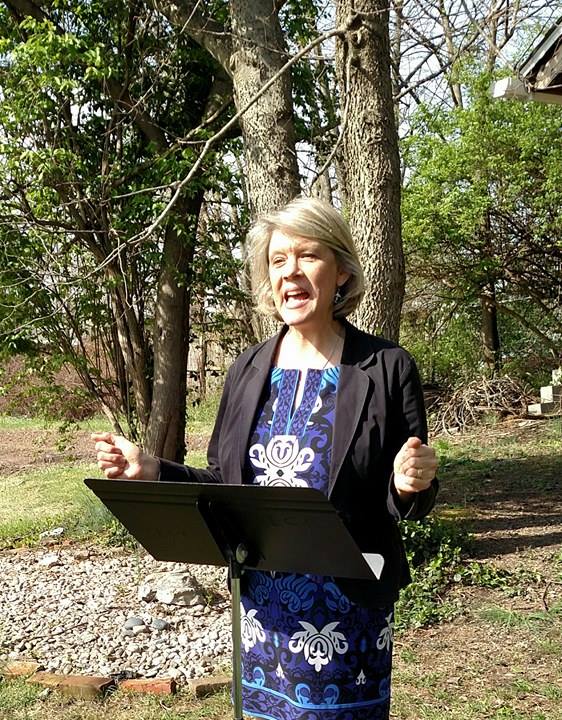
Carole Devine, Minister of Green Chalice (Disciples of Christ)
This sermon was preached on April 2, 2017, at at the community garden space at Transylvania University, Lexington, KY, for an Earth Day Worship Service. One of the many strengths of this sermon is the way Carol applies an eco-hermeneutic to scripture, giving us a “green lens” through which to view the story of Jonah and the Ninevites. She then shows us how their world and our own not only share many similarities, but are both desperately in need of God’s mercy – especially as we face the impending catastrophes associated with climate change.
Carol will receive a signed copy of my book, Creation-Crisis Preaching: Ecology, Theology, and the Pulpit (Chalice Press, 2015).
Living in Ninevah
Copyright, Carol L. Devine, 2017
Text: Jonah 3-4.2
Poor Jonah! His name is not remembered among other great prophets like Isaiah or Jeremiah or Elijah. He is not held up as a model for how to follow God. You don’t come upon statues of Jonah next to fish ponds or even by the seashore. Bless his heart, the only reason he is remembered at all is because his story includes a great big fish, and the whole idea of being swallowed by a whale makes memorable children’s books with beautiful illustrations.
You remember Jonah’s story.
God called him to go to the sinful city of Nineveh to tell them to repent. Jonah said, “Ain’t no way I am going to help save those wretched people.” And so he took off – got on a boat to sail the ocean blue to freedom. But then a powerful storm came up and it looked like they were all going to die.
The captain said to Jonah, “Pray to your God!” And Jonah had to confess that the storm was his fault because he was running from God. The Captain was not thrilled to hear this piece of news and asked what they needed to do to. Jonah responded with the only selfless act of the entire story. He said, “Throw me overboard so that you can live.” With some hesitation, they threw him into the sea and they were indeed saved.
After struggling in the crashing waves, assuming that he would die, Jonah was swallowed up by a huge fish. And in the fish’s belly he stayed – praying. After three days, the whale spit him out onto the beach and Jonah was ready to do what God wanted him to do – but not necessarily with a smile. He agreed to walk the city of Nineveh for 40 days telling them to repent. But he did not like it!
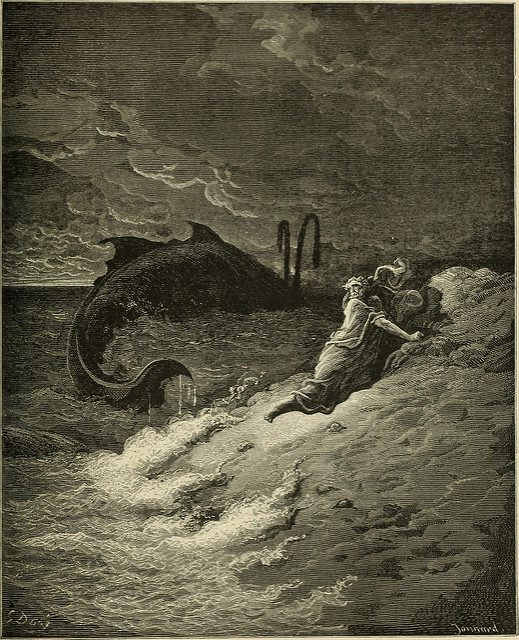
Jonah and the whale. “The Bible Panorama,” 1891. No known copyright restrictions. https://www.flickr.com/photos/internetarchivebookimages/
In fact, Jonah’s vain efforts to refuse God’s call and his bad attitude about the whole mission – including the success he ended up having – has earned him a reputation among some people for being crabby and ridiculous. We have all assumed that he hated the idea that God could care about Gentiles.
But maybe there is more to the story….
Nineveh is just southwest of what is now the city of Mosel, Iraq, just across the Tigris River. Nineveh was one of the oldest and greatest cities in ancient times. Its beginning dates back to 6,000 years before Christ. It was a pagan religious center, a trade center and the capital of Israel’s greatest enemy, Assyria.
Jonah does not tell us much about Nineveh but the Prophet Nahum does. He tells us that their primary sin was War. It was a city of bloodshed which murdered a lot of people and enslaved entire nations (Nahum 3:1). Nahum also says that they “increased the merchants more than the stars of heaven” (Nahum 3:16). It seems the people of Nineveh were most concerned with making money. Because of their violence and greed, when Nineveh is mentioned in the Bible, it is never with affection or compassion.
Saving Nineveh?
So, Nineveh’s deliverance – from Jonah’s perspective – would mean that this sinful city would “live to fight another day,” so to speak. Nineveh would be able to continue to kill and enslave, build wealth and ignore the least of these. Preserving this place and these people could mean that Israel would fight them again at some point in the near future. From his experience, from his knowledge, and from his gut intuition – saving Nineveh was a very bad idea.
As a matter of fact – and unfortunately – Jonah was right! Less than 20 years after he died, in 722 BC, the northern kingdom of Israel was utterly destroyed by the Assyrians. And for a long time after that, Judah and Jerusalem were firmly under the thumb of Assyria as its vassal. So God’s mercy for Nineveh did come at a terrible cost to Israel.
Looking back from our point in history, Jonah’s strong desire to NOT go to Nineveh makes a lot of sense. Jonah knew that God’s mercy is greater and more powerful than God’s justice. And mercy for Nineveh would one day spell destruction, death, and deportation for Jonah’s home and for Jonah’s people. Jonah did not want mercy; he wanted justice!
Saving the U.S.?

Suzan Shown Harjo, advocate for Native American rights. Photo credit: U.S. National Archives. No copyright restrictions.
Jonah’s story in today’s context in the U.S. might be like God calling Suzan Shown Harjo to warn this country of impending doom. Suzan is a Cheyenne and Muscogee Native American Leader who has dedicated her life to advocating for Native American rights.
We can imagine that God might say:
Suzan, the United States is a sinful nation, full of violence and evil. Go to Washington D.C., the center and power of this great nation, and tell the people to turn away from their wickedness and repent. Their greed is desecrating sacred native lands, causing global temperatures to rise, the polar ice caps to melt, and severe weather to destroy lives. My people are dying! Suzan, tell Congress and the President, tell the Supreme Court and all the people who call themselves Americans to change their ways and I will show them mercy.
Suzan might consider this kind of response:
Hmmm, well God – these people that you want to save committed genocide against my people. They continue to seize, loot, dig up, and build on top of our cemeteries and sacred sites without our permission. These people you want to save make a mockery of my people by using our images as mascots, naming a national sports team “Redskins,” and singing chants that denigrate us. They have made over 500 treaties with Indigenous tribes and have changed, nullified or broken all of them. These people you want me to save care more about making money than caring for your good earth and the least of these. I do not want to go to D.C. I do not want to save these sinful and rebellious people.
Do you see? We are living in Nineveh.
Jonah did not want to save those people. Likewise, Suzan and other Native Americans understandably would not want to save us. They can see the writing on the wall – these sinful people will not change! But unlike Jonah, Suzan has not run away from her charge. She is one of the leading Native American activists in the United States, raising public awareness about issues of concern to Native Americans by working on legislation to protect their rights, preserve their languages and traditions, reduce their high levels of poverty, alcoholism and unemployment, and safeguard their sacred lands. [Read more at http://biography.yourdictionary.com/suzan-shown-harjo#oFsqYvJxizPpjxdr.99.]
It has always baffled me that Jesus identified himself with Jonah (Matthew 12:40).
But there are a lot of similarities. Jonah was in the belly of the fish for 3 days and Jesus was dead in the tomb for 3 days. Jonah journeyed through the wilderness of Nineveh for 40 days and Jesus was tempted in the wilderness for 40 days. And like Jonah, who was one of the few prophets sent to speak to nations beyond Israel, Jesus also saved Gentiles.
Maybe the best insight for why Jesus identified with Jonah was when he prayed in the garden of Gethsemane the night he was betrayed. You remember how after the Last Supper with the Disciples, Jesus went outside to pray. Scripture says that Jesus was grieved and agitated as he went to pray and that he fell on his face and prayed, “If it is possible, let this cup pass from me,” (Matthew 26:39-42).
Jesus was fully human and his divinity did not get him a pass from suffering and pain; he did not get a pass from the struggles and feelings that we also experience. Perhaps Jesus felt like Jonah, at least sometimes, as he taught and preached the people, especially the Jewish leadership. Perhaps like Jonah, Jesus knew that everybody would NOT repent and change – that most people would continue to choose making money over caring for the least of these, including Creation. He knew the nations would continue to go to war, to kill and to enslave God’s people.
But thankfully, Jesus was not like Jonah in the most important way.
He did not run from the mission that God gave him. In fact, he faced his mission to save us all with compassion and love, grace and joy.
Thankfully, God’s justice contains a whole lot of grace, because today – we are Ninevites. We live in Nineveh and we need God’s grace and mercy as much today as the people in Jonah’s time. Thankfully, God is merciful and slow to anger. We are the nation continuously at war – participating in killing God’s people. Our nation participates in the multi-billion dollar industry of slavery. This country is much more concerned with making money than caring for the earth or our neighbors.
Recently President Trump put the construction of the Dakota Pipeline on the fast track, going against the pleas of Native Americans who say the pipeline threatens their religious rights and their water supply. And he has rolled back many U.S. climate policies, making it much harder for us to meet our obligations to the Paris-agreement.
So, yes, we live in Nineveh and we are Ninevites.
But what if … we are also all called to be Jonah?

Dakota Access Pipeline protest, Minneapolis, MN. Photo credit: Fibonacci Blue. Some rights reserved. https://www.flickr.com/photos/fibonacciblue/
What if God is calling me and you – each of us – to God’s work; to a mission that probably does not jibe with our desires, with our plans, and with our goals? What if God is calling us – urging us, pulling us, speaking to us?
To stand with our indigenous brothers and sisters and to help protect their land, their culture and their dignity.
Learn about issues that are important to Native Americans who have been oppressed since the first Europeans arrived to the Americas.
Listen to First Peoples who have much to teach us about caring for God’s good Earth.
Like Jonah we may be hesitant, even resistant, to even trying to do the work and save the Ninevites. We may feel like saying: it won’t work, they won’t listen, they won’t change, it is a waste of my breath. But our small actions combined with God’s power will, like Jonah, cause the people and “even animals” to repent (Jonah 3:8). Even the King of Nineveh put on a sackcloth and sat on an ash heap.
Our efforts are needed now more than ever because we are already seeing change…
The Solar and Wind energy industry is growing faster than anyone could have predicted and is cheaper today that ever.
Airborne coal pollution was killing 14,000 people a year in 2010, but today that number has been reduced to 7,000.
Apple, Walmart and Google all announced that they will stick with the established climate goals.
Native American issues are better known today than ever before – from Standing Rock to Sports team mascots, we are taking a stand and making a change.
The word of the Lord came – and is coming still – to all of us Jonahs:
“Get up, go to Nineveh, that great city, and proclaim to it the message that I tell you.”
So let’s get up and go!
To see the first-place winner of the 2017 EcoPreacher Earth Day contest, click here.
Looking for more ideas for “green” sermons, or examples of EcoPreacher sermons? Check out these links:
17 Ways to be an EcoPreacher and Help Heal Our Planet
Why I’m Not Just Preaching About Earth on Earth Day
Falling Off the Bike: A Sermon for Earth Day
Leah D. Schade is the author of the book Creation-CrisisPreaching: Ecology, Theology, and the Pulpit (Chalice Press, 2015).
You can follow Leah on Twitter at @LeahSchade, and on Facebook at https://www.facebook.com/LeahDSchade/.
Previous Post

May 21, 2017
EcoPreacher Earth Day Sermon Contest Winner: Brooke Baker
Next Post

May 28, 2017 Rebuilding the Temple . . . of Earth: EcoPreacher Guest Sermon
Browse Our Archives
Select a Category Academy of Homiletics Addiction Advent AI (Artificial Intelligence) Animals Apocalypse Appalachia Ash Wednesday Baptism Bible Black Lives Matter Blade Runner Book review Children in church Christian Nationalism Christian/Islamic relations Christmas Church Clergy Climate change COVID-19 Creation Data Centers Death penalty Devotional Dialogue Doubt Earth Day Easter Ecofeminism EcoPreacher 1-2-3 ELCA ELCA Youth Gathering Election Environment/ecology Epiphany Faith Faith and Politics Feminism Film review Food Food and Faith Forgiveness Fracking Good Friday Good Omens Grief Gun violence Holy Humor Sunday Holy Week Howard Thurman ICE Immigration Indigenous wisdom Interview Jesus Kentucky Lafayette High School Marching Band Leadership Lent LGBTQIA+ Marching band Martin Luther Martin Luther King Jr. Mary Maundy Thursday Michael Sheen Mother of Jesus Nature New Year's Eve Palm Sunday Parables Pentecost Poem, Poetry Politics Poor People's Campaign Pop culture Prayers Preaching Progressive Christianity Public theology Purple Zone Racism and White Privilege Religion Religion and environment Religion and politics Religion and pop culture Religion and violence Rev. Nelson Rabell Gonzalez Sermons Spanish language resources for preaching Technology Thanksgiving Theological education theology Trees Trump Uncategorized Vegan War Women and religion Workshop Worship
Select a Month October 2026 September 2026 July 2026 June 2026 May 2026 April 2026 March 2026 February 2026 January 2026 December 2025 November 2025 October 2025 September 2025 May 2025 April 2025 March 2025 February 2025 January 2025 December 2024 November 2024 October 2024 September 2024 August 2024 July 2024 June 2024 May 2024 April 2024 March 2024 February 2024 January 2024 December 2023 November 2023 October 2023 September 2023 August 2023 July 2023 June 2023 May 2023 April 2023 March 2023 February 2023 January 2023 December 2022 November 2022 October 2022 August 2022 July 2022 June 2022 May 2022 April 2022 March 2022 February 2022 January 2022 December 2021 November 2021 October 2021 September 2021 August 2021 July 2021 June 2021 May 2021 April 2021 March 2021 January 2021 December 2020 November 2020 October 2020 September 2020 August 2020 July 2020 June 2020 May 2020 April 2020 February 2020 January 2020 December 2019 November 2019 October 2019 September 2019 August 2019 July 2019 June 2019 May 2019 April 2019 March 2019 January 2019 December 2018 November 2018 October 2018 September 2018 August 2018 July 2018 June 2018 May 2018 April 2018 March 2018 February 2018 January 2018 December 2017 November 2017 October 2017 September 2017 August 2017 July 2017 June 2017 May 2017 April 2017
Follow Us!
TAKE THE
Religious Wisdom Quiz
Who did Jesus call the "greatest among those born of women"?
Select your answer to see how you score.
Elijah Peter Moses John the Baptist
Books by This Author Books by Leah D. Schade
Related posts from EcoPreacher

Pastoral Wisdom for Responding to Sermon Pushback

Preaching About Climate Change: What Clergy Need Most

Making Space for Eco-Grief—and Hope—in Your Church

Cancer Alley Prophets: Jeremiah 20, Matthew 10
TRENDING AT PATHEOS Progressive Christian

Why Christians Have a Sacred Duty to Vote:...
The Bible offers strong support for the sacred duty to vote. Here...

What Being a Modern-Day Apostle Means to Me
In my last column, I discussed the ins and outs of modern-day...

Did Ancient China Once Worship the God of...
Across human history, a common thread weaves through the origins of the...

Love Your Neighbor – Including Earth-Kin: Lev. 19,...
God’s command to love your neighbor means acting in an ethical and...

Lead a Church Study of “Jesus and Lao...
Guest writer Jack Thomas (The Irreverent Reverend) reflects on leading his church...

Principles for Understanding the Apostolic Ministry Today
Whenever people discover that my formal ministry title is "apostle," as in...
view all Progressive Christian blogs
Ad-Free & Subscriber Log-In Subscription Support
- About Us
- 2026 Calendar
- Videos
- Podcasts
- Library of World Religions
- Faith In Media Tracker
- Advertise With Us
- Write for Us
- Privacy Policy
- Terms of Service
- Do Not Sell My Data
- Contact Us
- Radiant Digital
- Manage Newsletter Subscriptions
- Unsubscribe From Notifications
- Sitemap
Copyright 2008-2026, Patheos. All rights reserved.
Subscription Support Ad-Free & Subscriber Log-In
Follow Patheos