
BuddhistCatholicContemplativeEvangelicalGeneral ChristianHinduJewishLatter-day SaintMuslimNew VisionsProgressive Christian
Beliefs
- Buddhist
- Catholic
- Contemplative
- Evangelical
- General Christian
- Hindu
- Jewish
- Latter-day Saint
- More Voices
- Muslim
- New Visions
- Pagan
- Progressive Christian
Topics
- Religion News
- Food and Religion
- Sports and Religion
- Religious Art
- Religious Music and Entertainment
- Religious Events
- History and Religion
- Style and Religion
- Politics and Religion
- Women in Religion
- Recreation Outdoors and Religion
- Business Finance and Religion
- Careers Workplace and Religion
- Education and Religion
- Family Parenting and Religion
- Health Fitness and Religion
- Home and Religion
- Relationships and Religion
- Technology and Religion
- Travel and Religion
Columnists
- Buddhist Columnists
- Business Finance and Religion Columnists
- Careers Workplace and Religion Columnists
- Catholic Columnists
- Contemplative Columnists
- Education and Religion Columnists
- Evangelists Columnists
- Family Parenting and Religion Columnists
- General Christian Columnists
- Health Fitness and Religion Columnists
- Hindu Columnists
- History and Religion Columnists
- Home and Religion Columnists
- Jewish Columnists
- More Voices Columnists
- Latter Day Columnists
- Muslim Columnists
- New Visions Columnists
- Nonreligious Columnists
- Pagan Columnists
- Politics and Religion Columnists
- Progressive Columnists
- Recreation Outdoors and Religion Columnists
- Relationships and Religion Columnists
- Religion News Columnists
- Religious Art Columnists
- Religious Events Columnists
- Religious Music and Entertainment Columnists
- Sports and Religion Columnists
- Style and Religion Columnists
- Technology and Religion Columnists
- Travel and Religion Columnists
- Women in Religion Columnists
Resource Library
- 2026 Calendar
- Library of World Religions
- The 100 Most Holy Places on Earth
- Patheos Answers
- Podcasts
- Videos
- Faith Leaders Database
- Anglican Episcopalian
- Bahai
- Baptist
- Buddhism
- Christianity
- Confucianism
- Eastern Orthodoxy
- Hinduism
- Holiness and Pentecostal
- ISKCON
- Islam
- Judaism
- Lutheran
- Methodist
- The Church of Jesus Christ of Latter-day Saints
- New Age
- Paganism
- Presbytarian and Reformed
- Protestantism
- Religion Behind the Scenes
- Roman Catholic
- Scientology
- Shia Islam
- Sikhism
- Sufism
- Sunni Islam
- Taoism
- Zen
- See all religions
Research Tools
 Ad-Free & Subscriber Log-In Subscription Support
Ad-Free & Subscriber Log-In Subscription Support
Follow Patheos 

- Trending:
- Forgiveness
- |
- Marriage
- |
- Consciousness
- |
- Death Penalty
- |
- Election
- |
- Halloween

- Home
- Progressive Christian
- Chaos Theory and the Butterfly Effect: Why Easter Still Matters
Chaos Theory and the Butterfly Effect: Why Easter Still Matters
Last updated on: May 26, 2017 at 8:57 am by Leah D. Schade
Chaos Theory and the Butterfly Effect: Why Easter Still Matters 2017-05-26T08:57:19-04:00 Leah D. Schade
Patheos Explore the world's faith through different perspectives on religion and spirituality! Patheos has the views of the prevalent religions and spiritualities of the world.
This may be a difficult year for Christians to proclaim the Good News of the resurrection of Jesus Christ on Easter Sunday.
Especially when Syrian massacres are escalating.
And the mother-of-all-bombs and Tomahawk missiles mean military conflict in the Middle East is escalating.
And pro- and anti-Trump clashes are escalating.
And North Korean military demonstrations are escalating.
And climate change feedback loops are escalating.
The Easter Conundrum
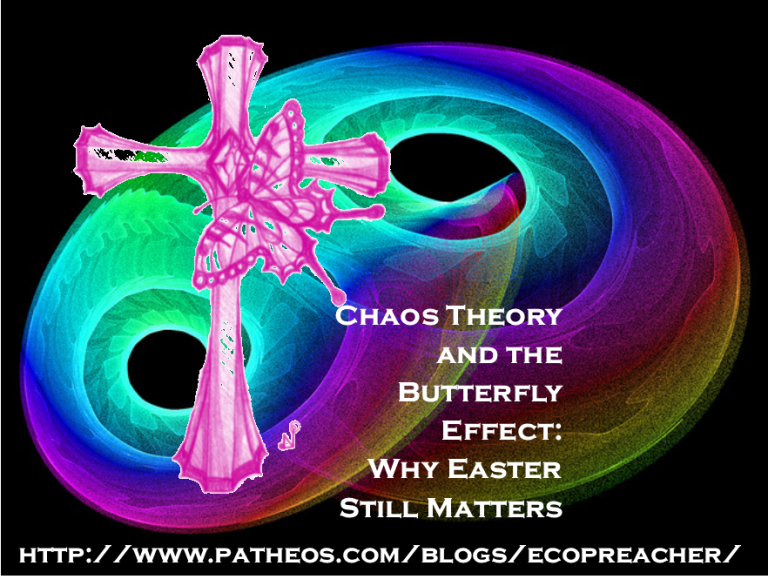
So Progressive Christians are caught in a difficult place. Sermons preaching Jesus’ glorious resurrection can sometimes feel disingenuous. The ubiquitous butterfly-and-cross images can feel trite. The old personal atonement themes of Jesus-dying-for-my-sins can feel as hollow as the chocolate bunnies in the basket – with about the same level of nutritional value. And the escalation of global conflict and possible nuclear war – all while planetary ecological conditions rapidly deteriorate – leave us wondering if the Easter story is even relevant anymore?
Yet the power of the Resurrection stands its ground in front of us. It will not let us off that easily. Ours is not the first generation to face existential annihilation. So is there a way to proclaim the resurrection that is at once authentic, honest and hopeful – without succumbing to the temptation of giving false hope and cheap grace? Is there a way to reclaim the Easter butterfly? Especially when butterflies like the monarch are one of the most threatened species on the planet?
Chaos theory?
Chaos theory is one possible way of recasting the resurrection narrative with a fresh perspective informed by science that may offer some surprising insights for Christians.
Chaos theory originated in the field of mathematics as a study of the way in which initial conditions affect dynamic systems. Sometimes called “the butterfly effect,” chaos theory studies the way non-linear reactions happen in supposedly stable systems. The phrase was coined by meteorologist Edward Norton in the 1960s when he described the flapping of a butterfly’s wings in one part of the world potentially creating a hurricane somewhere else on the planet. If you’ve read Ray Bradbury’s 1950s short story “A Sound of Thunder,” where the death of a butterfly in one moment in time has unexpected ramifications thousands of years later – this is chaos theory.
What’s so refreshing about chaos theory when applied to hegemonic human structures is its ability to break open any hubristic idea that we can control (benevolently or otherwise) nature and, by extension, our fellow humans. Personified in mythology by the “trickster” figure, chaos theory shows up in characters like Br’er Rabbit in African folklore, the Coyote figure in Native American mythology, and even Bugs Bunny from Saturday morning cartoons. They are the court jesters – the “holy fools” – who tell the truth through humor, wit and cunning. “It is not simply that fools change our perspective, though they do that. Rather, fools create a liminal space where new perception becomes possible, but where discernment is both invited and required,” (Campbell and Cilliers, 87).
Jesus the Trickster!
Homileticians Johann Cilliers and Charles Campbell identify Jesus as the ultimate liminal figure. So Jesus is a trickster! “[C]rossing boundaries, teaching and preaching with intentional ambiguity, and calling people to perceive and live at the threshold of the old age and the new – in the reign of God that is breaking into the world. . . [Jesus embodies] in his own person the threshold between the human and the divine, between the old age and the new,” (Campbell and Cilliers, 103).
From an ecological perspective, I’ve always been fascinated with the way in which Jesus, in his role as Trickster, enlists the elements of nature and his non-human kin to “play.” Wind and wave obey his command (Matthew 8:24-27, Mark 4:35-41, Luke 8:22-25). Birds and flowers serve as his teaching partners (Luke 12:24-32), as do fig trees (Matthew 24:32-35, Mark 13:28-31, Luke 21:29-33), wind and weather (Matthew 5:44-45, Luke 12:54-56, John 3:8). Water sneakily becomes wine in stone jars at the Cana wedding (John 2:1-11), and holds him up when he walks across the sea (Mark 6:48-51, John 6:18-21). Stones are enabled to cry out in praise (Luke 19:40). In all these cases, Creation surprises and even suspends its “natural” processes for the sake of thwarting our expectations.
Even the miraculous conception of Jesus in the womb of the Virgin Mary, normally problematic for most feminists, could be seen differently through the trickster lens. Rather than interpreting Jesus’ conception (devoid of sexual intercourse) as proof that sexuality – and thus women – are “dirty” and “sinful,” it may be that Jesus’ surprising conception is meant as a trick played on patriarchy that tries to control and dictate the activity of procreation, often victimizing the women in the process. In the case of Jesus’ conception – surprise! – men are taken completely out of the procreative picture. Which opens up new possibilities for women’s liberation, agency, and power.
The Trickster-Surprise of the Resurrection
And then we come to the Resurrection story. Now we see that Trickster-Jesus has played the ultimate joke on the forces of evil that would subjugate, humiliate and annihilate God’s life-giving love. This means the preacher-fool can joyfully proclaim the surprise of God’s grace upending the structures of death and revealing the triumph of resurrection.
Campbell and Cilliers remind us that “Christ carries in his resurrected body the coarse and vulgar joke of crucifixion. The joke, one might say, lives on. . . .[T]hrough the resurrection Christ defeats the final enemy – death – and sets believers free from the fear of death so we might take up the foolish way of the cross,” (34, 35). Like his crucifixion, Jesus’ resurrection “interrupts the world’s assumptions, opens a liminal space, and calls for new perception – for the bifocal vision at the juncture of the ages,” (36).
With this bi-focal vision applied to chaos theory, we are reminded us that “during stressful periods, particular changes at the micro-level of a given system can generate macro-level changes involving a massive phase shift. In other words, local perturbations can trigger off global changes,” (Zimmerman, 324).
Put another way:
a protest at a town hall meeting against injustice,
or an act of kindness extended to one’s sworn enemy,
or the closing of a coal plant,
or a refusal to return violence with more violence,
may set off shifts in social, economic and ecological dynamics that are not discernible at the outset, but have wider-ranging effects than initially realized.
Ecofeminist theologian Sallie McFague puts it best: “We must believe . . . that life, not death, is the last word; that against all evidence to the contrary (and most evidence is to the contrary), all our efforts on behalf of the well-being of our planet and especially of its most vulnerable creatures, including human ones, will not be defeated. It is the belief that the source and power of the universe is on the side of life and its fulfillment. The ‘risen Christ’ is the Christian way of speaking of this faith and hope: Christ is the firstborn of the new creation, to be followed by the rest of creation, including the last and the least,” (McFague, 191).

Monarch butterfly (Public domain)
What good are a butterflies wings against the hurricane?
Of course, as we partake in the rituals of Easter, some will still accuse us of being fools. An altar with candles is nothing against the explosions of sarin bombs. Easter lilies against MOABs are laughable. Peaceful protesters are nothing against the powers of the militarized police. What difference does it make? You accomplish nothing. You are fools.
Further, Jesus’ light is nothing against the darkness of evil. What good are a butterflies wings against the hurricane? So what if he was resurrected – what difference did it make? Hunger, poverty, disease, injustice, climate change, violence, war and death – those powers are still the law of the land.
And this is a fact. But do not underestimate the power of the Trickster-Jesus and the disrupting chaos of the cross. People advocating for the monarch butterfly and planting milkweed seeds and calling for the end of herbicides are all creating a small but noticeable increase in the population of the orange-winged insects. Micro-level changes are disrupting macro-level devastations.
In the same way, Christians singing hymns of joy, using a few drops of water for baptism, eating little crusts of bread and sipping tiny cups of wine, being generous and offering compassion to our neighbors, actively taking part in resistance to oppression, spontaneously erupting with the Easter laugh . . . these are micro-level disruptions of macro-level evil. And they sustain us, even surprise us, with God’s grace. The wind from the butterflies wings are the hurricane! The hurricane against the systems of oppression and injustice that had assumed eternal reign.
So go ahead and laugh and live. Because we know something that they don’t know. We may be living in the long night of Good Friday, but the promise of God’s Easter Sunday morning is sure to surprise us with joy. And the Trickster Jesus will always have the last laugh.
For another post on the “butterfly effect” as it relates to ecological and economic justice, click here.
For a reflection about preaching on Earth Sunday, click here.
Leah D. Schade is the Assistant Professor of Preaching and Worship at Lexington Theological Seminary (Kentucky) and author of the book Creation-CrisisPreaching: Ecology, Theology, and the Pulpit (Chalice Press, 2015).
You can follow Leah on Twitter at @LeahSchade, and on Facebook at https://www.facebook.com/LeahDSchade/.
Sources:
Charles L Campbell. and Johan H. Cilliers. Preaching Fools: The Gospel as a Rhetoric of Folly. Waco, TX: Baylor University Press, 2012.
Sallie McFague. The Body of God: An Ecological Theology. Minneapolis: Fortress Press, 1993.
Michael E. Zimmerman. Contesting Earth’s Future: Radical Ecology and Postmodernity. Berkeley: University of California Press, 1994.
Previous Post

April 13, 2017
5 A's for Earth Day: Practices of Compassion and Resistance
Next Post

April 16, 2017 Harnessing “The Butterfly Effect”: A Joint Book Review
Browse Our Archives
Select a Category Academy of Homiletics Addiction Advent AI (Artificial Intelligence) Animals Apocalypse Appalachia Ash Wednesday Baptism Bible Black Lives Matter Blade Runner Book review Children in church Christian Nationalism Christian/Islamic relations Christmas Church Clergy Climate change COVID-19 Creation Data Centers Death penalty Devotional Dialogue Doubt Earth Day Easter Ecofeminism EcoPreacher 1-2-3 ELCA ELCA Youth Gathering Election Environment/ecology Epiphany Faith Faith and Politics Feminism Film review Food Food and Faith Forgiveness Fracking Good Friday Good Omens Grief Gun violence Holy Humor Sunday Holy Week Howard Thurman ICE Immigration Indigenous wisdom Interview Jesus Kentucky Lafayette High School Marching Band Leadership Lent LGBTQIA+ Marching band Martin Luther Martin Luther King Jr. Mary Maundy Thursday Michael Sheen Mother of Jesus Nature New Year's Eve Palm Sunday Parables Pentecost Poem, Poetry Politics Poor People's Campaign Pop culture Prayers Preaching Progressive Christianity Public theology Purple Zone Racism and White Privilege Religion Religion and environment Religion and politics Religion and pop culture Religion and violence Rev. Nelson Rabell Gonzalez Sermons Spanish language resources for preaching Technology Thanksgiving Theological education theology Trees Trump Uncategorized Vegan War Women and religion Workshop Worship
Select a Month October 2026 September 2026 July 2026 June 2026 May 2026 April 2026 March 2026 February 2026 January 2026 December 2025 November 2025 October 2025 September 2025 May 2025 April 2025 March 2025 February 2025 January 2025 December 2024 November 2024 October 2024 September 2024 August 2024 July 2024 June 2024 May 2024 April 2024 March 2024 February 2024 January 2024 December 2023 November 2023 October 2023 September 2023 August 2023 July 2023 June 2023 May 2023 April 2023 March 2023 February 2023 January 2023 December 2022 November 2022 October 2022 August 2022 July 2022 June 2022 May 2022 April 2022 March 2022 February 2022 January 2022 December 2021 November 2021 October 2021 September 2021 August 2021 July 2021 June 2021 May 2021 April 2021 March 2021 January 2021 December 2020 November 2020 October 2020 September 2020 August 2020 July 2020 June 2020 May 2020 April 2020 February 2020 January 2020 December 2019 November 2019 October 2019 September 2019 August 2019 July 2019 June 2019 May 2019 April 2019 March 2019 January 2019 December 2018 November 2018 October 2018 September 2018 August 2018 July 2018 June 2018 May 2018 April 2018 March 2018 February 2018 January 2018 December 2017 November 2017 October 2017 September 2017 August 2017 July 2017 June 2017 May 2017 April 2017
Follow Us!
TAKE THE
Religious Wisdom Quiz
What New Covenant promise is found in Jeremiah?
Select your answer to see how you score.
God will raise a new king in Israel God will write His law on their hearts God will flood the earth God will destroy Egypt
Books by This Author Books by Leah D. Schade
Related posts from EcoPreacher

Palm Sunday Counters the Violence of Christian Nationalism
An Ecological Stations of the Cross, 2026

For God So Loved the World: Creation and...

10 Principios para la Predicación Ecológica
TRENDING AT PATHEOS Progressive Christian

What Being a Modern-Day Apostle Means to Me
In my last column, I discussed the ins and outs of modern-day...

Did Ancient China Once Worship the God of...
Across human history, a common thread weaves through the origins of the...

Love Your Neighbor – Including Earth-Kin: Lev. 19,...
God’s command to love your neighbor means acting in an ethical and...

Lead a Church Study of “Jesus and Lao...
Guest writer Jack Thomas (The Irreverent Reverend) reflects on leading his church...

Pastoral Wisdom for Responding to Sermon Pushback
Getting sermon pushback on your social justice sermon? Learn practical, Proverbs-based strategies...

Principles for Understanding the Apostolic Ministry Today
Whenever people discover that my formal ministry title is "apostle," as in...
view all Progressive Christian blogs
Ad-Free & Subscriber Log-In Subscription Support
- About Us
- 2026 Calendar
- Videos
- Podcasts
- Library of World Religions
- Faith In Media Tracker
- Advertise With Us
- Write for Us
- Privacy Policy
- Terms of Service
- Do Not Sell My Data
- Contact Us
- Radiant Digital
- Manage Newsletter Subscriptions
- Unsubscribe From Notifications
- Sitemap
Copyright 2008-2026, Patheos. All rights reserved.
Subscription Support Ad-Free & Subscriber Log-In
Follow Patheos