
BuddhistCatholicContemplativeEvangelicalGeneral ChristianHinduJewishLatter-day SaintMuslimNew VisionsProgressive Christian
Beliefs
- Buddhist
- Catholic
- Contemplative
- Evangelical
- General Christian
- Hindu
- Jewish
- Latter-day Saint
- More Voices
- Muslim
- New Visions
- Pagan
- Progressive Christian
Topics
- Religion News
- Food and Religion
- Sports and Religion
- Religious Art
- Religious Music and Entertainment
- Religious Events
- History and Religion
- Style and Religion
- Politics and Religion
- Women in Religion
- Recreation Outdoors and Religion
- Business Finance and Religion
- Careers Workplace and Religion
- Education and Religion
- Family Parenting and Religion
- Health Fitness and Religion
- Home and Religion
- Relationships and Religion
- Technology and Religion
- Travel and Religion
Columnists
- Buddhist Columnists
- Business Finance and Religion Columnists
- Careers Workplace and Religion Columnists
- Catholic Columnists
- Contemplative Columnists
- Education and Religion Columnists
- Evangelists Columnists
- Family Parenting and Religion Columnists
- General Christian Columnists
- Health Fitness and Religion Columnists
- Hindu Columnists
- History and Religion Columnists
- Home and Religion Columnists
- Jewish Columnists
- More Voices Columnists
- Latter Day Columnists
- Muslim Columnists
- New Visions Columnists
- Nonreligious Columnists
- Pagan Columnists
- Politics and Religion Columnists
- Progressive Columnists
- Recreation Outdoors and Religion Columnists
- Relationships and Religion Columnists
- Religion News Columnists
- Religious Art Columnists
- Religious Events Columnists
- Religious Music and Entertainment Columnists
- Sports and Religion Columnists
- Style and Religion Columnists
- Technology and Religion Columnists
- Travel and Religion Columnists
- Women in Religion Columnists
Resource Library
- 2026 Calendar
- Library of World Religions
- The 100 Most Holy Places on Earth
- Patheos Answers
- Podcasts
- Videos
- Faith Leaders Database
- Anglican Episcopalian
- Bahai
- Baptist
- Buddhism
- Christianity
- Confucianism
- Eastern Orthodoxy
- Hinduism
- Holiness and Pentecostal
- ISKCON
- Islam
- Judaism
- Lutheran
- Methodist
- The Church of Jesus Christ of Latter-day Saints
- New Age
- Paganism
- Presbytarian and Reformed
- Protestantism
- Religion Behind the Scenes
- Roman Catholic
- Scientology
- Shia Islam
- Sikhism
- Sufism
- Sunni Islam
- Taoism
- Zen
- See all religions
Research Tools
 Ad-Free & Subscriber Log-In Subscription Support
Ad-Free & Subscriber Log-In Subscription Support
Follow Patheos 

- Trending:
- Forgiveness
- |
- Marriage
- |
- Consciousness
- |
- Death Penalty
- |
- Election
- |
- Halloween
 Eating Peaches
- Home
- Catholic
- Saint Nicholas of Myra
Saint Nicholas of Myra
Last updated on: December 12, 2018 at 7:18 am by Marina S. Brungardt
Saint Nicholas of Myra 2018-12-12T07:18:39-07:00 Marina S. Brungardt
Patheos Explore the world's faith through different perspectives on religion and spirituality! Patheos has the views of the prevalent religions and spiritualities of the world.
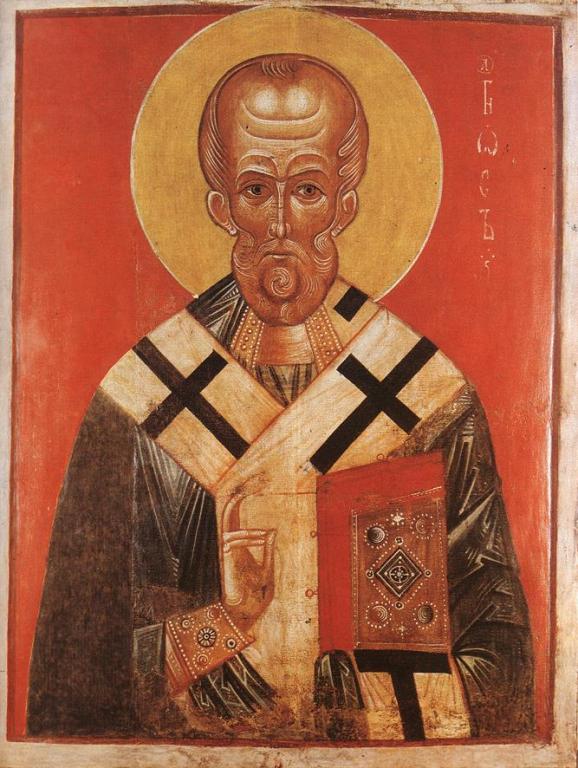
Saint Nicholas Icon, via Wikimedia.org

Saint Nicholas of Myra
Feast Day: December 6
Biography
Saint Nicholas of Myra’s story begins far south of the wintery wonderland we are used to associating with Santa Claus: Nicolas is believed to have been born in Parara, a city in Asia Minor, in the 4th Century. While historically accurate records are lacking, there are many legends about this saint, popular in both the Eastern and Western Church, that have nothing to do with either reindeer or elves.
That Nicholas became a bishop to the see of Myra in the 4th Century remains one of the few historically definite facts. However, the saint’s popularity over the centuries at least allows us to put forth some of the more consistent and endearing stories of his faith and charity. Nicholas was, according Butler’s Lives of the Saints, well brought up by pious parents; he began to study theology at age five and “day by day the teaching of the Church enlightened his mind and encouraged his thirst for sincere and true religion.”
When his parents died, while Nicholas was still a young man, he decided to devote his inheritance to acts of charity. One of the more famous legends about Nicolas is that the young saint used his inheritance to save three women from being forced into prostitution. After their father had become impoverished, he was unable to support his daughters, and their poverty made the girls unable to find husbands. The young women’s father “going to give them over to prostitution.” Nicholas learned of this, and in the middle of the night snuck over to the man’s house and there a bag of gold in the window, which served as a dowry for the eldest daughter, who was able to marry. Later, Nicholas tossed in a bag of gold for the second daughter. When he went to do so for the third daughter, the father recognized their benefactor and was overcome with gratitude. This is likely the origin of the more familiar tales of Santa Claus delivering presents.
As Bishop of Myra, he served during the persecution of the Emperor Diocletian, who it is said to have tortured and imprisoned Nicholas. When Constantine assumed the role of Emperor, he was far more friendly to Christians, and is said to have freed the bishop to return to Myra.
Nicholas’s reputation as a bulwark against heresies can be traced to St. Methodius’s claim that “thanks to the teaching of St Nicholas the metropolis of Myra alone was untouched by the filth of the Arian heresy, which it firmly rejected as death-dealing poison.”
This is the likely origin of the infamous Arius incident. Despite lack of evidence supporting his presence there, legend holds that Nicholas attended the Council of Nicaea and, encountering Arius, the saint was overcome with anger and slapped the heretic in the face. An action for which, the legend continues, the Council Fathers deprived him of his episcopal insignia and sent him to prison. However, while in prison, so the story goes, Our Lord and His Mother appeared to Nicholas and freed the man. Though this story itself is not verifiable, stories do tell us something of the man: he was a fierce defender of the truths of the Catholic Faith. He is also reported to have destroyed pagan temples, including that of Artemis. Moreover, he was a bishop who was devoted to his flock, caring for their spiritual and temporal needs.
The holy bishop died, according to unanimous accounts, in Myra. According to one 10th Century writer,
The West as well as the East acclaims and glorifies him. Wherever there are people, in the country and the town, in the villages, in the isles, in the furthest parts of the earth, his name is revered and churches are built in his honor. Images of him are set up, panegyrics preached and festivals celebrated. All Christians, young and old, men and women, boys and girls, reverence his memory and call upon his protection. And his favors, which know no limit of time and continue from age to age, are poured out over all the earth.
Patron Saint of…
A lot. Despite the lack of information we have on him, tradition tells us Nicholas is quite the popular saint. He is the patron saint of Greece, Russia, the Kingdom of Naples, Sicily, Lorraine, the Diocese of Liège; many cities in Italy, Germany, Austria, and Belgium; Campen in the Netherlands; Corfu in Greece; Freiburg in Switzerland; and Moscow in Russia. He is also the patron of mariners, merchants, bakers, travelers, children, and prisoners, just to name a few.
What’s He Got to Do with Me?
For most of us, it’s easy to say that “Santa” is a fairly relevant saint. After all, we have been seeing popularized images of him and hearing songs about him since sometime before Halloween. And yet, the commercialized whats-its and sentimentalized legends serve more to obscure rather than reveal anything about the sanctity the life of Saint Nicholas presents us with. Even if the legends are not entirely historically accurate, they point to certain practices of holiness that are worth bring in to our own lives.
Firstly, St. Nicholas’ holiness was steeped in a love of theology. Now, for many of us, that can sound like an intimidating word. But really it means the study of God. This Advent Season, consider taking fifteen minutes out of your day to emulate this saint and learn more about God, whether that is through reading the Scriptures or spiritual reading. If you don’t know where to start, perhaps you might begin with the Gospel of St. Luke or Fulton Sheen’s Advent and Christmas Reflections.
Secondly, we can imitate the holy bishop’s acts of charity. Whether it is in following his lead to give of our treasure to organizations that fight modern day slavery (including sex trafficking) like Catholic Charities’ End Slavery Now initiative, or donating to organizations that help those in poverty, like the Society of St. Vincent de Paul, or giving of our time to minister at local women’s shelters, food kitchens, or even prison ministry. St. Nicholas demonstrated what it means to minister to Christ’s Body in this world, and that is an example we can all strive to emulate more, particularly in this Advent season.
Interesting Facts:
- Oldest church dedicated to him was build in the 6th Century by Emperor Justinian I
- His relics can be viewed in Bari, Italy
- Yet another legend holds that the saint appeared to Emperor Constantine in a dream after he falsely imprisoned three of his officers under trumped up charges. The officers had seen the bishop save falsely condemned men in Myra and prayed for his intercession. That night, St. Nicholas appeared in a dream to Constantine and threatened the emperor if he would not free the men. Constantine did so, and sent a letter to Nicholas informing him that the men were free, and asking the bishop to not threaten him again and instead pray for peace in the world.
Prayers:
Give me, Lord, Nicholas as my intercessor, your great confessor whom you had glorified with the name of blessed throughout the world.
Saint Nicholas, I pray to you through him who has made your name venerated throughout the world; do not refuse to help a needy suppliant.
Why, Sir, are you called upon by all men in all the world unless you are to be an advocate of all who pray to you?
Why does this sound in all ears, “My Lord, Saint Nicholas,” “My Lord, Saint Nicholas,” unless it means, “My advocate, Saint Nicholas,” “My advocate Saint Nicholas?”
Why is your name poured forth everywhere except that the world may have some great good poured into it?
Your fame calls to me, your miracles send me to your intercession, your works draw me to seek your help.
But why do I speak about your miracles, when your power now is greater than them all?
Why do I recount what you have done, when before God you now have supreme grace? Why recount the help that you gave to many when you are able to give spiritual help now that you live in heaven, of more value than the corporal help that you gave during your pilgrimage upon earth?
For it is not as if you were able to do those things then and can no longer do them. No, I say, you could not have power only in those things that come to nothing, and to be powerless in those that go on into eternity.
Indeed, you did not only accomplish the former, you did not ascend merely that you might grant them. Bestow upon us the spiritual things in which you glory, the joys of eternity in which you rejoice, pour upon us the heavenly things to which you have turned. Through you we needy ones come to know that abundance which you receive fully in a perpetual stream.
O your plenitude of goodness, and my abundance of badness!
How far they are from each other!
How vehemently the first makes you happy, how greatly does the latter make me unhappy.
The first comes down from the plenitude of God, the latter goes up from the need of myself;
The first flows from the abundance of God, the latter surges up from my poverty.
O if only that super-abundance would overflow and flood into my abundant ills!
O if only that full plenitude would fill the emptiness of my need!
I do not doubt, Sir, that you can do this for me, if you are willing to ask that much for me of my judge who is your beloved friend.
—Saint Anselm, Archbishop of Canterbury (1093–1109)
Further Reading:
- The Saint Who Would be Santa Claus: The True Life and Trials of Nicholas of Myra by Adam C. English
- Saint Nicholas, Bishop of Myra: The Life and Times of the Original Father Christmas by D.L. Cann
- Retrieving Nicaea: The Development and Meaning of Trinitarian Doctrine by Khaled Anatolios
- The First Seven Ecumenical Councils (325-787): Their History and Theology by Leo D. Davis
- Arianism and Other Heresies by St. Augustine
- Defense Against the Arians by St. Athanasius of Alexandria
- The Great Heresies by Hillarie Belloc
- Saint Nicholas and the Nine Gold Coins by Jim Forest
- Saint Nicholas: The Real Story of the Christmas Legend by Julie Stiegemeyer
Resources:
- http://www.newadvent.org/cathen/11063b.htm
- https://archive.org/stream/ButlersLivesOfTheSaintsCompleteEdition/ButlersLivesOfTheSaintsCompleteEdition_djvu.txt
- http://www.stnicholascenter.org/pages/real-saint/
Previous Post

December 6, 2018
Advent and the Incarnation When Words Fail
Next Post
December 7, 2018 Saint Mary Josepha Rossello: Surprised by Vocation
Browse Our Archives
Select a Category Body Problems Fatherhood Feast Day Friendship Grace Building on Nature Holy Days and Liturgy Living Life in Christ Love and Marriage and Other Responsibilities Mary Motherhood Philosophic Wanderings Podcasts Reality of Things Saint of the Day The Beautiful The Good The Habit of Being In The Polis The Reality Superelevating Things The True Transcendentals Transcendentals Trinity Uncategorized Virtue
Select a Month December 2018 June 2017 May 2017 April 2017 March 2017 February 2017 January 2017 December 2016 September 2016 August 2016 July 2016 June 2016 May 2016
Follow Us!
TAKE THE
Religious Wisdom Quiz
True or False: Romans teaches that all Israel will be saved.
Select your answer to see how you score.
TRUE FALSE
Related posts from Eating Peaches
Mary, Mother of God: The Theotokos

Saint Lucy of Syracuse: Looking to God
Our Lady of Guadalupe: Empress of the Americas

Pope Saint Gregory III: Against the Iconoclasts
TRENDING AT PATHEOS Catholic

The Parable Of The Sower And The Word...
One of Christ’s most famous parables is that of the sower who...

Rejecting Doom: Christian Hope And Human Action
Christianity is a religion of hope. We are to have hope and...

Why I Choose the Eucharist Over the Sermon
Choose the Eucharist, Not the Sermon What are we supposed to get...

5 Design Elements Found in Spiritually Rooted Homes
Putting Spirituality Into Home Decor Our homes are more than our living...

Credo: A Story of God Told with the...
About 10 years ago, I began to imagine a personal "Credo" that...

The Anatomy of Divine Revelation in Catholic Thought
The claim that God has made Himself known to human beings is...
view all Catholic blogs
Ad-Free & Subscriber Log-In Subscription Support
- About Us
- 2026 Calendar
- Videos
- Podcasts
- Library of World Religions
- Faith In Media Tracker
- Advertise With Us
- Write for Us
- Privacy Policy
- Terms of Service
- Do Not Sell My Data
- Contact Us
- Radiant Digital
- Manage Newsletter Subscriptions
- Unsubscribe From Notifications
- Sitemap
Copyright 2008-2026, Patheos. All rights reserved.
Subscription Support Ad-Free & Subscriber Log-In
Follow Patheos