
BuddhistCatholicContemplativeEvangelicalGeneral ChristianHinduJewishLatter-day SaintMuslimNew VisionsProgressive Christian
Beliefs
- Buddhist
- Catholic
- Contemplative
- Evangelical
- General Christian
- Hindu
- Jewish
- Latter-day Saint
- More Voices
- Muslim
- New Visions
- Pagan
- Progressive Christian
Topics
- Religion News
- Food and Religion
- Sports and Religion
- Religious Art
- Religious Music and Entertainment
- Religious Events
- History and Religion
- Style and Religion
- Politics and Religion
- Women in Religion
- Recreation Outdoors and Religion
- Business Finance and Religion
- Careers Workplace and Religion
- Education and Religion
- Family Parenting and Religion
- Health Fitness and Religion
- Home and Religion
- Relationships and Religion
- Technology and Religion
- Travel and Religion
Columnists
- Buddhist Columnists
- Business Finance and Religion Columnists
- Careers Workplace and Religion Columnists
- Catholic Columnists
- Contemplative Columnists
- Education and Religion Columnists
- Evangelists Columnists
- Family Parenting and Religion Columnists
- General Christian Columnists
- Health Fitness and Religion Columnists
- Hindu Columnists
- History and Religion Columnists
- Home and Religion Columnists
- Jewish Columnists
- More Voices Columnists
- Latter Day Columnists
- Muslim Columnists
- New Visions Columnists
- Nonreligious Columnists
- Pagan Columnists
- Politics and Religion Columnists
- Progressive Columnists
- Recreation Outdoors and Religion Columnists
- Relationships and Religion Columnists
- Religion News Columnists
- Religious Art Columnists
- Religious Events Columnists
- Religious Music and Entertainment Columnists
- Sports and Religion Columnists
- Style and Religion Columnists
- Technology and Religion Columnists
- Travel and Religion Columnists
- Women in Religion Columnists
Resource Library
- 2026 Calendar
- Library of World Religions
- The 100 Most Holy Places on Earth
- Patheos Answers
- Podcasts
- Videos
- Faith Leaders Database
- Anglican Episcopalian
- Bahai
- Baptist
- Buddhism
- Christianity
- Confucianism
- Eastern Orthodoxy
- Hinduism
- Holiness and Pentecostal
- ISKCON
- Islam
- Judaism
- Lutheran
- Methodist
- The Church of Jesus Christ of Latter-day Saints
- New Age
- Paganism
- Presbytarian and Reformed
- Protestantism
- Religion Behind the Scenes
- Roman Catholic
- Scientology
- Shia Islam
- Sikhism
- Sufism
- Sunni Islam
- Taoism
- Zen
- See all religions
Research Tools
 Ad-Free & Subscriber Log-In Subscription Support
Ad-Free & Subscriber Log-In Subscription Support
Follow Patheos 

- Trending:
- Forgiveness
- |
- Marriage
- |
- Consciousness
- |
- Death Penalty
- |
- Election
- |
- Halloween
 Eating Peaches
- Home
- Catholic
- Saint Lucy of Syracuse: Looking to God
Saint Lucy of Syracuse: Looking to God
Last updated on: December 13, 2018 at 8:53 am by Marina S. Brungardt
Saint Lucy of Syracuse: Looking to God 2018-12-13T08:53:02-07:00 Marina S. Brungardt
Patheos Explore the world's faith through different perspectives on religion and spirituality! Patheos has the views of the prevalent religions and spiritualities of the world.
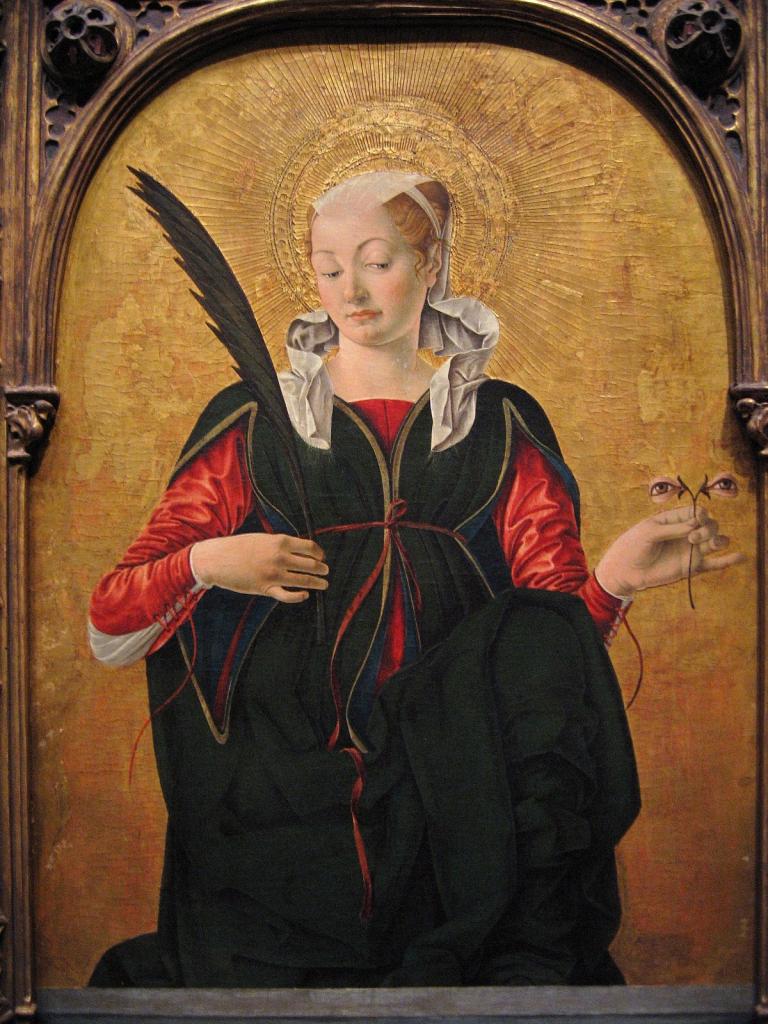
Image via wikimedia.org
Saint Lucy of Syracuse
Feast Day: December 13
Biography:
Saint Lucy is one of the early saints of the Church, a virgin-martyr who died in the year 304 and who is mentioned in the first Eucharistic Prayer in the Mass. According to tradition, Lucy was the daughter of wealthy noble parents, a Roman father and a Greek mother Eutychia, born around 283 in Syracuse. Her mother was a Christian, who raised Lucy as one as well. Lucy took her faith seriously, eventually deciding she wanted to consecrate her virginity to God and desired to spend her life in prayer and her wealth in service to the poor. Her mother, however, did not know of this vow, and had arranged a marriage for Lucy with a young pagan man.
Now Eutychia had suffered from a hemorrhage for several years, and Lucy suggested to her mother that they make a pilgrimage to the tomb of St. Agatha, a virgin-martyr who had died during the persecution of the Emperor Decius in 250. The two women went on this pilgrimage, and Eutychia was cured of her hemorrhage. In thanksgiving for this miracle, Lucy convinced her mother to allow her distribute a great part of their riches to the poor. She also told her mother about her desire to devote her virginity to God, and her mother gave her blessing to her daughter.
This is where the pagan fiancé re-enters the story. In seeing Lucy giving away her dowry, he began to realize she might not be marrying him anytime soon. Now, at this time, it was illegal to be a Christian, as the Emperor Diocletian had issued a series of edicts rescinding Christian’s legal rights and demanding they participate in traditional Roman religious practices. So, Lucy’s fiancé, motivated by greed and anger at being spurred, reported his former bride to the governor of Syracuse for being a Christian.
The governor first condemned Lucy to become a prostitute, essentially to be raped in a brothel house, but God made her immobile and the guards could not carry her off to complete the sentence. According to some accounts of her sentencing, Lucy replied to the governor
If you were to lift my hand to your idol and so make me offer against my will, I would still be guiltless in the sight of the true God, who judges according to the will and knows all things. If now, against my will, you cause me to be polluted, a twofold purity will be gloriously imputed to me. You cannot bend my will to your purpose; whatever you do to my body, that cannot happen to me.
Tradition then tells us that the governor sentenced her to be burned alive, but God did not allow the flames to touch her. Finally, she was wounded with a sword, and here traditional accounts are split: either she died immediately from the sword, or she was terribly wounded and later died in prison from the wounds caused by the sword.
Patron Saint of:
The blind; martyrs; epidemics; salesmen; writers; throat infections; Perugia, Italy; Mtarfa, Malta; Syracuse, Italy; Sasmuan, Pampanga Philippines
What Does She Have to Do With Me?
In thinking about the older martyrs, especially the virgin-martyrs, it can be hard to see what we can learn in a specific way from them. Certainly their courage, faithfulness, and perseverance are encouraging to those of us alive today; but their lives also seem so different. But, that would be too shallow a reading. Saint Lucy, in particular, gives us a wonderful example of someone who refused to let the world, no matter what it threw at her, pull her away from her vocation with God. She, unlike her fiancé, did not look at her wealth or position as something to use for her own benefit, but rather as something that she could use to benefit others in God’s service. Her death is certainly heroic, but what is even more heroic is how she lived her life: focused on serving God in whatever way she was able. The fact that her death became an act of sacrifice was only possible because her life prior to that moment had been a practice of sacrifice and growth in sanctity. She denied herself the temptations of the world, and because she was so faithful to her vocation, God gave her the grace of final perseverance and the glory of a martyr’s death.
Interesting Facts
- According to some accounts, Lucy warned the governor he would be punished for his persecution of the Church, and this led the governor to order her eyes gouged out. However, when her body was prepared for burial, it was found that God had restored her eyes. This is why many images of St. Lucy depict her holding a plate with two eyes on it, and why she is the patron saint of the blind.
- Saint Lucia’s Day has become a major part of Scandinavian Christmas traditions. Early on December 13th, a little girl who was elected St. Lucia dresses in a white robe and a red sash along with a wreath of candles, is accompanied by her handmaids and “star boys,” bearing “lussekatts,” or saffron flavored buns, and ginger biscuits and singing traditional songs.
Prayer
Hear us, O God, our salvation, as we rejoice on the feast of Saint Lucy, Thy virgin and Martyr, and grant us to learn the spirit of pious devotion.
-Via The Holyday Book
Further Reading
- The Life and Prayers of Saint Lucy of Syracuse by Wyatt North
- Lucia: Saint of Light by Katherine Bolger Hyde
- Lucy: A Light For Jesus by Barbara Yoffie
- Lucia Morning in Sweden by Ewa Rydaker
Resources
- https://www.bartleby.com/210/12/131.html
- http://www.newadvent.org/cathen/09414a.htm
- https://www.ewtn.com/library/MARY/LUCY.HTM
- https://catholicexchange.com/eyes-st-lucy
- https://www.catholic.org/saints/saint.php?saint_id=75
- http://faculty.virginia.edu/OldEnglish/aelfric/lucy.html
- https://www.britannica.com/topic/St-Lucias-Day
- https://www.whychristmas.com/cultures/sweden.shtml


About Marina S. Brungardt
Writer, teacher, grad student, wife, mother. If you like what you are reading, please consider making a small contribution to my patron page: https://www.patreon.com/marinabrungardt. You can read more about the author here.
Previous Post

December 12, 2018
Our Lady of Guadalupe: Empress of the Americas
Next Post
December 31, 2018 Mary, Mother of God: The Theotokos
Browse Our Archives
Select a Category Body Problems Fatherhood Feast Day Friendship Grace Building on Nature Holy Days and Liturgy Living Life in Christ Love and Marriage and Other Responsibilities Mary Motherhood Philosophic Wanderings Podcasts Reality of Things Saint of the Day The Beautiful The Good The Habit of Being In The Polis The Reality Superelevating Things The True Transcendentals Transcendentals Trinity Uncategorized Virtue
Select a Month December 2018 June 2017 May 2017 April 2017 March 2017 February 2017 January 2017 December 2016 September 2016 August 2016 July 2016 June 2016 May 2016
Follow Us!
TAKE THE
Religious Wisdom Quiz
Which prophet asked, "What does the Lord require of you?"
Select your answer to see how you score.
Joel Jonah Micah Amos
Related posts from Eating Peaches
Mary, Mother of God: The Theotokos
Our Lady of Guadalupe: Empress of the Americas

Pope Saint Gregory III: Against the Iconoclasts
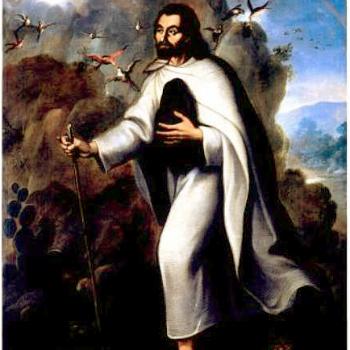
Saint Juan Diego: The First Indigenous American Saint
TRENDING AT PATHEOS Catholic

The Parable Of The Sower And The Word...
One of Christ’s most famous parables is that of the sower who...

Rejecting Doom: Christian Hope And Human Action
Christianity is a religion of hope. We are to have hope and...

Why I Choose the Eucharist Over the Sermon
Choose the Eucharist, Not the Sermon What are we supposed to get...

5 Design Elements Found in Spiritually Rooted Homes
Putting Spirituality Into Home Decor Our homes are more than our living...

Credo: A Story of God Told with the...
About 10 years ago, I began to imagine a personal "Credo" that...

The Anatomy of Divine Revelation in Catholic Thought
The claim that God has made Himself known to human beings is...
view all Catholic blogs
Ad-Free & Subscriber Log-In Subscription Support
- About Us
- 2026 Calendar
- Videos
- Podcasts
- Library of World Religions
- Faith In Media Tracker
- Advertise With Us
- Write for Us
- Privacy Policy
- Terms of Service
- Do Not Sell My Data
- Contact Us
- Radiant Digital
- Manage Newsletter Subscriptions
- Unsubscribe From Notifications
- Sitemap
Copyright 2008-2026, Patheos. All rights reserved.
Subscription Support Ad-Free & Subscriber Log-In
Follow Patheos