
BuddhistCatholicContemplativeEvangelicalGeneral ChristianHinduJewishLatter-day SaintMuslimNew VisionsProgressive Christian
Beliefs
- Buddhist
- Catholic
- Contemplative
- Evangelical
- General Christian
- Hindu
- Jewish
- Latter-day Saint
- More Voices
- Muslim
- New Visions
- Pagan
- Progressive Christian
Topics
- Religion News
- Food and Religion
- Sports and Religion
- Religious Art
- Religious Music and Entertainment
- Religious Events
- History and Religion
- Style and Religion
- Politics and Religion
- Women in Religion
- Recreation Outdoors and Religion
- Business Finance and Religion
- Careers Workplace and Religion
- Education and Religion
- Family Parenting and Religion
- Health Fitness and Religion
- Home and Religion
- Relationships and Religion
- Technology and Religion
- Travel and Religion
Columnists
- Buddhist Columnists
- Business Finance and Religion Columnists
- Careers Workplace and Religion Columnists
- Catholic Columnists
- Contemplative Columnists
- Education and Religion Columnists
- Evangelists Columnists
- Family Parenting and Religion Columnists
- General Christian Columnists
- Health Fitness and Religion Columnists
- Hindu Columnists
- History and Religion Columnists
- Home and Religion Columnists
- Jewish Columnists
- More Voices Columnists
- Latter Day Columnists
- Muslim Columnists
- New Visions Columnists
- Nonreligious Columnists
- Pagan Columnists
- Politics and Religion Columnists
- Progressive Columnists
- Recreation Outdoors and Religion Columnists
- Relationships and Religion Columnists
- Religion News Columnists
- Religious Art Columnists
- Religious Events Columnists
- Religious Music and Entertainment Columnists
- Sports and Religion Columnists
- Style and Religion Columnists
- Technology and Religion Columnists
- Travel and Religion Columnists
- Women in Religion Columnists
Resource Library
- 2026 Calendar
- Library of World Religions
- The 100 Most Holy Places on Earth
- Patheos Answers
- Podcasts
- Videos
- Faith Leaders Database
- Anglican Episcopalian
- Bahai
- Baptist
- Buddhism
- Christianity
- Confucianism
- Eastern Orthodoxy
- Hinduism
- Holiness and Pentecostal
- ISKCON
- Islam
- Judaism
- Lutheran
- Methodist
- The Church of Jesus Christ of Latter-day Saints
- New Age
- Paganism
- Presbytarian and Reformed
- Protestantism
- Religion Behind the Scenes
- Roman Catholic
- Scientology
- Shia Islam
- Sikhism
- Sufism
- Sunni Islam
- Taoism
- Zen
- See all religions
Research Tools
 Ad-Free & Subscriber Log-In Subscription Support
Ad-Free & Subscriber Log-In Subscription Support
Follow Patheos 

- Trending:
- Forgiveness
- |
- Marriage
- |
- Consciousness
- |
- Death Penalty
- |
- Election
- |
- Halloween
 Eating Peaches
- Home
- Catholic
- Saint Juan Diego: The First Indigenous American Saint
Saint Juan Diego: The First Indigenous American Saint
Last updated on: December 12, 2018 at 6:55 am by Marina S. Brungardt
Saint Juan Diego: The First Indigenous American Saint 2018-12-12T06:55:42-07:00 Marina S. Brungardt
Patheos Explore the world's faith through different perspectives on religion and spirituality! Patheos has the views of the prevalent religions and spiritualities of the world.
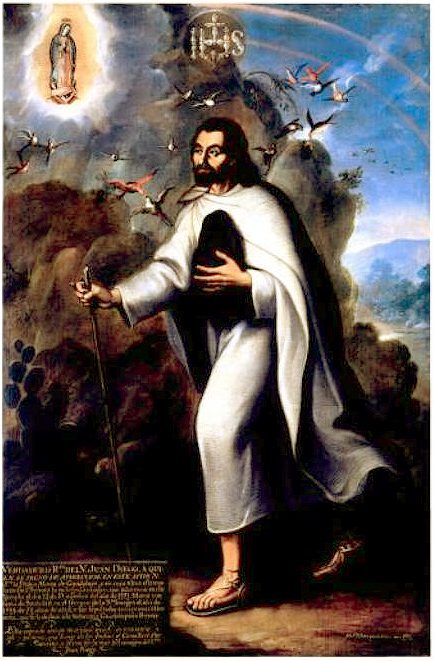
Image via Wikimedia Commons
Saint Juan Diego Cuauhtlatotzin
Feast Day: December 9
Biography:
Born in 1474 in Cuautlitlan (now part of Mexico City, Mexico) and given the name “Cuauthlatoatzin,” which means “the talking eagle,” Juan Diego, a member of the Chichimeca people, would grow up to become the Church’s first saint indigenous to the Americas.
Though little is known about Juan Diego’s early life, records tell us he was baptized in 1524 at 50 years old, along with his wife, Maria Lucia, by the Franciscan priest, Father Peter da Gand. Prior to his conversion to the Catholic Faith, Juan deco hd been raised in the Aztec religion and culture. After his conversion, he threw himself into his faith, with humility, love, and a great devotion to the sacraments and to Our Lady.
Early Saturday morning, December 9, 1531, two years or so after his wife’s death, Juan Diego was walking to Mass and catechism lessons in Tlalteloclco at the first Franciscan convent in Mexico City. As he reached Tepeyac Hill at the outskirts of Mexico City, our Blessed Mother appeared to Juan Diego in what he described as a shining white cloud and rainbow of many colors. Our Lady called him to her saying, “Juanito, Juan Dieguito,” and asked her son where he was headed. He replied “My Lady, Queen, My Little Girl, I go there, to your little house in Mexico, Tlaltelolco, to follow the things of God which are given to us, that we are taught, by those who are the image of Our Lord, our priests.”
The Blessed Mother told Juan Diego that she desired that her “little sacred house be erected” at the foot of the hill, so that she might show her Son and “give Him to all the people in my personal love, in my compassionate sight, in my shell, in my salvation; because I am truly your compassionate mother, yours and those men in this land who are one.” She then instructed Juan Diego to go to the Bishop of Mexico’s palace, telling the bishop that Mary had sent him and wished them to build a church at the sight of the meeting.
Juan Diego went to tell the bishop, Juan de Zumarraga, and was initially not allowed into the bishop’s palace because of his humble and poor appearance. Eventually, he was let in to meet with the bishop, but Bishop Zumarraga was skeptical of the vision.
On that same day, Juan Diego returned to the hill where Mary had appeared to him, and told her that the bishop did not believe his report. He spoke to Mary, begging “my Lady, Queen, my Little Girl, that you send one of those noble persons, who is well-known, respected, honored, to take your kind word so that it will be believed.” Our Lady, however, replied that it was Juan Diego that she “must entrust the delivery of [her] message” with, and she told him to return to the bishop again with her message. So that Sunday, Juan Diego again spoke with the bishop, who instructed Juan Diego to ask for a miraculous sign to prove the veracity of the vision. When Juan Diego returned to Tepeyac, he asked her for a sign, and Our Lady promised to provide one the next day.
However, Juan Diego’s uncle, Juan Bernardino fell sick the next day, and Juan Diego stayed to care for his uncle. By December 12, Juan Bernardino was in danger of death, and Juan Diego set out to find a priest who could provide his uncle with last rites. So, Juan Diego took a different route to Tlatelolco, avoiding Tepeyac Hill, because he was ashamed he had failed to meet Mary the previous day. Our Lady, nevertheless, appeared to Juan Diego and asked where he was going. When he told her of his uncle’s illness, she reminded him that she was his Mother, and she was here, telling Juan Diego “Do not be afflicted by the illness of your uncle, who will not die now of it. Be assured that he is now cured.” Then she asked Juan Diego to climb to the top of Tepeyac Hill and cut the flowers he found there, bringing them before her. The diversity of roses would be a sign to the bishop that the vision was true.
So again Juan Diego went to the bishop’s house, where he met with the bishop and relayed his vision. When he handed the bishop his tilma filled with flowers to prove the vision, the flowers fell to the floor, revealing that the tilma had been impressed with an image of the Holy Virgin Mary. The bishop then believed Juan Diego, and asked to see the place where “it is the will of the Queen of Heaven to have her temple built.”
Later, the bishop granted Juan Diego permission to live the rest of his life as a hermit in a small house near the chapel that was built on Tepeyac Hill. Juan Diego lived his life out dedicated to prayer and the practice of virtue, caring for the church and the early pilgrims who came to ask for Mary’s intercession. He died in 1548 and was buried in the first chapel dedicated to the Virgin of Guadalupe. He was canonized by Pope John Paul II in 2002.
What Does He Have to Do With Me?
Perhaps one of the less obvious lessons in holiness we can learn from St. Juan Diego is what Our Lady taught him: we are all her children, and she is our Mother. Saint Juan Diego was ashamed of his failure to meet Our Lady, and certainly many of us are ashamed of our failures to live holy lives, to turn away from our sins once and for all, or even when we neglect our prayers because we are tired, or sick, or life is simply overwhelming. So, like St. Juan Diego, we try to hide from our Mother, avoiding her and her Son, because we feel that once again we have disappointed them. However, Our Blessed Mother’s gentle correction to St. Juan Diego serves as a gentle correction to us as well: she is our mother, and she wants us not to avoid her when we fail, but to come to her with our worries, anxieties, and fears even and especially when we feel we have failed. She wants to intercede for us, to help us, to assist us, and to support us as we follow her Son and grow in holiness. And like any good mother, she is there to soothe our anxieties and give us graces beyond what we could ever have imagined. Moreover, St. Juan Diego serves as a model for our faith. Once Mary reminded him that she was his mother, he faithfully served her with humility and love, returning to the bishop to proclaim her wishes even after failing the past two times. And, for his courage and faith, he was rewarded with her faithfulness to him. St. Juan Diego teaches us to turn to Our Lady in our moments of failure, and to faithfully trust her as we continue on in the life God has called us to.
Interesting Facts
-St. Juan Diego’s tilma, which should have decomposed within a few years of the apparition, is still in pristine condition and can be seen in the Basilica of Our Lady of Guadalupe in Mexico City.
-The first miracle attributed to St. Juan Diego, in 1990, was the “scientifically inexplicable” healing of Juan Jose Barragán Silva, who was addicted to drugs and, under the influence of those drugs, stabbed himself in front of his mother and attempted to throw himself off of a balcony, falling head first to the ground. His mother, while her son was falling, prayed to Juan Diego, asking the saint to “give me a proof…save this son of mine! And you, my mother, listen to Juan Diego.” Even more providential, this fall happened at the exact same time as Pope St. John Paul II was beatifying Juan Diego at the Basilica of Our Lady of Guadalupe in Mexico City.
Prayers
Saint Juan Diego, you are our first American indigenous saint.
Please pray that God the Father would protect all migrants through his Son, Jesus Christ.
Ask the Father to pour out the love of the Holy Spirit upon all who are isolated, alone and separated by choice or necessity from their native lands.
May those torn away from their families and forced to leave their country to find work elsewhere be reunited: husbands with wives and parents with children.
We ask especially for migrant women and children who are particularly vulnerable to the dangers of human trafficking. Give them your protection and shield them from evil.
May we as a Church receive the grace to welcome with love migrants who enter into our country, seeking a home in our parishes and communities.
We ask for your prayers and intercession for all immigrants who are desperate, alone and in need of God’s loving support.
And we ask Our Lady, who appeared to you as your Mother and Mother of all in our land, to wrap her mantle of protection around all migrant people.
We beg for her love, compassion, help and protection on all immigrants who today experience great sufferings, sorrows, necessities and misfortunes.
Amen.
–via the USCCB
In His Own Words:
“I am a nobody, I am a small rope, a tiny ladder, the tail end, a leaf.””
Further Reading:
- Our Lady of Guadalupe and Saint Juan Diego: The Historical Evidence by Eduardo Chavez
- Our Lady of Guadalupe: Mother of the Civilization of Love by Eduardo Chavez and Carl Anderson
- The Lady of Guadalupe by Tomie dePaolo
- Saint Juan Diego and Our Lady of Guadalupe by Josephine Nobisso
Resources:
- http://www.vatican.va/news_services/liturgy/saints/ns_lit_doc_20020731_juan-diego_en.html
- http://w2.vatican.va/content/john-paul-ii/en/homilies/2002/documents/hf_jp-ii_hom_20020731_canonization-mexico.html
- https://www.catholicnewsagency.com/saint/st-juan-diego-409
- https://www.franciscanmedia.org/saint-juan-diego/
- https://www.catholic.org/saints/saint.php?saint_id=73
- https://aleteia.org/2017/12/09/how-a-drug-addicts-life-was-miraculously-saved-by-st-juan-diego/
- https://www.catholiceducation.org/en/culture/catholic-contributions/saint-juan-diego-and-our-lady.html
- https://www.catholicculture.org/culture/liturgicalyear/calendar/day.cfm?date=2017-12-09


About Marina S. Brungardt
Writer, teacher, grad student, wife, mother. If you like what you are reading, please consider making a small contribution to my patron page: https://www.patreon.com/marinabrungardt. You can read more about the author here.
Previous Post
December 7, 2018
Mary: The Immaculate Conception
Next Post
December 10, 2018 Pope Saint Gregory III: Against the Iconoclasts
Browse Our Archives
Select a Category Body Problems Fatherhood Feast Day Friendship Grace Building on Nature Holy Days and Liturgy Living Life in Christ Love and Marriage and Other Responsibilities Mary Motherhood Philosophic Wanderings Podcasts Reality of Things Saint of the Day The Beautiful The Good The Habit of Being In The Polis The Reality Superelevating Things The True Transcendentals Transcendentals Trinity Uncategorized Virtue
Select a Month December 2018 June 2017 May 2017 April 2017 March 2017 February 2017 January 2017 December 2016 September 2016 August 2016 July 2016 June 2016 May 2016
Follow Us!
TAKE THE
Religious Wisdom Quiz
What did God send to feed Elijah during the drought?
Select your answer to see how you score.
Camels Sheep Ravens Serpent
Related posts from Eating Peaches
Mary, Mother of God: The Theotokos

Saint Lucy of Syracuse: Looking to God
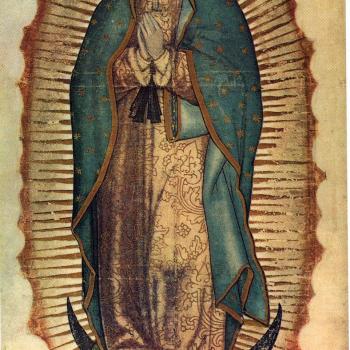
Our Lady of Guadalupe: Empress of the Americas

Pope Saint Gregory III: Against the Iconoclasts
TRENDING AT PATHEOS Catholic

The Parable Of The Sower And The Word...
One of Christ’s most famous parables is that of the sower who...

Rejecting Doom: Christian Hope And Human Action
Christianity is a religion of hope. We are to have hope and...

Why I Choose the Eucharist Over the Sermon
Choose the Eucharist, Not the Sermon What are we supposed to get...

5 Design Elements Found in Spiritually Rooted Homes
Putting Spirituality Into Home Decor Our homes are more than our living...

Credo: A Story of God Told with the...
About 10 years ago, I began to imagine a personal "Credo" that...

The Anatomy of Divine Revelation in Catholic Thought
The claim that God has made Himself known to human beings is...
view all Catholic blogs
Ad-Free & Subscriber Log-In Subscription Support
- About Us
- 2026 Calendar
- Videos
- Podcasts
- Library of World Religions
- Faith In Media Tracker
- Advertise With Us
- Write for Us
- Privacy Policy
- Terms of Service
- Do Not Sell My Data
- Contact Us
- Radiant Digital
- Manage Newsletter Subscriptions
- Unsubscribe From Notifications
- Sitemap
Copyright 2008-2026, Patheos. All rights reserved.
Subscription Support Ad-Free & Subscriber Log-In
Follow Patheos