
BuddhistCatholicContemplativeEvangelicalGeneral ChristianHinduJewishLatter-day SaintMuslimNew VisionsProgressive Christian
Beliefs
- Buddhist
- Catholic
- Contemplative
- Evangelical
- General Christian
- Hindu
- Jewish
- Latter-day Saint
- More Voices
- Muslim
- New Visions
- Pagan
- Progressive Christian
Topics
- Religion News
- Food and Religion
- Sports and Religion
- Religious Art
- Religious Music and Entertainment
- Religious Events
- History and Religion
- Style and Religion
- Politics and Religion
- Women in Religion
- Recreation Outdoors and Religion
- Business Finance and Religion
- Careers Workplace and Religion
- Education and Religion
- Family Parenting and Religion
- Health Fitness and Religion
- Home and Religion
- Relationships and Religion
- Technology and Religion
- Travel and Religion
Columnists
- Buddhist Columnists
- Business Finance and Religion Columnists
- Careers Workplace and Religion Columnists
- Catholic Columnists
- Contemplative Columnists
- Education and Religion Columnists
- Evangelists Columnists
- Family Parenting and Religion Columnists
- General Christian Columnists
- Health Fitness and Religion Columnists
- Hindu Columnists
- History and Religion Columnists
- Home and Religion Columnists
- Jewish Columnists
- More Voices Columnists
- Latter Day Columnists
- Muslim Columnists
- New Visions Columnists
- Nonreligious Columnists
- Pagan Columnists
- Politics and Religion Columnists
- Progressive Columnists
- Recreation Outdoors and Religion Columnists
- Relationships and Religion Columnists
- Religion News Columnists
- Religious Art Columnists
- Religious Events Columnists
- Religious Music and Entertainment Columnists
- Sports and Religion Columnists
- Style and Religion Columnists
- Technology and Religion Columnists
- Travel and Religion Columnists
- Women in Religion Columnists
Resource Library
- 2026 Calendar
- Library of World Religions
- The 100 Most Holy Places on Earth
- Patheos Answers
- Podcasts
- Videos
- Faith Leaders Database
- Anglican Episcopalian
- Bahai
- Baptist
- Buddhism
- Christianity
- Confucianism
- Eastern Orthodoxy
- Hinduism
- Holiness and Pentecostal
- ISKCON
- Islam
- Judaism
- Lutheran
- Methodist
- The Church of Jesus Christ of Latter-day Saints
- New Age
- Paganism
- Presbytarian and Reformed
- Protestantism
- Religion Behind the Scenes
- Roman Catholic
- Scientology
- Shia Islam
- Sikhism
- Sufism
- Sunni Islam
- Taoism
- Zen
- See all religions
Research Tools
 Ad-Free & Subscriber Log-In Subscription Support
Ad-Free & Subscriber Log-In Subscription Support
Follow Patheos 

- Trending:
- Forgiveness
- |
- Marriage
- |
- Consciousness
- |
- Death Penalty
- |
- Election
- |
- Halloween
 Eating Peaches
- Home
- Catholic
- Mary: The Immaculate Conception
Mary: The Immaculate Conception
Last updated on: December 7, 2018 at 1:34 pm by Marina S. Brungardt
Mary: The Immaculate Conception 2018-12-07T13:34:27-07:00 Marina S. Brungardt
Patheos Explore the world's faith through different perspectives on religion and spirituality! Patheos has the views of the prevalent religions and spiritualities of the world.
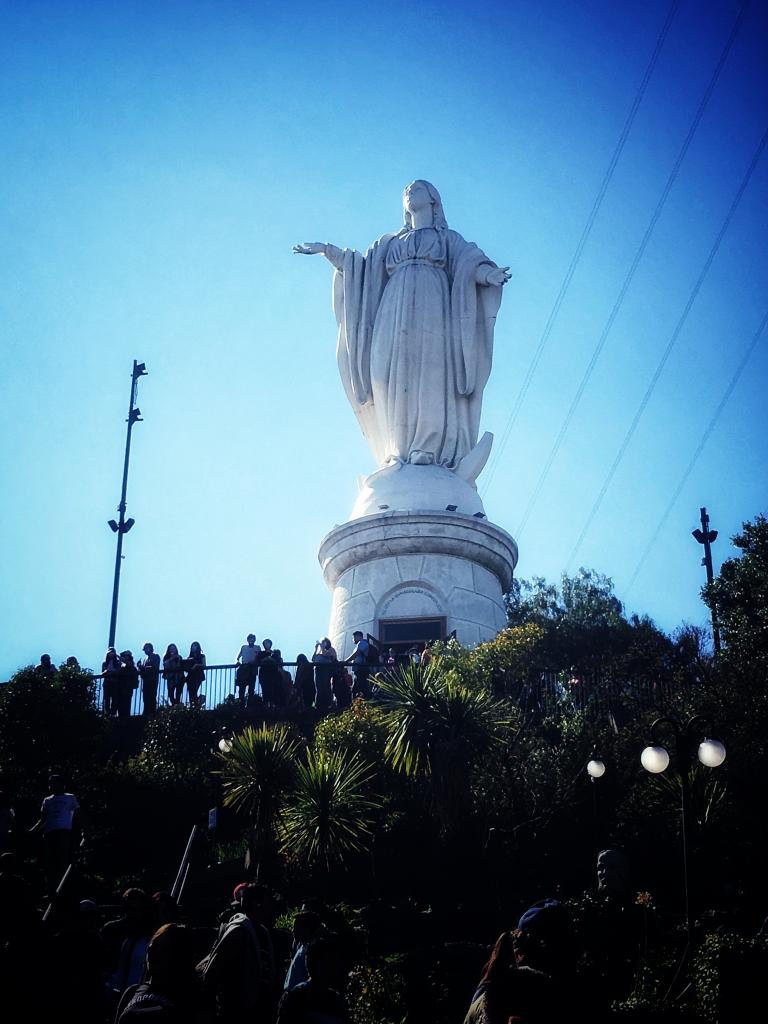
The Shrine of the Immaculate Conception in Santiago, Chile. Photo credit: Marina Brungardt, all rights reserved.
The Immaculate Conception
Day Celebrated:
December 8th, Holy Day of Obligation.
What Is the Feast About?
Firstly, it is important to remember that the Immaculate Conception is a feast in the Church which celebrates Mary who is conceived without original sin; it is not a feast celebrating the conception of Jesus.
So, let’s back things up way back. Turning back to the very beginning, with Adam and Eve and the Garden and the snake and the tree, we need to remember that decisions were made—decisions with rather serious consequences. When Adam and Eve chose to listen to Satan and sin by disobeying God’s command to not eat from the Tree of the Knowledge of Good and Evil, they fell, losing the grace of their original innocence.
Through their choice, “sin came into the world…and death through sin” (Romans 4:12). So after they fell, all of their descendants—all the rest of us—would be born with the stain of original sin, as well as being inclined to commit personal sins. This means that sin, or refusing to obey God’s will, is going to stain every human who is born, darkening our intellects, inclining us to do evil acts, and turning us away from God. This is something that the stain of original sin, among other factors, makes us unable to rectify: with our fallen human nature, we are incapable of wholly saying yes to God. As St. Athenasius describes it, we were in a lot of trouble, and through our tendency to commit actual sin, we were on the path towards destroying the human race.
But, when God is explaining the consequences of their actions to Adam and Eve, and the snake, He also gives Adam and Eve and their descendants hope, proclaiming that:
I will put enmity between you and the woman, and between your offspring and hers;They will strike at your head, while you strike at their heel.
The Church calls this the “Proto-evangelium,” or First Gospel. When the Word assumes to Himself a human nature and is Incarnate, or becomes flesh, in the womb of the Virgin Mary, He does so to save us from the curse of sin. God decreed that “what had been lost in the first Adam would be gloriously restored in the Second Adam” (Ineffabilis Deus). Now, as a part of this plan, God also predestined His Son’s Mother, who above all creatures He so loved that he endowed “her with the abundance of all heavenly gifts poured from the treasury of his divinity that this mother, ever absolutely free of all stain of sin, all fair and perfect, would possess that fullness of holy innocence and sanctity than which, under God, one cannot even imagine anything greater, and which, outside of God, no mind can succeed in comprehending fully” (Ineffabilis Deus).
But why would God do this? Because God loved the woman who would grow up to be called the Mother of God. As such, He chose to give her a superabundance of graces, not because of anything she did to deserve this, but because He chose her to freely assent to being the Mother of God. It’s important to note that Mary does not in any way merit such grace. It was not because of something she did, but rather because God loved her and saved her in a wondrous way, preserving her to be the mother of Jesus, who would merit salvation for His entire Church.
The Immaculate Conception is the day on which the Church as a whole celebrates the goodness of God who would so “regard the lowliness of His handmaiden,” and “magnify her,” allowing Christ to redeem her in a special and exalted manner by His meritorious acts.
When Did the Church Begin Celebrating It?
The communication of the word of God in Sacred Scripture and sacred tradition, along with the explanation and interpretation of that one deposit of the word of God is an authority and responsibility entrusted by Christ and the Holy Spirit to the Apostles and their successors as noted in the Dogmatic Constitution on Divine Revelation, Dei Verbum. This is why in one way, we can say the Catholic Church always celebrated the Immaculate Conception: the Immaculate Conception was always a part of the deposit of faith, however, understanding it took centuries to work out before the Church could express a dogmatic definition of the doctrine.
Such a celebration of the Immaculate Conception was not only an implicit celebration, meaning it was celebrated inasmuch as we celebrate the whole of the Catholic Faith.
The Scriptures themselves point to Mary as the Immaculate Conception in a implicit way, in passages such as Genesis 3:15, often called the Proto-evangelium, the angel Gabriel’s declaration that Mary is “full of grace” (Luke 1:28), and even more deeply veiled in references like that in Song of Songs 4:7, where we learn that the bride is “all fair, my love, there is no flaw in you.” Though these are not proofs that Mary is the Immaculate Conception, they are illustrative and indicative of the truth the Church proclaims.
Moreover, even the Church Fathers did not remain wholly ignorant of the super-abundant grace granted to the Mother of God. St. Augustine explicitly excepts Mary from having known sin, because of her role as Mother of Our Lord. St. John Damascene writes that the human material from which she was formed was pure and holy. These are just two of the many Church Fathers who put forth Mary’s Immaculate Conception in one form or another, however, as the doctrine was not defined, there are notable objections to this doctrine made, even by Doctors of the Church like St. Thomas Aquinas.
However, if we want to know when the Church began celebrating the Immaculate Conception because it had been dogmatically defined, the answer is in 1854 when, on December 8th, Pope Pius IX issued the Constitution Ineffabilis Deus, pronouncing and defining that the Blessed Virgin Mary “in the first instance of her conception, by a singular privilege and grace granted by God, in view of the merits of Jesus Christ, the Saviour of the human race, was preserved exempt from all stain of original sin.” Under Pope Leo XIII, the Immaculate Conception was celebrated as “double first class feast,” or what we now call a “Solemnity” or a Holy Day of Obligation.
Prayers for the Feast:
-
O Virgin Immaculate, Mother of God and my Mother, from thy sublime height turn upon thine eyes of pity. Filled with confidence in thy goodness and knowing full well thy power, I beseech Thee to extend to me thine assistance in the journey of life, which is so full of dangers for my soul. And in order that I may never be the slave of the devil through sin, but may ever live with my heart humble and pure, I entrust myself wholly to thee. I consecrate my heart to thee forever, my only desire being to love thy Divine Son, Jesus. Mary, none of thy devout servants has ever perished; may I too be saved. Amen.
- Also check out the Litany of the Immaculate Conception.
Further Reading:
- On The Immaculate Conception by Pope St. Pius X
- Immaculate Conception and the Holy Spirit: The Marian Teaching of St. Maximilian Kolbe by H.M. Manteau-Bonamy
- The Dogma of the Immaculate Conception: History and Significance by Edward D. O’Connor C.S.C.
- The Immaculate Conception: Why Thomas Aquinas Denied, While John Duns Scotus, Gregory Palamas, & Mark Eugenicus Professed the Absolute Immaculate Existence of Mary by Father Christiaan W. Kappes
- Mary and the Fathers of the Church: The Blessed Virgin Mary in Patristic Thought by Luigi S.M. Gambero
- Bernadette: The Little Girl from Lourdes by Sophie Marvel-Hutin
- Saint Bernadette Soubirous: And Our Lady of Lourdes by Anne Eileen Heffernan and Mary Elizabeth Tebo
Resources:
- http://www.papalencyclicals.net/pius09/p9ineff.htm
- http://www.cin.org/users/jgallegos/immac.htm
- http://www.newadvent.org/library/docs_pi09id.htm
- http://www.newadvent.org/cathen/07674d.htm
- https://www.ewtn.com/faith/teachings/marya2.htm
- http://www.ncregister.com/blog/jimmy-akin/8-things-you-need-to-know-about-the-immaculate-conception

About Marina S. Brungardt
Writer, teacher, grad student, wife, mother. If you like what you are reading, please consider making a small contribution to my patron page: https://www.patreon.com/marinabrungardt. You can read more about the author here.
Previous Post
December 7, 2018
Saint Mary Josepha Rossello: Surprised by Vocation
Next Post

December 8, 2018 Saint Juan Diego: The First Indigenous American Saint
Browse Our Archives
Select a Category Body Problems Fatherhood Feast Day Friendship Grace Building on Nature Holy Days and Liturgy Living Life in Christ Love and Marriage and Other Responsibilities Mary Motherhood Philosophic Wanderings Podcasts Reality of Things Saint of the Day The Beautiful The Good The Habit of Being In The Polis The Reality Superelevating Things The True Transcendentals Transcendentals Trinity Uncategorized Virtue
Select a Month December 2018 June 2017 May 2017 April 2017 March 2017 February 2017 January 2017 December 2016 September 2016 August 2016 July 2016 June 2016 May 2016
Follow Us!
TAKE THE
Religious Wisdom Quiz
How many chapters are in the book of Hebrews?
Select your answer to see how you score.
10 16 13 15
Related posts from Eating Peaches
Mary, Mother of God: The Theotokos

Saint Lucy of Syracuse: Looking to God
Our Lady of Guadalupe: Empress of the Americas

Pope Saint Gregory III: Against the Iconoclasts
TRENDING AT PATHEOS Catholic

The Parable Of The Sower And The Word...
One of Christ’s most famous parables is that of the sower who...

Rejecting Doom: Christian Hope And Human Action
Christianity is a religion of hope. We are to have hope and...

Why I Choose the Eucharist Over the Sermon
Choose the Eucharist, Not the Sermon What are we supposed to get...

5 Design Elements Found in Spiritually Rooted Homes
Putting Spirituality Into Home Decor Our homes are more than our living...

Credo: A Story of God Told with the...
About 10 years ago, I began to imagine a personal "Credo" that...

The Anatomy of Divine Revelation in Catholic Thought
The claim that God has made Himself known to human beings is...
view all Catholic blogs
Ad-Free & Subscriber Log-In Subscription Support
- About Us
- 2026 Calendar
- Videos
- Podcasts
- Library of World Religions
- Faith In Media Tracker
- Advertise With Us
- Write for Us
- Privacy Policy
- Terms of Service
- Do Not Sell My Data
- Contact Us
- Radiant Digital
- Manage Newsletter Subscriptions
- Unsubscribe From Notifications
- Sitemap
Copyright 2008-2026, Patheos. All rights reserved.
Subscription Support Ad-Free & Subscriber Log-In
Follow Patheos